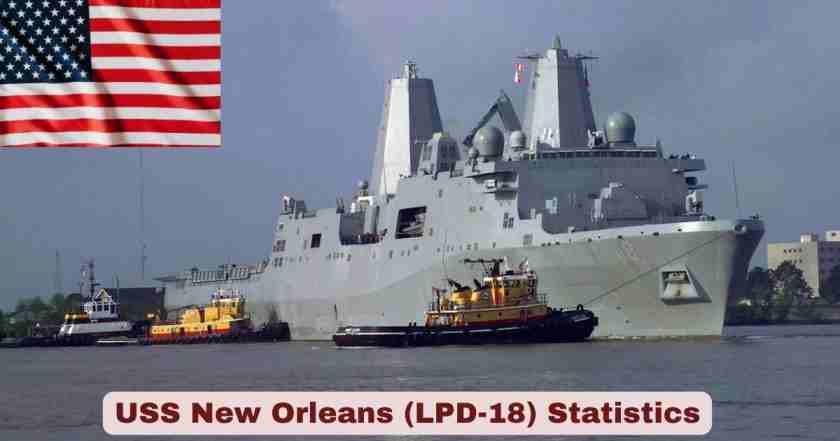
USS New Orleans (LPD-18) in America 2026
USS New Orleans (LPD-18) is one of the most capable and strategically positioned amphibious warships in the United States Navy, currently serving as a San Antonio-class amphibious transport dock (LPD) — a ship type purpose-built to embark, transport, and land United States Marine Corps forces, vehicles, aircraft, and equipment across a wide spectrum of expeditionary warfare missions, from full-scale amphibious assault to humanitarian disaster relief. She is the fourth U.S. Navy ship to bear the name of New Orleans, Louisiana, and the second ship commissioned in the San Antonio class, which represents the most advanced Landing Platform, Dock design in American naval history. Built by Northrop Grumman Ship Systems at its New Orleans, Louisiana shipyard, her contract was awarded on 18 December 1998, her keel laid on 14 October 2002, and she was commissioned on 10 March 2007 in her namesake city. Carrying the motto “Victory from the Sea,” she was christened by Carolyn Shelton, wife of General Henry H. Shelton, former Chairman of the Joint Chiefs of Staff — a connection to the highest level of American military leadership that befits a warship of her significance. As of April 2026, she is forward-deployed to Fleet Activities Sasebo, Japan, as a core asset of Amphibious Squadron 11 (PHIBRON 11) under U.S. 7th Fleet, and is actively deployed in the CENTCOM area of responsibility in the Middle East as part of the Tripoli Amphibious Ready Group supporting Operation Epic Fury.
What makes USS New Orleans (LPD-18) particularly noteworthy in 2026 is the extraordinary operational arc she has traced in just the past twelve months. In August 2025, she survived a major 12-hour shipboard fire anchored near White Beach Naval Facility, Okinawa, Japan — a fire that required coordinated firefighting from her own crew, the crew of USS San Diego (LPD-22), the Japan Maritime Self-Defense Force, the Japan Coast Guard, and multiple U.S. Navy commands across Okinawa. The ship returned under her own power to Sasebo Naval Base for repairs, demonstrating the resilience and damage-control proficiency of her nearly 380-sailor crew. Then, less than seven months later, she was underway again — transiting through the South China Sea, Strait of Malacca, and Indian Ocean as part of the Tripoli Amphibious Ready Group carrying 31st Marine Expeditionary Unit personnel toward the Middle East, arriving in the CENTCOM area of responsibility by late March 2026. The speed of her return to full operational status after a significant fire, followed immediately by a real-world combat-theater deployment, speaks to both the toughness of the San Antonio-class design and the readiness standards demanded of forward-deployed naval forces in Japan.
Interesting Facts About USS New Orleans (LPD-18) 2026
| Fact Category | Detail |
|---|---|
| Ship Name | USS New Orleans (LPD-18) |
| Hull Classification | LPD-18 (Amphibious Transport Dock) |
| Class | San Antonio-class — Flight I |
| Ship Number in Class | 2nd ship commissioned in the San Antonio class |
| Navy Naming Legacy | 4th U.S. Navy ship named for New Orleans, Louisiana |
| Ship Motto | “Victory from the Sea” |
| Callsign | NOLA |
| MMSI Number | 200700018 |
| Builder | Northrop Grumman Ship Systems, New Orleans, Louisiana |
| Contract Award | 18 December 1998 |
| Keel Laid | 14 October 2002 |
| Christened | 20 November 2004 |
| Launched | 11 December 2004 |
| Builder’s Trials Completed | 26 October 2006 |
| Commissioned | 10 March 2007, New Orleans, Louisiana |
| Ship Sponsor | Carolyn Shelton — wife of Gen. Henry H. Shelton, former Chairman of the Joint Chiefs of Staff |
| Original Homeport | Naval Base San Diego, California (arrived 3 May 2007) |
| Current Homeport (2026) | Fleet Activities Sasebo, Japan (forward-deployed since 1 November 2019) |
| Squadron Assignment | Amphibious Squadron 11 (PHIBRON 11) |
| Fleet | U.S. 7th Fleet |
| ARG Role — 2026 | Part of Tripoli Amphibious Ready Group — deployed to CENTCOM for Operation Epic Fury |
| Key 2025 Incident | 12-hour shipboard fire, 20–21 August 2025, off Okinawa — 2 minor injuries; returned under own power 29 August 2025 |
| Notable First | First San Antonio-class ship to complete a “stern gate marriage” with a U.S. Army logistics support vessel (October 2019) |
| Notable First | First of her class to undergo deperming (11 July 2011, Point Loma) — reduced magnetic signature to below that of most destroyers |
Source: Wikipedia — USS New Orleans (LPD-18), verified March 2026; U.S. Navy Official Fact File — Amphibious Transport Dock (LPD), navy.mil (updated 6 March 2025); USNI News — “USS New Orleans Suffers Fire Off Okinawa,” 20 August 2025; U.S. 7th Fleet Public Affairs statement, 22 August 2025; Stars and Stripes — “USS New Orleans Fire” (August 2025); The Aviationist — Tripoli ARG arrival, 28 March 2026
The story of USS New Orleans (LPD-18) is in many ways the story of the San Antonio class itself — a technically ambitious ship program that had painful early growing pains but matured into one of the most capable amphibious platforms the U.S. Navy has ever fielded. The ship’s August 2008 INSURV inspection failure — which documented 2,600 deficiencies including problems with the steering system, broken ventilation fans, inoperable elevators, and an unreliable propulsion system — was a low point that made national news. It required an additional 400,000 man-hours of post-commissioning construction work before the ship could be called fully operational. But the fact that in 2026, this same ship is deployed to a combat theater in the Middle East after recovering from a serious onboard fire within months tells a very different story — one of systematic improvement, crew competence, and a hull that was fundamentally sound enough to endure both.
Two operational firsts stand out in the ship’s history that rarely get the attention they deserve. On 11 July 2011, USS New Orleans pulled into Point Loma’s deperming slip and became the first San Antonio-class ship to undergo deperming — a six-day, 96-cable evolution that wrapped electrical cables around the entire ship by hand, then ran current through them to reduce the ship’s magnetic signature to below that of most destroyers, making her dramatically less vulnerable to magnetically-triggered mines. Then, on 24 October 2019, she completed the first-ever “stern gate marriage” between a San Antonio-class ship and a U.S. Army logistics support vessel in Pearl Harbor — lowering the Army vessel’s bow ramp into her well deck for direct vehicle transfer, a cross-service logistics innovation that demonstrated how the class can integrate with forces beyond the Navy-Marine Corps team. These are the kinds of milestones that define a ship’s legacy.
USS New Orleans (LPD-18) — Physical & Technical Specifications
| Specification | Data |
|---|---|
| Ship Type | Amphibious Transport Dock (LPD) — San Antonio-class, Flight I |
| Overall Length | 684 feet (208.4 meters overall; 201.4 meters waterline) |
| Beam (Width) | 105 feet (32 meters extreme; 29.5 meters waterline) |
| Draft | 23 feet (7 meters) |
| Full Load Displacement | Approximately 24,900 long tons (25,300 metric tons) |
| Propulsion System | 4 × Colt-Pielstick sequentially turbocharged marine diesel engines |
| Number of Shafts | 2 shafts |
| Total Shaft Horsepower | 41,600 shp (30,000 kW) |
| Maximum Speed | In excess of 22 knots (24.2 mph / 38.7 km/h) |
| Landing/Attack Craft | 2 LCACs (air cushion) or 1 Landing Craft Utility (LCU) |
| Amphibious Assault Vehicles | Up to 14 Amphibious Assault Vehicles (AAVs) |
| Well Deck | Large floodable well deck for LCAC and vehicle operations |
| Aircraft Simultaneously Launched/Recovered | 2 × CH-53E Super Stallion helicopters, or 2 × MV-22 Osprey tiltrotors, or up to 4 × AH-1Z, UH-1Y, or MH-60 helicopters |
| Combat System Space | Three-deck-high void originally designed for 16-cell Mk 41 VLS (now used for storage) |
| Hull Construction | Steel — survivability-optimized design |
| Design Philosophy | Networked, survivable, built for 21st-century joint and combined amphibious operations |
Source: U.S. Navy Official Fact File — Amphibious Transport Dock (LPD), navy.mil (updated 6 March 2025); Wikipedia — USS New Orleans (LPD-18); HII (Huntington Ingalls Industries) San Antonio-class LPD product page; USNI News — “USS New Orleans Arrives in Japan After Fire,” 29 August 2025
The sheer physical scale of USS New Orleans sets her in a completely different category from the Whidbey Island-class dock landing ships she helps supplement in the 7th Fleet amphibious force. At 684 feet in length — more than 75 feet longer than a Whidbey Island-class LSD — and displacing approximately 24,900 long tons at full load, she is more than 1.5 times the displacement of USS Rushmore (LSD-47), making her one of the largest surface combatants in the entire U.S. Pacific Fleet. That size directly translates to capability: more deck space for aviation operations, a larger command-and-control suite, more space for embarked Marine forces and their equipment, and a significantly more advanced internal architecture built from the ground up to operate MV-22 Osprey tiltrotor aircraft — something the older LSDs were never designed to do. The 41,600 shaft horsepower from four Colt-Pielstick diesel engines gives her a sustained speed exceeding 22 knots, fast enough to keep pace with carrier strike groups during transit and to sprint clear of submarine threat zones.
One detail about the USS New Orleans that many observers miss is the three-deck-high void inside the forward section of the hull — originally designed to house a 16-cell Mk 41 Vertical Launch System that was never actually fitted. This space, confirmed in USNI News reporting during the August 2025 fire investigation, is now used primarily for storage, but its existence is a reminder that the San Antonio-class was designed with future weapons growth in mind from the outset. The fire that burned for 12 hours on 20–21 August 2025 was located in this forward area of the ship — forward of the superstructure and aft of the forecastle — and caused damage that was limited to the forward area, according to U.S. 7th Fleet damage assessors. The fact that the ship returned to Sasebo under her own power on 29 August 2025 and was deployed to the Middle East by March 2026 confirms that the structural damage was contained and corrected within months.
USS New Orleans (LPD-18) — Crew & Troop Capacity Statistics
| Category | Number / Detail |
|---|---|
| Ship’s Officers | 33 |
| Ship’s Enlisted Sailors | 364 |
| Total Ship’s Company (Sailors) | 397 total (383 Sailors + 3 Marines per official Fact File) |
| Crew Aboard After Fire (Aug 2025) | Nearly 380 Sailors continued to live and work aboard |
| Standard Marine Embarked Force (Flight I) | 699 (66 officers, 633 enlisted) |
| Marine Surge Capacity (Flight I) | Up to 800 total |
| Combined Ship + Marines (Standard) | Approximately 1,096 personnel |
| Combined Ship + Marines (Surge) | Approximately 1,197+ personnel |
| Squadron Assignment | Amphibious Squadron 11 (PHIBRON 11) |
| Fleet | U.S. 7th Fleet / U.S. Pacific Fleet |
| Current ARG (2026) | Tripoli Amphibious Ready Group — with 31st Marine Expeditionary Unit |
| Total ARG + MEU Personnel (2026) | Approximately 3,500 Sailors and Marines across the ARG (per CENTCOM, 28 March 2026) |
| Medical Facilities | Complete medical and dental suites aboard |
Source: U.S. Navy Official Fact File — Amphibious Transport Dock (LPD), navy.mil (updated 6 March 2025); Wikipedia — USS New Orleans (LPD-18); U.S. 7th Fleet Public Affairs statement, 22 August 2025 (crew of nearly 380 Sailors); U.S. CENTCOM statement, 28 March 2026 — Tripoli ARG arrival in CENTCOM AOR
The personnel capacity of USS New Orleans (LPD-18) is what separates the San Antonio class from virtually every other surface combatant currently sailing under the American flag. A standard Arleigh Burke-class destroyer carries approximately 329 sailors with no provision for embarked combat troops. USS New Orleans carries a similar-sized ship’s crew — roughly 397 sailors — but then adds a full Marine battalion landing team’s worth of combat power on top: 699 Marines in standard configuration, surging to 800 when operational requirements demand it. That means a single LPD-18 can embark and support more combat personnel than some small nations field in their entire ground forces, and do so while simultaneously operating MV-22 Ospreys, landing craft, and AAVs as the delivery mechanisms to get those forces ashore. The command-and-control suites aboard the San Antonio class are specifically designed to serve as an Amphibious Task Force command ship, giving senior naval commanders afloat the connectivity to manage complex multi-domain amphibious operations in real time.
The 2026 deployment context makes these crew and capacity numbers immediately concrete. When the Tripoli Amphibious Ready Group arrived in the CENTCOM area of responsibility on 28 March 2026, U.S. Central Command confirmed the ARG and its embarked 31st Marine Expeditionary Unit brought approximately 3,500 Sailors and Marines into theater — a force that includes the 2,200+ personnel spread across USS Tripoli (LHA-7) and USS New Orleans (LPD-18) as the principal troop-carrying ships. That Marine force includes the aviation combat element with F-35B Lightning II fighters of VMFA-121 “Green Knights”, MV-22B Ospreys of VMM-265 “Dragons”, and MH-60S Seahawks from HSC-25 — a complete, self-sustaining expeditionary force that USS New Orleans helped carry over thousands of nautical miles from Sasebo to the Middle East.
USS New Orleans (LPD-18) — Armament & Defensive Systems Statistics
| Weapon System | Specification / Quantity |
|---|---|
| 30mm Mk 46 Close-In Guns | 2 mounts — one fore, one aft — for surface threat defense |
| Rolling Airframe Missile (RAM) Launchers | 2 mounts — one fore, one aft — for air defense and missile defense |
| M2 Browning .50 Caliber Machine Guns | 10 mounts |
| Primary Short-Range Air Defense | Rolling Airframe Missile (RAM) — infrared-homing guided missile system |
| Primary Surface Defense | 30mm Mk 46 Bushmaster II autocannons |
| Combat System Space (Growth) | Three-deck void designed for 16-cell Mk 41 VLS — not fitted; available for future upgrades |
| Electronic Systems | Advanced networked combat systems for 21st-century joint operations |
| Survivability Design | Built-in damage control systems; compartmentalized hull for flooding resistance |
| Mine Defense | Depermed 11 July 2011 — magnetic signature reduced below that of most destroyers |
| CBR Protection | Chemical, Biological, Radiological (CBR) protection systems |
Source: U.S. Navy Official Fact File — Amphibious Transport Dock (LPD), navy.mil (updated 6 March 2025); Wikipedia — USS New Orleans (LPD-18); Wikipedia — San Antonio-class amphibious transport dock; USNI News — “USS New Orleans Arrives in Japan After Fire,” 29 August 2025
The weapons configuration of USS New Orleans reflects a design philosophy built around survivability and self-defense rather than offensive firepower — a deliberate choice for a ship whose primary value lies in the Marines, aircraft, and vehicles she carries, not in her own weapons. The two 30mm Mk 46 Bushmaster II autocannons — one positioned forward and one aft — provide a close-range deterrent against small boat swarms and fast-attack craft, the threat most relevant to operations in confined waters like the Strait of Hormuz and Persian Gulf where the ship is now deployed in 2026. The two Rolling Airframe Missile (RAM) launchers — also positioned fore and aft — extend the defensive bubble significantly further, providing an autonomous infrared-guided intercept capability against incoming anti-ship missiles and hostile aircraft that can engage multiple simultaneous targets. The combination of guns for surface threats and RAM for air threats gives USS New Orleans a credible 360-degree point-defense envelope that covers her most likely threat scenarios in the current operational environment.
The deperming milestone from 2011 is worth revisiting in 2026 because it speaks to a longer-term pattern of capability investment in USS New Orleans that goes beyond what the weapons spec sheet shows. The 96-cable deperming evolution at Point Loma — which reduced her magnetic signature below that of most destroyers and required the ship to transit a degaussing range 14 times — was a deliberate investment in survivability against one of the oldest and most reliable naval weapons: the influence mine. In a Middle East theater where Iranian naval mines remain a perennial concern, this kind of signature reduction represents real operational value. The fact that the three-deck-high void originally designed for a Mk 41 VLS has gone unfilled also represents an important future opportunity: as the San Antonio class continues to evolve and threats grow, that space could potentially host offensive strike weapons, giving LPDs a capability that would fundamentally change what an Amphibious Ready Group can threaten independently.
USS New Orleans (LPD-18) — Operational Deployment History Statistics
| Year | Operation / Event | Theater / Significance |
|---|---|---|
| 10 March 2007 | Ship commissioned | New Orleans, Louisiana |
| 3 May 2007 | Arrived homeport | Naval Base San Diego — assigned Amphibious Squadron Five |
| August 2008 | INSURV inspection failed — 2,600 deficiencies documented | San Diego — required 400,000 additional man-hours of construction |
| 9 January 2009 | Initial deployment as part of Boxer ESG + 13th MEU | Persian Gulf / 5th Fleet — 4,000+ Sailors and Marines |
| 20 March 2009 | Collision with USS Hartford (SSN-768) in the Strait of Hormuz | 25,000 gallons of diesel spilled; 15 Hartford sailors minor injuries; both vessels continued under own power |
| 2010 | Southern Partnership Station deployment — counter-narcotics | Latin America — Mexico, Peru, Panama |
| 11 July 2011 | First San Antonio-class ship to undergo deperming | Point Loma — 96 cables, 6 days; magnetic signature below most destroyers |
| November 2011 | Third deployment — 5th Fleet | Cambodia, Singapore, Abu Dhabi |
| 2015 | Exercise Dawn Blitz 2015 | Multi-national amphibious exercise |
| 12 Feb – 16 Sep 2016 | 7-month WESTPAC deployment — Boxer ARG + 13th MEU | Yemen support, Operation Inherent Resolve (ISIL airstrikes, 16 June 2016) |
| 9 Jan 2017 – Nov 2017 | Dry-dock Planned Maintenance Period at BAE Systems | 10-month drydock — hull, propulsion, combat systems overhaul |
| March 2019 | Exercise Pacific Blitz 19 — 5,000 Marines and Sailors | San Diego, Camp Pendleton — island campaign concept |
| 24 October 2019 | First San Antonio-class “stern gate marriage” with Army LSV-2 | Pearl Harbor — cross-service logistics innovation |
| 1 November 2019 | Homeport shift to Sasebo, Japan | Forward-Deployed Naval Forces-Japan (FDNF-J) — PHIBRON 11 |
| Spring 2020 | Maiden FDNF-J patrol — East China Sea, COVID-free | UN sanctions enforcement against North Korea |
| November 2022 | KEEN SWORD 23 — Japan ARDB ACV launch from well deck | Philippine Sea — deepening U.S.-Japan amphibious cooperation |
| 22 March 2024 | Change of command ceremony — new CO | Sasebo, Japan |
| 20–21 August 2025 | 12-hour shipboard fire — White Beach, Okinawa | 2 sailors minor injuries; extinguished at 4:00 a.m. Aug. 21; damage limited to forward area |
| 22 August 2025 | Returned to White Beach under own power | Crew of nearly 380 Sailors remained aboard |
| 29 August 2025 | Arrived Fleet Activities Sasebo under own power for repairs | U.S. 7th Fleet statement confirmed |
| Early March 2026 | Departed Sasebo with Tripoli ARG bound for Middle East | Transited South China Sea, Strait of Malacca, Indian Ocean |
| 28 March 2026 | Arrived CENTCOM AOR — Middle East | Operation Epic Fury — approximately 3,500 Sailors and Marines in ARG |
Source: Wikipedia — USS New Orleans (LPD-18), verified March 2026; USNI News — Fire and Sasebo arrival (August 2025); U.S. 7th Fleet Public Affairs statements (August 2025); Stars and Stripes — fire reporting (August 2025); U.S. CENTCOM statement 28 March 2026; The Aviationist — Tripoli ARG arrival, March 2026; Naval News — “31st MEU Ordered to Middle East,” March 2026; navysite.de — USS New Orleans operational history
The deployment record of USS New Orleans (LPD-18) traces nearly two decades of continuous operational tempo that reflects the true cost of forward-deployed naval presence. The 2009 collision with USS Hartford (SSN-768) in the Strait of Hormuz — where the nuclear-powered submarine surfaced beneath New Orleans, rupturing the LPD’s fuel tank and causing a 25,000-gallon diesel spill that injured 15 Hartford crew members with minor injuries — was the most dramatic early incident in the ship’s life and triggered significant Navy safety reviews. That both vessels continued under their own power despite the severity of the contact speaks to the structural integrity of both hulls. The 2016 seven-month deployment with the Boxer ARG was arguably the most operationally intense of her San Diego-based years, with the ship staging off the coast of Yemen in May 2016 with roughly 4,500 U.S. Marines of the 13th MEU ready for crisis response, then participating directly in Operation Inherent Resolve as AV-8B Harriers of the 13th MEU began airstrikes against ISIL in Iraq and Syria on 16 June 2016.
The November 2019 homeport shift to Sasebo fundamentally changed the operational character of USS New Orleans. As a Forward-Deployed Naval Forces-Japan (FDNF-J) unit under Amphibious Squadron 11, she became part of the most forward-positioned amphibious force the United States maintains anywhere in the world — a force that can respond to a crisis in the South China Sea, Korean Peninsula, Taiwan Strait, or East China Sea faster than any ship homeported in the continental United States. The August 2025 fire tested that readiness severely, but the speed of recovery — under own power to Sasebo within 9 days of the fire starting, and then fully deployed to a live combat theater within 7 months — demonstrates why the Navy’s forward-deployment posture in Japan remains one of its most strategically valuable assets. As of April 2026, USS New Orleans is in the CENTCOM theater, completing the most consequential deployment of her service life.
USS New Orleans (LPD-18) — Class & Fleet Context Statistics
| Data Point | Statistic |
|---|---|
| Class Name | San Antonio-class Amphibious Transport Dock |
| Class Designation | LPD-17 class |
| Lead Ship | USS San Antonio (LPD-17) — construction commenced June 2000, delivered July 2005 |
| New Orleans Position in Class | 2nd ship (LPD-18) |
| Total Flight I Ships in Class | 13 ships (LPD-17 through LPD-29) |
| Ships in Service (as of Dec 2022) | 11 warships in service; 3 under construction |
| Additional Ships Planned | LPD Flight II — 13 planned; lead ship USS Harrisburg (LPD-30) |
| Total Ships Planned (Program) | 26 ships (LPD-17 through LPD-35+) |
| Original Target Price Per Ship | $890 million |
| Average As-Built Cost Per Ship | $1.6 billion |
| Builder (All Ships) | Huntington Ingalls Industries (HII) — sole provider |
| Ships Replaced by Class | Austin-class LPDs, Newport-class tank landing ships, Anchorage-class dock landing ships, Charleston-class amphibious cargo ships |
| LPD-21 Special Honor | USS New York — bow stem cast using 7.5 tons of steel from World Trade Center |
| New Orleans Age as of March 2026 | 19 years in commissioned service |
| PHIBRON 11 Companion Ships (Sasebo) | USS Tripoli (LHA-7), USS Rushmore (LSD-47), USS San Diego (LPD-22) |
| Flight II Ships (New Design) | LPD 30 onward — include Enterprise Air Surveillance Radar (EASR); LPD-29 first with EASR |
Source: U.S. Navy Official Fact File — Amphibious Transport Dock (LPD), navy.mil (updated 6 March 2025); Wikipedia — San Antonio-class amphibious transport dock; HII San Antonio-class product page; Wikipedia — U.S. Fleet Activities Sasebo (PHIBRON 11 composition)
Understanding USS New Orleans within the full context of the San Antonio class helps explain why she is deployed where she is in 2026 and what she represents to American amphibious power. The LPD-17 program was arguably the most ambitious amphibious shipbuilding effort the U.S. Navy had attempted since the Austin class of the 1960s, designed to replace not one but four entire classes of older amphibious ships simultaneously — the Austin-class LPDs, Newport-class tank landing ships, Anchorage-class dock landing ships, and Charleston-class amphibious cargo ships. That consolidated replacement strategy meant each San Antonio-class ship needed to perform missions that previously required multiple specialized hulls, which explains why the class came with a price tag that averaged $1.6 billion per ship against an original target of $890 million. The cost overruns and early construction quality issues — including those documented on USS New Orleans herself — were painful and well-publicized. But by 2026, the class has validated its design and is now the backbone of U.S. Navy amphibious power projection in both the Pacific and Atlantic fleets.
The composition of Amphibious Squadron 11 at Sasebo as of April 2026 represents the most powerful single concentration of U.S. amphibious forward-deployed force in the world: USS Tripoli (LHA-7), USS New Orleans (LPD-18), USS Rushmore (LSD-47), and USS San Diego (LPD-22) — a flagship large-deck amphibious assault ship, two San Antonio-class LPDs, and a Whidbey Island-class LSD, all homeported at Sasebo Naval Base within 60 nautical miles of mainland Japan. The LPD Flight II ships now under construction — beginning with USS Harrisburg (LPD-30), the first to carry the Enterprise Air Surveillance Radar (EASR) — will eventually replace older Whidbey Island-class LSDs and further strengthen this force structure. USS New Orleans, as the second ship commissioned in the class, stands as a foundational element of that evolving force — a ship that has grown from troubled beginnings into one of the Navy’s most operationally proven amphibious warships.
USS New Orleans (LPD-18) — Aviation & Well Deck Capabilities Statistics
| Category | Specification |
|---|---|
| Simultaneous Helicopter Operations | 2 spots — launch and recover simultaneously |
| Helicopter Types Supported | CH-53E Super Stallion, MH-60S/R Seahawk, AH-1Z Viper, UH-1Y Venom |
| Tiltrotor Aircraft | MV-22B Osprey — 2 simultaneously launched or recovered |
| Aviation Hangar | Yes — enclosed hangar for aircraft maintenance and stowage |
| LCAC Capacity (Well Deck) | 2 LCACs (Landing Craft Air Cushion) |
| Alternative Landing Craft | 1 LCU (Landing Craft Utility) |
| AAV Capacity | 14 Amphibious Assault Vehicles (AAVs) |
| KEEN SWORD 23 (2022) | Embarked and launched Japan ARDB Assault Amphibious Vehicles from well deck — Philippine Sea |
| Stern Gate Marriage (2019) | First San Antonio-class ship to conduct stern gate marriage with Army USAV CW3 Harold C. Clinger (LSV-2) |
| Vehicle/Cargo Handling | Materiel handling equipment including elevators and vehicle ramps |
| Medical Facilities | Full medical and dental suites for embarked force |
| Command & Control | Advanced networked C2 systems — capable of serving as Amphibious Task Force command ship |
Source: U.S. Navy Official Fact File — Amphibious Transport Dock (LPD), navy.mil (updated 6 March 2025); Wikipedia — USS New Orleans (LPD-18); Wikipedia — San Antonio-class amphibious transport dock; navysite.de — USS New Orleans operational history (KEEN SWORD 23 detail)
The aviation and well deck capabilities of USS New Orleans are where the San Antonio-class advantage over older amphibious ships becomes most operationally concrete. The ability to launch and recover two MV-22B Osprey tiltrotor aircraft simultaneously — a capability the older Whidbey Island-class LSDs simply do not have — gives New Orleans a vertical lift capacity that can deliver Marines and their equipment to objectives 300+ nautical miles from the ship, far beyond the range of any traditional helicopter or landing craft. When paired with the well deck LCAC operations that can push heavy vehicles and equipment through the surf zone regardless of beach gradient, the result is a multi-modal assault capability that can attack an adversary’s coastline from multiple vectors simultaneously. This is precisely why Amphibious Ready Groups built around the San Antonio class represent such a complex problem for any adversary attempting to defend a coastline.
The KEEN SWORD 23 exercise in November 2022 provided a particularly vivid illustration of how USS New Orleans functions within the U.S.-Japan alliance framework. During that exercise, the ship embarked assault amphibious vehicles from Japan’s Amphibious Rapid Deployment Brigade (ARDB) — the Japanese military’s newest and most capable amphibious unit — and launched them from her well deck into the Philippine Sea for combined amphibious training. This was not merely a bilateral military exercise but a visible demonstration that Japan’s ground forces can embark, deploy, and assault from a U.S. Navy ship — a level of interoperability that carries significant deterrence value in the East China Sea and Taiwan Strait context. As USS New Orleans operates in the Middle East in April 2026, the experience and interoperability earned during years of forward-deployed operations in the Indo-Pacific is part of the operational toolkit her crew brings to every mission.
Disclaimer: The data research report we present here is based on information found from various sources. We are not liable for any financial loss, errors, or damages of any kind that may result from the use of the information herein. We acknowledge that though we try to report accurately, we cannot verify the absolute facts of everything that has been represented.