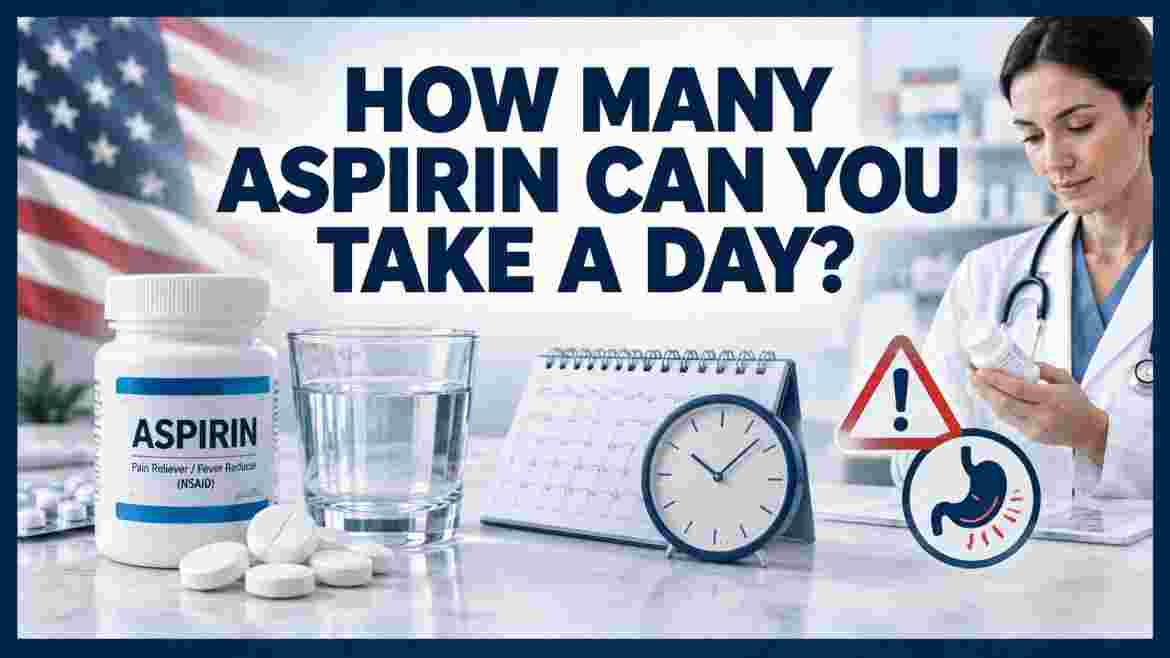
For short-term pain or fever relief, adults can take 325 to 650 mg of aspirin every 4 to 6 hours, up to a maximum of 4,000 mg (4 grams) in 24 hours, while daily low-dose aspirin for heart protection typically means just 81 mg once a day. Roughly 36% of US adults — more than 50 million people — take aspirin regularly for cardiovascular prevention, together consuming an estimated 10 to 20 billion tablets each year.
How Many Aspirin Can You Take a Day? – Introduction
Aspirin dosage varies dramatically depending on why someone is taking it, and that range confuses more people than almost any other over-the-counter medication question. A dose used to bring down a fever or ease a headache looks nothing like the dose a cardiologist prescribes for long-term heart protection, and the maximum amount considered safe for short-term pain relief is many times higher than what’s recommended for daily, ongoing use. Understanding where a given situation falls on that spectrum matters, because aspirin’s risks — primarily gastrointestinal bleeding and, in rare cases, more serious internal bleeding — climb directly alongside the dose and duration of use.
This guide breaks down aspirin’s dosage ranges for its most common uses in 2026: everyday pain and fever relief, long-term cardiovascular protection, and the maximum daily limits set by drug labeling and pharmacy references. It also covers the side effects, bleeding risks, and specific populations — including children and older adults — for whom standard dosing guidance doesn’t apply. None of this replaces a conversation with a doctor or pharmacist about an individual’s own situation, but it reflects the dosing information currently published by the FDA, drug reference databases, and major US health organizations.
Interesting Facts about Aspirin Dosage
| Category | Figure |
|---|---|
| Typical adult dose for pain/fever | 325-650 mg every 4-6 hours as needed |
| Maximum daily dose (short-term, pain/fever use) | 4,000 mg (4 grams) in 24 hours |
| Most common low-dose aspirin for heart protection | 81 mg once daily |
| Share of that 81 mg dose among US aspirin-for-prevention prescriptions | More than 60% |
| US adults taking aspirin regularly for cardiovascular prevention | ~36% (more than 50 million people) |
| Aspirin tablets consumed annually in the US for CVD prevention | 10-20 billion |
| FDA-recognized dosing range for cardiovascular prevention | 50-1,300 mg/day |
| USPSTF guidance for adults 60+ starting daily aspirin for primary prevention | Recommends against |
The single most important distinction in aspirin dosing is the gap between what’s approved on the label for occasional pain relief and what’s actually used for daily heart protection. The 4,000 mg maximum that appears on standard aspirin labeling applies specifically to short-term use for pain or fever — roughly 12 regular-strength (325 mg) tablets spread across a full day — and is not a target or recommended amount, simply an upper boundary. By contrast, the dose doctors actually prescribe for ongoing cardiovascular protection, 81 mg, represents less than 2% of that maximum, reflecting research showing that higher doses provide no additional heart-protective benefit while meaningfully increasing bleeding risk.
The scale of aspirin’s regular use among American adults is also worth noting on its own: with roughly 36% of US adults, more than 50 million people, taking aspirin regularly for cardiovascular prevention, the drug remains one of the most widely used daily medications in the country despite updated 2022 guidance from the US Preventive Services Task Force recommending against starting daily low-dose aspirin for primary prevention in adults 60 and older — a shift that has prompted many patients and physicians to revisit long-standing aspirin regimens that may no longer be appropriate.
Standard Aspirin Dosage for Pain and Fever in 2026
ASPIRIN DOSE BY USE CASE (MG PER DOSE)
PAIN/FEVER (SINGLE DOSE)      ████████████████████████████████  325-650 mg
HEART PROTECTION (DAILY)      ████  81 mg
ACUTE HEART ATTACK (INITIAL)  ████████████████  160-325 mg
| Use | Typical Dose | Frequency |
|---|---|---|
| Pain or fever relief (oral) | 325-650 mg | Every 4-6 hours as needed |
| Pain or fever relief (alternate range) | 300-650 mg | Every 4-6 hours as needed |
| Rectal suppository (pain/fever) | 300-600 mg | Every 4 hours |
| Maximum single-day total (short-term use) | 4,000 mg (4 g) | Within a 24-hour period |
Data Source: Drugs.com Dosage Guide, GoodRx
For everyday pain or fever, the standard adult aspirin dose is 325 to 650 mg, taken orally every 4 to 6 hours as needed, with some references listing a slightly wider starting range of 300 to 650 mg. This dosing applies to the common uses most people associate with aspirin: headaches, muscle aches, menstrual pain, minor arthritis flare-ups, toothaches, and reducing fever. A rectal suppository form exists as well, typically dosed at 300 to 600 mg every 4 hours, for situations where oral dosing isn’t practical.
Critically, this pain-and-fever dosing range is intended for short-term, as-needed use rather than ongoing daily treatment. The commonly cited maximum of 4,000 mg (4 grams) in 24 hours — roughly 12 regular-strength 325 mg tablets — represents the upper boundary for this kind of occasional use, not a daily target, and taking that much aspirin regularly, rather than occasionally for acute symptoms, substantially raises the risk of gastrointestinal irritation and bleeding. Anyone needing pain or fever relief for more than a few days in a row is generally advised to check with a doctor or pharmacist rather than continuing at these higher doses indefinitely. For related context on how NSAID use factors into broader digestive health risks in the US, see our Digestive Disease Statistics in US report.
Low-Dose Aspirin for Heart Protection in 2026
US ASPIRIN-FOR-PREVENTION PRESCRIPTIONS BY DOSE
81 MG/DAY       ████████████████████████████████████████  >60%
325 MG/DAY      ██████████████████████  35%
| Dose | Share of US CVD-Prevention Prescriptions | Context |
|---|---|---|
| 81 mg/day | >60% | Most commonly prescribed low-dose aspirin regimen |
| 325 mg/day | ~35% | Second most common, no proven added benefit over 81 mg |
| FDA-recognized dosing range (CVD prevention) | 50-1,300 mg/day | Full range studied in clinical trials |
| Initial dose, suspected heart attack | 160-162.5 mg | Taken once, as soon as a heart attack is suspected |
| Post-heart-attack maintenance dose | 160-162.5 mg/day | Typically for 30 days post-infarction |
Data Source: USPSTF, FDA, published clinical pharmacology research
Low-dose aspirin, almost always meaning 81 mg once daily, is the dose doctors most commonly recommend for people managing or preventing cardiovascular disease, accounting for more than 60% of all aspirin-for-prevention prescriptions in the US. Research has consistently found that this low dose provides cardiovascular benefits equivalent to higher doses — the Antithrombotic Trialists’ Collaboration found no meaningful difference in effectiveness between low-dose (under 150 mg) and medium-dose (150-325 mg) aspirin for preventing cardiovascular events — while carrying a lower risk of the gastrointestinal bleeding that becomes more common at higher, sustained doses. That evidence is why this dosage isn’t listed on standard OTC medication labels: daily low-dose aspirin isn’t appropriate for everyone, and current guidance consistently emphasizes that it should only be started on a doctor’s recommendation.
In the specific setting of a suspected heart attack, dosing looks different again: a single dose of 160 to 162.5 mg is recommended as soon as a heart attack is suspected, chewed rather than swallowed whole for faster absorption, followed by a maintenance dose in that same range daily for about 30 days following the event. Notably, USPSTF guidance updated in 2022 now recommends against starting daily low-dose aspirin for primary cardiovascular prevention in adults aged 60 and older, while describing the decision as an individual one, made with a doctor, for adults aged 40 to 59 who have a 10-year cardiovascular disease risk of 10% or greater — a meaningful shift from the broader aspirin recommendations that were common in prior decades. For a deeper look at how cardiovascular disease burden in the US has shaped these prevention guidelines, see our United States Heart Disease Statistics report.
Maximum Daily Aspirin Limit in 2026
MAXIMUM DAILY ASPIRIN DOSE: CONTEXT
SHORT-TERM PAIN/FEVER MAX      ████████████████████████████████████████  4,000 mg (4g) / 24 hrs
DAILY PREVENTIVE DOSE (TYPICAL) █  81 mg / 24 hrs
| Context | Maximum/Typical Amount |
|---|---|
| Absolute maximum for short-term pain/fever (per label) | 4,000 mg (4 g) in 24 hours |
| Equivalent in regular-strength (325 mg) tablets | ~12 tablets |
| Equivalent in extra-strength/other formulations | Varies by product strength |
| Recommended maximum for sustained daily use (cardiovascular) | 325 mg/day, with 75-81 mg considered optimal |
| Gastrointestinal bleeding risk | Rises with dose, particularly above 81 mg for long-term daily use |
Data Source: Drugs.com, GoodRx, clinical pharmacology references
The 4,000 mg (4-gram) figure is the maximum daily dose referenced across major drug information sources for short-term aspirin use targeting pain or fever — a ceiling, not a recommendation, intended to guide safe use in situations where standard doses aren’t providing adequate relief. That maximum works out to roughly 12 regular-strength 325 mg tablets consumed across a full day, spaced appropriately through the recommended 4-to-6-hour dosing intervals, and it applies only to short-term, as-needed treatment rather than ongoing daily use.
For anyone taking aspirin regularly rather than occasionally — which, for most people, means for cardiovascular protection rather than pain relief — the relevant maximum looks completely different: 325 mg per day is generally considered the upper bound for sustained cardiovascular use, with 75 to 81 mg daily widely regarded as the optimal dose that balances effectiveness against bleeding risk. The gap between these two numbers, 4,000 mg for occasional short-term use versus roughly 81-325 mg for daily long-term use, is the single most important distinction in understanding aspirin dosing safely, since gastrointestinal bleeding risk climbs meaningfully with both higher individual doses and longer durations of regular use.
Aspirin Side Effects and Risks in 2026
ASPIRIN RISK PROFILE BY USE PATTERN
LOW-DOSE DAILY (CVD PREVENTION)     ████████  Moderate long-term bleeding risk, monitored
HIGH-DOSE SHORT-TERM (PAIN/FEVER)   ████████████  Higher acute GI irritation risk
| Side Effect/Risk | Detail |
|---|---|
| Gastrointestinal irritation/bleeding | Most common serious risk, increases with dose and duration |
| Tinnitus (ringing in ears) | Classic early warning sign of excessive aspirin/salicylate levels |
| Intracranial hemorrhage | Rare but serious risk, increases with daily low-dose use over time |
| Reye’s syndrome | Rare, serious condition linked to aspirin use in children/teens with viral illness |
| No effect on cardiovascular mortality | Daily low-dose aspirin reduces nonfatal MI/stroke but does not reduce CVD death risk, per USPSTF modeling |
Data Source: USPSTF, Drugs.com, published clinical research
Aspirin’s most common serious side effect at any dose level is gastrointestinal irritation and bleeding, ranging from mild stomach upset to more serious ulceration, with risk climbing as both the dose and the duration of use increase. Tinnitus, or ringing in the ears, is a classically recognized early warning sign that aspirin levels in the body have become too high, and anyone experiencing new or worsening ringing in the ears while taking aspirin regularly is generally advised to stop and contact a healthcare provider. At the more serious end of the risk spectrum, long-term daily low-dose aspirin use carries a small but real increased risk of intracranial hemorrhage (bleeding in the brain), a risk the USPSTF explicitly factored into its 2022 decision to recommend against starting preventive aspirin in adults 60 and older.
One particularly important finding from USPSTF’s own modeling deserves emphasis: daily low-dose aspirin use reduces the risk of nonfatal heart attack and nonfatal stroke, but has no measurable effect on overall cardiovascular mortality — meaning the drug can reduce the chance of a non-fatal cardiac event without necessarily extending life expectancy, a nuance that has informed the more selective, individualized approach to aspirin recommendations seen in current clinical guidance compared with decades past.
Who Should Avoid Aspirin in 2026
POPULATIONS REQUIRING SPECIAL CAUTION OR AVOIDANCE
CHILDREN/TEENS WITH VIRAL ILLNESS   ████████████████████████████████████████  Avoid (Reye's syndrome risk)
ADULTS 60+ STARTING PREVENTIVE USE  ████████████████████████████  Routine use not recommended (USPSTF)
| Population | Guidance |
|---|---|
| Children and teenagers | Aspirin, including low-dose “baby aspirin,” is not considered safe for children and teens, particularly during viral illnesses |
| Adults 60 and older (starting new preventive use) | USPSTF recommends against initiating daily low-dose aspirin for primary CVD prevention |
| Adults 40-59 with ≥10% 10-year CVD risk | Decision to start should be individualized, made with a healthcare provider |
| People with a history of GI bleeding/ulcers | Generally advised to avoid or use aspirin only under close medical supervision |
| People on other blood thinners | Combined use significantly raises bleeding risk; requires medical guidance |
Data Source: Drugs.com, USPSTF, GoodRx
Children and teenagers represent the clearest population for whom standard aspirin dosing simply does not apply: aspirin, including low-dose formulations sometimes informally called “baby aspirin,” is not considered safe for use in children, primarily because of its association with Reye’s syndrome, a rare but serious condition affecting the brain and liver that has been linked to aspirin use in children and teenagers recovering from viral infections like chickenpox or influenza. Pediatric aspirin use is generally reserved for specific medical conditions, such as Kawasaki disease, under direct physician supervision, rather than for routine pain or fever management.
Among adults, the most significant recent shift in guidance affects people aged 60 and older: current USPSTF recommendations advise against starting a new daily low-dose aspirin regimen purely for primary cardiovascular prevention in this age group, a reversal from older guidance that more broadly encouraged aspirin use for heart health. People with a prior history of gastrointestinal bleeding or ulcers, and those already taking other blood-thinning medications, face compounded bleeding risks that generally call for closer medical supervision before starting or continuing any aspirin regimen, regardless of age. Anyone currently taking daily aspirin who falls into one of these categories is generally encouraged to revisit that decision with their doctor rather than assuming older guidance still applies. For broader context on how cardiovascular conditions continue to shape US mortality patterns that these aspirin guidelines are designed to address, see our Leading Causes of Death Statistics in US report.
Frequently Asked Questions
How many aspirin can I take in a day?
For short-term pain or fever relief, the maximum is 4,000 mg (4 grams) in 24 hours, roughly equivalent to 12 regular-strength (325 mg) tablets. For daily, ongoing use — such as cardiovascular protection — the typical and much lower dose is just 81 mg once a day.
What is the difference between regular aspirin dosage and low-dose aspirin?
Regular dosing for pain or fever is 325-650 mg taken every 4-6 hours as needed. Low-dose aspirin, used for long-term heart protection, is typically just 81 mg once daily — a fraction of the pain-relief dose, reflecting research showing higher doses don’t add cardiovascular benefit while increasing bleeding risk.
Is it safe to take aspirin every day?
Daily aspirin use is appropriate for some people under medical guidance, particularly those with existing cardiovascular disease, but current USPSTF guidelines recommend against starting daily low-dose aspirin purely for prevention in adults 60 and older, and advise an individualized decision for adults 40-59 with elevated cardiovascular risk.
What happens if you take too much aspirin?
Taking excessive aspirin increases the risk of gastrointestinal bleeding, and in more serious cases, can cause salicylate toxicity, with warning signs including tinnitus (ringing in the ears), rapid breathing, nausea, and confusion. Anyone experiencing these symptoms while taking aspirin should seek medical attention.
Can children take aspirin?
Generally, no. Aspirin is not considered safe for children and teenagers, primarily due to its association with Reye’s syndrome, a rare but serious condition linked to aspirin use during viral illnesses like flu or chickenpox. Pediatric aspirin use is typically reserved for specific conditions under direct physician supervision.
What is the most common low-dose aspirin prescription in the US?
81 mg once daily is the most commonly prescribed low-dose aspirin regimen in the US, accounting for more than 60% of aspirin prescriptions written for cardiovascular prevention, followed by 325 mg at roughly 35%.
Does daily aspirin reduce the risk of dying from heart disease?
According to USPSTF modeling, daily low-dose aspirin reduces the risk of nonfatal heart attack and stroke, but research has not shown a reduction in overall cardiovascular mortality from daily aspirin use, an important nuance in current prevention guidelines.
How many Americans take aspirin regularly?
An estimated 36% of US adults, more than 50 million people, take aspirin regularly for cardiovascular disease prevention, together consuming roughly 10 to 20 billion aspirin tablets annually.
Disclaimer: The data research report we present here is based on information found from various sources. We are not liable for any financial loss, errors, or damages of any kind that may result from the use of the information herein. We acknowledge that though we try to report accurately, we cannot verify the absolute facts of everything that has been represented.