FIFA World Cup 2030: The Centenary Tournament
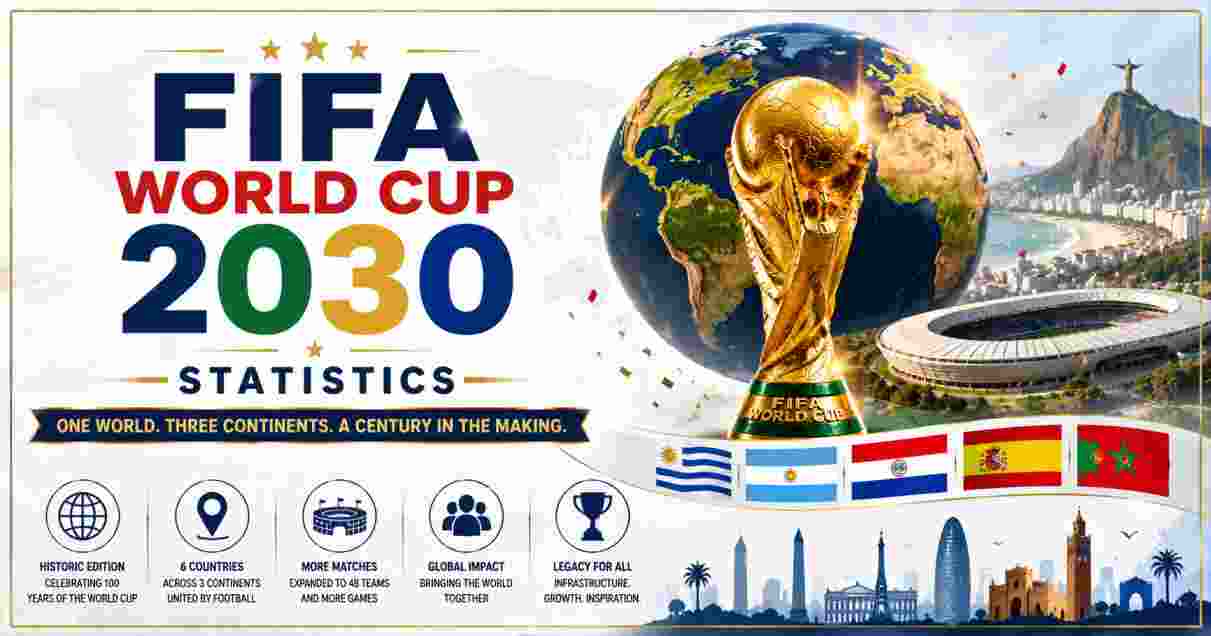
The 2030 FIFA World Cup will be the 24th edition of football’s biggest tournament and the first ever spread across six countries and three continents, jointly hosted by Morocco, Portugal, and Spain, with Uruguay, Argentina, and Paraguay each staging one centenary celebration match to mark 100 years since the very first World Cup kicked off in Montevideo in 1930. FIFA confirmed the arrangement at an Extraordinary FIFA Congress on December 11, 2024, closing a bidding process that had run since October 2020.
This report covers the full, current picture of the FIFA World Cup 2030: the confirmed host countries and centenary arrangement, the tournament’s record-breaking 44-day schedule, the 48-team format carried over from 2026, the proposed 23-stadium venue list, and the historic firsts this edition will set. All figures come directly from FIFA’s official announcements and confirmed reporting from major sports outlets covering the December 2024 host confirmation.
Key FIFA World Cup 2030 Statistics
| Statistic | Figure |
|---|---|
| Tournament edition | 24th FIFA World Cup |
| Main host countries | Morocco, Portugal, Spain |
| Centenary celebration hosts | Uruguay, Argentina, Paraguay (one match each) |
| Total host countries | 6 — a World Cup record |
| Continents spanned | 3 (Africa, Europe, South America) |
| Tournament dates | June 8 – July 21, 2030 |
| Tournament length | 44 days — the longest World Cup ever |
| 2026 tournament length (for comparison) | 39 days |
| Number of competing teams | 48, same format as 2026 |
| Proposed stadiums (final list pending) | 23 |
| Spain’s proposed stadium count | 11 — the most of any host nation |
| Host confirmation date | December 11, 2024 |
| Bidding process duration | October 2020 – October 2023 |
Source: FIFA official announcements, October 2023 and December 2024; Al Jazeera, “When is the next FIFA World Cup?,” July 2026; Fox Sports, “2030 World Cup: Locations, Hosts, Dates,” July 2026.
The 2030 World Cup’s six-country, three-continent footprint has no precedent in the tournament’s near-century history. FIFA President Gianni Infantino framed the decision explicitly around unity, stating “In a divided world, FIFA and football are uniting” when the FIFA Council unanimously approved the arrangement. The centenary matches specifically honor the first-ever World Cup, held in Uruguay in 1930, where the host nation beat Argentina in the final at the Estadio Centenario in Montevideo — the same stadium now confirmed to host a dedicated centenary celebration ceremony in 2030.
The tournament’s 44-day span makes it the longest World Cup ever staged, a direct consequence of the logistics required to open the competition in South America before shifting the remaining matches across the Atlantic to Morocco, Portugal, and Spain. Per the confirmed schedule, centenary matches take place June 8-9, 2030 in Montevideo, Buenos Aires, and Asunción, with teams in those groups given additional time to travel, rest, and prepare before the main tournament’s opening ceremony and first matches in Morocco, Portugal, and Spain begin on June 13-14, 2030.
Host Confirmation Timeline and Bidding Process
| Milestone | Date |
|---|---|
| Bidding process opens | October 2020 |
| Morocco joins the Spain-Portugal bid | March 2023 |
| Morocco-Portugal-Spain confirmed as sole candidate | October 4, 2023 |
| FIFA Council approves centenary celebration in Uruguay | October 2023 |
| Official host ratification, Extraordinary FIFA Congress | December 11, 2024 |
| FIFA member associations voting | All 211 |
Source: FIFA, “World Cup 2030: Spain, Portugal, Morocco Host, Centenary Argentina, Uruguay, Paraguay,” October 2023; CBS Sports, October 2023.
Morocco wasn’t originally part of the winning bid. Spain and Portugal initially pursued a joint bid on their own, with Morocco — which had separately hoped to host the tournament solo after several unsuccessful prior bids — joining the Spain-Portugal bid in March 2023 rather than continuing to compete against it. This merger produced the single candidacy FIFA’s Council confirmed on October 4, 2023, with Uruguay, Argentina, and Paraguay’s centenary role approved unanimously in the same council session.
Formal ratification required a full vote of FIFA’s membership. All 211 FIFA member associations convened at an Extraordinary FIFA Congress on December 11, 2024, officially confirming Morocco, Portugal, and Spain as tournament hosts, with Uruguay, Argentina, and Paraguay confirmed as centenary celebration hosts in the same session — the final procedural step required before venue planning and stadium proposals could move forward in earnest. For a look at how the last World Cup’s hosting economics actually played out once the tournament concluded, see our FIFA World Cup 2026 Economic Statistics coverage, which found the completed 2026 tournament generated a confirmed $40 billion in global economic impact.
The Centenary Celebration: Uruguay, Argentina, and Paraguay
| Detail | Figure |
|---|---|
| Centenary host countries | Uruguay, Argentina, Paraguay |
| Matches hosted by each | 1 match each |
| Centenary match dates | June 8-9, 2030 |
| Centenary celebration ceremony location | Montevideo, Uruguay |
| Significance of Montevideo | Site of the first-ever World Cup Final in 1930 |
| 1930 World Cup Final result | Uruguay defeated Argentina |
| Hosting debuts among centenary nations | Paraguay (first-ever hosting role) |
Source: FIFA, October 2023; Al Jazeera, July 2026.
The centenary arrangement is a deliberate homage to football history rather than a standard co-hosting structure. Uruguay hosted and won the very first FIFA World Cup in 1930, defeating Argentina in the final at what is now the Estadio Centenario — a name that translates directly to “Centenary Stadium,” making it the natural site for FIFA’s 2030 commemorative ceremony. Argentina, as Uruguay’s opponent in that historic first final, and Paraguay, marking its first-ever World Cup hosting role of any kind, round out the three-nation South American opening.
Teams drawn into groups alongside the centenary hosts receive a unique scheduling accommodation. Because Uruguay, Argentina, and Paraguay’s opening matches happen an ocean away from the main tournament, the remaining teams in those specific groups are given additional time to travel, rest, and prepare before their second group matches, scheduled for June 21-22, 2030 — a logistical adjustment unique to this tournament’s unprecedented cross-continental format.
Proposed Stadiums and Venues
| Venue Detail | Figure |
|---|---|
| Total proposed stadiums | 23 (final list still to be confirmed) |
| Spain’s proposed venue count | 11 — largest of any host nation |
| Camp Nou, Barcelona (renovated) | ~105,000 capacity — projected largest European World Cup stadium |
| Santiago Bernabéu, Madrid | Real Madrid’s home; hosted the 1982 World Cup Final |
| Metropolitano, Madrid | Atlético Madrid’s home; hosted the 2019 Champions League Final |
| RCDE Stadium, Barcelona | Espanyol’s home; ~40,000 capacity |
| Spain’s last World Cup hosting | 1982 — 48 years before 2030 |
Source: Newsweek, “Map Shows 2030 World Cup Stadium Locations Across 6 Countries,” July 2026; Sports Illustrated, July 2026; Olympics.com, January 2025.
Spain’s stadium proposal dwarfs its co-hosts, submitting 11 of the tournament’s 23 proposed venues, anchored by some of European football’s most recognizable grounds. The centerpiece is Barcelona’s renovated Camp Nou, expected to become the largest World Cup stadium in Europe at a planned capacity of roughly 105,000 once renovation work concludes. Madrid contributes two major venues — the Santiago Bernabéu, which previously hosted the 1982 World Cup Final when Spain last hosted the tournament, and Atlético Madrid’s Metropolitano, site of the 2019 UEFA Champions League Final.
This will mark Spain’s first World Cup since 1982 — a 48-year gap — while representing genuine hosting debuts for Morocco and Portugal at the men’s World Cup level. The final venue list, including which stadiums Morocco and Portugal will contribute and confirmation of specific centenary-match venues in South America, remained unconfirmed as of the most recent reporting, with FIFA expected to finalize the complete stadium list in a subsequent announcement.
Historic Firsts the 2030 Tournament Will Set
| Historic First | Detail |
|---|---|
| First World Cup held across the Mediterranean Sea | Morocco-Portugal-Spain co-hosting spans two continents bordering the Mediterranean |
| First World Cup in Africa since 2010 | South Africa hosted in 2010; Morocco will be the second African host |
| First World Cup ever held in North Africa specifically | Morocco |
| First World Cup played across multiple confederations simultaneously | CAF (Africa), UEFA (Europe), CONMEBOL (South America) |
| Longest World Cup in history | 44 days, surpassing 2026’s 39-day record |
| Most host countries ever | 6, surpassing 2026’s three-nation record |
| Hosting debuts | Morocco, Portugal, Paraguay |
Source: Sports Illustrated, “2030 World Cup: Host, Locations and Format,” July 2026; Wikipedia, “2030 FIFA World Cup,” 2026.
The 2030 tournament breaks the record for host countries just four years after that record was last set. The 2026 World Cup made history as the first tournament hosted by three nations — the United States, Canada, and Mexico. 2030 doubles that figure to six, while also becoming the first World Cup ever played across three different FIFA confederations simultaneously — CAF in Africa, UEFA in Europe, and CONMEBOL in South America — a structural first that goes beyond simply adding more host cities within a single region.
Morocco’s hosting role carries particular historical weight for African football. It will be only the second World Cup held on the African continent, following South Africa in 2010, and the first ever held specifically in North Africa, a milestone Morocco pursued across several previous unsuccessful bids before finally securing hosting rights by joining the Spain-Portugal bid in 2023.
Qualification and Automatic Host Berths
| Qualification Detail | Figure |
|---|---|
| Teams receiving automatic qualification | 6 — Morocco, Portugal, Spain, Uruguay, Argentina, Paraguay |
| Qualification basis for host nations | Automatic slot from their respective confederation’s allocation |
| Remaining teams to be determined via qualifying | 42 |
| Total tournament field | 48 teams, unchanged from 2026 |
| Qualification process governing body | Each team’s respective continental confederation |
Source: FIFA, October 2023; Al Jazeera, July 2026.
All six host nations qualify automatically, a standard practice for World Cup hosts extended here to all six countries with a hosting role, including the three centenary nations that will play only a single match each in South America before elimination or advancement depends on results in the main tournament phase. This automatic qualification draws from each nation’s existing confederation slot allocation rather than creating additional berths, meaning Uruguay, Argentina, and Paraguay’s automatic spots come from CONMEBOL’s regular allocation, just as Morocco’s comes from CAF’s and Portugal and Spain’s from UEFA’s.
The remaining 42 places in the 48-team field will be decided through each confederation’s standard continental qualifying tournaments over the years leading up to 2030, following the same 48-team format introduced at the 2026 World Cup, which itself expanded the tournament from the 32-team structure used continuously since 1998. For historical context on how the tournament’s format and scale have evolved since its 1930 origins, see our FIFA World Cup History Statistics coverage, which tracks the competition’s growth from a 13-team invitational to today’s global 48-team spectacle.
How 2030 Compares to the 2026 World Cup
| Metric | 2026 World Cup | 2030 World Cup |
|---|---|---|
| Host countries | 3 (USA, Mexico, Canada) | 6 (Morocco, Portugal, Spain, Uruguay, Argentina, Paraguay) |
| Continents spanned | 1 (North America) | 3 (Africa, Europe, South America) |
| Tournament length | 39 days | 44 days |
| Teams | 48 | 48 |
| Confederations represented as hosts | 1 (CONCACAF) | 3 (CAF, UEFA, CONMEBOL) |
| Edition number | 23rd | 24th |
| Anniversary significance | None specific | 100th anniversary of the World Cup |
Source: Wikipedia, “2026 FIFA World Cup” and “2030 FIFA World Cup”; FIFA official records.
Both tournaments share the same 48-team format, but 2030’s cross-continental structure represents a genuinely different logistical undertaking than 2026’s three-nation, single-continent model. Where the 2026 tournament required coordinating 16 host cities across three countries within a single confederation, 2030 spreads matches across six countries spanning three separate confederations and three continents, a structure that will test travel logistics, broadcast scheduling, and fan mobility in ways no prior World Cup has attempted. Ticket pricing for an event of this scale and prestige will likely draw comparisons to the record-setting demand seen in 2026, where our FIFA World Cup Most Expensive Tickets Statistics coverage documented resale prices reaching as high as $32,000 for premium seats — a benchmark the centenary status and expanded host footprint of 2030 could plausibly meet or exceed once ticketing opens closer to the tournament.
Disclaimer: The data research report we present here is based on information found from various sources. We are not liable for any financial loss, errors, or damages of any kind that may result from the use of the information herein. We acknowledge that though we try to report accurately, we cannot verify the absolute facts of everything that has been represented.