History of FIFA World Cup
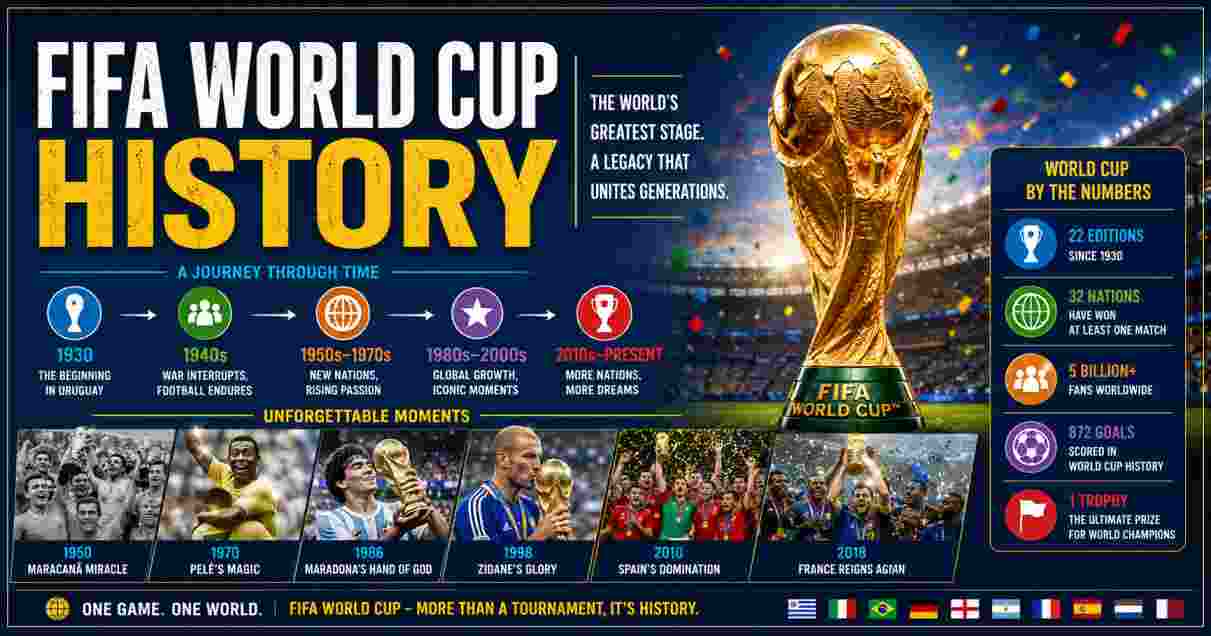
The FIFA World Cup stands as the most-watched and most-attended single-event sporting competition on the planet. Since its inaugural edition in 1930, the tournament has grown from a modest 13-team invitational hosted by Uruguay into a global spectacle that now commands the attention of billions of fans across every continent. What began as an experiment in international football has evolved into a quadrennial festival of sport, identity, and national pride — one where careers are immortalised, records are shattered, and entire nations stop in their tracks every four years. Over 22 editions played between 1930 and 2022, the World Cup has produced 2,720 goals, crowned eight different champions, and built a legacy that no other sporting event can rival.
The 2026 FIFA World Cup marks a watershed moment in the tournament’s near-century-long history. For the first time ever, three nations — the United States, Canada, and Mexico — are jointly hosting the event, spreading 104 matches across 16 cities from June 11 to July 19, 2026. The expanded 48-team format replaces the 32-team structure that had been in place since 1998, creating a new Round of 32 and pushing total match days to 39. With a record $871 million in financial distributions and prize money for the 2026 champion set at $50 million, the stakes — financial, competitive, and cultural — have never been higher. This edition is not merely the biggest World Cup in history; it is a reinvention of what the tournament can be.
Interesting FIFA World Cup Facts (All-Time | 1930–2026)
| Fact | Detail |
|---|---|
| First World Cup held | 1930, Uruguay |
| Total editions played (including 2026) | 23 |
| Total goals scored (1930–2022) | 2,720 |
| All-time top scorer | Miroslav Klose (Germany) — 16 goals |
| Most goals in a single tournament | Just Fontaine (France) — 13 goals (1958) |
| Most goals in a single match (player) | Oleg Salenko (Russia) — 5 goals vs. Cameroon, 1994 |
| Highest-scoring match | Austria 7–5 Switzerland (1954) — 12 goals |
| Highest goals-per-game average (tournament) | 5.38 per game (1954, Switzerland) |
| Record single-match attendance | 173,850 — Uruguay vs. Brazil, Maracanã, 1950 |
| Highest total tournament attendance | 3.6 million — USA 1994 |
| Most World Cup titles | Brazil — 5 (1958, 1962, 1970, 1994, 2002) |
| Most finals played | Germany — 8 finals |
| Youngest player | Norman Whiteside (N. Ireland) — 17 years, 41 days (1982) |
| Youngest scorer | Pelé (Brazil) — 17 years, 239 days (1958) |
| Oldest scorer | Roger Milla (Cameroon) — 42 years, 39 days (1994) |
| Countries to have won the World Cup | 8 (Brazil, Germany, Italy, Argentina, France, Uruguay, England, Spain) |
| Only nation in every World Cup | Brazil (all 23 editions) |
| 2026 format change | 48 teams, 104 matches — largest edition ever |
Source: FIFA Official Records; Guinness World Records; Britannica Sports Reference
The sheer breadth of FIFA World Cup history statistics tells a story spanning nearly a century of football. Brazil’s five titles remain the gold standard, and the Seleção’s distinction as the only nation to participate in every single edition of the tournament — all 23 — speaks to the country’s unmatched relationship with the game. The 1950 Maracanã attendance figure of 173,850 remains the largest crowd ever to witness a football match anywhere in the world, a record that has stood for over 70 years and shows no sign of being broken under current stadium safety regulations.
The individual records embedded in this table are equally staggering. Miroslav Klose’s 16 career World Cup goals, scored across four tournaments from 2002 to 2014, represent a feat of remarkable longevity and consistency that active players such as Kylian Mbappé (12 goals) and Lionel Messi (13 goals) are still chasing. Just Fontaine’s 13 goals in a single 1958 tournament — achieved in only six matches — is widely considered one of the most unbreakable records in all of sport. The move to a 48-team, 104-match format in 2026 introduces new records that will almost certainly rewrite the history books before July 19.
FIFA World Cup Champions by Country | All-Time Titles (1930–2022)
FIFA World Cup Titles by Country (1930–2022)
=============================================
Brazil       ████████████████████  5 titles
Germany      ████████████████      4 titles
Italy        ████████████████      4 titles
Argentina    ████████████          3 titles
France       ████████              2 titles
Uruguay      ████████              2 titles
England      ████                  1 title
Spain        ████                  1 title
| Country | Titles | Years Won | Finals Lost |
|---|---|---|---|
| Brazil | 5 | 1958, 1962, 1970, 1994, 2002 | 2 (1950, 1998) |
| Germany | 4 | 1954, 1974, 1990, 2014 | 4 |
| Italy | 4 | 1934, 1938, 1966, 2006 | 2 |
| Argentina | 3 | 1978, 1986, 2022 | 3 |
| France | 2 | 1998, 2018 | 2 |
| Uruguay | 2 | 1930, 1950 | 0 |
| England | 1 | 1966 | 0 |
| Spain | 1 | 2010 | 0 |
Source: FIFA Official Tournament Records; Britannica Sports Reference
Only eight nations have ever lifted the FIFA World Cup trophy since the competition began in 1930, underlining just how difficult it is to claim football’s ultimate prize. Brazil’s five championships are unmatched and were achieved across four different decades, cementing the country’s identity as the sport’s most successful international team. Germany and Italy, each on four titles, round out the top three, with Germany’s tally including their West Germany victories in 1954 and 1974, which FIFA officially counts as part of the same footballing lineage.
Argentina’s 2022 triumph in Qatar delivered Lionel Messi his long-awaited World Cup medal and ended a 36-year drought for the South American nation, who had not lifted the trophy since Diego Maradona’s famous 1986 campaign. Germany holds the distinction of appearing in eight World Cup finals — more than any other nation — though four of those ended in defeat. Notably, six champions have won on home soil, a pattern that underscores the formidable advantage of hosting, though no host nation has won the title since France in 1998.
FIFA World Cup Tournament Format Evolution | Teams & Matches (1930–2026)
World Cup Team Count Expansion Over History
============================================
1930           ████                         13 teams
1934–1978      ████████████████             16 teams
1982–1994      ████████████████████████     24 teams
1998–2022      ████████████████████████████████  32 teams
2026           ██████████████████████████████████████████████████  48 teams
| Era | Teams | Matches | Host(s) | First Edition | Last Edition |
|---|---|---|---|---|---|
| Inaugural era | 13 | 18 | Uruguay | 1930 | 1930 |
| 16-team era | 16 | 32 | Italy | 1934 | 1978 |
| 24-team era | 24 | 52 | Spain | 1982 | 1994 |
| 32-team era | 32 | 64 | France | 1998 | 2022 |
| 48-team era | 48 | 104 | USA/Canada/Mexico | 2026 | Present |
Source: FIFA Official Tournament Records; Al Jazeera Sports Data; Britannica
The evolution of the FIFA World Cup format reflects the sport’s extraordinary global expansion. The competition moved from 16 to 24 teams in 1982 following growing demand from African, Asian, and CONCACAF federations for fairer representation, then jumped to 32 teams in 1998 — a structure that persisted for seven editions through 2022. The 2026 edition’s leap to 48 teams is the single largest expansion in the tournament’s history, adding 16 nations at once and pushing total matches from 64 to 104. To accommodate the additional teams, a brand-new Round of 32 has been introduced as the first knockout stage.
The practical impact of this expansion is profound. 39 days of football across 16 cities in three countries will test logistics, broadcasting, and fan travel in entirely new ways. The group stage alone will feature 72 matches across 12 groups of four, with the top two teams from each group plus the eight best third-place finishers advancing to the knockout rounds. For smaller footballing nations, the expanded format represents a genuine opportunity to reach the Round of 16 — a stage previously reserved almost exclusively for established football powers.
FIFA World Cup All-Time Top Scorers | Career Goals Record (1930–2026)
All-Time FIFA World Cup Top Scorers (Career Goals)
===================================================
Miroslav Klose (GER)   ████████████████   16 goals
Ronaldo (BRA)          ███████████████    15 goals
Gerd Müller (GER)      ██████████████     14 goals
Just Fontaine (FRA)    █████████████      13 goals
Lionel Messi (ARG)     █████████████      13 goals
Pelé (BRA)             ████████████       12 goals
Kylian Mbappé (FRA)    ████████████       12 goals (entering 2026)
Sándor Kocsis (HUN)    ███████████        11 goals
Jürgen Klinsmann (GER) ███████████        11 goals
Gary Lineker (ENG)     ██████████         10 goals
| Rank | Player | Country | Goals | Appearances | Tournaments |
|---|---|---|---|---|---|
| 1 | Miroslav Klose | Germany | 16 | 24 | 2002–2014 |
| 2 | Ronaldo | Brazil | 15 | 19 | 1998–2006 |
| 3 | Gerd Müller | West Germany | 14 | 13 | 1970–1974 |
| 4 | Just Fontaine | France | 13 | 6 | 1958 |
| 4 | Lionel Messi | Argentina | 13 | 26 | 2006–2022 |
| 6 | Pelé | Brazil | 12 | 14 | 1958–1970 |
| 6 | Kylian Mbappé | France | 12 | 14 | 2018–2022 |
| 8 | Sándor Kocsis | Hungary | 11 | 5 | 1954 |
| 8 | Jürgen Klinsmann | Germany | 11 | 17 | 1990–1998 |
| 10 | Gary Lineker | England | 10 | 12 | 1986–1990 |
Source: FIFA Official Statistics; Olympics.com; Sports Mole All-Time Records
Miroslav Klose’s record of 16 World Cup goals has stood since he broke Ronaldo’s previous mark of 15 with a strike in Germany’s historic 7–1 semi-final demolition of Brazil at the 2014 World Cup in Belo Horizonte. Klose achieved this tally across four tournaments and 24 appearances, a testament to longevity as much as goalscoring brilliance. What makes his record particularly remarkable is its consistency — he netted 5 goals in 2002, 5 in 2006, 4 in 2010, and 2 in 2014 — with the Golden Boot at the 2006 home tournament as a personal highlight.
Kylian Mbappé entered the 2026 World Cup with 12 career goals from just two tournaments, making him the most credible threat to Klose’s record in the modern era. At only 27 years old, Mbappé has at least two more tournaments ahead of him at peak ability. Lionel Messi’s 13 goals — amassed across five World Cups from 2006 to 2022 — place him joint-fourth all time and represent one of football’s most emotionally significant scoring runs, culminating in his Golden Ball and World Cup triumph at the 2022 Qatar final. Just Fontaine’s 13 goals in a single tournament (1958) remains an entirely separate category of achievement, coming in six matches with a scoring rate that no player in the modern era has come close to matching.
FIFA World Cup 2026 Prize Money Breakdown | Record $871 Million Fund
FIFA World Cup 2026 Prize Money by Stage (USD)
===============================================
Winner          ████████████████████████████████████████████████████  $50M
Runner-Up       █████████████████████████████████████                 $33M
3rd Place       ████████████████████████████████████                  $29M
4th Place       ████████████████████████████████                      $27M
QF (5th–8th)    ████████████████████████                              $19M
R16 (9th–16th)  ██████████████████                                    $15M
R32 (17th–32nd) █████████████                                         $11M
Group (33rd–48th) ███████████                                         $9M
| Stage / Finish | Prize Money (USD) | % Increase vs. 2022 |
|---|---|---|
| Champion | $50 million | +19% |
| Runner-Up | $33 million | +10% |
| 3rd Place | $29 million | +12% |
| 4th Place | $27 million | +13% |
| Quarterfinalists (5th–8th) | $19 million each | +15% |
| Round of 16 (9th–16th) | $15 million each | +25% |
| Round of 32 (17th–32nd) | $11 million each | New stage |
| Group Stage exit (33rd–48th) | $9 million each | New stage |
| Preparation fee (all 48 teams) | $2.5 million each | +67% |
| Total prize pool | $655 million | +49% |
| Total financial distribution | $871 million | ~+98% |
Source: FIFA Official Council Decision, revised May 2026; FanDuel Research; Sports Illustrated
The $655 million prize pool for the 2026 FIFA World Cup represents a 49% increase on the $440 million distributed at Qatar 2022, making it the largest direct prize fund in the tournament’s history. When the $2.5 million preparation fee paid to all 48 participating nations is added alongside additional delegation and ticketing funds, total FIFA financial distributions reach $871 million — nearly double what Qatar’s teams received. The 2026 World Cup champion will pocket $50 million, surpassing Argentina’s $42 million payout for winning in 2022. Every team is guaranteed at least $11.5 million regardless of performance.
The financial architecture of 2026 prize money is especially significant for smaller footballing nations. A federation that exits in the group stage still earns $9 million in performance money plus the $2.5 million preparation grant, guaranteeing at least $11.5 million — funds that can meaningfully transform youth academies, coaching infrastructure, and women’s football programmes in developing countries. The introduction of a new Round of 32 means teams that previously would have earned nothing beyond group-stage money can now target an additional $2 million by winning even a single knockout match, creating fresh financial incentives across the expanded field.
FIFA World Cup Host Nations & Attendance Records | 1930–2026
Top 5 FIFA World Cup Total Tournament Attendance
=================================================
USA 1994          ██████████████████████████████████████████████████  3,600,000
Brazil 2014       ███████████████████████████████████████████████     3,429,873
Germany 2006      ███████████████████████████████████████████████     3,359,439
South Korea/Japan 2002  ████████████████████████████████████████████  3,278,247
Mexico 1970       ████████████████████████████████████████            2,951,848
| Year | Host Country | Teams | Matches | Total Attendance | Champion |
|---|---|---|---|---|---|
| 1930 | Uruguay | 13 | 18 | 590,549 | Uruguay |
| 1950 | Brazil | 13 | 22 | 1,045,246 | Uruguay |
| 1954 | Switzerland | 16 | 26 | 943,000 | West Germany |
| 1966 | England | 16 | 32 | 1,614,677 | England |
| 1986 | Mexico | 24 | 52 | 2,394,031 | Argentina |
| 1994 | USA | 24 | 52 | 3,600,000 | Brazil |
| 2002 | South Korea/Japan | 32 | 64 | 3,278,247 | Brazil |
| 2006 | Germany | 32 | 64 | 3,359,439 | Italy |
| 2010 | South Africa | 32 | 64 | 3,178,856 | Spain |
| 2014 | Brazil | 32 | 64 | 3,429,873 | Germany |
| 2018 | Russia | 32 | 64 | 3,031,768 | France |
| 2022 | Qatar | 32 | 64 | 3,404,252 | Argentina |
| 2026 | USA/Canada/Mexico | 48 | 104 | TBC (record targeted) | TBC |
Source: FIFA Official Records; Al Jazeera Sports Data 2026; Topend Sports Database
The United States hosted the most attended World Cup in history in 1994, drawing 3.6 million spectators across 52 matches — a figure that has stood for over 30 years as the overall tournament attendance record. That achievement was particularly notable given that the US was not considered a major football market at the time, and yet the tournament’s average attendance of nearly 70,000 per game exceeded every previous edition. FIFA has repeatedly stated that the 2026 edition — with 104 matches across 16 cities in three countries including the same US market — is positioned to surpass the 1994 record, though ticket pricing concerns and slower-than-expected early sales have tempered those projections.
Single-match attendance tells a different story. The Maracanã’s 173,850-strong crowd for Uruguay vs. Brazil at the 1950 World Cup remains the largest gathering for any football match in history, and modern stadium safety regulations make it effectively unrepeatable. The 2026 tournament’s largest venue is MetLife Stadium in New Jersey, which will host the final on July 19 with a capacity of around 82,500, representing a very different spectator experience from the Maracanã era but one broadcast to a vastly larger global audience. Mexico becomes the first nation to host three FIFA World Cups (1970, 1986, and 2026 in a co-hosting capacity), while the USA last hosted in 1994 and Canada hosts for the first time.
FIFA World Cup 2026 Key Tournament Facts | Format, Venues & Records
FIFA World Cup 2026 — Tournament Scale at a Glance
====================================================
Host nations        ███                                    3 (USA, Canada, Mexico)
Host cities         ████████████████                      16
Participating teams ████████████████████████████████████████████████  48
Total matches       ████████████████████████████████████████████████████████████████████████████████████████████████████████  104
Tournament days     ██████████████████████████████████████████  39 days
| Category | 2026 Detail | Previous Record (2022) |
|---|---|---|
| Total teams | 48 | 32 |
| Total matches | 104 | 64 |
| Host nations | 3 (USA, Canada, Mexico) | 1 (Qatar) |
| Host cities | 16 | 8 |
| Tournament duration | 39 days | ~32 days |
| Group stage matches | 72 | 48 |
| Knockout stage matches | 32 | 16 |
| New stage introduced | Round of 32 | N/A |
| Groups | 12 groups of 4 | 8 groups of 4 |
| Final venue | MetLife Stadium, New Jersey | Lusail Stadium, Qatar |
| Final date | July 19, 2026 | December 18, 2022 |
| Opening match | Mexico vs. South Africa, Estadio Azteca | Qatar vs. Ecuador |
| Champion prize money | $50 million | $42 million |
Source: Britannica World Cup Guide 2026; Sky Sports; Good Morning America; FIFA Official
The 2026 FIFA World Cup breaks virtually every record in the tournament’s history on pure scale alone. The 48-team format — first proposed in January 2017 and confirmed for implementation in 2026 — represents the biggest structural change to the competition since the move to 32 teams in 1998. Hosting across three nations simultaneously is itself unprecedented, requiring cross-border logistics for both teams and fans on a scale never previously attempted. The opening match on June 11 at the historic Estadio Azteca in Mexico City — where Mexico hosted South Africa — added particular weight to the occasion, given that the Azteca is the only stadium to have hosted two World Cup finals (1970 and 1986).
The final at MetLife Stadium on July 19 carries its own historical significance as a return to North American soil for the first time since Brazil’s 1994 triumph in the same region. Coldplay will perform at the halftime show at FIFA president Gianni Infantino’s direction — a direct borrowing of the NFL Super Bowl format that signals FIFA’s intent to position the World Cup final as a broader entertainment event. With 104 matches delivering far more football than any previous edition, the 2026 tournament is expected to generate goals totals, viewing figures, and digital engagement records that will define the sport’s commercial landscape for the decade ahead.
Disclaimer: The data research report we present here is based on information found from various sources. We are not liable for any financial loss, errors, or damages of any kind that may result from the use of the information herein. We acknowledge that though we try to report accurately, we cannot verify the absolute facts of everything that has been represented.