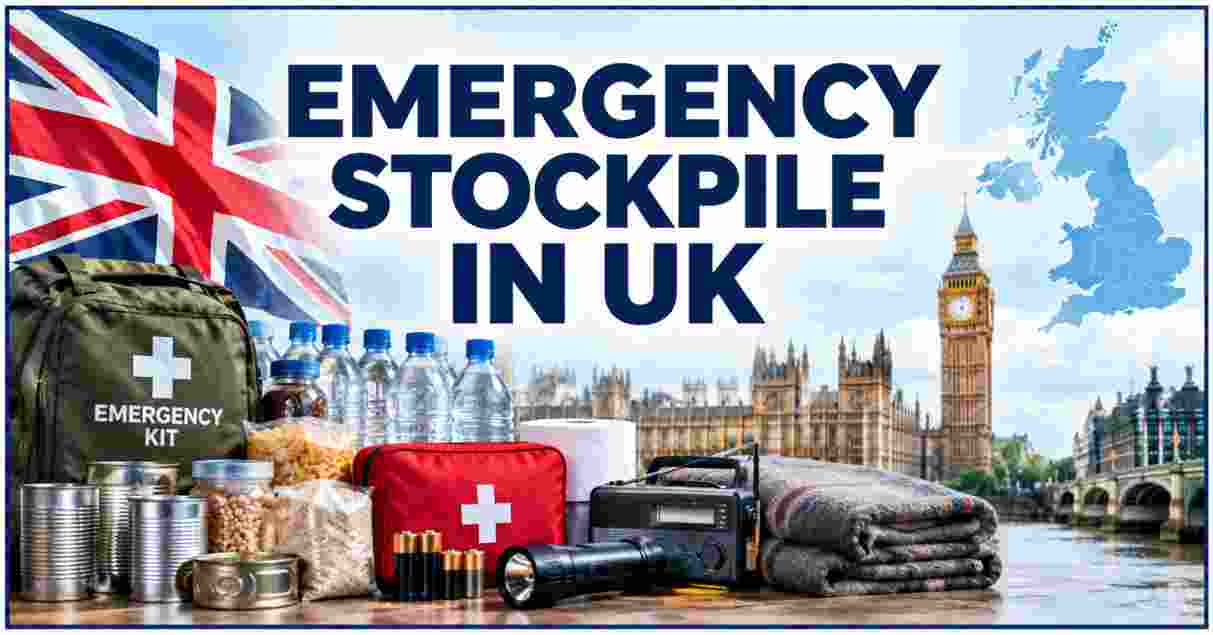
Emergency Stockpile in UK households should cover 3 days, according to the Be Ready campaign the Cabinet Office launched on 22 October 2026. The official checklist asks for 3 litres of drinking water per person per day (9 litres per person in total), non-perishable food for 3 days, a torch, a battery or wind-up FM radio, a charged power bank, cash and essential medicines.
Emergency Stockpile in the UK 2026 – Introduction
The Emergency Stockpile in UK debate changed on 22 October 2026. The Cabinet Office launched Be Ready, a 3-year campaign that asks every household to cope for 3 days if power, water, phones or the internet fail. The advice replaces the old GOV.UK Prepare website. Much of it stays the same, but the headline target is now clear: 3 days, the same figure used in France, Ireland and the Netherlands.
The government’s own research explains the push. Only 13% of UK adults feel their household is largely or totally prepared, and 82% hold less than a day of bottled water at the recommended rate. This report covers the official checklist, water and food quantities, the supplies households own, the risks behind the advice and the barriers that stop people preparing.
Interesting Fact(s) About Emergency Stockpile in UK 2026
How Prepared Do UK Adults Feel? (% of adults)
Largely or totally prepared  ███████  13
Moderately prepared          █████████████████  33
Slightly or not prepared     █████████████████████████  50
Don't know                   ██  3
| Fact | 2026 Data |
|---|---|
| Be Ready campaign launch | 22 October 2026 |
| Household supply target | 3 days |
| Drinking water per person per day | 3 litres |
| Water for a household of four | 36 litres |
| Adults feeling largely or totally prepared | 13% |
| Households with less than 1 day of bottled water | 82% |
| Households with 3 days of no-cook food | 60% |
| Organisations backing the campaign | More than 500 |
Source: Cabinet Office, Be Ready campaign (October 2026); UK Public Survey of Risk Perception, Resilience and Preparedness 2026
The 3-day target is the core of the advice. The government says being ready for 3 days helps households cope while support reaches the people who need it most. The checklist is not an order to hoard. It asks people to check their cupboards, note gaps and add an item or two on regular shopping trips.
The survey figures show the gap. Half of adults feel only slightly prepared or not prepared at all. Water is the weakest area, because 82% of households would run dry in under a day at 3 litres per person. Food looks stronger, with 60% holding 3 days of non-perishable food that needs no cooking.
Be Ready Campaign Launch for Emergency Stockpile in UK 2026 | Key Dates & Facts
Household Emergency Supply Target (days)
United Kingdom  ███  3
France          ███  3
Ireland         ███  3
Netherlands     ███  3
| Metric | 2026 Data |
|---|---|
| Launch date | 22 October 2026 |
| Campaign length | 3 years, first stage launched |
| Supply target | 3 days |
| Backing organisations | More than 500 |
| Website replaced | GOV.UK Prepare |
| Government household advice published since | May 2024 |
| Matching 3-day advice in other countries | France, Ireland, Netherlands |
Source: Cabinet Office and Security Minister Dan Jarvis (22 October 2026 announcement and written statement to Parliament)
The Cabinet Office describes Be Ready as the first stage of a 3-year campaign. It builds on advice published since May 2024, and the old Prepare website now redirects to the new one. Dan Jarvis, the Security Minister, links the advice to storms last winter and wildfires this summer. Social media and radio advertising will target families with young children and older people.
The government frames the advice as small steps, not a shopping spree. Joining the Priority Services Register costs nothing. Other steps aim to cost little. Research published alongside the launch shows 84% of people want the government to share more preparedness information.
3-Day Emergency Water Stockpile in UK 2026 | Litres per Person & Household Supplies
How Long Would Household Bottled Water Last at 3 Litres per Person per Day? (% of households)
Less than 1 day  ██████████████████████████████████████████  82
1 day            ████████████  10
3 days or more   █████  4
| Metric | 2026 Data |
|---|---|
| Drinking water per person per day | 3 litres |
| Drinking water per person for 3 days | 9 litres |
| Household of two, 3 days | 18 litres |
| Household of four, 3 days | 36 litres |
| Households holding under 1 litre | 35% |
| Households holding 3 litres or more | 37% |
| Households with under 1 day of water | 82% |
| Households with 3 days or more of water | 4% |
Source: Cabinet Office Be Ready checklist (October 2026); Cabinet Office UK Public Survey 2026 (10,791 adults, fieldwork 27 February to 11 May 2026)
The checklist asks for bottled water for 3 days at 3 litres per person per day for drinking. That equals 9 litres per person and 36 litres for a household of four. Cooking and washing need more. The old Prepare page gave no fixed figure, so the new number is a change worth noting. Babies, pets and anyone on medication add to the total needed.
Households fall well short. In the Cabinet Office survey, 35% hold under 1 litre of bottled water and 37% hold 3 litres or more. Measured against the 3-litre standard, 82% have under a day, 10% have 1 day and only 4% reach 3 days.
3-Day Emergency Food Supplies in UK 2026 | Non-Perishable Food Households Hold
Days of Non-Perishable Food at Home (% of households)
1 day               ███  7
3 days or more       ██████████████████████████████████████████  85
7 days or more      ████████████  25
3 days, no cooking  ██████████████████████████████  60
| Metric | 2026 Data |
|---|---|
| Households with 3 days of no-cook food | 60% (down from 66%) |
| Households with 3 or more days of non-perishable food | 85% |
| Households with 7 or more days | 25% |
| Households with only 1 day | 7% |
| Households with 3 days of non-refrigerated drinks | 40% |
| Households owning a camping stove | 19% |
| Households growing their own fruit or vegetables | 17% |
Source: Cabinet Office UK Public Survey 2026; Cabinet Office Be Ready checklist (October 2026)
The official list names tinned meat, fish or vegetables, dried fruit and nuts. It tells households to buy food they usually eat, so nothing goes to waste. Food should need no fridge and no cooking. That detail matters because 60% of households hold 3 days of food that meets it, down 6 points from 66% in 2025.
Read the 85% figure with care. That question did not say “no cooking”, so respondents may have counted dried pasta or rice that needs a hob. The 25% with 7 days or more show a solid minority already hold a deep buffer. Only 40% hold 3 days of non-refrigerated drinks, and only 19% own a camping stove.
Be Ready Checklist for Emergency Supplies in UK 2026 | Categories & Items
Checklist Items by Category (tick boxes)
Money and documents         ███  3
Light and warmth            ██  2
Communication               ██  2
Medical and health          ██  2
Baby products               ██  2
Water, food, hygiene, pets  █  1 each
| Category | Official Items | Tick Boxes |
|---|---|---|
| Water and food | Bottled water, non-perishable food | 2 |
| Hygiene | Hand sanitiser, wet wipes, bathroom products | 1 |
| Light and warmth | Torch with spare batteries; blankets, sleeping bags, warm clothing | 2 |
| Communication | Battery or wind-up FM radio; charged power bank | 2 |
| Money and documents | Cash and cards; document copies; phone numbers | 3 |
| Medical and health | First aid kit; essential medication | 2 |
| Baby and pets | Formula, nappies, wipes; pet food and water | 3 |
Source: Cabinet Office, Be Ready checklist (October 2026)
The checklist has 15 tick boxes across 9 categories. The government prefers torches to candles and warns that homes cool quickly once heating stops. It wants a radio that works without mains power, with news station frequencies written down. Cash should be a mix of coins and notes, because card payments and cash machines can fail.
Health items carry timing advice. Households should request repeat prescriptions up to 5 working days before they need them. For babies, ready-made formula is best because boiling water may not be possible. The government asks households to check their kit every 6 months for expiry dates, and to keep printed copies of passports, insurance details and instructions for medical equipment.
Emergency Supplies Households Own in UK 2026 | Torches, Radios, Power Banks & Cash
Emergency Items Held at Home (% of households)
Smoke detector    ██████████████████████████████████████  78
Hand sanitiser    ███████████████████████████████████  71
Cash (£10+ each)  ██████████████████████████████  60
Spare batteries   ██████████████████████████████  60
Power bank        ███████████████████████████  54
Torch (non-mains) ██████████████████████████  53
FM radio          ███████████  23
| Item | Households Holding It |
|---|---|
| Smoke detector | 78% |
| Hand sanitiser | 71% |
| Wet wipes | 68% |
| First aid supplies | 63% |
| Cash (£10 or more per person) | 60% |
| Spare batteries for radio or torch | 60% |
| Power bank | 54% |
| Battery, solar or wind-up torch | 53% |
| Battery, solar or wind-up FM radio | 23% |
Source: Cabinet Office UK Public Survey of Risk Perception, Resilience and Preparedness 2026
Common items sit at the top. 78% own a smoke detector, 71% own hand sanitiser and 68% own wet wipes. First aid supplies rose from 57% to 63%. Cash is held by 60%, though the survey counts only £10 or more per person. That is a low bar. The checklist leaves the amount to each family’s needs.
The radio is the weak point. Only 23% own an FM radio that runs without mains power, yet the government says phones, broadband and mobile networks can all fail together. Torches reach 53%, down 2 points on last year. Among people who take essential medicine, 76% hold at least 7 days of it.
How Prepared Are UK Households for an Emergency in 2026 | Cabinet Office Survey
How Long Could Households Meet Basic Needs in a Power, Gas and Water Cut? (% of adults)
1 day or less  ██████████████████████████  25
2 to 3 days    ██████████████████████████████████████████  41
6 days or more ████████████  12
| Indicator | 2026 Data |
|---|---|
| Household largely or totally prepared | 13% |
| Household moderately prepared | 33% |
| Household slightly or not at all prepared | 50% |
| Could cope 1 day or less | 25% (down from 32%) |
| Could cope 2 to 3 days | 41% |
| Could cope 6 days or more | 12% |
| Own a grab bag | 19% |
| Have none of the listed preparations | 21% |
| Have a household emergency plan | 14% |
Source: Cabinet Office UK Public Survey 2026 (10,791 adults, fieldwork 27 February to 11 May 2026)
Only 13% of adults call their household largely or totally prepared, unchanged from last year. Another 33% feel moderately prepared and 50% feel slightly or not at all prepared. Confidence in a combined power, gas and water cut is improving. The share expecting to last a day or less fell from 32% to 25%, while 41% expect 2 to 3 days.
Actions lag behind attitudes. 74% agree that effective actions exist, yet only 19% own a grab bag and 21% have taken none of the listed steps. Just 14% hold a household plan and 12% have agreed a meeting point. Fewer people recall seeing advice: 23% did so in the past year, up from 19%. Of those, 56% acted on it.
Risks Behind the Emergency Stockpile in UK 2026 | Storms, Power Cuts & Cyber Attacks
Emergencies Seen as Likely in Next 2 Years (% of adults)
Severe storm           ██████████████████████████████  51
Extreme cold           █████████████████████████████  46
Cyber attack on CNI    ██████████████████████████  42
Extreme heat           ██████████████████████████  42
Food supply disruption ██████████████████████████  42
Power cut of 3+ days   █████████████████████  35
War ██████████████████ 28| Risk | 2026 Data |
|---|---|
| Expect more emergencies in 10 years | 68% |
| Severe storm likely locally | 51% (down from 55%) |
| Extreme cold likely locally | 46% |
| Infrastructure cyber attack likely | 42% (up from 39%) |
| Food supply disruption likely | 42% |
| Power cut of 3 days or more likely | 35% |
| War likely to affect local area | 28% (up from 19%) |
| Terrorist attack likely | 25% (up from 20%) |
Source: Cabinet Office UK Public Survey 2026 (10,791 adults, fieldwork 27 February to 11 May 2026)
Most adults expect more trouble. 68% think emergencies will increase over the next 10 years. Weather tops the list, with 51% expecting a severe storm and 46% expecting extreme cold. A cyber attack on infrastructure, extreme heat and food supply disruption each reach 42%. A power cut lasting 3 days or more reaches 35%, which matches the length of the official target.
Security fears climbed fastest. War rose 9 points to 28%, and 68% of adults say war would hit them hard. Ministers have named severe weather and hostile-state action as reasons for the campaign.
Barriers to Building an Emergency Stockpile in UK 2026 | Cost, Waste & Community Support
What Stops UK Adults Preparing Further? (% of adults)
Not enough money       █████████████████████████████  29
Supplies may expire    █████████████████████████  25
Don't know enough      ███████████████████████  23
Stressful to think of  ███████████████████  19
No storage space       ██████████████████  18
No time                ███████████  11
| Barrier or Support | 2026 Data |
|---|---|
| Not enough money to spend | 29% |
| Do not want supplies to expire | 25% |
| Do not know enough about actions | 23% |
| No space to store supplies | 18% |
| Aware of Priority Services Register | 44% |
| Household registered for priority support | 38% |
| Willing to volunteer after an emergency | 71% |
| Have a neighbour who may need support | 48% |
Source: Cabinet Office UK Public Survey 2026 (10,791 adults, fieldwork 27 February to 11 May 2026)
Money is the biggest barrier at 29%, up from 27%. Households squeezed by bills will struggle to buy 36 litres of water in one trip, which is why the government says to build up gradually.
Community fills part of the gap. 71% would volunteer after an emergency and 62% expect their neighbourhood to pull together. 48% have a neighbour who may need help, up from 42%. The Priority Services Register is free, yet only 44% knew about it.
Household Emergency Plans, Grab Bags & Car Kits in UK 2026 | Preparedness Actions
Preparedness Actions Taken (% of adults)
Emergency contacts in phone  ████████████████████████  48
Items in car (car owners)    ██████████████████  35
Numbers written on paper     ███████████████  29
Grab bag                     ██████████  19
Household plan               ███████  14
Meeting point agreed         ██████  12
| Action | 2026 Data |
|---|---|
| Emergency contacts saved in mobile phone | 48% |
| Items kept in car in case of being stranded | 35% |
| Important numbers written on paper | 29% |
| Grab bag of essentials | 19% |
| Household emergency plan | 14% |
| Meeting point agreed with family or friends | 12% |
| Know how to turn off water, gas or electricity | 59% |
| Aware of Emergency Alerts service | 74% |
Source: Cabinet Office UK Public Survey 2026 (10,791 adults); Cabinet Office Be Ready guidance (October 2026)
The checklist covers a stockpile for sitting tight. The wider guidance also covers leaving fast. It suggests a spare grab bag of essentials, a printable household plan and a meeting point that is easy to find and open to the public. Only 19% own a grab bag, 14% hold a plan and 12% have agreed where to meet. The plan also records the power cut number, 105 in England, Scotland and Wales.
Cars need a kit too. The government suggests a torch, phone charger, warm clothes, blankets, high-visibility clothing, jump leads, food, drink and a snow shovel, and 35% of car owners already carry some of these items. Knowledge is stronger than kit. 59% know how to turn off their utilities, 74% know about Emergency Alerts and 48% store emergency contacts in their phone, which lets responders read them without a passcode.
Emergency Stockpile in UK 2026 FAQs
What is the emergency stockpile advice for UK households in 2026?
The Cabinet Office’s Be Ready campaign, launched on 22 October 2026, asks households to prepare for 3 days of disruption. It lists water, food, hygiene items, light, a radio, cash, medicines and baby and pet supplies. The advice is gradual and voluntary.
How much water should a UK household store in 2026?
The checklist says 3 litres of drinking water per person per day for 3 days, which is 9 litres per person. A household of four needs 36 litres. Cooking and washing need more.
What food should be in a 3-day emergency stockpile in 2026?
Choose food with a long shelf life that needs no fridge and no cooking. Examples are tinned meat, fish or vegetables, dried fruit and nuts. The government advises buying food you usually eat.
What items are on the 2026 Be Ready checklist?
The checklist has 15 tick boxes. They cover water, food, hygiene, a torch, warm clothing, an FM radio, a power bank, cash, document copies, first aid, medication, baby products and pet food.
Is the UK government telling people to stockpile in 2026?
The government asks for small, gradual steps, not panic buying. It wants households to check cupboards first, note gaps and add items during normal shopping. Some steps, such as the Priority Services Register, are free.
How many UK households are prepared for an emergency in 2026?
The Cabinet Office survey found 13% of adults feel largely or totally prepared. 33% feel moderately prepared and 50% feel slightly or not at all prepared.
How often should I check my emergency kit in 2026?
Set a reminder every 6 months. Check expiry dates, swap out items that need replacing and update the kit if your household’s needs have changed.
How early should I request prescriptions before an emergency in 2026?
The checklist says to request prescriptions up to 5 working days before you need your medicine. That leaves less chance of running out.
What is the Priority Services Register in 2026?
The Priority Services Register lets electricity, gas and water companies know you need extra support during a supply interruption. Signing up is free. Northern Ireland uses Customer Care Registers.
What should be in a grab bag in the UK in 2026?
The government says to keep essentials you would need if asked to leave quickly in a spare bag. Include medicines, document copies, a charger, cash, warm clothing and any baby or pet supplies. Only 19% of adults own one.
What should I keep in my car in winter 2026?
Pack a torch, in-car phone charger, warm clothes, blankets, high-visibility clothing, jump leads, food and drink, and a snow shovel. 35% of car owners already keep some of these items.
Disclaimer: The data research report we present here is based on information found from various sources. We are not liable for any financial loss, errors, or damages of any kind that may result from the use of the information herein. We acknowledge that though we try to report accurately, we cannot verify the absolute facts of everything that has been represented.