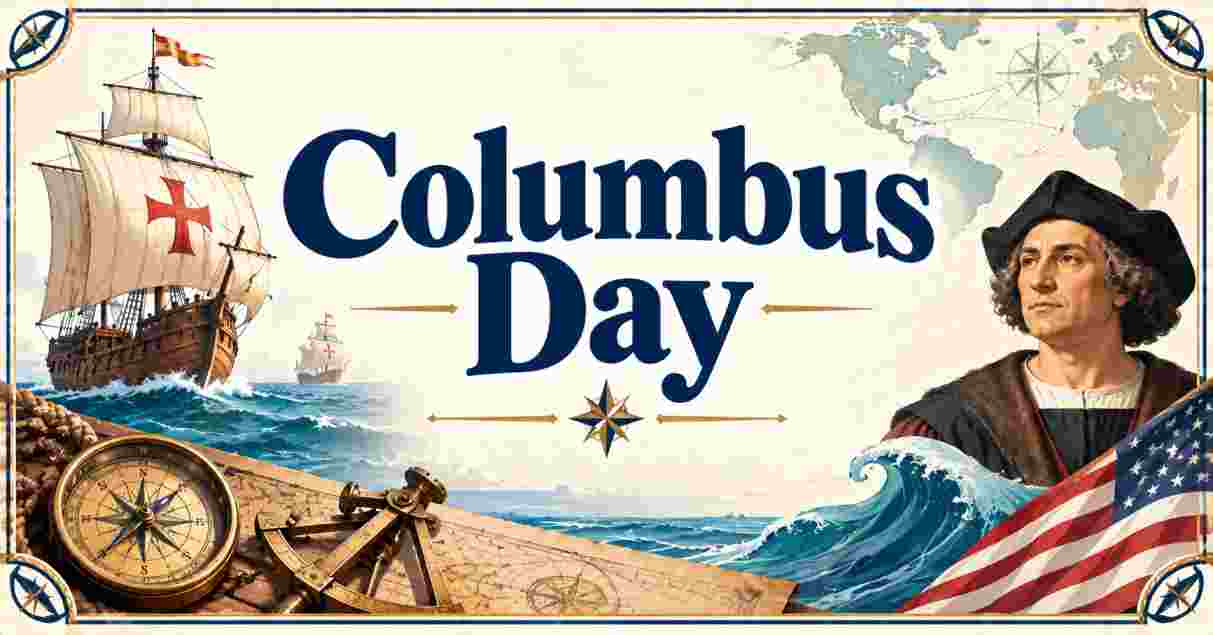
Columbus Day 2026 falls on Monday, October 12, 2026, the second Monday of the month, marking one of 11 permanent federal holidays observed by the US government. The date coincides exactly with the traditional anniversary of Columbus’s 1492 landfall, and it shares its calendar spot with Indigenous Peoples’ Day, now formally observed in 17 states and Washington, D.C.
Columbus Day 2026 – Introduction
Columbus Day 2026 lands on Monday, October 12, a date set by a fixed rule rather than a fixed number: the second Monday of every October, which can fall anywhere between October 8 and October 14 depending on the year. Columbus Day has been a federal holiday since 1937, when President Franklin D. Roosevelt signed it into law following a decades-long lobbying push by the Knights of Columbus, a Catholic fraternal organization founded in 1882. The holiday commemorates Christopher Columbus’s arrival in the Americas on October 12, 1492.
What makes Columbus Day 2026 notable beyond the ordinary calendar rotation is the growing overlap with Indigenous Peoples’ Day, a separate observance that many states, cities, and school districts now mark on the identical date. This report covers the federal holiday’s history, what closes and stays open, the state-by-state observance landscape, public opinion trends, and how communities across the country mark October 12 in 2026.
Both observances draw genuine, sincere public support from different communities for different reasons, and neither history cancels out the other. For Italian-American families, the day traces a century-long thread of heritage recognition that began well before the federal holiday existed. For Indigenous communities and their allies, the same date marks an opportunity to center a history that the original holiday never told. The sections below lay out the verified facts behind both traditions rather than arguing for one interpretation over the other.
Interesting Facts About Columbus Day 2026
| Fact | Detail |
|---|---|
| 2026 Date | Monday, October 12, 2026 |
| Federal Holiday Since | 1937 |
| Shifted to Second Monday | 1971, under the Uniform Monday Holiday Act of 1968 |
| Total Permanent Federal Holidays | 11 |
| States + D.C. Observing Indigenous Peoples’ Day | 17 |
| First State to Officially Celebrate Columbus Day | Colorado, 1907 |
| First City to Observe Indigenous Peoples’ Day | Berkeley, California, 1992 |
| Federally Recognized Native American Tribes | 574 |
Source: US Office of Personnel Management federal holiday schedule and state legislative records, 2026.
The Columbus Day 2026 facts above capture a holiday that has evolved considerably since its federal origins in the 1930s. What began as a single national commemoration of Columbus’s voyage has, over the past three decades, split into two parallel observances that share the same date but honor very different historical narratives. Both observances remain legally distinct: Columbus Day carries federal status nationwide, while Indigenous Peoples’ Day operates as a state or local designation.
That distinction matters practically. Federal offices, the US Postal Service, and the bond market all close for Columbus Day regardless of which name a particular city or state uses for the day, while Indigenous Peoples’ Day closures depend entirely on state and local government decisions. The 574 federally recognized Native American tribes represent the broader population whose history Indigenous Peoples’ Day was created to center.
Columbus Day 2026 – Date and Federal Holiday Status
Columbus Day Date Range by Year
2025  |████████████████████████████████████ Oct 13
2026  |████████████████████████████████ Oct 12
2027  |████████████████████████ Oct 11
2028  |████████████ Oct 9
| Year | Columbus Day Date |
|---|---|
| 2025 | October 13 |
| 2026 | October 12 |
| 2027 | October 11 |
| 2028 | October 9 |
| Legal Basis | 5 U.S.C. § 6103 |
Source: US Office of Personnel Management federal holiday calendar.
The October 12, 2026 date carries a small but notable coincidence: it lines up exactly with Columbus’s actual 1492 landfall date, something that only happens occasionally under the second-Monday formula. That formula, set by the Uniform Monday Holiday Act, guarantees Columbus Day always falls on a Monday, creating a reliable three-day weekend for federal employees regardless of which specific date it lands on in a given year.
Columbus Day’s federal status under 5 U.S.C. § 6103 puts it in the same legal category as Thanksgiving, Independence Day, and Veterans Day, meaning it isn’t subject to the state-by-state variation that governs many other commemorative days. That said, federal recognition doesn’t obligate any state, city, or private employer to close for the holiday, which is exactly why the open-and-closed picture across the country looks so different depending on where you live.
History and Origins of Columbus Day 2026
Columbus Day Timeline
1892  |████████████████ First presidential proclamation (Harrison)
1907  |██████████████████████ Colorado becomes first state to observe
1934  |████████████████████████████ FDR's first national proclamation
1937  |████████████████████████████████ Signed into federal law
1968  |████████████████████████████████████ Uniform Monday Holiday Act
1971  |████████████████████████████████████████ Moved to second Monday
| Year | Milestone |
|---|---|
| 1892 | President Benjamin Harrison issues the first Columbus Day proclamation |
| 1907 | Colorado becomes the first state to officially observe Columbus Day |
| 1934 | President Franklin D. Roosevelt proclaims the first national observance |
| 1937 | Columbus Day formally becomes a federal holiday |
| 1968 | Uniform Monday Holiday Act passed, shifting several holidays to Mondays |
| 1971 | Columbus Day observance moves to the second Monday in October |
Source: US National Archives records and state legislative history documentation.
Colorado’s role as the first state to formally observe Columbus Day traces back to a 1907 campaign led by Angelo Noce, an Italian immigrant who pushed the state legislature to recognize the day years before the federal government did. That early state-level push reflected the holiday’s original character as much a celebration of Italian-American heritage as of Columbus himself, a dual identity the holiday has carried ever since.
The Knights of Columbus played a decisive role in pushing the observance to the federal level in the 1930s, running a sustained letter-writing campaign that historians credit with helping secure Roosevelt’s 1937 signature. More than three decades later, the Uniform Monday Holiday Act of 1968 shifted Columbus Day away from its fixed October 12 date entirely, moving it to the second Monday in October starting in 1971 to guarantee federal workers a predictable three-day weekend. You can see how Native American history connects to the broader story behind this shift in this overview of Native Americans in the US, covering tribal history and heritage across the country.
President Benjamin Harrison’s original 1892 proclamation predates the federal holiday by 45 years and was tied specifically to the 400th anniversary of Columbus’s voyage, framed at the time as a one-time national commemoration rather than a recurring annual observance. It took Roosevelt’s 1934 proclamation, followed by the 1937 statutory holiday, to turn what had been an occasional, anniversary-driven observance into the fixed annual fixture Americans recognize today.
What’s Open and Closed on Columbus Day 2026
Columbus Day 2026 Closures
Federal Offices     |████████████████████████████████████████ Closed
Banks / Fed Reserve |████████████████████████████████████████ Closed
USPS                |████████████████████████████████████████ Closed
NYSE / Nasdaq       |██ Open (normal session)
Bond Market         |████████████████████████████████████████ Closed
UPS / FedEx         |███ Normal operations
| Institution | Status on Columbus Day 2026 |
|---|---|
| Federal offices | Closed |
| Banks and Federal Reserve | Closed |
| USPS | Closed, no regular mail delivery |
| NYSE and Nasdaq | Open, full normal session, 9:30 AM–4:00 PM ET |
| Bond market | Closed, per SIFMA recommended schedule |
| UPS and FedEx | Normal operations |
| Most public schools | Closed |
Source: New York Stock Exchange, Federal Reserve, and USPS 2026 holiday schedules.
The stock market’s decision to stay open on Columbus Day sets it apart from nearly every other federal holiday on the calendar. Columbus Day and Veterans Day are the only two dates each year when equities trade a full normal session while the bond market closes entirely, a divergence that has held for decades and that catches some investors off guard every October. Banks, by contrast, follow the Federal Reserve’s closure schedule exactly, meaning wire transfers and ACH processing pause for the day even though stock trades settle normally.
The USPS closure carries its own carve-out: while regular mail delivery stops completely, Priority Mail Express continues on its normal delivery schedule since it operates under separate service guarantees. Private carriers UPS and FedEx don’t observe Columbus Day at all, running full operations, which makes the holiday one of the more fragmented closure days on the entire federal calendar once you account for financial markets, shipping, and government services separately.
Indigenous Peoples’ Day and State Observance Statistics 2026
State Observance Categories, 2026
Replaced Columbus Day Entirely  |████████████████████████████████████ 9 states + D.C.
Observe Both Holidays           |██████████████████████████████ 6+ states
No State-Level Observance       |████████████████ Remaining states
| Category | States |
|---|---|
| Replaced Columbus Day with Indigenous Peoples’ Day | Alaska, Hawaii, Maine, New Mexico, Oregon, South Dakota (as Native Americans’ Day), Vermont, Wisconsin, D.C. |
| Observe both holidays | Montana, Nebraska, Ohio, Pennsylvania, Rhode Island, Alabama |
| First state-level Native American observance | South Dakota, 1990 |
| First city observance | Berkeley, California, October 12, 1992 |
| Roots of the modern movement | 1977 UN International NGO Conference on Discrimination Against Indigenous Populations, Geneva |
Source: State legislative records and Indigenous Peoples’ Day historical documentation compiled from state government sources.
South Dakota holds a unique place in this history as the first state to formally recognize a Native American-focused holiday on the second Monday in October, establishing “Native Americans’ Day” in 1990 under Governor George S. Mickelson. Berkeley, California followed two years later, becoming the first US city to officially observe Indigenous Peoples’ Day on October 12, 1992, a date deliberately chosen to coincide with the 500th anniversary of Columbus’s landfall. This overview of Native American tribes in Michigan offers additional context on tribal heritage at the state level, complementing the national observance patterns tracked here.
The movement’s roots reach back even further, to a 1977 United Nations conference in Geneva where delegates representing roughly 50 Indigenous nations proposed October 12 as an international day of solidarity. Nearly two decades later, in 2021, President Biden became the first US president to issue a formal presidential proclamation recognizing Indigenous Peoples’ Day, a practice repeated in 2022, 2023, and 2024, even though the day has never received the statutory federal holiday status that Columbus Day retains.
States that recognize both holidays simultaneously, rather than choosing one over the other, represent a distinct middle path in this landscape. Montana, Nebraska, Ohio, Pennsylvania, Rhode Island, and Alabama all maintain Columbus Day’s traditional status while also formally acknowledging Indigenous Peoples on the same date, an approach that avoids the binary choice other states have made and instead treats the two observances as complementary rather than competing. Advocacy for a federal Indigenous Peoples’ Day Act has continued in Congress in recent years, though as of the 2026 observance, no such legislation has passed to grant the day the same statutory status Columbus Day holds.
Public Opinion Polling on Columbus Day 2026
Approval of Celebrating Each Holiday (YouGov, Oct 2024)
Indigenous Peoples' Day  |███████████████████████████ 54%
Columbus Day             |██████████████████████ 44%
| Poll | Finding |
|---|---|
| YouGov (Oct. 2024) | 54% approve celebrating Indigenous Peoples’ Day; 44% approve Columbus Day |
| YouGov, disapproval rates | 23% disapprove of Columbus Day; only 5% disapprove of Indigenous Peoples’ Day |
| Knights of Columbus/Marist | Americans support Columbus Day observance by nearly a 2-to-1 margin |
| College Pulse (college students) | 79% support replacing Columbus Day with Indigenous Peoples’ Day |
| Familiarity with Indigenous Peoples’ Day | 55% say they are not very familiar with or have never heard of it |
Source: YouGov national survey (October 2024), Knights of Columbus/Marist Poll, and College Pulse survey data.
Public opinion on this topic varies significantly depending on which poll, population, and specific question researchers use, and the results reflect real division rather than a clear national consensus. The YouGov survey, conducted among a nationally representative sample of adults, found meaningfully higher approval for celebrating Indigenous Peoples’ Day than Columbus Day, along with far less disapproval directed at the newer observance. A separate poll commissioned by the Knights of Columbus and conducted by Marist found the opposite lean, with Americans favoring Columbus Day’s continued observance by close to a 2-to-1 margin.
Age and institutional context shape these results considerably. The College Pulse survey of college students found overwhelming support, 79%, for replacing Columbus Day with Indigenous Peoples’ Day entirely, a much stronger preference than seen in general-population polling. Several surveys also found that a majority of Americans, 55% in YouGov’s sample, report being unfamiliar with Indigenous Peoples’ Day altogether, suggesting public opinion on the topic may continue shifting as awareness of the newer observance grows across different age groups and regions. For a broader look at the demographic groups connected to these observances, this overview of Hispanic population statistics covers another community with a historical stake in how October 12 gets recognized nationally.
Columbus Day Events and Traditions 2026
Common October 12 Observances
Parades (NYC, Denver, others)     |████████████████████████████████ Columbus Day
Italian Heritage Celebrations     |████████████████████████████ Columbus Day
Indigenous Cultural Events        |████████████████████████████████████ Indigenous Peoples' Day
School Closures/Curriculum Days   |██████████████████████ Varies by district
| Tradition | Where It Happens |
|---|---|
| Columbus Day parade | New York City hosts one of the nation’s largest |
| Italian-American heritage events | Communities nationwide, tied to the holiday’s origins |
| Indigenous Peoples’ Day ceremonies | Cities and states observing the alternate designation |
| School district observances | Vary widely; some hold class, others mark the day differently |
| Denver-area events | Historically a flashpoint for both Columbus Day and counter-observances |
Source: Municipal event calendars and news coverage of 2025-2026 October 12 observances.
New York City’s Columbus Day parade remains one of the largest and most visible Italian-American cultural events tied to the holiday, continuing a tradition that predates the federal holiday itself. For many Italian-American families and organizations, the second Monday of October functions as a heritage day first and a Columbus commemoration second, with parades serving as the public face of a broader cultural identity built around the holiday over more than a century.
Indigenous Peoples’ Day observances take a markedly different form, typically centering cultural events, educational programming, and ceremonies organized by tribal nations and Indigenous community groups rather than parades. Denver, Colorado has historically served as a flashpoint where both traditions visibly intersect, given Colorado’s status as the first state to observe Columbus Day, making it a recurring site of both celebration and counter-observance activity each October.
School districts nationwide handle the day with considerable inconsistency, and that variation is itself worth noting for parents planning around the long weekend. Some districts close entirely and use the day as a curriculum-focused observance covering Indigenous history, others hold regular classes since the district doesn’t recognize either holiday as a day off, and still others close for Columbus Day specifically without addressing Indigenous Peoples’ Day content at all. Checking a specific school district’s academic calendar remains the only reliable way to know which approach applies locally, since neither the federal government nor most states mandate a single uniform policy for public education.
Frequently Asked Questions About Columbus Day 2026
What day is Columbus Day 2026?
Columbus Day 2026 falls on Monday, October 12, 2026.
Is Columbus Day a federal holiday?
Yes. Columbus Day has been a federal holiday since 1937 and is one of 11 permanent federal holidays observed nationwide under 5 U.S.C. § 6103.
Is the stock market open on Columbus Day 2026?
Yes. The NYSE and Nasdaq trade a full, normal session on Columbus Day, though the bond market remains closed.
Are banks open on Columbus Day 2026?
No. Banks and the Federal Reserve are closed on Columbus Day, though ATMs and online banking remain available.
Is mail delivered on Columbus Day 2026?
No. USPS suspends regular mail delivery nationwide, though Priority Mail Express continues on its normal delivery schedule since it operates under separate service guarantees.
How many states observe Indigenous Peoples’ Day instead of Columbus Day?
Nine states plus Washington, D.C. have fully replaced Columbus Day with Indigenous Peoples’ Day, including Maine, Vermont, New Mexico, and Oregon, while several others recognize both holidays on the same date.
Which state first observed Columbus Day?
Colorado became the first state to officially observe Columbus Day in 1907, following a campaign led by Italian immigrant Angelo Noce nearly three decades before the federal holiday existed.
Which city first observed Indigenous Peoples’ Day?
Berkeley, California became the first US city to officially observe Indigenous Peoples’ Day, on October 12, 1992, timed to coincide with the 500th anniversary of Columbus’s arrival.
Do Americans support Columbus Day or Indigenous Peoples’ Day more?
Polling results vary by source: a 2024 YouGov survey found more approval for Indigenous Peoples’ Day (54%) than Columbus Day (44%), while a separate Knights of Columbus/Marist poll found stronger overall support for Columbus Day, illustrating how differently the two questions get answered depending on the survey population and methodology.
Why does Columbus Day fall on a different date every year?
Since 1971, Columbus Day has been observed on the second Monday of October rather than a fixed date, so it can fall anywhere between October 8 and October 14 depending on the year.
Does Columbus Day always coincide with Indigenous Peoples’ Day?
Yes, in every jurisdiction that observes Indigenous Peoples’ Day. Because both fall on the second Monday of October, the two observances share the identical calendar date every year, including October 12, 2026, even though they are legally distinct designations.
Disclaimer: The data research report we present here is based on information found from various sources. We are not liable for any financial loss, errors, or damages of any kind that may result from the use of the information herein. We acknowledge that though we try to report accurately, we cannot verify the absolute facts of everything that has been represented.