Anti-Inflammatory Diet Meal Plans in US 2026
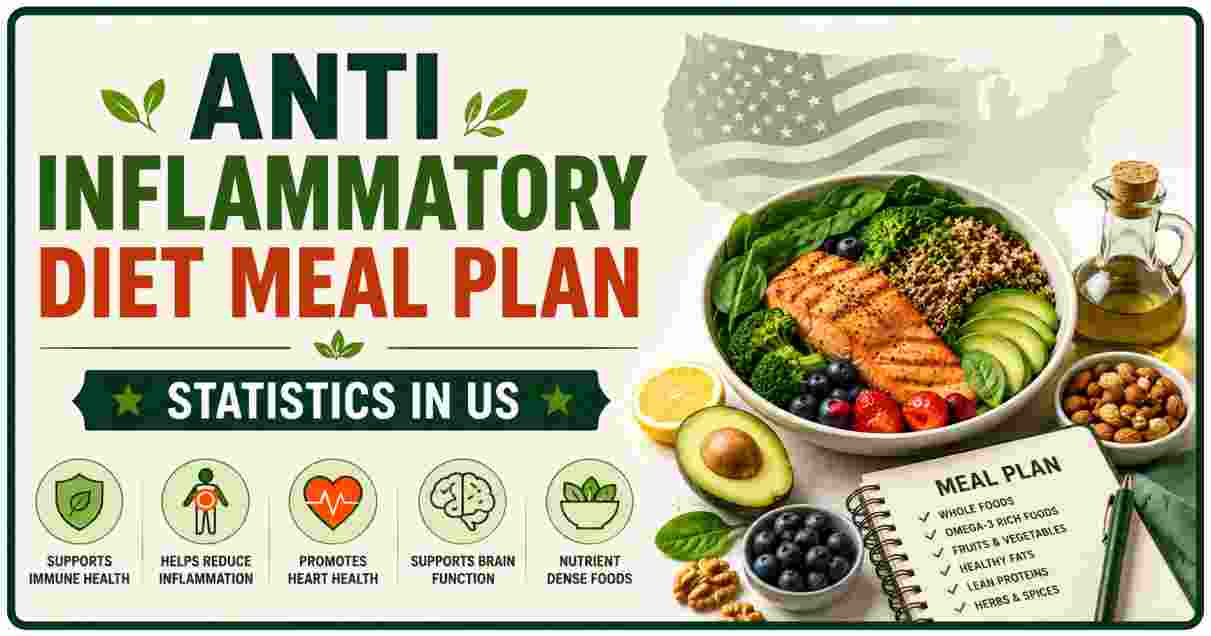
Anti-inflammatory diet meal plans in US 2026 have moved firmly from a niche wellness trend into one of the fastest-growing functional food categories tracked by the American food industry. Consumer data shows anti-inflammatory positioning on food and beverage products has grown 70% in the past year alone, outpacing even the surging gut-health category, which is up 44%. This growth is not happening in isolation: it reflects a broader shift among American shoppers who are, according to food-trend analytics firm Tastewise, 8.3 times more likely to actively follow a specific eating pattern like anti-inflammatory or keto than to prioritize general recovery nutrition.
Behind this consumer shift sits a genuine and sizable health burden that anti-inflammatory eating is marketed to address: more than 53 million US adults live with diagnosed arthritis, and chronic, low-grade inflammation is now understood to be a contributing factor across heart disease, diabetes, autoimmune disorders, and metabolic syndrome. This article compiles the newest verified numbers on anti-inflammatory food trends, supplement and meal-kit market size, and how leading US health authorities rank anti-inflammatory diets, using data confirmed as of mid-2026.
Key Facts and Latest Anti-Inflammatory Diet Statistics in US 2026
| Fact | Figure (Latest Verified Data) |
|---|---|
| Growth in anti-inflammatory food positioning (past year) | +70% |
| US adults with diagnosed arthritis | 53.2 million (21.2%) |
| Consumers following a specific diet vs. prioritizing recovery nutrition | 8.3x more likely |
| US Dietary Supplements for Inflammation Market (2022) | $19.05 billion |
| Projected market size by 2027 | $32.86 billion (11.7% CAGR) |
| Turmeric/curcumin supplement sales growth | +30% |
| Experts recommending the Mediterranean diet for chronic disease (2026 panel) | 69% |
| Mediterranean diet’s rating for inflammation (U.S. News, out of 5) | 4.7 |
Source: Tastewise, “2026 Food Trends USA,” May 2026; CDC, “Prevalence of Diagnosed Arthritis,” National Health Interview Survey; Allied Market Research, “U.S. Dietary Supplements for Inflammation Market,” 2026; U.S. News & World Report, “Best Diets 2025/2026” rankings.
The 70% growth in anti-inflammatory food positioning over just the past year stands out even against a food industry already saturated with functional health claims, and it specifically outpaces broader wellness categories like gut health (+44%) and metabolism-focused products (+61%), suggesting inflammation has become the most specific and commercially resonant functional claim brands can currently make to US consumers. That precision matters: Tastewise’s research explicitly found that broad wellness language is underperforming while precise functional language is winning, meaning “anti-inflammatory” succeeds specifically because it names a mechanism rather than a vague health outcome.
With 53.2 million US adults already carrying a diagnosed arthritis condition, a disease closely tied to chronic inflammation, and a 69% expert consensus favoring the Mediterranean diet, which earned a 4.7 out of 5 rating specifically for inflammation in U.S. News’s most recent Best Diets rankings, the anti-inflammatory eating trend has real clinical backing behind its commercial momentum. That combination of genuine chronic disease prevalence and credible expert endorsement helps explain why this category has grown into a multi-billion-dollar supplement and food market rather than remaining a passing social media trend.
Chronic Inflammation and Related Disease Prevalence Statistics in US 2026
| Condition | US Prevalence |
|---|---|
| Diagnosed arthritis (all adults) | 53.2 million (21.2%) |
| Arthritis among adults with disability | 54.8% (12.3 million) |
| Estimated additional undiagnosed arthritis cases | Up to 37 million |
| Autoimmune disease (any type) | 15.4 million (4.6%) |
| Most prevalent autoimmune condition | Rheumatoid arthritis-related, ~10.6 million affected |
| Musculoskeletal-condition lost work days annually | 364 million days (10 per worker) |
| Share of arthritis patients without treatment insurance coverage | 46% |
Source: CDC, “Prevalence of Diagnosed Arthritis — United States, 2019–2021”; CDC, National Health Interview Survey 2022; SingleCare, “Arthritis Statistics,” April 2026; Mayo Clinic Journal of Clinical Investigation autoimmune disease study, 2024-2025.
US Chronic Inflammatory Condition Burden
Diagnosed arthritis         53.2 million (21.2% of adults)
Possible undiagnosed cases  up to 37 million additional
Autoimmune disease          15.4 million (4.6% of population)
The gap between 53.2 million diagnosed arthritis cases and an estimated 37 million additional undiagnosed cases suggests the true scope of chronic joint inflammation in the United States could be considerably larger than headline prevalence figures alone convey, a gap that likely reflects both mild, unreported symptoms and unequal access to the diagnostic testing needed to formally confirm a case. With 15.4 million Americans carrying at least one diagnosed autoimmune condition, a category of disease defined by the immune system’s own inflammatory response attacking healthy tissue, the total population living with some form of chronic inflammatory burden extends well beyond arthritis alone.
The 364 million lost workdays annually attributed to musculoskeletal conditions, an average of 10 days per affected worker, translates chronic inflammation from a purely clinical statistic into a measurable economic burden that touches employers and the broader economy, not just individual patients. With 46% of arthritis patients lacking insurance coverage for their treatment or care, dietary and lifestyle interventions like anti-inflammatory eating patterns carry particular appeal as a lower-cost, self-directed complement to medical treatment that patients can pursue without waiting on insurance approval or specialist referrals.
Anti-Inflammatory Food Trend and Consumer Demand Statistics in US 2026
| Trend Metric | Growth (Year-over-Year) |
|---|---|
| Anti-inflammatory positioning (food/beverage claims) | +70% |
| Gut health claims | +44% |
| Metabolism-related motivations | +61% |
| Anti-bloat positioning | +98% |
| Probiotic mentions | +69% |
| Fermentation mentions | +95% |
| Magnesium as an ingredient | +62% |
| Coconut water | +38% |
Source: Tastewise, “2026 Food Trends USA: Data-Driven Market & Consumer Insights,” May 2026.
Fastest-Growing Functional Food Claims in the US (2026)
Anti-bloat positioning       +98%
Fermentation mentions        +95%
Probiotic mentions           +69%
Anti-inflammatory claims     +70%
Metabolism motivations       +61%
While anti-bloat positioning’s 98% growth and fermentation mentions climbing 95% technically outpace anti-inflammatory claims in raw percentage terms, food industry analysts note these categories are increasingly converging rather than competing, since fermented, probiotic-rich foods are frequently marketed simultaneously for both gut health and anti-inflammatory benefits. This overlap reflects a genuine shift in how brands build product positioning: rather than choosing a single functional claim, companies are layering complementary claims, gut health, anti-inflammatory, and anti-bloat, onto the same products to capture multiple consumer motivations at once.
Magnesium’s 62% growth as a called-out ingredient is a particularly telling data point, since magnesium is not traditionally marketed with the same consumer awareness as omega-3s or turmeric, yet its rise alongside anti-inflammatory positioning suggests brands and consumers are increasingly researching and acting on more specific, less mainstream nutritional science. Tastewise’s finding that these are “proven ingredients that have not yet been fully claimed in the functional positioning space” indicates the anti-inflammatory food category still has considerable room to expand into ingredients that have not yet been marketed to their full commercial potential.
Anti-Inflammatory Supplement Market Statistics in US 2026
| Supplement Metric | Figure |
|---|---|
| U.S. Dietary Supplements for Inflammation Market (2022) | $19.05 billion |
| Projected market size (2027) | $32.86 billion |
| Market CAGR (2023–2027) | 11.7% |
| Turmeric/curcumin supplement sales growth | +30% |
| US adults regularly taking garlic supplements | ~8% |
| Herbal/botanical supplement sales (2020, all categories) | $9.6 billion |
| US adults taking a daily multivitamin | 50%+ |
Source: Allied Market Research, “U.S. Dietary Supplements for Inflammation Market,” 2026 press release; Market.us, “Dietary Supplements Statistics and Facts,” February 2026.
If you’re curious how these supplement trends compare with broader collagen and joint-support product growth, the Meal Replacement Statistics in US report offers relevant context on how Americans are restructuring daily nutrition habits more broadly.
US Dietary Supplements for Inflammation Market Growth
2022                 ▓▓▓▓▓▓▓▓▓▓▓▓ $19.05B
2027 (projected)     ▓▓▓▓▓▓▓▓▓▓▓▓▓▓▓▓▓▓▓▓ $32.86B
The projected 73% growth in the US inflammation-focused supplement market, from $19.05 billion in 2022 to $32.86 billion by 2027, reflects sustained demand driven partly by an aging population more prone to arthritis and joint issues, and partly by younger consumers proactively seeking preventive, food-and-supplement-based approaches to long-term health rather than waiting for a diagnosis. Turmeric and curcumin specifically posting 30% sales growth stands out as one of the clearest single-ingredient success stories in this category, since curcumin’s anti-inflammatory properties have been extensively studied and are now widely recognized by mainstream consumers, not just wellness enthusiasts.
With more than half of US adults already taking a daily multivitamin, the baseline consumer habit of routine supplementation is already deeply established, making inflammation-specific add-ons like turmeric, omega-3s, and magnesium a comparatively easy upsell for supplement brands rather than requiring consumers to adopt an entirely new health behavior. The $9.6 billion in herbal and botanical supplement sales recorded in 2020 provides useful context for how large the broader category anti-inflammatory supplements sit within actually is, showing this is a mature, well-established market rather than an emerging niche.
Meal Kit and Meal Plan Delivery Market Statistics in US 2026
| Market Metric | Figure |
|---|---|
| US meal kit delivery market size (2026) | $14.59 billion (Mordor Intelligence estimate) |
| Projected US market size (2031) | $21.29 billion (7.84% CAGR) |
| Global meal kit market alternative estimate (2026) | $22.65 billion (Fortune Business Insights) |
| US shoppers planning to prepare more meals at home | 50%+ |
| Americans eating dinner at home with others daily | 1 in 3+ |
| Non-vegetarian meal kit segment market share (2025) | 61.2% |
| Online platform share of meal kit orders (2025) | 64.5% |
Source: Mordor Intelligence, “US Meal Kit Delivery Services Market,” January 2026; Food Industry Association (FMI), 2025 consumer data; Fortune Business Insights, “Meal Kit Delivery Services Market,” June 2026.
For a detailed breakdown of what these anti-inflammatory-friendly meal plans actually cost consumers per delivery, the Average Cost of Meal Kits in US report compares pricing across major services.
US Meal Kit Delivery Market Growth
2026 (current)         $14.59 billion
2031 (projected)       $21.29 billion
The notable variance between different market research firms’ meal kit sizing estimates, $14.59 billion versus $22.65 billion for essentially the same 2026 period, reflects a common challenge across the meal-kit and functional-food industry: different firms define “meal kit” differently, with some including only fully pre-portioned ingredient kits and others folding in ready-to-heat meal delivery and broader grocery-adjacent subscription services into the same category. Regardless of which specific figure proves most accurate, all major research firms agree on the underlying growth direction, with most projecting CAGRs between 7% and 8.5% through the early 2030s.
The finding that more than half of US shoppers plan to prepare more meals at home, per 2025 Food Industry Association data, aligns directly with anti-inflammatory eating’s emphasis on whole, minimally processed ingredients, since home preparation gives consumers direct control over the oils, seasonings, and food quality that dietary guidance for inflammation consistently emphasizes. With the non-vegetarian segment holding 61.2% of the meal kit market, anti-inflammatory-positioned meal kits emphasizing fish, olive oil, and lean proteins, core Mediterranean diet staples, appear well-positioned to capture a meaningful share of this already-dominant segment rather than needing to build an entirely new plant-based category from scratch.
Best-Ranked Anti-Inflammatory Diets Statistics in US 2026
| Diet | U.S. News Rating (Inflammation Category, out of 5) |
|---|---|
| Mediterranean diet | 4.7 |
| Dr. Weil’s Anti-Inflammatory Diet | Top expert-recommended (specific score not separately published) |
| Flexitarian diet | Top expert-recommended (specific score not separately published) |
| DASH diet (comparison, high blood pressure category) | 4.9 |
| MIND diet (comparison, brain health category) | 4.7 |
| Experts recommending Mediterranean diet overall (2026 panel) | 69% |
| Experts recommending plant-based diet as runner-up | 20% |
Source: U.S. News & World Report, “Best Diets 2025/2026” rankings, released January 2025 and updated 2026; U.S. News Health, “Expert-Recommended Diets for Inflammation.”
For readers managing a specific inflammatory joint condition rather than general wellness goals, the Arthritis Statistics in the U.S report offers additional context on prevalence, age patterns, and diagnosis trends tied directly to this dietary category’s core audience.
U.S. News Best Diets: Inflammation Category Leaders
Mediterranean diet     ▓▓▓▓▓▓▓▓▓▓▓▓▓▓▓▓▓▓▓▓▓▓▓ 4.7/5
DASH diet (comparison) ▓▓▓▓▓▓▓▓▓▓▓▓▓▓▓▓▓▓▓▓▓▓▓▓ 4.9/5
The Mediterranean diet’s 4.7-out-of-5 rating specifically in U.S. News’s inflammation category, one of 12 new categories the publication added to its rankings alongside gut health, arthritis, and fatty liver, reflects a deliberate editorial recognition that inflammation has become significant enough as a public health concern to warrant its own dedicated diet ranking rather than being folded into general “healthy eating” scores. That the same diet also topped the overall rankings for an eighth consecutive year underscores that its anti-inflammatory benefits are not treated as a separate, niche strength but as one pillar of a broader, consistently validated health profile.
Dr. Weil’s Anti-Inflammatory Diet and the flexitarian diet rounding out U.S. News’s top expert recommendations specifically for inflammation, alongside the Mediterranean diet, shows a clear pattern: all three emphasize whole plant foods, healthy fats, and reduced processed food intake rather than eliminating entire food groups, a structural similarity that nutrition experts increasingly argue matters more for reducing inflammation than any single diet’s specific brand name or marketing. With 69% of the expert panel backing the Mediterranean diet overall and a further 20% favoring a plant-based approach, roughly 9 in 10 nutrition experts are functionally recommending the same whole-food, anti-inflammatory-aligned eating pattern, even when they describe it using different diet names.
Anti-Inflammatory Diet Adoption and Consumer Behavior Statistics in US 2026
| Behavior Metric | Figure |
|---|---|
| Consumers 8.3x more likely to follow a specific diet vs. prioritize recovery nutrition | Tastewise, 2026 |
| Expert consensus: fiber intake as top chronic-disease recommendation | 38% |
| Expert consensus: Mediterranean diet as most effective approach | 69% |
| Consumer goal shift | From weight loss to “optimization” |
| Top brain-health-associated ingredient (2026) | Blueberries (surpassing matcha and turmeric) |
| US consumers actively seeking fermented, anti-bloat food formats | Rising across both food and beverage categories |
Source: Tastewise, “Healthy Food Trends In 2026” and “2026 Food Trends USA”; US News Health, “Top Health and Nutrition Trends for 2026,” January 2026.
The shift Tastewise identifies from weight loss to “optimization” as the primary motivation behind diets like anti-inflammatory eating marks a meaningful change in how Americans frame their relationship with food, moving away from restrictive, deprivation-based dieting language toward a performance and longevity-oriented mindset. This reframing helps explain why anti-inflammatory eating has proven more commercially durable than many prior diet trends: framing food choices around reducing inflammation and supporting long-term function appeals to a broader, less weight-focused audience than diets explicitly built around calorie restriction.
The 38% of experts citing fiber intake as the single most important chronic-disease nutrition recommendation for 2026, even ahead of anti-inflammatory-specific advice, suggests that within the broader functional nutrition conversation, fiber and anti-inflammatory eating are increasingly viewed as complementary rather than competing priorities, since high-fiber whole foods, legumes, vegetables, and whole grains, are also core components of virtually every top-ranked anti-inflammatory diet. With blueberries overtaking both matcha and turmeric as the top ingredient consumers now associate with brain health, the anti-inflammatory food conversation in 2026 appears to be broadening beyond its original heart-and-joint-health framing into cognitive and long-term brain function territory as well, a sign the category continues finding new health narratives to attach to the same underlying whole-food nutritional science.
Disclaimer: The data research report we present here is based on information found from various sources. We are not liable for any financial loss, errors, or damages of any kind that may result from the use of the information herein. We acknowledge that though we try to report accurately, we cannot verify the absolute facts of everything that has been represented.