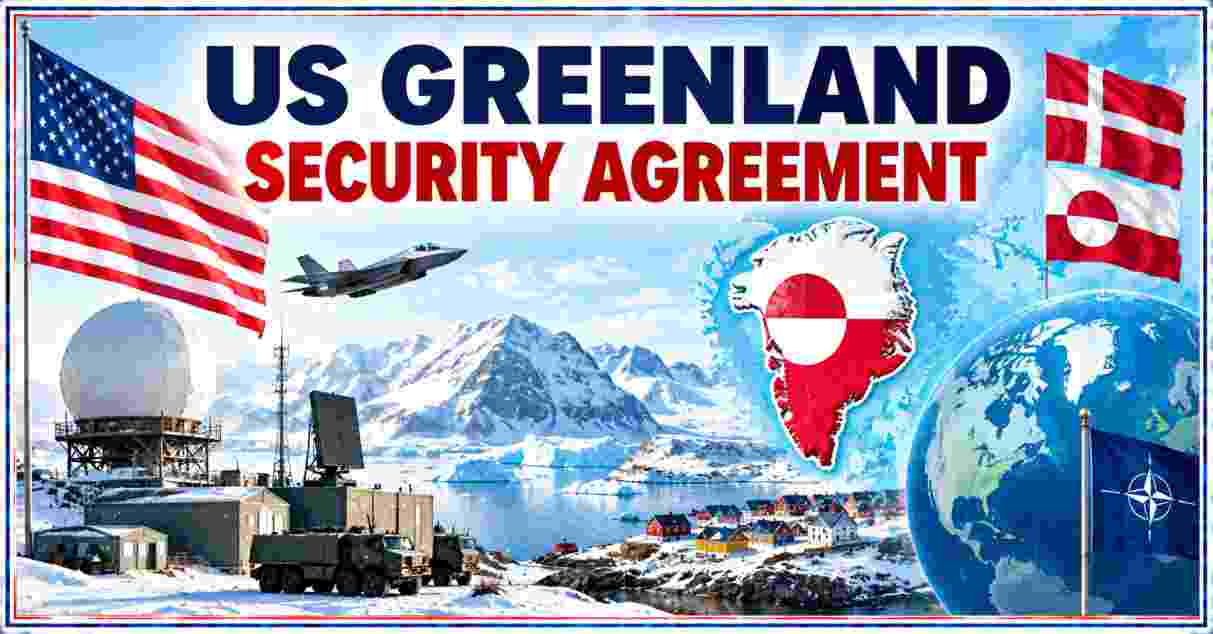
The United States, Denmark, and Greenland announced a security agreement on September 18, 2026 granting Washington permanent access, basing, and overflight rights across Greenland, while leaving Danish sovereignty over the Arctic territory unchanged. The deal bans non-NATO countries from building bases there and explicitly guarantees China and Russia cannot establish a military presence on the island.
US Greenland Security Agreement 2026 – Introduction
The US Greenland security agreement announced on September 18, 2026 marks the resolution, at least for now, of a standoff that had simmered since the start of the year, when President Trump repeatedly threatened to take control of the Arctic island by force. Trump announced the deal via Truth Social, describing it as giving the United States “permanent control over security, and all other needs, in Greenland,” while a State Department official clarified the arrangement grants permanent access, basing, and overflight rights rather than territorial ownership. Secretary of State Marco Rubio called it a “historic deal” that would place Greenland “forever” within North America’s strategic defense area.
This report breaks down the US Greenland security agreement in 2026 across every dimension currently known: what the deal actually grants versus what it does not, the existing American military footprint at Pituffik Space Base, the year-long diplomatic path that led here from Trump’s earlier threats, Greenland’s rare earth mineral significance, the Russian and Chinese Arctic military buildup driving US urgency, and how this arrangement compares to America’s other major overseas basing relationships. Because the agreement was announced through a presidential social media post rather than a signed and published treaty text, this report is careful to separate confirmed details from what remains pending formal signature and Danish parliamentary approval.
Interesting Facts About the US Greenland Security Agreement in 2026
| Statistic | 2026 Data |
|---|---|
| Agreement Announcement Date | September 18, 2026 |
| Parties Involved | United States, Denmark, Greenland |
| Does the Deal Transfer Sovereignty? | No — Denmark retains sovereignty |
| Agreement Expiry Date | None specified — no expiration date |
| Applies If Greenland Becomes Independent? | Yes, per State Department official |
| Formal Signing Expected | The following week (week of Sept 21, 2026) |
| Requires Parliamentary Approval? | Yes, before taking legal effect |
| Current US Personnel at Pituffik Space Base | ~150-200 active duty |
| Cold War Peak US Personnel in Greenland | Up to 6,000-12,000 troops |
| Greenland’s Total Population | ~56,000-57,000 people |
| Legal Basis for Existing US Presence | 1951 Defense of Greenland Agreement |
Data Source: NPR, Reuters, US News, White House Truth Social Statements (September 18-19, 2026)
The numbers above frame a deal that is, in one sense, a formalization of decisions already reached in principle over the preceding months, and in another sense, a genuinely new chapter in a security relationship dating back 75 years. The core legal foundation predates this week’s announcement entirely: the 1951 Defense of Greenland Agreement already gives the United States authority to operate in designated Greenlandic defense areas in perpetuity, and America’s only current installation there, Pituffik Space Base, has hosted US forces continuously since that Cold War-era arrangement took effect. What changes under the new September 2026 agreement is the explicit scope and permanence of that access, paired for the first time with formal guarantees barring rival powers from any foothold on the island.
The gap between Greenland’s tiny population of roughly 56,000 people, spread across the world’s least densely populated country, and the outsized geopolitical attention the island commands this week illustrates just how much this agreement is about strategic geography and mineral resources rather than population or economic scale. With the deal still pending formal signature and Danish parliamentary approval as of this report’s writing, and carrying no expiration date according to Trump’s own statement, the agreement is designed to settle Greenland’s security status for the long term rather than serve as a temporary political fix to this year’s tensions.
What the September 2026 Agreement Does and Does Not Do
Agreement Scope: Access Rights vs. Sovereignty Transfer
Permanent Access, Basing, Overflight Rights |████████████████████████████████████████ Confirmed
Sovereignty Transfer to United States         |░░░░░░░░░░░░░░░░░░░░░░░░░░░░░░░░░░░░░░░░ Not included
| Provision | Status |
|---|---|
| Permanent US Access, Basing, and Overflight Rights | Granted |
| US Sovereignty Over Greenland | Not granted — Denmark retains sovereignty |
| Greenland’s Territorial Integrity Recognized | Yes, per Danish statement |
| Greenlandic Right to Self-Determination Recognized | Yes, per Danish statement |
| Non-NATO Countries Banned From Building Bases | Yes |
| Adversary “Sensitive Investments” Require US Approval | Yes, written approval required |
| China and Russia Explicitly Barred From Bases | Yes |
Data Source: Reuters, NPR, State Department Officials (September 18-19, 2026)
Understanding exactly what this agreement does and does not do matters enormously given how differently Trump has characterized Greenland’s future at different points over the past year. As recently as January 2026, Trump told the New York Post in an interview that the US would gain “sovereignty over parts of Greenland that host American military bases” and take outright ownership of that land, a far more aggressive claim than what officials describe in this week’s finalized arrangement. The September deal, as characterized by administration and Danish officials, does not transfer Greenland’s sovereignty to the United States in any form; Denmark retains full sovereignty, and both Greenland’s territorial integrity and its people’s right to self-determination are explicitly recognized in the agreement.
What the deal does grant is substantial nonetheless: permanent access, basing, and overflight rights across Greenland, an arrangement a State Department official said would continue to apply even in the event Greenland eventually becomes independent from Denmark, a scenario Greenlandic political parties have discussed for years. The agreement also bars non-NATO countries from establishing any military base on the island and requires written US approval before adversarial nations can make “sensitive investments,” explicitly naming China and Russia as barred from establishing any base or military presence whatsoever, addressing the core anxiety that drove much of Washington’s interest in Greenland throughout 2026.
Pituffik Space Base: America’s Military Presence in Greenland
Pituffik Space Base Personnel, Cold War vs. Today
Cold War Peak     |████████████████████████████████████████ 6,000-12,000 troops
Current (2026)    |██ 150-200 troops
| Metric | Value |
|---|---|
| Base Name (Current) | Pituffik Space Base |
| Former Name | Thule Air Base |
| Original Construction | 1951, codename “Blue Jay” |
| Current Active-Duty Personnel | ~150-200 |
| Cold War Peak Personnel | 6,000-12,000 |
| Runway Length | 3,047 meters, painted white |
| Key Units | 12th Space Warning Squadron, 23rd Space Operations Squadron Det. 1 |
| Annual Satellite Contacts Supported | Over 15,000 |
Data Source: CSIS, CNBC, Secret Atlas, US Department of Defense
Pituffik Space Base, formerly known as Thule Air Base, remains the sole active US military installation in Greenland and the physical anchor underlying every aspect of this week’s security agreement. Built in 1951 under the classified codename “Blue Jay,” the base’s construction rivaled the scale of building the Panama Canal: an armada of 120 ships carrying 12,000 men and 300,000 tons of cargo sailed from Naval Station Norfolk to establish it, with construction proceeding around the clock under continuous Arctic summer daylight. Today, the base sits far smaller in personnel terms, with an estimated 150 to 200 active-duty US service members stationed there, a fraction of the 6,000 to 12,000 troops who served across multiple camps on the island during the Cold War’s peak.
Despite its reduced footprint, Pituffik retains genuine strategic weight, hosting the 12th Space Warning Squadron, which operates a solid-state phased-array radar system capable of detecting ballistic missile launches aimed at North America, and the 23rd Space Operations Squadron Detachment 1, which conducts more than 15,000 satellite contacts annually supporting military and allied government satellite operations. Trump’s September 2026 statement that the US would “immediately begin the process of developing a large Military presence in the appropriate part of Greenland” suggests this modest current footprint could expand substantially in the coming months, though no specific numbers, locations, or construction timelines had been publicly disclosed as of this report’s writing.
Historical Context: From Truman’s 1946 Offer to Trump’s 2026 Deal
Key Moments in US-Greenland History
1946     |█ Truman offers $100M gold + Alaska oil rights to buy Greenland — rejected
1951     |███ Defense of Greenland Agreement signed; Thule Air Base built
2019     |█████ Trump (1st term) floats purchasing Greenland — rebuffed
Jan 2026 |████████████████████████████████ Trump threatens NATO tariffs, "taking Greenland by force"
Sep 2026 |████████████████████████████████████████ Security agreement announced
| Year | Event |
|---|---|
| 1946 | Truman offers $100 million in gold plus Alaska oil rights to buy Greenland; rejected |
| 1951 | Defense of Greenland Agreement signed; Thule Air Base (now Pituffik) constructed |
| 2004 | 1951 agreement amended to modernize framework |
| 2019 | Trump, in his first term, floats purchasing Greenland; the idea is rebuffed |
| January 2026 | Trump threatens NATO tariffs and “taking Greenland by force”; crisis temporarily defused |
| September 18-19, 2026 | Security agreement announced, short of full sovereignty transfer |
Data Source: CSIS, Fortune, CNBC, Asia Times Historical Reporting
The US interest in acquiring or controlling Greenland is not a new phenomenon, and understanding this longer history helps place this week’s agreement in proper context. President Truman offered Denmark $100 million in gold, along with rights to a patch of Alaskan oil, to purchase Greenland outright in 1946, an offer Denmark rejected, leading instead to the 1951 Defense of Greenland Agreement that established the framework for American bases still in use today. Trump revived the idea of purchasing Greenland during his first term in 2019, an overture that was similarly rebuffed by Danish officials.
The most recent chapter began in earnest in January 2026, when Trump’s renewed rhetoric, sharpened during remarks at the World Economic Forum in Davos, escalated into explicit threats of NATO tariffs and even taking Greenland “by force,” triggering what NATO Secretary General Mark Rutte and European officials worked to temporarily defuse. Throughout the following months, negotiations continued between Washington, Copenhagen, and Nuuk, ultimately producing the September 2026 agreement that grants the US sweeping access rights while stopping well short of the outright ownership or sovereignty transfer Trump had floated at various points earlier in the year, representing what appears to be a negotiated middle ground between the administration’s maximalist early rhetoric and Denmark’s firm insistence on retaining sovereignty.
Greenland’s Strategic and Mineral Significance
| Metric | Value |
|---|---|
| Greenland’s Proven Rare Earth Reserves | 1.5 million tonnes (USGS estimate) |
| Greenland’s Global Rare Earth Ranking | 8th largest |
| China’s Global Rare Earth Processing Share | ~90% |
| Ice Coverage of Greenland | ~80% of the island |
| China’s Prior Investment in Greenland Mining | $99 million (Greenland Minerals project) |
Data Source: USGS, Global Mining Review, CSIS
Beneath Greenland’s ice sheet, which covers roughly 80% of the island, lies mineral wealth that has become central to why Washington considers the territory strategically indispensable. The US Geological Survey estimates 1.5 million tonnes of proven rare earth element reserves in Greenland, ranking the island 8th globally, with several potential world-class deposits still largely unexploited due to the island’s harsh climate and strict environmental permitting requirements. This matters enormously given that China controls approximately 90% of the world’s rare earth processing capacity, a dominance detailed extensively in the US Tariff on China report, which documents how Beijing has repeatedly leveraged export restrictions on these same critical minerals as pressure in its own trade disputes with Washington.
China’s interest in Greenland’s minerals specifically predates this year’s diplomatic tensions: a Chinese state-linked firm previously acquired a stake in the Greenland Minerals project, investing $99 million toward developing what was projected to become a major rare-earth and uranium mine in southern Greenland. The United States and Denmark have since actively worked to counter similar Chinese investment attempts, previously blocking Chinese efforts to purchase a Greenlandic naval base, construct a research antenna, and finance airport infrastructure on the island, all cited explicitly as security risks, a pattern of resistance that directly foreshadowed this week’s agreement’s explicit provision requiring US approval before any adversarial “sensitive investments” can proceed in Greenland going forward.
Russia and China’s Arctic Military Buildup
Arctic Military Bases: Russia vs. NATO
Russian Bases Inside Arctic Circle |██████████████████████████████ ~33% more than NATO
NATO Arctic Presence               |█████████████████████ Baseline
| Metric | Value |
|---|---|
| Russian Arctic Base Advantage Over NATO | Roughly one-third more bases |
| Russia’s Share of Arctic Population/Territory | Over 50% |
| China’s Self-Declared Arctic Status | “Near-Arctic state” (declared 2018) |
| China’s Arctic Strategy Name | “Polar Silk Road” |
| Russian Submarines Based in Arctic Kola Peninsula | 8 of 11 long-range nuclear-capable submarines |
Data Source: Global News, CSIS, Industrialist Media Arctic Analysis
The urgency behind Washington’s push for expanded Greenland access stems directly from a documented shift in the broader Arctic military balance. Russia has spent the past decade reopening dozens of Soviet-era military bases across its Arctic territory, expanding its presence with nuclear-powered icebreakers and strategic bomber patrols, to the point that Russian bases inside the Arctic Circle now outnumber NATO’s by roughly one-third, according to defense analysts. Russia’s Kola Peninsula alone hosts 8 of the country’s 11 submarines capable of launching long-range nuclear weapons, giving Moscow a concentrated undersea strike capability positioned within striking distance of the North American continent via Arctic and North Atlantic approaches that run directly past Greenland’s coastline.
China has compounded this dynamic by declaring itself a “near-Arctic state” in 2018, despite having no Arctic territory of its own, and has since announced plans for a “Polar Silk Road” of economic and infrastructure links spanning Arctic nations. Chinese and Russian military incursions into Arctic waters, including areas near Canada’s northern coast, have increased in frequency in recent years, a trend NATO members have sought to counter by boosting their own collective Arctic presence, a response accelerated significantly by Russia’s full-scale invasion of Ukraine in 2022. Greenland’s position anchoring the western edge of the GIUK Gap, the critical Greenland-Iceland-United Kingdom maritime chokepoint historically used to monitor Soviet and now Russian and Chinese naval movement between the Arctic and Atlantic, explains precisely why this relatively small, sparsely populated island commands such disproportionate strategic attention from all three great powers simultaneously.
US Overseas Basing Compared: Greenland vs. Germany
US Troop Presence Comparison
Germany (2025)     |████████████████████████████████████████ ~36,400 troops
Greenland (2026)   |█ ~150-200 troops
| Metric | Greenland | Germany |
|---|---|---|
| Current US Troop Presence | ~150-200 | ~36,400 (Dec 2025) |
| Number of Active US Installations | 1 (Pituffik Space Base) | Over 40 |
| Legal Basis for Presence | 1951 Defense of Greenland Agreement | Post-WWII occupation, later NATO framework |
| Years of Continuous US Presence | 75 years (since 1951) | 81 years (since 1945) |
| 2026 Political Trajectory | Expanding (per new agreement) | Contracting (5,000-troop withdrawal ordered) |
Data Source: US Military Bases in Germany Statistics 2026, US Defense Manpower Data Center
Placing the Greenland agreement alongside America’s other major overseas basing relationships reveals just how differently these two Arctic and European security arrangements are currently trending. Germany, detailed comprehensively in the US Military Bases in Germany Statistics report, hosts more than 40 active US installations and roughly 36,400 troops, the largest concentration of American forces anywhere in Europe, yet that presence is currently contracting after Defense Secretary Pete Hegseth ordered a 5,000-troop withdrawal in May 2026 following a public dispute between Trump and German Chancellor Friedrich Merz. Greenland’s far smaller current footprint of roughly 150 to 200 troops at a single installation is, by contrast, poised to expand under the terms of this week’s new agreement.
This divergence, one long-standing European basing relationship contracting while a comparatively minor Arctic outpost expands, reflects a broader recalibration in how the current administration weighs strategic value. Germany’s bases, while critically important for logistics, medical evacuation, and command functions supporting operations across Europe, Africa, and the Middle East, sit within a mature, decades-old alliance framework Trump has repeatedly criticized over burden-sharing disputes. Greenland, by contrast, offers a comparatively blank slate for expanded American military infrastructure directly astride emerging Arctic shipping routes and rare earth mineral deposits, positioning it as a rare growth area within an otherwise contracting European basing posture.
NATO’s Role in Arctic Security
NATO Members with Arctic Territory
Total NATO Arctic States |███████ 7 (of 32 total members)
| Metric | Value |
|---|---|
| NATO Member States with Arctic Territory | 7 (Denmark, US, Canada, Iceland, Norway, Sweden, Finland) |
| Total NATO Membership (2026) | 32 countries |
| Denmark’s NATO Status | Founding member (1949) |
| NATO’s Total Combined Defense Spending (2025) | Over $1.4 trillion |
The US Greenland security agreement does not exist in isolation from the broader NATO alliance framework, since Denmark, Greenland’s sovereign, has been a founding NATO member since April 1949, one of the original 12 signatories of the Washington Treaty, detailed extensively in the NATO Allies Countries Statistics report. Of NATO’s current 32 member states, seven possess Arctic territory in some form, including the United States, Canada, Iceland, Norway, and the more recent additions of Finland and Sweden, whose 2023 and 2024 accessions fundamentally reshaped NATO’s northern security architecture in direct response to Russia’s invasion of Ukraine.
This NATO membership context matters directly for interpreting the new agreement’s ban on non-NATO countries building bases in Greenland: rather than creating an entirely new legal category, the provision effectively formalizes and extends protections that already flow naturally from Denmark’s decades-long NATO membership and the alliance’s collective defense commitments. With NATO’s combined defense spending having surpassed $1.4 trillion in 2025 and all 32 members now meeting the alliance’s 2% of GDP spending threshold for the first time in its history, the broader alliance context suggests Greenland’s enhanced security arrangement arrives amid a period of unusually intense and well-funded collective Western attention to exactly the kind of Arctic and near-Arctic security gaps this deal is designed to close.
US Greenland Security Agreement 2026 – Frequently Asked Questions
Did the US take control of Greenland in September 2026? No. The agreement grants the United States permanent access, basing, and overflight rights, but Denmark retains full sovereignty over Greenland; no territorial ownership was transferred.
When was the US-Greenland security agreement announced? President Trump announced the agreement via Truth Social on September 18, 2026, with formal signing expected the following week.
Does the agreement have an expiration date? No. Trump stated the agreement has no expiry date, and a State Department official confirmed it would continue to apply even if Greenland becomes independent from Denmark.
What is Pituffik Space Base? Pituffik Space Base, formerly Thule Air Base, is the sole active US military installation in Greenland, built in 1951 and currently home to roughly 150 to 200 active-duty personnel.
Can China or Russia build a military base in Greenland? No. The agreement explicitly bans non-NATO countries from building bases in Greenland and specifically guarantees China and Russia cannot establish any military presence there.
Why does the US want a bigger presence in Greenland? Key factors include Greenland’s position along the strategic GIUK Gap maritime chokepoint, its estimated 1.5 million tonnes of rare earth mineral reserves, and growing concern over Russian and Chinese Arctic military expansion.
Has the US tried to acquire Greenland before? Yes. President Truman offered $100 million in gold for Greenland in 1946, and Trump floated purchasing it again in 2019, both times without success.
Does this agreement need further approval to take effect? Yes. As of this report’s publication, the deal requires formal signing and Danish parliamentary approval before taking legal effect.
How many US troops are currently stationed in Greenland? Approximately 150 to 200 active-duty personnel, down significantly from the 6,000 to 12,000 troops stationed there during the Cold War peak.
How does the Greenland deal compare to US bases in Germany? Germany hosts a far larger US presence, at roughly 36,400 troops across more than 40 installations, though that presence is currently contracting while Greenland’s is expected to grow under the new agreement.
Disclaimer: The data research report we present here is based on information found from various sources. We are not liable for any financial loss, errors, or damages of any kind that may result from the use of the information herein. We acknowledge that though we try to report accurately, we cannot verify the absolute facts of everything that has been represented.