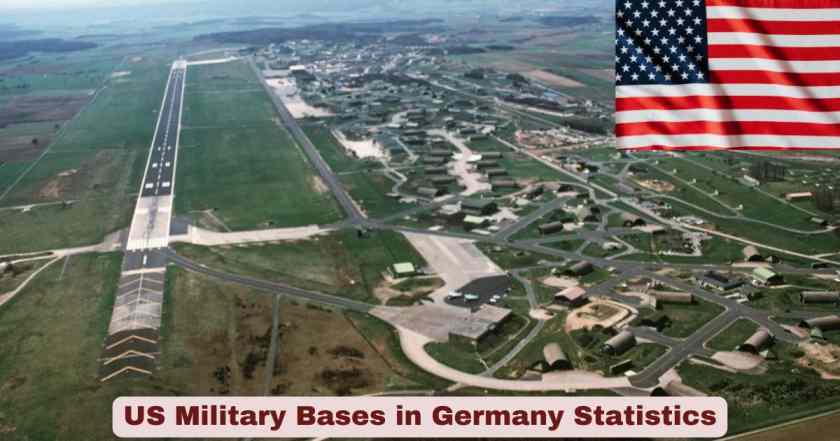
US Military Bases in Germany in 2026
Germany has been home to a U.S. military presence continuously since the end of World War II in 1945 — making it the longest-running and most strategically consequential overseas basing arrangement in American history. What began as an occupation force tasked with denazification and reconstruction evolved through the Cold War into a vast network of forward-deployed Army, Air Force, and logistics installations that formed the backbone of NATO’s conventional deterrence against the Soviet Union. As of 2026, the United States operates over 40 active military installations across Germany, organized under four major garrison commands: U.S. Army Garrison (USAG) Bavaria, USAG Rheinland-Pfalz, USAG Wiesbaden, and USAG Stuttgart — alongside the critically important Ramstein Air Base, which serves as headquarters for both U.S. Air Forces in Europe – Air Forces Africa (USAFE-AFAFRICA) and NATO Allied Air Command. According to data from the U.S. Defense Manpower Data Center as of December 2025, Germany hosts just over 36,400 active-duty U.S. military personnel — the single largest concentration of American forces anywhere in Europe, and the second largest overseas deployment of U.S. troops in the world after Japan.
The strategic importance of these bases in 2026 has never been more sharply contested — both militarily and politically. On the military side, Germany’s central geographic position in Europe makes its bases irreplaceable as logistics hubs, command centers, medical facilities, training grounds, and forward deployment platforms for operations across Europe, Africa, and the Middle East. The Ramstein Air Base alone serves as the relay node for U.S. drone operations across Africa and the Middle East, the primary air bridge for resupply to Ukraine, and the headquarters of NATO’s entire air command architecture. On the political side, April 30–May 1, 2026 brought the most dramatic single-day escalation in the U.S.-Germany basing relationship in decades: following a public confrontation between President Trump and German Chancellor Friedrich Merz over U.S. strategy in the Iran war, Defense Secretary Pete Hegseth ordered the withdrawal of approximately 5,000 U.S. troops from Germany — to be completed over the next six to twelve months — and Trump immediately warned the withdrawal would go “a lot further.” That single order — leaving more than 30,000 troops in Germany — has sent shockwaves through NATO and European defense planning, and defines the single most significant development in the U.S. military presence in Germany as of May 3, 2026.
Interesting Facts About US Military Bases in Germany 2026 | Key Stats at a Glance
| Fact Category | Key Detail |
|---|---|
| US Military Presence Since | 1945 — 81 consecutive years of U.S. military presence in Germany |
| Total Active U.S. Installations in Germany (2026) | Over 40 active military installations |
| Total U.S. Installations (including closed) | Over 220 closed since Cold War end; 79 sites including active and support |
| Total Active-Duty Troops (December 2025) | ~36,400 (U.S. Defense Manpower Data Center data) |
| Largest Concentration in Europe | Germany hosts the most U.S. troops of any country in Europe |
| Second Largest Overseas Deployment | Only Japan hosts more U.S. troops abroad |
| Hegseth Withdrawal Order (May 1, 2026) | ~5,000 troops ordered withdrawn over 6–12 months; ~30,000+ will remain |
| Ramstein Air Base | Most important U.S. air base outside the USA; HQ of USAFE-AFAFRICA and NATO Allied Air Command |
| Grafenwoehr Training Area | 223+ square kilometers — largest U.S. Army training area in Europe |
| USAG Bavaria Active-Duty Troops | ~16,240 (July 2024 ASIP garrison fact sheet data) |
| USAG Stuttgart Total Community | Over 20,000 U.S. military + civilians + families |
| USAG Wiesbaden Community | Approximately 56,000 soldiers, families, retirees, and civilian employees |
| Kaiserslautern Military Community (KMC) | ~54,000 American service members; 5,400+ U.S. civilian employees; 6,200+ German workers |
| Landstuhl Regional Medical Center | Largest U.S. military hospital outside the United States — Level II Trauma Center; 65 beds; 205,000+ beneficiary population |
| LRMC Replacement (2027) | $970 million Rhine Ordnance Barracks Medical Center — 68 beds + 25 expandable emergency beds; 2,500 staff |
| Dark Eagle Hypersonic Missiles | From 2026, U.S. Tomahawk, SM-6 cruise missiles, and Dark Eagle hypersonic missiles to be stationed in Germany (Wiesbaden/56th Artillery Command, Mainz-Kastel) |
| Ramstein Drone War Role | Ramstein serves as global relay hub for U.S. drone operations in Africa and the Middle East |
| NATO Space Center | Ramstein selected as future home of NATO Space Center — increases strategic importance |
| USAREUR-AF HQ | USAG Wiesbaden (Clay Kaserne) — HQ of U.S. Army Europe and Africa |
Source: Wikipedia – List of United States Army installations in Germany (updated May 2026); U.S. Defense Manpower Data Center (December 2025); CNBC (April 30, 2026); Breaking Defense (May 1, 2026); CNN (May 1, 2026); NPR (May 2, 2026); Newsweek (May 2, 2026); Ramstein Air Base Official Site (ramstein.af.mil); Stars and Stripes (April 2023 – LRMC replacement); Visualbases.org (2024 U.S. Bases Europe notes)
The scale of the U.S. military footprint in Germany captured in the table above is the product of 81 years of continuous presence — a duration that has made these installations not just military facilities but effectively small American cities embedded within German society. The Kaiserslautern Military Community with its 54,000 American service members and 6,200 German employees is the clearest example: it is one of the largest concentrations of Americans outside the United States, generating significant economic activity for the surrounding region while providing the U.S. military with a self-contained operational and logistics ecosystem that no other European host nation can match. The Hegseth withdrawal order of May 1, 2026 — reducing the force by approximately 14% from 36,400 to roughly 31,400 — represents the largest single announced reduction in the U.S. Germany garrison since the post-Cold War drawdown of the 1990s, and has immediately raised questions about which specific units and locations will be affected and whether Trump’s threat to cut “a lot further” signals a more fundamental reconsideration of the basing relationship.
US Military Bases Germany 2026 | Ramstein Air Base Statistics
| Ramstein Air Base Metric | Data |
|---|---|
| Location | Rhineland-Palatinate, Germany (near Kaiserslautern) |
| Designation | Most important U.S. air base outside the continental United States |
| Host Command | U.S. Air Forces in Europe – Air Forces Africa (USAFE-AFAFRICA) |
| NATO Command | NATO Allied Air Command (HQ at Ramstein) |
| Host Unit | 86th Airlift Wing |
| 86th Airlift Wing Structure | 7 groups, 30 squadrons across 4 bases (Germany, Spain, Belgium, Portugal) |
| 86th Airlift Wing Aircraft | C-130J Super Hercules, C-21A Learjet, C-37A Gulfstream |
| 86th Airlift Wing Mission | USAFE’s only airlift, airdrop, and aeromedical evacuation flying operations |
| Runways | 2 runways: 09/27 and 08/26 |
| KMC Air Force Military Personnel | ~9,800 military personnel |
| KMC Air Force Family Members | ~11,100 family members |
| KMC Total Community (all services) | ~54,000 Americans; 5,400+ U.S. civilian employees; 6,200+ German workers |
| Construction Period | 1949–1952 (French Army + U.S. Army Corps of Engineers) |
| Site History | Built on a former WWII Luftwaffe airstrip (autobahn section used as runway) |
| Opened | Landstuhl Air Base: August 5, 1952; Ramstein Air Station: 1953 |
| Renamed Ramstein Air Base | 1961 |
| Drone War Role | Global satellite relay hub for U.S. drone operations in Africa and the Middle East |
| Ukraine Support Role | Primary air bridge for U.S. military aid and resupply to Ukraine |
| NATO Space Center | Ramstein selected as future home of NATO Space Center |
| Schools on Base | 4 schools: Elementary (PreK–2), Intermediate (3–5), Middle (6–8), High School (9–12) |
| Largest Construction Site (History) | 1948–1953 construction employed over 270,000 workers — largest single-site construction project in Europe at the time |
| Legal Jurisdiction | United States has jurisdiction over Ramstein Air Base under Status of Forces Agreement |
Source: Ramstein Air Base Official Website (ramstein.af.mil); Wikipedia – Ramstein Air Base (updated January 2026); Global Military Net (globalmilitary.net, updated January 19, 2026); EUCOM Official Website; Visualbases.org (2024)
Ramstein Air Base is not merely the most important U.S. air base outside American soil — it is arguably the most strategically consequential piece of real estate in the entire NATO alliance’s operational architecture. Serving simultaneously as the headquarters of USAFE-AFAFRICA, the seat of NATO Allied Air Command, a global drone relay hub, a Ukraine war logistics node, and the future home of the NATO Space Center, Ramstein concentrates more distinct strategic functions in a single installation than any comparable facility anywhere in the world. The 86th Airlift Wing’s unique position as USAFE’s only airlift, airdrop, and aeromedical evacuation flying unit means that when U.S. personnel are wounded anywhere from the Sahel to Afghanistan and need to reach Landstuhl Regional Medical Center, they are almost certainly passing through Ramstein’s flight line on the way. The base’s role as the satellite relay hub for U.S. drone strikes across Africa and the Middle East — a function that has drawn significant legal challenges in German courts, including a July 2025 German Constitutional Court dismissal of a case seeking to compel the German government to monitor U.S. compliance with international law at Ramstein — makes it perhaps the single most operationally sensitive U.S. installation in Europe.
US Military Bases Germany 2026 | USAG Bavaria (Grafenwoehr & Hohenfels)
| USAG Bavaria Metric | Data |
|---|---|
| Major Installations | Tower Barracks (Grafenwoehr), Rose Barracks (Vilseck), Hohenfels, Garmisch |
| Location | Eastern Bavaria, near Czech Republic border |
| Active-Duty Military Personnel | ~16,240 (July 2024 ASIP garrison fact sheet) |
| Grafenwoehr Training Area Size | Over 223 square kilometers — largest U.S. Army training area in Europe |
| Primary Mission | Combat training, readiness, and force modernization for U.S. and allied forces in Europe |
| Training Command | 7th Army Joint Multinational Training Command (7th JMTC) at Grafenwoehr |
| Key Units — Grafenwoehr | 7th JMTC; 172nd Infantry Brigade (172nd IBCT) |
| Hohenfels Role | Joint Multinational Readiness Center (JMRC) — simulated combat training for multinational forces |
| Garmisch Installation | Edelweiss Lodge and Resort + George C. Marshall European Center for Security Studies |
| Ukraine Support Role | Grafenwoehr serves as primary training site for Ukrainian forces under U.S./NATO programs |
| Multinational Training | Hosts forces from NATO allies and partner nations for combat readiness exercises |
| Garrison Command | U.S. Army Garrison Bavaria — part of Installation Management Command Europe (IMCOM-E) |
| Location Significance | Eastern Bavaria placement provides rapid rail and road links to NATO eastern flank |
| Scheduled Closures | 2 installations within USAG Bavaria scheduled to close |
Source: Newsweek (May 2, 2026 – citing official garrison fact sheet, ASIP data July 2024); Wikipedia – List of U.S. Army Installations in Germany (updated May 2026); OperationMilitaryKids.org (February 2026); aacvr-germany.org
USAG Bavaria — anchored by the vast Grafenwoehr Training Area — represents the U.S. Army’s most important land combat training investment in Europe. The 223+ square kilometer training ground at Grafenwoehr is not just the largest American training area in Europe; it is the continent’s premier combined-arms maneuver training environment, capable of hosting brigade-level exercises that replicate the full spectrum of terrain, obstacle, and electronic warfare conditions that a U.S. Army formation might encounter in a peer conflict on NATO’s eastern flank. Since Russia’s full-scale invasion of Ukraine in February 2022, Grafenwoehr has taken on an additional mission of acute strategic importance: it became the primary location for training Ukrainian military personnel under U.S. and NATO programs, hosting thousands of Ukrainian soldiers in armor, artillery, and combined-arms tactics before they return to the front lines. This mission has transformed Grafenwoehr from a Cold War relic into the most actively utilized training facility in the Alliance — and one whose continued operation is directly linked to the outcome of the war in Ukraine.
Hohenfels, as the location of the Joint Multinational Readiness Center (JMRC), provides a complementary but distinct capability: a dedicated instrumented training environment where opposing force (OPFOR) units replicate the tactics, techniques, and procedures of near-peer adversaries, forcing visiting NATO formations to fight their way through realistic, degraded, contested conditions before being evaluated and corrected. The Hohenfels JMRC has been the proving ground for virtually every NATO brigade-level force that has deployed to the eastern flank since 2014, and in the current strategic environment — with both Russia and China fielding sophisticated electronic warfare, air defense, and drone capabilities — the lessons learned at Hohenfels are more operationally relevant than at any point since the Cold War.
US Military Bases Germany 2026 | USAG Wiesbaden Statistics
| USAG Wiesbaden Metric | Data |
|---|---|
| Location | Wiesbaden, Hesse state, western Germany |
| Primary Installation | Lucius D. Clay Kaserne (formerly Wiesbaden Army Airfield), Wiesbaden-Erbenheim |
| Strategic Significance | Headquarters of U.S. Army Europe and Africa (USAREUR-AF) |
| Other Key Facility | Dagger Complex, Darmstadt — former NSA/Army intelligence processing center; being closed as new Wiesbaden facility built |
| Total Community Served | ~56,000 soldiers, family members, retirees, and civilian employees (Military.com data) |
| Sites Managed | 15 installations and housing areas in and around Wiesbaden |
| Additional Sites | Clay Kaserne, Dagger Complex (Darmstadt), housing area in Mainz, McCully Support Center (Wackernheim) |
| 56th Artillery Command Location | Mainz-Kastel district of Wiesbaden |
| Dark Eagle / Hypersonic Role | 56th Artillery Command designated as command center for Dark Eagle hypersonic missiles and planned Tomahawk / SM-6 deployments from 2026 |
| Intelligence Role | 66th Military Intelligence Group (66th MI) headquartered at Wiesbaden |
| Army Division HQ | 1st Armored Division (1AD) headquartered at Wiesbaden |
| EUCOM Subordination | USAREUR-AF subordinate to U.S. European Command (EUCOM) at Patch Barracks, Stuttgart |
| New Intelligence Facility | More advanced NSA/Army intelligence processing facility under construction at Clay Kaserne (replacing Dagger Complex) |
| Historical Note | USAREUR originally established January 1, 1950 at Frankfurt; moved to Heidelberg’s Campbell Barracks 1948 then Stuttgart 1967 before Wiesbaden |
Source: Wikipedia – List of U.S. Army Installations in Germany (updated May 2026); Newsweek (May 2, 2026); aacvr-germany.org; Visualbases.org (2024); WarCosts.org U.S. installations Germany database
USAG Wiesbaden occupies a uniquely powerful position in the U.S. military architecture in Germany: as the headquarters of U.S. Army Europe and Africa, it is the command node from which all U.S. Army operations across the entire European and African theaters are planned, directed, and sustained. The 1st Armored Division’s presence at Wiesbaden, combined with the 66th Military Intelligence Group and the 56th Artillery Command, creates an extraordinarily dense concentration of command, intelligence, and fires capability at a single location — a deliberate design choice that reflects Wiesbaden’s central position in Germany, with excellent road, rail, and air connectivity to both NATO’s eastern flank and the southern Mediterranean. The 56th Artillery Command in Mainz-Kastel — reactivated from 2021 — is particularly significant in 2026: it is designated as the command center for the Dark Eagle hypersonic missile system and the planned deployment of Tomahawk and SM-6 missiles to Germany, a stationing decision that represents the most significant expansion of U.S. long-range precision fires capability in Europe since the Cold War-era removal of Pershing II missiles under the 1987 INF Treaty.
The Dagger Complex in Darmstadt — once one of the most sensitive intelligence facilities in Europe, serving as an NSA and Army intelligence processing and analysis center — is being phased out as a more capable replacement facility takes shape at Clay Kaserne in Wiesbaden. This transition reflects both the physical obsolescence of the original Darmstadt facilities and the intelligence community’s broader push toward consolidated, purpose-built secure facilities that are easier to defend, maintain, and upgrade with the latest signals intelligence and cyber capabilities. The 56,000-person community that USAG Wiesbaden serves — stretching across 15 installations and housing areas — makes it the largest U.S. Army community in Germany by total population, even if its active-duty headcount is smaller than USAG Bavaria’s.
US Military Bases Germany 2026 | USAG Stuttgart & EUCOM / AFRICOM
| USAG Stuttgart Metric | Data |
|---|---|
| Location | Stuttgart, Baden-Württemberg state, southwestern Germany |
| Primary Installations | Patch Barracks, Panzer Kaserne, Kelley Barracks, Robinson Barracks, Stuttgart Army Airfield |
| Primary Tenant Commands | EUCOM (U.S. European Command) and AFRICOM (U.S. Africa Command) |
| EUCOM Mission | Commands all U.S. military activities across 51 countries in Europe, parts of Asia, the Middle East |
| AFRICOM Mission | Commands all U.S. military activities across 54 African nations |
| Total Community | Over 20,000 U.S. military personnel, federal agency staff, civilians, and family members |
| Patch Barracks | EUCOM and AFRICOM headquarters; USAG Stuttgart HQ |
| Panzer Kaserne | Special Operations Command Europe (SOCEUR) headquarters |
| Kelley Barracks | AFRICOM command components |
| Robinson Barracks | Support functions, medical, and community facilities |
| Stuttgart Army Airfield | Army aviation support; C-12 and helicopter operations |
| Joint-Service Community | U.S. Army, Air Force, Navy, Marine Corps, and federal civilian personnel |
| Strategic Role | Preeminent command and control hub for all U.S. operations in Europe and Africa |
| SOCEUR (Special Operations Command Europe) | Coordinates all U.S. special operations forces across the European theater |
Source: Wikipedia – List of U.S. Army Installations in Germany (updated May 2026); OperationMilitaryKids.org (February 2026); OperationMilitaryKids.org U.S. Bases Europe Guide (2026); EUCOM Official Website (eucom.mil)
USAG Stuttgart is the strategic brain of the U.S. military’s European presence — a compact but extraordinarily powerful joint-service command community where the decisions about U.S. military engagement across 105 countries spanning two continents are made. The presence of both EUCOM and AFRICOM at Patch Barracks in Stuttgart creates a unique command density: the officers responsible for every U.S. military interaction with NATO allies, European partner nations, and 54 African countries work side by side, share intelligence, and coordinate operations from a set of low-profile offices in a former German Army barracks that belies the strategic weight they carry. The SOCEUR at Panzer Kaserne adds the special operations dimension: all U.S. Special Forces, Rangers, Civil Affairs, Psychological Operations, and other SOCOM elements operating across Europe route their planning, support, and command authority through Stuttgart.
The geographic logic of Stuttgart as a command location reflects Cold War planning that has proven remarkably durable: positioned in southwestern Germany, it is equidistant from NATO’s northern, central, and southern flanks, accessible by air to any capital in Europe within two hours, and far enough from Germany’s borders to have been considered relatively secure from Soviet conventional attack. In 2026, with Russia’s military bogged down in Ukraine and the strategic focus shifting toward China and the Indo-Pacific, Stuttgart’s role has evolved: AFRICOM has grown in importance as the U.S. competes with China for influence across the African continent, and EUCOM is managing the most complex alliance management challenge since the Cold War as Trump’s troop withdrawal threats and burden-sharing demands reshape the transatlantic security relationship in real time.
US Military Bases Germany 2026 | USAG Rheinland-Pfalz & Spangdahlem Air Base
| USAG Rheinland-Pfalz Metric | Data |
|---|---|
| Location | Rhineland-Palatinate state, southwestern Germany |
| Communities Covered | 9 communities: Kaiserslautern, Landstuhl, Baumholder, Sembach, Germersheim, Grünstadt, Miesau, Mannheim, Pirmasens |
| Total Sites | 26 sites and installations |
| Active-Duty Military Personnel Supported | ~8,000 military personnel |
| Part of Kaiserslautern Military Community (KMC) | Yes — includes Ramstein Air Base community |
| Baumholder Role | Primary U.S. special operations and infantry training site; Navy SEALs and other SOF use Baumholder for exercises |
| Sembach Kaserne | Hosts Joint Force Air Component Command (JFACC) elements |
| Miesau Army Depot | Largest U.S. Army conventional ammunition storage point in Europe |
| Germersheim Role | U.S. Army materiel and logistics hub |
| Spangdahlem Air Base Location | Rhineland-Palatinate (near Trier, Germany’s oldest city) |
| Spangdahlem Host Wing | 52nd Fighter Wing |
| 52nd Fighter Wing Aircraft | F-16 Fighting Falcons (transitioning to F-35A) |
| 52nd Fighter Wing Mission | Full-spectrum air superiority, close air support, air interdiction across USAFE theater |
| Spangdahlem Subordinate Groups | Operations, Maintenance, Logistics, Medical, and Personnel Support Groups |
| Spangdahlem Strategic Role | NATO’s frontline tactical fighter presence in western Germany; rapid response to eastern flank |
Source: Newsweek (May 2, 2026); Wikipedia – List of U.S. Army Installations in Germany; OperationMilitaryKids.org (February 2026); MilitaryBases.com Germany profile; Visualbases.org (2024 U.S. Bases Europe notes)
USAG Rheinland-Pfalz functions as the logistical spine of the U.S. military presence in western Germany — and the Miesau Army Depot is perhaps the single most important installation in the garrison for wartime planning purposes. As the largest U.S. Army conventional ammunition storage point in Europe, Miesau holds the munitions stockpile that would sustain U.S. and allied forces through the initial weeks of any major combat operation on NATO’s eastern flank. The depot’s location in the Rhineland — well behind potential front lines and connected by road and rail to every major U.S. installation in Germany — makes it the logistical guarantee underpinning all of USAREUR-AF’s warfighting plans, and its protection and resupply are a fundamental planning consideration for any scenario in which U.S. forces in Germany are called to fight. Baumholder, meanwhile, serves as the premier special operations training site in Germany, used by Navy SEALs, Army Special Forces, Rangers, and allied SOF elements for exercises that take advantage of the rugged Hunsrück terrain, which closely replicates the wooded highlands of Eastern Europe.
Spangdahlem Air Base — home of the 52nd Fighter Wing — provides USAFE with its forward tactical fighter presence in western Germany. The F-16 Fighting Falcons currently assigned to Spangdahlem are the immediate response option for any air sovereignty or close air support mission across the USAFE theater that cannot wait for aircraft to transit from Ramstein’s larger but transport-focused infrastructure. The 52nd Fighter Wing’s planned transition to the F-35A — as part of the broader USAF modernization of European-theater tactical aviation — will significantly increase Spangdahlem’s capability, giving NATO a stealth fifth-generation fighter presence in Germany for the first time, positioned to operate against the advanced integrated air defense systems that both Russia and potential future adversaries field.
US Military Bases Germany 2026 | Landstuhl Regional Medical Center Statistics
| LRMC Metric | Data |
|---|---|
| Location | Landstuhl, Rhineland-Palatinate (near Ramstein Air Base) |
| Established | October 15, 1951 |
| Original Building Completion | April 7, 1953 (1,000-bed Army General Hospital) |
| Current Status | Largest U.S. military hospital outside the continental United States |
| Trauma Center Level | Level II Trauma Center — only U.S. facility overseas with this designation (American College of Surgeons) |
| German Dual Certification | May 2025 — achieved dual certification from ACS + German DGU (Deutsche Gesellschaft für Unfallchirurgie); integrated into German national trauma network |
| Current Inpatient Beds | 65 beds |
| Outpatient Visits | Over 46,000 outpatient visits per month |
| Beneficiary Population | Over 205,000 U.S., NATO, and coalition personnel across Europe, Africa, and Middle East |
| Combat Casualties Treated (2004–2013) | Nearly 66,000 patients from Iraq and Afghanistan operations |
| Survival Rate (Trauma Patients) | 99.5% |
| Staff | ~2,500 personnel (military and civilian) |
| Additional Clinics Under LRMC Command | 7 clinics (2 in Belgium, 2 in Italy, 3 in Germany) |
| LRMC Replacement — RORBMC | Rhine Ordnance Barracks Medical Center (RORBMC) — $970 million project; scheduled completion 2027 |
| RORBMC Size | 968,000+ square feet (~218,000 sq ft larger than current LRMC) |
| RORBMC Beds | 68 beds standard + 25 expandable emergency beds = 93 beds at surge |
| RORBMC Community | Primary care for ~31,000 KMC beneficiaries; specialty services for 209,000 throughout Europe |
| Ukraine War Role | Treated Ukrainian soldiers and American volunteer veterans wounded in Russia-Ukraine fighting |
| COVID-19 Response | Over 75 nurses volunteered for critical care surges during 2020 pandemic |
Source: Wikipedia – Landstuhl Regional Medical Center (updated March 2026); Stars and Stripes (April 20, 2023 – RORBMC construction update); Grokipedia – LRMC (March 2026); U.S. Army Official (army.mil – LRMC patient statistics); Spangdahlem AFB Fact Sheet – LRMC; LRMC Tricare official site (landstuhl.tricare.mil)
Landstuhl Regional Medical Center is the institution that most viscerally demonstrates the human cost and the lifesaving capability of the U.S. military presence in Germany. Its 99.5% trauma patient survival rate — achieved across nearly 66,000 combat casualties from Iraq and Afghanistan alone between 2004 and 2013 — is not a statistical accident but the product of decades of investment in combat casualty care protocols, en-route surgery capabilities, and aeromedical evacuation systems that have progressively pushed the “golden hour” of trauma care from the emergency room directly into the combat zone. The Landstuhl model — where a critically wounded soldier can move from a battlefield in Afghanistan through a forward surgical team, onto a CASEVAC aircraft, into Ramstein’s flight line, and into LRMC’s operating theaters within 18–24 hours of wounding — represents the most sophisticated casualty care system in military history, and has directly saved thousands of lives that would have been lost under any previous military medical evacuation framework.
The $970 million Rhine Ordnance Barracks Medical Center replacement — scheduled for completion in 2027 — is the most significant investment in U.S. military medical infrastructure in Europe in the institution’s 73-year history. The new facility’s 968,000 square feet — roughly four football fields larger than the current LRMC — and its 93-bed surge capacity reflect the Army’s realistic assessment of what a peer conflict on NATO’s eastern flank would demand from the theater’s primary medical evacuation center. The May 2025 dual certification from both the American College of Surgeons and the German Deutsche Gesellschaft für Unfallchirurgie — integrating LRMC into Germany’s national trauma network — is both a mark of clinical excellence and a practical operational enhancement, enabling joint German-American trauma protocols and resource-sharing arrangements that would be essential in any scenario requiring mass casualty care across the theater.
US Military Bases Germany 2026 | Trump Troop Withdrawal & Strategic Impact
| Withdrawal / Political Metric | Data |
|---|---|
| Pre-Withdrawal Troop Level | ~36,400 active-duty U.S. troops (December 2025 DMDC data) |
| Hegseth Withdrawal Order Date | May 1, 2026 |
| Troops Ordered Withdrawn | ~5,000 troops (~14% of Germany garrison) |
| Completion Timeline | 6–12 months (by approximately May–November 2027) |
| Troops Remaining After Withdrawal | ~30,000–31,400 (Pentagon statement: “more than 30,000”) |
| Trump Follow-Up Threat | “Cutting a lot further” than 5,000 — no specific number given (May 1, 2026) |
| Trigger for Withdrawal | Dispute with German Chancellor Friedrich Merz who said Iran had “humiliated” Washington; Trump retaliation |
| Pentagon Justification | “Thorough review of Department’s force posture in Europe; recognition of theater requirements and conditions on the ground” (Sean Parnell, Chief Pentagon Spokesman) |
| German Government Response | Defense Minister Boris Pistorius called decision “anticipated”; said Germany ready to “shoulder more of the burden” |
| Senator Jack Reed (D-RI) Warning | Called withdrawal “a serious mistake that will reverberate well beyond this moment”; said it was “a priceless gift to Vladimir Putin” |
| Historical Parallel — First Trump Term | 2020: Trump sought to pull ~9,500 troops from Germany (over NATO spending concerns); Biden halted the plan in 2021 |
| Congressional Constraint | U.S. defense legislation has imposed conditions on Germany withdrawals; future cuts may face legal challenges |
| Impact on Other NATO Countries | Germany withdrawal signals risk of similar action in Spain, Italy (NPR/AP reporting) |
| Iran War Context | Withdrawal announced during active Operation Epic Fury U.S.-Iran conflict; analysts note timing undermines CENTCOM logistics support chain through Germany |
| Analyst Assessment | Large-scale reductions “remain unlikely” due to strategic importance and legal constraints (The Guardian, April 30, 2026) |
Source: Breaking Defense (May 1, 2026); CNN (May 1, 2026); NPR (May 2, 2026); Washington Times (May 1, 2026); Newsweek (May 2, 2026); CNBC (April 30, 2026); CBS News (May 2, 2026); Wikipedia – List of U.S. Army Installations in Germany (updated May 2026)
The Hegseth withdrawal order of May 1, 2026 is simultaneously a politically charged bilateral dispute and a genuinely consequential military planning event — and separating the two is essential to understanding what it actually means for U.S. military posture in Europe. The political dimension is clear: Trump’s anger at Chancellor Merz’s public criticism of U.S. Iran strategy triggered a rapid, retaliatory decision that was announced within 24 hours of the chancellor’s remarks — a timeline that strongly suggests the order was driven by presidential anger rather than the “thorough review” that Pentagon spokesman Sean Parnell cited in his official statement. The military dimension is more complex: 5,000 troops — approximately one standard infantry brigade — is a significant but not catastrophic reduction from the 36,400-person garrison, and the 30,000+ who remain would still constitute by far the largest U.S. military presence in Europe.
What genuinely alarms NATO planners and U.S. defense analysts is not the 5,000-troop reduction itself but the trajectory it suggests. Trump’s immediate promise to cut “a lot further” echoes his 2020 attempt to withdraw 9,500 troops — which was blocked by congressional conditions and reversed by Biden. If the current Congress does not impose similar constraints, and if Trump follows through on deeper cuts, the strategic implications for NATO’s deterrence posture are severe. The bases affected would not just lose their troop populations — they would lose the institutional expertise, pre-positioned equipment, training relationships, and command infrastructure that take years to build and cannot be rapidly reconstituted. In the context of Operation Epic Fury and the ongoing Russia-Ukraine war, the timing of this announcement is particularly consequential: Ramstein is the primary logistics node for U.S. support to Ukraine, and any reduction in its garrison directly affects the capacity of that mission.
Disclaimer: The data research report we present here is based on information found from various sources. We are not liable for any financial loss, errors, or damages of any kind that may result from the use of the information herein. We acknowledge that though we try to report accurately, we cannot verify the absolute facts of everything that has been represented.