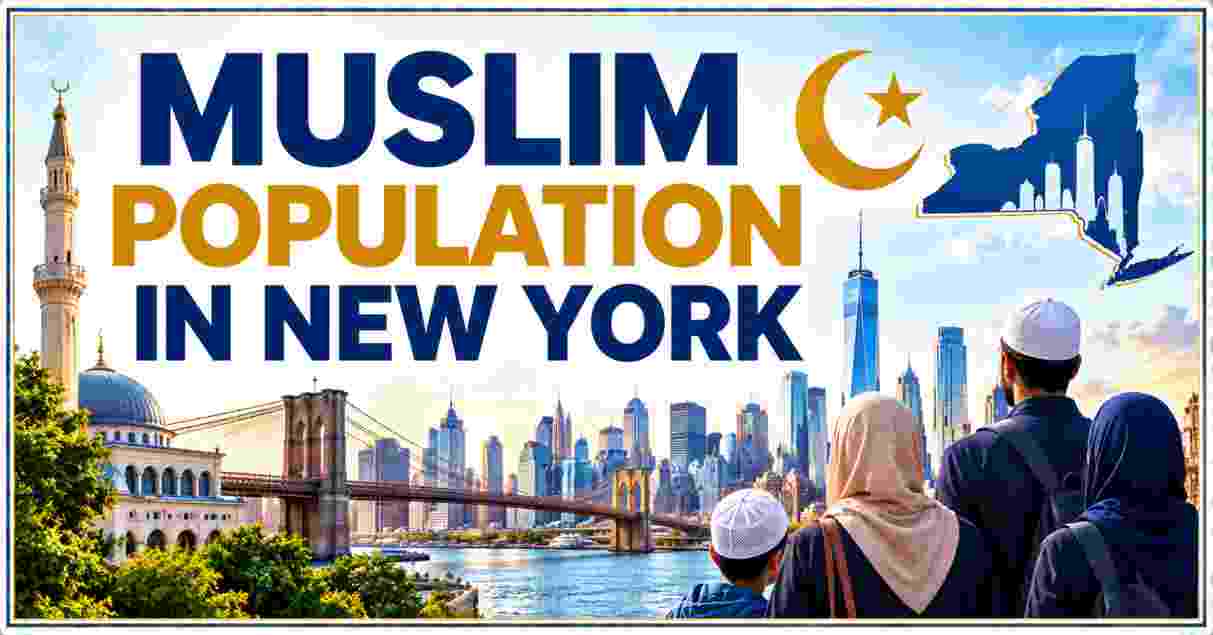
New York is home to an estimated 724,475 Muslims statewide, more than any other US state, representing roughly 3.6% of the state’s population. Within New York City, estimates of the Muslim population range widely from about 670,000 to over 900,000 depending on methodology, with Queens County recording the highest concentration of any borough at 6%.
Muslim Population in New York 2026 – Introduction
The Muslim population in New York is the largest of any state in the country, a distinction rooted in more than a century of immigration history that has made New York City the most ethnically diverse Muslim community of any city in the world. Because the US Census Bureau does not collect data on religious affiliation, every figure in this report comes from surveys, academic research, or estimates built from immigration and ancestry data rather than a single official government count, a methodological reality that produces meaningfully different numbers depending on which organization is doing the counting.
That range matters more in New York than almost anywhere else in the country, since the state’s Muslim community is large enough that a few percentage points of difference in methodology can mean a gap of hundreds of thousands of people between the low and high estimates. 2026 has brought renewed national attention to this population following the historic election of New York City’s first Muslim mayor, adding fresh context to a community whose size, geographic distribution, and political influence continue to grow across the five boroughs and well beyond them into upstate counties like Erie.
Interesting Facts About the Muslim Population in New York 2026
| Fact | Figure |
|---|---|
| New York State Muslim Population | ~724,475 (largest of any US state) |
| Share of State Population | ~3.6% |
| New York City Muslim Population (range) | ~670,000 to 940,000+ |
| Highest-Concentration NYC Borough | Queens County, 6% |
| Share of All US Muslims Living in NY Metro Area | ~23% |
| NYC Religious Diversity Index Score | 0.850 (vs. 0.589 national average) |
| Erie County (Buffalo Area) Muslim Population | ~26,492 |
| NYC’s First Muslim Mayor | Zohran Mamdani, took office January 2026 |
Data Source: World Population Review; Pew Research Center Religious Landscape Study; PRRI 2023 Census of American Religion
These figures illustrate both the scale and the definitional complexity of counting a religious minority in a country that does not track religion on its census. The 724,475 state-level figure comes from World Population Review’s demographic modeling and is the number most consistently cited across sources, but city-level estimates for New York City alone swing from roughly 670,000, based on Pew’s phone-survey methodology, up to figures near 940,000 cited by city officials and community advocacy groups, a gap of more than a quarter-million people within the same metropolitan area.
New York City’s religious diversity index score of 0.850, far above the national average of 0.589, reflects a five-borough patchwork where no single religious group dominates and where Muslim, Jewish, Hindu, and Christian communities each maintain strong, geographically distinct concentrations. That diversity is part of why Queens County alone accounts for a disproportionate share of the city’s Muslim population, a pattern explored in more detail in the borough-level breakdown below.
Muslim Population in New York State 2026 | Total Numbers & National Ranking
TOP 5 STATES BY MUSLIM POPULATION — 2026
New York        ████████████████████████████████████████ 724,475
California      ███████████████████████████               504,056
Illinois        █████████████████████████                  473,792
New Jersey      █████████████████████                       ~350,000
Michigan        ████████████████                            ~300,000
| State | Estimated Muslim Population, 2026 |
|---|---|
| New York | 724,475 |
| California | 504,056 |
| Illinois | 473,792 |
| New Jersey | 300,000-400,000 |
| Michigan | 250,000-350,000 |
Data Source: World Population Review Muslim Population by State Rankings, 2026
New York has held the position of the US state with the largest Muslim population for decades, a status driven overwhelmingly by New York City’s role as a historic port of entry and settlement hub for immigrants from South Asia, the Middle East, and West Africa. At an estimated 724,475 residents, New York’s Muslim population exceeds California’s 504,056 by roughly 44%, despite California having a larger total state population overall, underscoring just how concentrated Muslim settlement in America has historically been around the New York metropolitan region specifically rather than simply tracking general population size.
As a share of total state population, New York’s Muslim community represents roughly 3.6%, several times the 1% to 1.6% national average most commonly cited by demographers. The vast majority of that population lives in and around New York City, though the state’s Muslim community also extends meaningfully into Long Island, the Hudson Valley, and Western New York around Buffalo, regions covered later in this report. For a broader national picture of how these state-level figures fit together, see Muslim Population in US, which breaks down the full state-by-state ranking alongside national demographic and religious-practice data.
Muslim Population in New York City 2026 | Citywide Estimates & Definitions
NYC MUSLIM POPULATION ESTIMATES BY SOURCE (thousands)
Pew (phone survey, 3% of metro)      ██████████████████████████████████ 671
2018 academic study (9% of city)       ██████████████████████████████████████ 750+
ISPU/MAP community study (2016)          ███████████████████████████████████████ 769
City officials, "1 in 9" (2025)             ██████████████████████████████████████████████ 942
| Estimate Source | NYC Muslim Population | % of City |
|---|---|---|
| Pew Research (phone-survey methodology) | ~670,984 | 3% |
| 2018 Academic Study (most-cited city figure) | 750,000+ | ~9% |
| ISPU/Muslims for American Progress (2016) | 768,767 | 8.96% |
| City Officials, “One in Nine New Yorkers” (2025) | ~942,000 | ~11% |
Data Source: Pew Research Religious Landscape Study; Institute for Social Policy and Understanding; NYC Mayor’s Office Community Affairs Unit
Counting New York City’s Muslim population is genuinely contested territory among researchers, and the range of credible estimates spans nearly 300,000 people. Pew Research’s phone-survey-based estimate puts the figure at roughly 670,984, or 3% of the metro population, but Pew itself acknowledges this methodology likely undercounts a community that is disproportionately young, non-English-speaking in many households, and sometimes wary of survey outreach from unfamiliar callers. A widely cited 2018 academic study instead put the figure above 750,000, or about 9% of city residents, a number regularly repeated in encyclopedic references as the standard citywide estimate.
Higher still, a 2016 community-based study from the Institute for Social Policy and Understanding estimated 768,767 Muslims in the city, and a February 2025 press release from the mayor’s office cited a city advisor’s claim that “one in nine New Yorkers” identifies as Muslim, which would translate to roughly 942,000 people given the city’s population at that time. Advocacy organizations have cited figures approaching one million. Because the New York metropolitan area, including New Jersey and Connecticut suburbs, is home to roughly 23% of the entire US Muslim population according to Pew’s 2014 Religious Landscape Study, even modest changes in how “the city” versus “the metro area” is defined can shift the headline number substantially.
Muslim Population by NYC Borough 2026 | Queens, Brooklyn & the Religious Diversity Index
MUSLIM SHARE OF POPULATION BY NYC BOROUGH — PRRI 2023 (%)
Queens (Queens County)        ██████████████████████████ 6.0%
Brooklyn (Kings County)       ██████████████     4.0%
Remaining 3 boroughs (range)  ████     0.6%-lower
| Borough (County) | Muslim Share, 2023 | Other Notable Religious Data |
|---|---|---|
| Queens (Queens County) | 6% | Also has the city’s largest Hindu population |
| Brooklyn (Kings County) | 4% | Also 12% Jewish, the city’s highest |
| Manhattan (New York County) | Lower end of range | 7% Jewish; most religiously unaffiliated (34%+) |
| Bronx (Bronx County) | Lower end of range | 30% Hispanic Catholic, the city’s highest |
| Staten Island (Richmond County) | Lowest of the five | Whitest borough; 42% white Christian |
Data Source: PRRI 2023 Census of American Religion, County-Level Religious Affiliation Data
New York City is composed of five counties, each corresponding to one of the five boroughs: Bronx County, Kings County (Brooklyn), New York County (Manhattan), Queens County, and Richmond County (Staten Island). According to the 2023 PRRI Census of American Religion, the Muslim share of the population across these five counties ranges from a low of 0.6% to a high of 6%, with Queens recording the highest concentration of any borough, where PRRI also found the city’s largest Hindu population, reflecting Queens’s status as home to some of the most ethnically diverse neighborhoods in the country. Brooklyn follows at 4%, alongside the city’s highest Jewish population share at 12%, concentrated substantially in the borough’s large Hasidic communities.
PRRI’s data also notes that three of the five counties with the highest Muslim population shares statewide are located within New York City itself, underscoring how heavily the state’s Muslim population concentrates in the five boroughs relative to the rest of New York. The remaining boroughs, Manhattan, the Bronx, and Staten Island, each have smaller Muslim population shares within PRRI’s overall 0.6%-to-6% range, while showing their own distinct religious profiles: Manhattan is the least religious borough overall, with more than a third of residents religiously unaffiliated, the Bronx has the city’s highest concentration of Hispanic Catholics, and Staten Island remains the whitest and most heavily Christian of the five boroughs.
Muslim Population by Ethnic Origin 2026 | Pakistani, Bangladeshi & Diverse Communities
SELECTED NYC ETHNIC POPULATIONS LINKED TO MUSLIM COMMUNITIES — 2020 CENSUS
Bangladeshi     ████████████████████████████████████████ 103,399
Pakistani       ████████████████████████                   63,843
| Ethnic Group | NYC Population, 2020 Census | Trend |
|---|---|---|
| Bangladeshi | 103,399 | Nearly tripled over the prior decade |
| Pakistani | 63,843 | Community groups cite figures above 120,000 |
| Overall Muslim American Composition | No single majority race/ethnicity | ~26% white, 18% Asian, 18% Arab, 9% Black, 7% mixed, 5% Hispanic |
Data Source: NYC Department of City Planning, 2020 US Census; Institute for Social Policy and Understanding 2017 Study
New York City’s Muslim population is not concentrated within a single ethnic community but spans dozens of countries of origin. The 2020 US Census recorded 103,399 Bangladeshi residents in New York City, a figure that had nearly tripled over the previous decade according to contemporaneous reporting, alongside 63,843 Pakistani residents, though city officials and community organizations have separately cited figures above 120,000 Pakistani New Yorkers, illustrating the same estimate-versus-official-count gap seen at the citywide level. Both communities are heavily concentrated in specific Queens neighborhoods, including Jackson Heights, Jamaica, and Astoria.
Nationally, Muslim Americans are frequently described by researchers as the country’s most racially diverse religious community, with no single racial or ethnic group forming a majority: an Institute for Social Policy and Understanding study found the community breaks down to roughly 26% white, 18% Asian, 18% Arab, 9% Black, 7% mixed race, and 5% Hispanic, a composition reflecting both long-established African American Muslim communities and more recent immigration waves from South Asia, the Middle East, and West Africa, all of which are represented within New York’s Muslim population specifically.
Muslim Population Outside NYC 2026 | Buffalo, Erie County & Upstate New York
WESTERN NEW YORK MUSLIM COMMUNITY GROWTH
Mosques, 50 years ago         ██ 2
Mosques, today                ████████████████████████ ~50
| Metric | 2025-2026 Data Point |
|---|---|
| Erie County (Buffalo Area) Muslim Population | ~26,492 |
| Erie County Total Population | 946,741 |
| Muslim Share of Erie County | ~2.8% |
| Buffalo-Rochester Market Muslim Share (of religiously affiliated) | 2.7% (above national average) |
| Mosques in Western New York Today | ~50, up from about 2 fifty years ago |
Data Source: Buffalo-Rochester Regional Market Religious Data; Muslim Public Affairs Council of Western New York
While New York City holds the overwhelming majority of the state’s Muslim population, communities have grown substantially in Western New York as well, particularly around Buffalo and Erie County. Current estimates put Erie County’s Muslim population at roughly 26,492, or about 2.8% of the county’s total population of 946,741, driven significantly by Yemeni American families who began settling in the Buffalo area in meaningful numbers in recent decades. The Buffalo-Rochester media market shows a Muslim share of 2.7% of its religiously affiliated population, notably higher than the national average for a mid-sized metro region.
Community leaders describe the growth as dramatic in relative terms even if the absolute numbers remain far smaller than New York City’s. Khalid Qazi, founding president of the Muslim Public Affairs Council of Western New York, has described the local mosque count growing from just two mosques fifty years ago to nearly fifty today, spread across Buffalo, Cheektowaga, Amherst, Grand Island, and surrounding communities, a pattern he attributes to both new immigration and internal migration of Muslim families from elsewhere in New York State into the Buffalo region over the past two decades.
Muslim Americans Nationally 2026 | How New York Fits the Broader Picture
US MUSLIM POPULATION ESTIMATES — RANGE ACROSS SOURCES (millions)
World Population Review    ██████████████████████████████████████ 4.45
2020 US Religion Census      ██████████████████████████████████████ 4.5
Pew Research (2026 est.)       ████████████████████████████████████████████████ 5.5
| Source | US Muslim Population Estimate | Share of US Population |
|---|---|---|
| World Population Review | 4,446,380 | ~1% |
| 2020 US Religion Census | ~4.5 million | ~1.3%-1.4% |
| Pew Research Center (2026 estimate) | ~5.5 million | ~1.6% |
| Sunni / Shia Split (Pew) | 73% Sunni, 16% Shia | Remainder unaffiliated with either branch |
Data Source: World Population Review; Pew Research Center; 2020 US Religion Census
New York’s status as the top state for Muslim population sits within a national count that itself varies by more than a million people depending on the source consulted, ranging from World Population Review’s 4,446,380 up to Pew Research’s more recent estimate of roughly 5.5 million, or about 1.6% of the total US population. Regardless of which national total is used, New York’s roughly 724,475 residents consistently represent somewhere between 13% and 16% of the entire American Muslim population concentrated in a single state, a level of geographic concentration matched by few other American religious or ethnic communities of comparable size.
Nationally, Pew Research estimates that 73% of American Muslims identify as Sunni and 16% as Shia, with the remainder identifying with neither branch specifically, including adherents of movements such as the Nation of Islam and Ahmadiyya communities, both of which maintain a historical presence in New York City dating back nearly a century. For additional context on how New York’s overall population and demographic makeup compares to other major English-speaking countries, see UK Population, which tracks religious composition trends across the United Kingdom’s own growing Muslim population.
Muslim Political Representation in New York 2026 | Historic Milestones
KEY MILESTONES — MUSLIM POLITICAL REPRESENTATION IN NYC
2021   Zohran Mamdani elected to NY State Assembly
2025   Wins NYC Democratic mayoral primary (June 24)
2026   Inaugurated as NYC's first Muslim mayor (January)
| Year | Milestone |
|---|---|
| 2021 | Zohran Mamdani elected to the New York State Assembly |
| 2025 | Wins NYC Democratic mayoral primary, defeating former Gov. Andrew Cuomo (June 24) |
| 2026 | Inaugurated as New York City’s first Muslim mayor; youngest mayor since 1892 |
Data Source: New York State Assembly Records; NYC Board of Elections; PRRI Spotlight Analysis, January 2026
New York City reached a genuine milestone in its political history in January 2026 with the inauguration of Zohran Mamdani, a Ugandan-born immigrant who had served in the New York State Assembly since 2021, as the city’s first Muslim mayor. Mamdani won the Democratic primary on June 24, 2025, defeating former Governor Andrew Cuomo, and took office as the youngest person to hold the office since 1892. His election drew national attention to New York’s Muslim community generally, prompting renewed demographic research, including the PRRI analysis cited throughout this report, aimed at better understanding the population size and geographic distribution of Muslim New Yorkers.
The milestone reflects a broader, decades-long pattern of growing civic and political engagement within New York’s Muslim community, a population that PRRI’s research shows is disproportionately young relative to the city’s overall religious landscape. For a wider look at how the city’s total population, including its immigrant and foreign-born residents, has evolved alongside these demographic shifts, see US Population Statistics, which tracks national population trends that provide useful context for understanding regional and state-level growth patterns like New York’s.
Frequently Asked Questions About the Muslim Population in New York in 2026
How many Muslims live in New York State?
New York State has an estimated 724,475 Muslim residents, the largest Muslim population of any US state, representing roughly 3.6% of the state’s total population.
How many Muslims live in New York City?
Estimates vary widely, from about 670,000 using Pew’s phone-survey methodology to more than 940,000 cited by city officials, with most academic estimates clustering between 750,000 and 770,000.
Which NYC borough has the largest Muslim population share?
Queens County has the highest Muslim population share of any NYC borough, at 6%, according to the 2023 PRRI Census of American Religion.
Why do Muslim population estimates for New York vary so much?
The US Census Bureau does not collect data on religious affiliation, so all estimates rely on surveys, academic studies, or community research, each using different methodologies that produce different results.
What percentage of all US Muslims live in the New York metro area?
Approximately 23% of the entire US Muslim population lives in the greater New York metropolitan area, according to Pew Research’s 2014 Religious Landscape Study.
Does New York have a Muslim population outside New York City?
Yes. Erie County, home to Buffalo, has an estimated Muslim population of about 26,492, roughly 2.8% of the county’s total population, with a community that has grown substantially through Yemeni American immigration.
Who is New York City’s first Muslim mayor?
Zohran Mamdani, a Ugandan-born immigrant and former New York State Assembly member, became New York City’s first Muslim mayor when he took office in January 2026.
What ethnic groups make up New York’s Muslim population?
New York’s Muslim community includes large Bangladeshi (103,399 in NYC per the 2020 Census) and Pakistani (63,843 per Census, though community estimates run higher) populations, alongside significant Arab, African American, and other South Asian communities.
How does New York’s Muslim population compare to the national total?
New York’s roughly 724,475 Muslim residents represent between 13% and 16% of the total US Muslim population, depending on which national estimate (ranging from 4.45 to 5.5 million) is used.
Are most Muslims in New York Sunni or Shia?
Nationally, Pew Research estimates 73% of American Muslims identify as Sunni and 16% as Shia, though New York’s Muslim community includes significant populations from both traditions given its ethnic diversity.
Disclaimer: The data research report we present here is based on information found from various sources. We are not liable for any financial loss, errors, or damages of any kind that may result from the use of the information herein. We acknowledge that though we try to report accurately, we cannot verify the absolute facts of everything that has been represented.