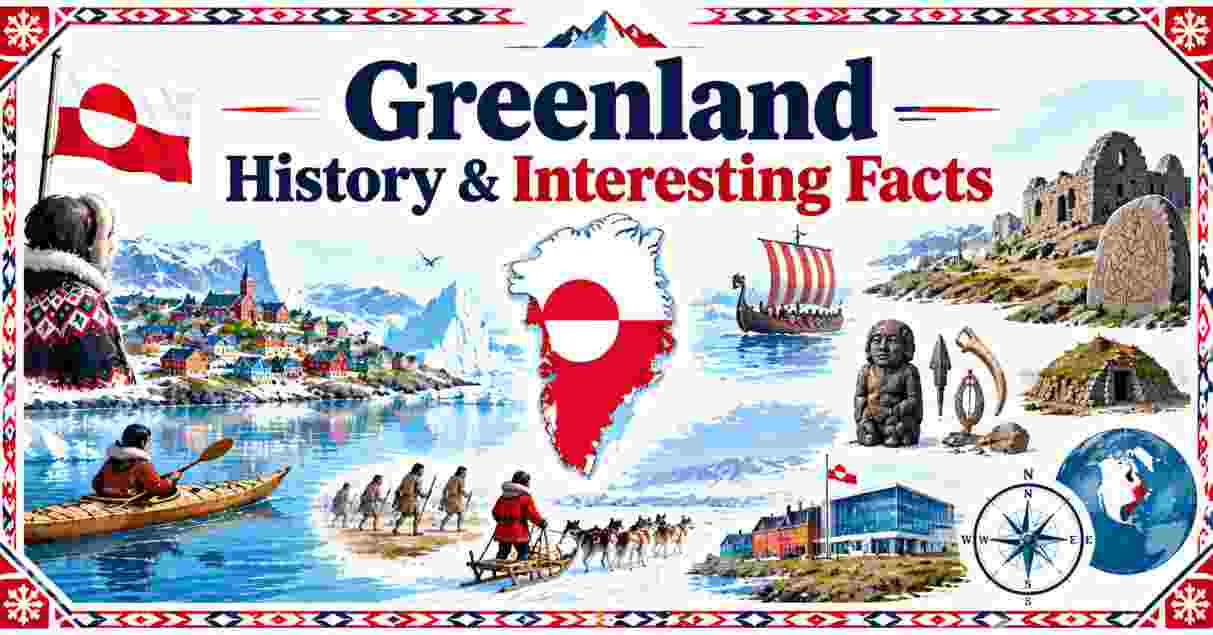
Greenland’s recorded history spans over 4,500 years, from the first Saqqaq migration around 2500 BCE to Erik the Red’s Norse settlement in 985 CE and Danish colonization starting in 1721. Its Norse colony vanished by the mid-15th century after 500 years, and the island did not gain Home Rule from Denmark until 1979.
Greenland History
Greenland history spans more than 4,500 years of human habitation, five distinct waves of Arctic migration, a 500-year Norse settlement that vanished without explanation, and three centuries of Danish colonial rule that only ended in name in 1953. Every layer of that history left a physical trace still visible today: ruined Norse farmsteads along the southwestern fjords, Thule-era hunting camps further north, and the churches and trading posts Danish missionaries built starting in 1721. Few places on Earth compress so many distinct chapters of human adaptation into so small a habitable strip of land.
Greenland is the world’s largest island at 2,166,086 square kilometers, roughly 80% buried under an ice sheet up to three kilometers thick, yet it has never supported more than a few thousand year-round Norse settlers or, today, more than 57,000 residents total. That combination of enormous landmass and near-empty population is not an accident of geography. It is the direct result of a history defined by waves of people arriving, adapting, and in the Norse case, disappearing entirely — a pattern that shapes how historians and archaeologists still study the island today.
Interesting Facts About Greenland
| Fact | Detail |
|---|---|
| First human arrival in Greenland | ~2500 BCE, Saqqaq culture from present-day Canada |
| Norse discovery and naming | 982-985 CE, Erik the Red |
| Norse settlement founded | 985 CE, roughly 14 of 25 ships survived the crossing |
| Norse settlement disappearance | Early-mid 15th century, cause still debated |
| Danish colonization begins | 1721, missionary Hans Egede |
| Greenland ceases to be a colony | 1953, incorporated into Denmark |
| Home Rule granted | 1979 |
| Self-Rule granted | 2009 |
| Total land area | 2,166,086 square kilometers |
| Current population | ~56,000-57,000 |
Source: Britannica, Greenland: Viking, Inuit, Colonization; Wikipedia, History of Greenland; Council of the European Union historical summaries.
The gap between Greenland’s first human arrival around 2500 BCE and its current population of roughly 57,000 is the single most revealing statistic in the island’s history. Six distinct waves of migration — Saqqaq, Independence I and II, Dorset, and finally Thule culture — each arrived, adapted to one of the harshest inhabitable environments on Earth, and either vanished or evolved into the next group. The Norse were the only Europeans to attempt permanent settlement before the 18th century, and their roughly 500-year presence, followed by total disappearance, remains one of Arctic archaeology’s most studied mysteries.
The jump from Danish colonization in 1721 to Home Rule in 1979 — a gap of 258 years — represents one of the longer uninterrupted colonial relationships in modern history, and it explains why Greenland’s political status remains genuinely unresolved even today. Self-Rule followed in 2009, giving Greenland authority over every domestic sphere except foreign affairs, security, and financial policy, and opening a legal pathway toward eventual independence should Greenlanders choose to pursue it.
Greenland’s Ancient Settlement History 2026
| Culture | Approximate Period | Origin |
|---|---|---|
| Saqqaq | c. 2500 BCE – 800 BCE | Arctic Canada |
| Independence I | c. 2400 BCE – 1300 BCE | Arctic Canada |
| Independence II | c. 800 BCE – 1 CE | Arctic Canada |
| Dorset (Paleo-Inuit) | c. 500 BCE – 1300 CE | Arctic Canada |
| Thule culture (ancestors of modern Inuit) | c. 1200-1300 CE onward | Alaska, via Arctic Canada |
| Late Dorset disappearance | Second half of 13th century | N/A |
Source: Wikipedia, Norse Settlements in Greenland and History of Greenland; Who Owns Greenland and Why, Poseidon Expeditions.
Long before any European set foot on Greenland, at least four separate Paleo-Inuit cultures had already lived, adapted, and disappeared across the island over roughly 2,500 years. The Saqqaq culture, the earliest confirmed arrivals, crossed from what is now Canada around 2500 BCE and persisted for close to 1,750 years before vanishing from the archaeological record. The Independence I and II cultures, named for the fjord where their remains were first documented, occupied Greenland’s harsh northern reaches in overlapping and successive waves, demonstrating that human beings were willing to repeatedly attempt survival in one of the most extreme environments on the planet, generation after generation, culture after culture.
The Dorset culture, which Danish records place across roughly 500 BCE to 1300 CE, represents the longest single continuous Paleo-Inuit presence in Greenland’s pre-Norse history, and its disappearance in the second half of the 13th century coincides almost exactly with the arrival of the Thule culture migrating east from Alaska. This overlap is not coincidental: archaeological and oral-history evidence increasingly suggests direct contact, and possibly conflict or displacement, between the incoming Thule people and the declining Dorset population — a pattern of cultural succession that would later repeat itself when Thule-descended Inuit encountered the Norse settlers arriving from the opposite direction.
Erik the Red and the Norse Discovery of Greenland 2026
| Metric | Detail |
|---|---|
| Erik the Red’s birth | c. 950 CE, Rogaland, Norway |
| Exiled from Norway | c. 960, father Thorvald exiled for manslaughter |
| Exiled from Iceland | c. 982, three-year banishment for killings |
| First exploration of Greenland | 982-983 CE |
| Returned to Iceland to recruit settlers | 985 or 986 CE |
| Fleet that departed for Greenland | 25 ships, approximately 700 settlers |
| Ships that safely arrived | 14 ships |
| Settlement founded | Brattahlíð, Eastern Settlement |
| Initial settler population | 400-500, never exceeding 2,000-3,000 |
Source: Britannica, Erik the Red; Wikipedia, Erik the Red; Visit Greenland, Erik the Red.
Erik the Red’s naming of the island is one of history’s most enduring pieces of destination marketing. Having explored Greenland’s ice-free southwestern fjords during his three-year exile from Iceland, Erik returned in 985 or 986 CE and deliberately named the harsh, mostly ice-covered landmass “Greenland” — not because it was green, but because a favorable name would attract settlers desperate for new farmland in an increasingly crowded Iceland. The pitch worked: 25 ships and roughly 700 people departed for the new colony, though only 14 ships survived the crossing, with the rest lost to storms or forced to turn back.
The settlers who arrived established what became known as the Eastern Settlement at Brattahlíð, near modern Qassiarsuk, while a second group pushed further north to found the Western Settlement near present-day Nuuk. Even at its historical peak, the Norse Greenlandic population never exceeded roughly 2,000 to 3,000 people — a remarkably small base from which to sustain five centuries of continuous European presence in the Arctic, and one that makes the settlement’s eventual, still-unexplained disappearance all the more historically significant.
The Norse Settlement’s Rise and Disappearance 2026
| Event | Date |
|---|---|
| Norse settlement established | 985 CE |
| Leif Erikson sails to North America (Vinland) | c. 1000 CE |
| First Christian missionaries arrive | c. 1000 CE, brought by Leif Erikson |
| Greenland becomes part of Kingdom of Norway | 1261 |
| Norway enters union with Denmark | 1380 |
| Last documented Norse event: Hvalsey Church wedding | 1408 |
| Norse settlements cease to be inhabited | 15th century, likely by 1450 |
Source: Wikipedia, History of Greenland and Norse Settlements in Greenland; Geopolitical Brief, A Brief History of Greenland.
For roughly two centuries after its founding, Norse Greenland thrived as a functioning outpost of medieval Scandinavian civilization, maintaining trade links with Norway, developing its own bishopric, and even sending Leif Erikson, Erik the Red’s son, on the voyage around 1000 CE that reached North America centuries before Columbus. The settlement’s formal absorption into the Kingdom of Norway in 1261, followed by Norway’s own union with Denmark in 1380, placed Greenland under a chain of distant royal authority that would, centuries later, form the legal basis for modern Danish sovereignty claims.
The Norse settlements’ disappearance remains genuinely unresolved. The last confirmed written record of the Greenland Norse is a high-society wedding recorded at Hvalsey Church in 1408, between two people who are documented as having subsequently left for Iceland by 1410 — meaning even the final documented event describes people leaving, not staying. By some point in the mid-15th century, likely by 1450, the settlements had been abandoned entirely. Historians point to a combination of factors: the onset of the Little Ice Age cooling the climate and shortening growing seasons, the collapse of the European ivory trade that had sustained Greenland’s walrus-tusk export economy, increasing isolation as Norwegian shipping declined, and escalating contact — possibly conflict — with the expanding Thule Inuit population moving into the same fjord systems the Norse had settled.
Danish Colonization of Greenland 2026
| Metric | Detail |
|---|---|
| Hans Egede arrives in Greenland | 1721 |
| Original purpose | To find surviving Norse settlers and convert them to Protestant Christianity |
| Nuuk founded | 1728, relocated from earlier Hope Colony |
| Smallpox epidemic kills much of population | 1733-1734 |
| Danish trade monopoly established | 1776 |
| Greenland closed to foreign access | 1776, reopened only in 1950 |
| Norway ceded from Denmark (Treaty of Kiel) | 1814, Denmark retains Greenland |
| Greenland ceases to be a formal colony | 1953 |
Source: Britannica, Greenland: Viking, Inuit, Colonization; Wikipedia, Nuuk; DIIS, Why is Greenland Part of the Kingdom of Denmark.
Hans Egede’s arrival in 1721 marked the real beginning of continuous Danish presence in Greenland, though his original mission failed completely: the Norwegian-Danish priest had sailed specifically to locate descendants of the medieval Norse settlers, hoping to find they had missed the Protestant Reformation and needed reconverting. He found no Norse survivors at all — only the Thule-descended Inuit population, who had occupied the same fjords for centuries. Egede redirected his mission toward converting the Inuit instead, founding a Lutheran mission and trading post that, after relocating in 1728, became the settlement of Godthaab — modern Nuuk, Greenland’s capital.
The colonial relationship that followed was defined by control and isolation as much as by religious conversion. Denmark established a full trading monopoly in 1776, closing Greenland’s coast to virtually all foreign contact for 174 years, a policy not reversed until 1950. The Treaty of Kiel in 1814, which formally separated Norway from Denmark following the Napoleonic Wars, could have transferred Greenland to Norwegian control alongside Norway’s independence — instead, Denmark retained sovereignty, a decision whose legal legacy still underpins Denmark’s claim to the island today. That colonial status did not formally end until 1953, when constitutional amendments folded Greenland into Denmark proper as a county rather than a colony — a status upgrade that fell well short of genuine self-governance and set the stage for the home rule movement that followed. The broader Nordic context behind Denmark’s centuries-long Arctic ambitions is explored further in our report on Norway’s population statistics, the country whose medieval crown once claimed Greenland before ceding it to Denmark.
Greenland’s Path to Self-Governance 2026
| Milestone | Year | Significance |
|---|---|---|
| County status within Denmark | 1953 | Greenland ceases to be a colony; gains two seats in Danish Parliament |
| Home Rule Act | 1979 | Greenlandic Parliament (Inatsisartut) formed; own government established |
| Kalaallisut becomes sole official language | 2012 | Cultural and linguistic self-determination |
| Self-Rule Act | 2009 | Greenland gains authority over all domestic spheres except foreign, security, and financial policy |
| Independence referendum right | Established 2009 | Referendum requires Greenlandic parliamentary consent and popular vote |
Source: Danish Ministry of Foreign Affairs, History and Culture; DIIS, Why is Greenland Part of the Kingdom of Denmark; Wikipedia, Greenlandic Independence.
The transition from county status in 1953 to Home Rule in 1979 took 26 years, and it was driven substantially by growing Greenlandic frustration with Danish-directed modernization policies of the 1950s and 1960s that had relocated populations and reshaped traditional fishing and hunting economies with limited local input. The 1979 Home Rule Act was a genuine turning point: it created the Inatsisartut, Greenland’s own parliament, along with a home rule government exercising authority over an expanding range of domestic matters, even as Denmark retained control over foreign affairs, defense, and the judiciary.
The 2009 Self-Rule Act represented an even more consequential shift, because it did something no prior arrangement had: it explicitly established a legal pathway for full Greenlandic independence, contingent on approval by both the Inatsisartut and a popular referendum, with independence terms to be separately negotiated with Denmark. This is the legal foundation underlying every independence debate that has followed, including the intense international attention Greenland received throughout 2025 and 2026. Opinion polling has consistently shown a majority of Greenlanders favor eventual independence, but with significant hesitation about pursuing it if doing so would collapse Greenland’s welfare state, which remains substantially subsidized by an annual Danish block grant.
Greenland Geography and Demographic Statistics 2026
| Metric | 2026 Figure |
|---|---|
| Total land area | 2,166,086 square kilometers |
| Ice sheet coverage | ~80% of total area |
| Ice sheet thickness (maximum) | Up to 3 kilometers |
| Current total population | ~56,000-57,000 |
| Share of population that is Inuit or mixed Inuit-Danish | ~88-90% |
| Population living in capital, Nuuk | ~19,000-25% of total |
| Coastline length | 39,330 kilometers |
Source: Geographical, Greenland: At a Glance; CIA World Factbook, Greenland; Visit Greenland, 10 Facts About Greenland.
Greenland’s 2,166,086 square kilometers make it the world’s largest island by a wide margin, yet roughly 80% of that landmass sits buried under an ice sheet up to three kilometers thick — a physical reality that has shaped every wave of human settlement described above. Only the narrow, ice-free coastal strip, concentrated primarily along the southwest, has ever supported meaningful habitation, which explains why a landmass three times the size of Texas has never hosted more than a few thousand Norse settlers historically and supports barely 57,000 residents today.
The demographic composition of that modern population — roughly 88 to 90% Inuit or of mixed Inuit-Danish descent — reflects the ultimate historical outcome of Greenland’s settlement story: the Thule-descended Inuit population that arrived around the 13th century outlasted the Norse entirely and remains the demographic and cultural foundation of the island today. Nuuk’s concentration of roughly a quarter of the total population in a single capital city is itself a modern phenomenon, reflecting 20th-century Danish-directed urbanization policies that consolidated a historically dispersed, coastal-settlement population into fewer, larger towns — a pattern of remote-territory demographic upheaval echoed elsewhere in colonial history, including the forced relocation covered in our report on Diego Garcia’s history and geography.
Greenland’s Great Polar Expeditions 2026
| Explorer / Expedition | Date | Key Achievement |
|---|---|---|
| First Thule Expedition (Rasmussen and Freuchen) | 1912 | Traveled 620 miles across the inland ice, disproving Robert Peary’s claim of a channel dividing Peary Land from Greenland |
| Second Thule Expedition | 1916-1918 | Mapped a previously little-known stretch of Greenland’s north coast |
| Fourth Thule Expedition | 1919-1920 | Collected ethnographic data around Tasiilaq in east Greenland |
| Fifth Thule Expedition | 1921-1924 | Rasmussen’s team traveled roughly 18,000 miles, becoming the first Europeans to cross the Northwest Passage by dog sled |
| Ten-volume ethnographic report published | 1946 | Documented Inuit culture and origins from Greenland to Siberia |
Source: Wikipedia, Knud Rasmussen and Fifth Thule Expedition; Explorersweb, One Hundred Years On: The Fifth Thule Expedition; Quark Expeditions, A Northwest Passage Legend.
Knud Rasmussen, born in 1879 in Ilulissat on Greenland’s west coast to a Danish father and a mother of partial Inuit descent, grew up speaking Kalaallisut before Danish and became the most consequential Arctic explorer of the 20th century. His First Thule Expedition in 1912, undertaken with fellow explorer Peter Freuchen, set out specifically to test Robert Peary’s claim that a channel separated Peary Land from the rest of Greenland. The team’s grueling 620-mile crossing of the inland ice, conducted with four sledges and 53 dogs through temperatures as low as -30°C at elevations over 2,000 meters, proved Peary wrong and prompted the Royal Geographical Society’s president to call it “the finest journey ever performed by dogs.”
Rasmussen’s Fifth Thule Expedition, launched in 1921 with a team of Danish and Greenlandic Inuit companions, dwarfed everything that came before it. Over more than three years, expedition members covered close to 18,000 miles by dog sled and on foot, traveling from Greenland across the length of the Canadian Arctic to Nome, Alaska, and becoming the first Europeans to traverse the Northwest Passage entirely by sled. The resulting ten-volume scientific report, published between 1927 and 1946, remains a foundational reference in Arctic anthropology, documenting shared cultural threads among Inuit communities separated by thousands of miles of tundra and sea ice — evidence, gathered nearly a millennium after the Thule migration itself, of just how far that single wave of Arctic settlement had once spread. The broader story of how Arctic peoples migrated across North America before eventually reaching Greenland is explored further in our report on Native American history, tribes, and heritage, since the Thule culture’s own migration route traced back through the same Arctic Canadian corridor that shaped Indigenous settlement across the wider continent.
Frequently Asked Questions About Greenland History
Who discovered Greenland?
Erik the Red, a Norwegian Viking exiled from Iceland, is credited with the first successful European settlement of Greenland, arriving around 982-983 CE and founding a permanent colony in 985 CE. Earlier Norse sailors, including Gunnbjörn Ulfsson, had sighted the coastline decades before without settling it, and Paleo-Inuit cultures had inhabited parts of the island for thousands of years before any European contact.
Why is it called Greenland if it’s covered in ice?
Erik the Red deliberately chose the name “Greenland” as a recruitment tool, hoping an appealing name would attract Icelandic settlers to the mostly ice-covered island. The strategy worked: 25 ships carrying roughly 700 people set sail for the new colony in 985 CE.
What happened to the Norse settlers in Greenland?
The Norse settlements, which lasted roughly 500 years, disappeared sometime in the mid-15th century, likely by 1450. Historians attribute the collapse to a combination of the Little Ice Age’s cooling climate, the collapse of the European walrus-ivory trade, increasing isolation from Norway, and growing contact with the expanding Thule Inuit population.
When did Denmark colonize Greenland?
Danish colonization effectively began in 1721 when missionary Hans Egede arrived, though Denmark’s legal claim traces back to medieval Norse settlement and the 1380 union between Norway and Denmark. Greenland remained a formal Danish colony until 1953.
When did Greenland gain independence from Denmark?
Greenland has not gained full independence. It received Home Rule in 1979 and expanded Self-Rule in 2009, which established a legal pathway to independence requiring both parliamentary and popular referendum approval, though Denmark still controls foreign affairs, defense, and financial policy.
How many people lived in Norse Greenland at its peak?
The Norse Greenlandic population never exceeded roughly 2,000 to 3,000 people at its historical peak, spread across the Eastern and Western Settlements founded by Erik the Red and his followers starting in 985 CE.
What is Greenland’s population today?
Greenland’s total population is approximately 56,000 to 57,000 people, of whom roughly 88 to 90% are Inuit or of mixed Inuit-Danish descent, making it one of the least densely populated territories on Earth.
How big is Greenland compared to other places?
Greenland covers 2,166,086 square kilometers, making it the world’s largest island. It is more than three times the size of Texas and larger than France, Germany, Spain, the United Kingdom, Italy, Greece, Switzerland, and Belgium combined.
What is the Thule culture and how does it relate to modern Greenlanders?
The Thule culture, ancestors of the modern Inuit, migrated from Alaska into Arctic Canada and then Greenland starting around 1200-1300 CE, eventually displacing or absorbing the earlier Dorset culture. Today’s Inuit and mixed Inuit-Danish population, making up roughly 88-90% of Greenland’s residents, descends directly from this Thule migration.
Who was Knud Rasmussen?
Knud Rasmussen (1879-1933) was a Greenlandic-Danish polar explorer and anthropologist born in Ilulissat. He led seven Thule Expeditions between 1912 and 1933, most famously the Fifth Thule Expedition (1921-1924), during which his team traveled roughly 18,000 miles by dog sled and became the first Europeans to cross the Northwest Passage.
Disclaimer: The data research report we present here is based on information found from various sources. We are not liable for any financial loss, errors, or damages of any kind that may result from the use of the information herein. We acknowledge that though we try to report accurately, we cannot verify the absolute facts of everything that has been represented.