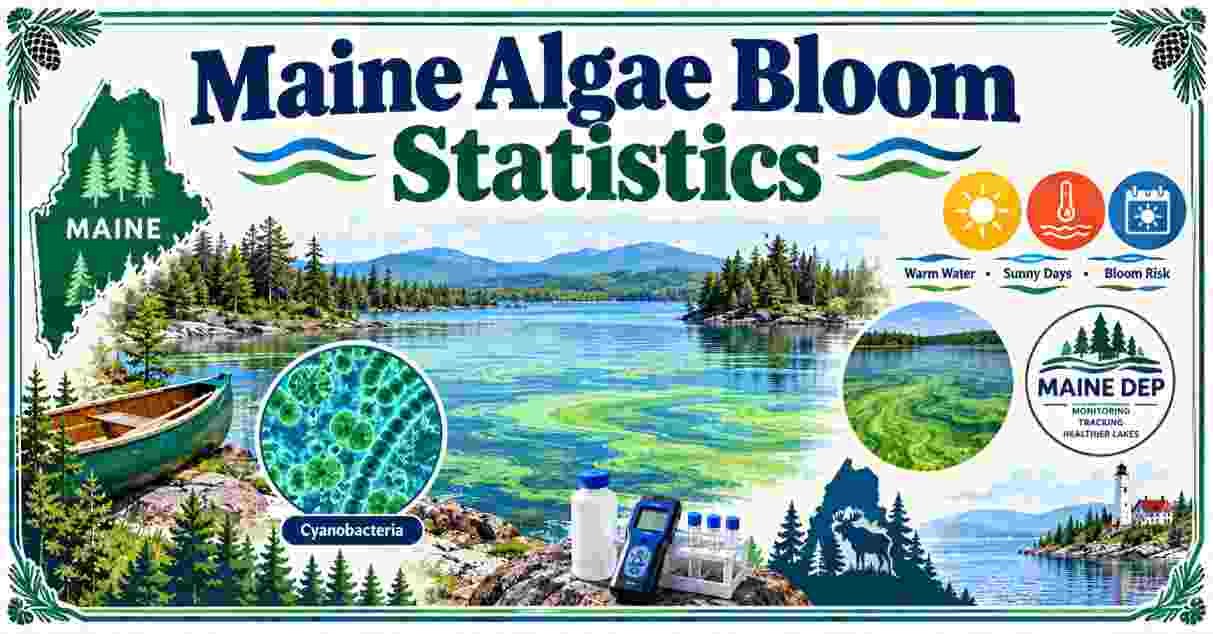
A harmful algae bloom of Karenia mikimotoi spread along the Maine coast in September 2026, with satellite imagery showing it stretching from Penobscot Bay south through New Hampshire and Massachusetts. Maine’s Department of Marine Resources measured phytoplankton counts as high as 2 million cells per liter in Portland Harbor before issuing an emergency shellfish harvesting closure for Maquoit Bay and Middle Bay on September 18, 2026.
Maine Algae Bloom – Introduction
The 2026 Maine algae bloom became one of the most closely watched harmful algal events on the East Coast this year, notable less for the intensity of any single measurement and more for how far it spread along the New England coastline. The bloom, caused by a phytoplankton species called Karenia mikimotoi, does not pose a direct health risk to people, but it produces compounds that can kill fish and shellfish, and it triggered visible brown discoloration and a distinct odor in Casco Bay waters starting in early September.
Maine’s Department of Marine Resources first identified the species in central and southern Casco Bay in early September, and within weeks satellite imagery showed the bloom’s footprint extending far beyond its original detection zone, prompting emergency shellfish harvesting closures in two Casco Bay locations. This report covers the verified statistics behind the bloom: its geographic size, cell count measurements, marine life impact, and how it compares to the last major Karenia mikimotoi event in Maine, back in 2017.
Interesting Facts About the 2026 Maine Algae Bloom
| Fact | Figure |
|---|---|
| Species Responsible | Karenia mikimotoi |
| Peak Cell Count, 2026 (Portland Harbor) | 2 million cells per liter |
| Peak Cell Count, 2017 Bloom (for comparison) | 44 million cells per liter |
| Geographic Extent | Penobscot Bay to New Hampshire and Massachusetts |
| Areas Under Emergency Shellfish Closure | Maquoit Bay (Brunswick) and Middle Bay |
| Closure Effective Date | September 20, 2026 |
| 2017 Economic Loss to Fishermen | $250,000 |
| Harmful to Humans | No |
Data Source: Maine Department of Marine Resources; Bigelow Laboratory for Ocean Sciences
These figures describe a bloom that is smaller in concentrated cell count than Maine’s last major Karenia mikimotoi event but considerably larger in geographic reach. The 2026 peak measurement of 2 million cells per liter in Portland Harbor is a small fraction of the 44 million cells per liter recorded during the 2017 bloom, yet satellite imagery shows the 2026 bloom extending across a much wider stretch of coastline, from Penobscot Bay in the north down through New Hampshire and Massachusetts in the south.
The species itself, Karenia mikimotoi, is not harmful to humans, distinguishing it from the toxin-producing algae behind “red tide” shellfish poisoning. Its risk is instead concentrated entirely on marine life: the department’s own announcement noted the species “can produce compounds that can potentially impact fish and shellfish,” with fish kills and seafloor die-offs reported during past blooms of this species in locations including Hong Kong, Australia, Ireland, Japan, Korea, and Alaska.
2026 Maine Algae Bloom Timeline | Key Dates
2026 MAINE ALGAE BLOOM — TIMELINE
Sept 1     DMR finds bloom on New Meadows River (mostly different species)
Sept 8     DMR identifies Karenia mikimotoi in central/southern Casco Bay
Mid-Sept   Cell counts reach 2 million/liter in Portland Harbor
Sept 18    Emergency shellfish closure announced
Sept 20    Closure takes effect in Maquoit Bay and Middle Bay
| Date | Event |
|---|---|
| September 1, 2026 | DMR finds an algal bloom on the New Meadows River, mostly a different species |
| September 8, 2026 | DMR identifies Karenia mikimotoi in central and southern Casco Bay |
| Mid-September 2026 | Cell counts reach 2 million per liter in Portland Harbor |
| September 18, 2026 | DMR announces emergency shellfish harvesting closure |
| September 20, 2026 | Closure takes effect in Maquoit Bay and Middle Bay |
Data Source: Maine Department of Marine Resources; Portland Press Herald
The bloom’s identification followed a short but eventful sequence. Maine’s Department of Marine Resources found an earlier bloom on the New Meadows River on September 1, though that bloom was made up mostly of a different phytoplankton species, with only trace amounts of Karenia mikimotoi present. The department learned of a separate bloom in central and southern Casco Bay the following Monday and confirmed Karenia mikimotoi there on Tuesday, September 8, notifying harvesters and the public the same day.
Within two weeks, conditions had progressed enough that the department announced an emergency closure of shellfish harvesting in two specific locations, Maquoit Bay in Brunswick and Middle Bay, effective September 20, 2026. The department’s own data showed cell counts trending downward by the time of the closure announcement, though officials specifically cautioned that past mortality events have often occurred as a bloom declines rather than at its peak.
Geographic Size of the 2026 Bloom | From Penobscot Bay to Massachusetts
2026 BLOOM GEOGRAPHIC EXTENT (NORTH TO SOUTH)
Penobscot Bay, ME       (northern extent)
Casco Bay, ME           (core impact zone)
Portland Harbor, ME
New Hampshire coast
Massachusetts coast     (southern extent)
| Location | Bloom Status |
|---|---|
| Penobscot Bay | Northern extent, per satellite imagery |
| Casco Bay (Portland Harbor to Middle Bay) | Core impact zone; most significant effects |
| Harpswell and Brunswick, ME | Among the most severely affected towns |
| New Hampshire coast | Within the bloom’s tracked extent |
| Massachusetts coast | Southern extent, per satellite imagery |
Data Source: Satellite Imagery Cited by WGME; University of New Hampshire Department of Biological Sciences
Satellite imagery tracking the bloom showed it extending across nearly the entire length of the Maine coastline and beyond, reaching as far north as Penobscot Bay and as far south as the New Hampshire and Massachusetts coasts. Researchers monitoring the bloom, including Elizabeth Harvey, associate professor and chair of the Department of Biological Sciences at the University of New Hampshire, noted that its size, rather than any single toxicity measurement, is what made this particular bloom stand out from typical seasonal algae activity.
Within that broad geographic footprint, the most significant, concentrated effects were reported around Casco Bay, particularly the towns of Harpswell and Brunswick, where harbormasters and harvesters documented the earliest and most visible signs of marine life stress. Harpswell’s harbormaster and marine resources administrator, Darcie Couture, told local reporters that satellite images showed the bloom moving into new areas even as it appeared to decrease in others, a pattern consistent with a large-scale coastal bloom shifting with wind and current conditions rather than sitting static in one location.
Karenia mikimotoi 2026 | The Species Behind the Bloom
KARENIA MIKIMOTOI — KEY FACTS
First Isolated                    1957, near Woods Hole, MA
First Maine Occurrence            2017
Harmful to Humans                  No
Harmful to Fish and Shellfish     Yes
Produces Bioluminescent Glow       No
| Fact | Detail |
|---|---|
| First Scientifically Isolated | 1957, near Woods Hole, Massachusetts |
| First Documented in Maine | August 2017 |
| Harmful to Humans | No |
| Harmful to Fish and Shellfish | Yes, via toxic compounds |
| Produces Bioluminescent Glow | No |
| Prior Global Mortality Events | Hong Kong, Australia, Ireland, Japan, Korea, Alaska |
Data Source: Northeast Harmful Algal Bloom (HAB) Monitoring Network
Karenia mikimotoi was first isolated from a coastal lagoon near Woods Hole, Massachusetts, in 1957, though it was originally classified under a different scientific name. Large-scale blooms of the species have become an emerging pattern in New England specifically since its first documented occurrence in Maine in August 2017, when it was concentrated in the Fore River, Portland Harbor, and parts of the Harpswell coastal waters.
Unlike the algae species responsible for traditional “red tide” shellfish poisoning, Karenia mikimotoi poses no direct threat to human health and does not produce the bioluminescent glow sometimes associated with other algae blooms. Its danger lies entirely in the compounds it produces that are toxic to fish and shellfish, a characteristic that has caused documented fish kills and seafloor die-offs in prior blooms recorded in locations as far apart as Hong Kong, Australia, Ireland, Japan, Korea, and Alaska.
Marine Life Impact 2026 | Shellfish & Finfish Mortality
REPORTED MARINE LIFE IMPACTS — SEPTEMBER 2026
Clam die-offs reported               Middle Bay, Maquoit Bay
Species affected                     Softshell clams, worms, other benthic organisms
Cause of shellfish/lobster death     Anoxic (low-oxygen) conditions in gear
| Impact | Detail |
|---|---|
| Species Affected | Softshell clams, marine worms, other benthic organisms |
| Locations With Reported Die-Offs | Middle Bay and Maquoit Bay |
| Cause of Death for Trapped Shellfish/Lobster (2017 precedent) | Anoxic (low-oxygen) water in traps and crates |
| First Reports of 2026 Mortality | Early-to-mid September, Harpswell and Brunswick |
Data Source: Maine Department of Marine Resources; Harpswell Anchor
Clam harvesters in Harpswell and Brunswick began reporting dead and dying clams in early-to-mid September, with the most significant impacts concentrated in Middle Bay and Maquoit Bay. Harvesters described an intense smell of rotting shellfish on exposed mud at low tide, alongside visibly dying clams in the affected flats. The Department of Marine Resources has been collecting water, shellfish, and marine worm samples to document the full extent of the bloom’s biological impact.
The mechanism behind past Karenia mikimotoi mortality events, established during the 2017 Casco Bay bloom, involves shellfish and lobster trapped in fishing gear being unable to escape anoxic, or oxygen-depleted, water created by the bloom, effectively suffocating them where they sit. That same dynamic is what officials are watching for as the 2026 bloom continues to move through different areas of the Maine coast. For context on how other environmental events have affected marine and coastal ecosystems elsewhere in North America, see Wildfire Smoke Death Statistics in Canada.
Shellfish Harvesting Closures 2026 | Maquoit Bay & Middle Bay
EMERGENCY SHELLFISH CLOSURE — SEPTEMBER 2026
Location 1        Maquoit Bay, Brunswick
Location 2        Middle Bay
Effective Date    September 20, 2026
| Detail | Fact |
|---|---|
| Closure Type | Emergency closure of shellfish harvesting |
| Locations Closed | Maquoit Bay (Brunswick) and Middle Bay |
| Announced | September 18, 2026 |
| Effective | September 20, 2026 |
| Reason | Karenia mikimotoi bloom and associated marine life mortality |
Data Source: Maine Department of Marine Resources
Maine’s Department of Marine Resources announced an emergency closure of shellfish harvesting in Maquoit Bay in Brunswick and Middle Bay on September 18, 2026, with the closure taking effect two days later. The decision followed weeks of monitoring that included brown water discoloration, an accompanying odor, and reported shellfish mortality in the affected areas.
The department noted that algae cell counts had been trending downward by the time of the closure announcement, indicating the bloom was past its peak concentration in those specific locations. However, officials were explicit that this did not mean the risk to marine life had passed, since past Karenia mikimotoi mortality events in Maine have often occurred as a bloom declines rather than at the moment of its highest measured cell count. Shellfish safety monitoring like this fits into a much broader national food-safety system; for wider context, see Foodborne Illness Statistics in the US.
2026 Bloom vs. 2017 and Other Historical Events | How It Compares
MAINE KARENIA MIKIMOTOI BLOOMS COMPARED
2017: Peak cell count (millions/liter)    ███████████████ 44
2026: Peak cell count (millions/liter)    ██ 2
| Metric | 2017 Bloom | 2019 Bloom | 2026 Bloom |
|---|---|---|---|
| Peak Cell Count | 44 million cells/liter | Not specified | 2 million cells/liter |
| Geographic Extent | Fore River, Portland Harbor, Harpswell | Casco Bay | Penobscot Bay to Massachusetts |
| Mortality Reported | Yes (softshell clams) | No | Yes (clams, in progress) |
| Economic Impact | $250,000 to fishermen | None recorded | Under assessment |
Data Source: Northeast Harmful Algal Bloom (HAB) Monitoring Network; Maine Department of Marine Resources
Comparing the 2026 bloom to Maine’s documented history with this species shows a smaller peak concentration but a notably larger geographic footprint. The 2017 bloom, Maine’s first documented Karenia mikimotoi event, peaked at 44 million cells per liter and coincided with a softshell clam die-off in Brunswick that cost fishermen an estimated $250,000, though a direct causal link between the bloom and that specific mortality event was not formally established. A smaller 2019 bloom in Casco Bay produced no recorded mortalities at all.
The 2026 bloom’s peak measurement of 2 million cells per liter sits far below the 2017 figure, but its documented spread from Penobscot Bay to Massachusetts covers considerably more coastline than either prior Maine event. That combination, lower peak concentration but wider geographic distribution, is part of why researchers describe this bloom as notable primarily for its size rather than its intensity at any single measured location. For comparison, other major waterways face their own distinct water-quality and ecological monitoring challenges; see Danube River Statistics.
Frequently Asked Questions About the Maine Algae Bloom
What species is causing the 2026 Maine algae bloom?
The bloom is caused by Karenia mikimotoi, a phytoplankton species first documented in Maine in 2017.
Is the 2026 Maine algae bloom dangerous to humans?
No. Karenia mikimotoi is not harmful to humans, though it can produce compounds toxic to fish and shellfish.
How large is the 2026 Maine algae bloom?
Satellite imagery shows the bloom extending from Penobscot Bay in the north to New Hampshire and Massachusetts in the south.
What was the peak cell count recorded in 2026?
Maine’s Department of Marine Resources measured cell counts as high as 2 million cells per liter in Portland Harbor.
How does the 2026 bloom compare to the 2017 Maine bloom?
The 2017 bloom peaked far higher, at 44 million cells per liter, but covered a smaller geographic area than the 2026 bloom.
Which areas were closed to shellfish harvesting in 2026?
Maquoit Bay in Brunswick and Middle Bay were placed under an emergency shellfish harvesting closure effective September 20, 2026.
What marine life has been affected by the bloom?
Softshell clams, marine worms, and other benthic organisms have shown signs of mortality, particularly in Middle Bay and Maquoit Bay.
How does Karenia mikimotoi kill shellfish and lobster?
It produces compounds toxic to marine life and can create low-oxygen (anoxic) conditions, which can suffocate shellfish and lobster trapped in fishing gear.
Has this species caused problems in other parts of the world?
Yes. Prior Karenia mikimotoi mortality events have been documented in Hong Kong, Australia, Ireland, Japan, Korea, and Alaska.
Is the bloom still growing as of this report?
Cell counts were trending downward in some areas by mid-September 2026, though officials cautioned that mortality events have historically occurred as the bloom declines, not just at its peak.
Disclaimer: The data research report we present here is based on information found from various sources. We are not liable for any financial loss, errors, or damages of any kind that may result from the use of the information herein. We acknowledge that though we try to report accurately, we cannot verify the absolute facts of everything that has been represented.