Edinburgh Fringe Festival in 2026
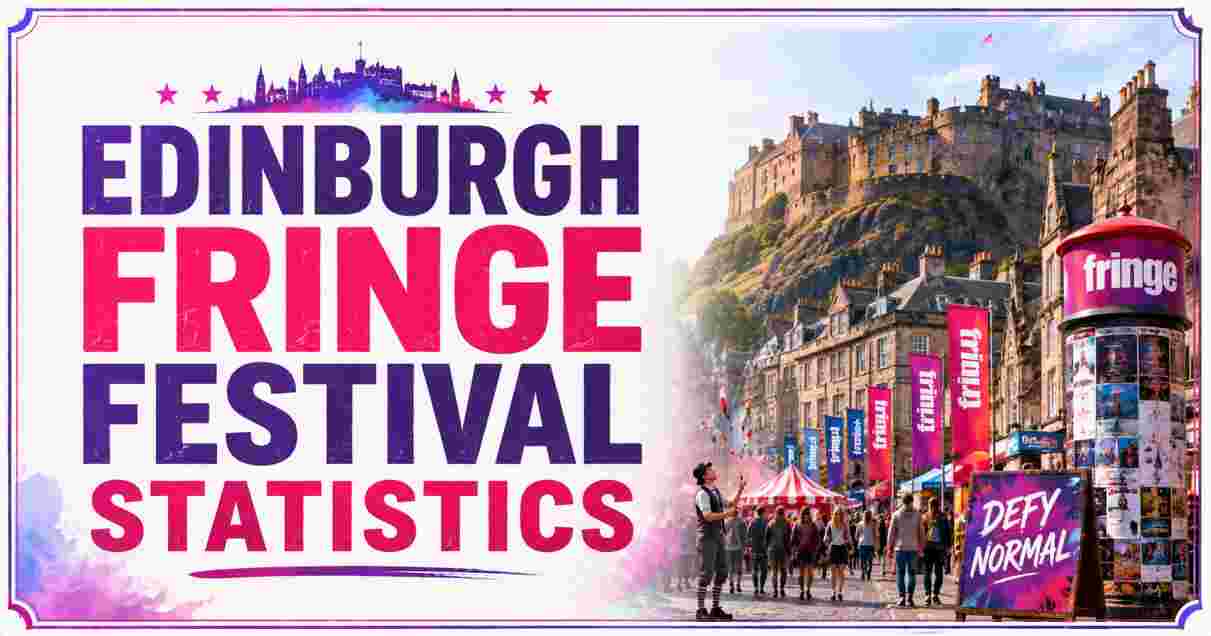
The Edinburgh Festival Fringe, the world’s largest arts festival, returns for its 80th anniversary run from 7 to 31 August 2026, with organizers expecting over 3,000 shows across more than 300 venues throughout Scotland’s capital. Founded in 1947 when eight uninvited theatre groups turned up alongside the newly established Edinburgh International Festival, the Fringe has grown into a 25-day, global cultural phenomenon that issued 2.6 million tickets in 2025 alone.
This report compiles the most current, verified Edinburgh Fringe statistics for 2026, covering confirmed 2025 final attendance figures, 2026 dates and ticket pricing, international participation, and the economic impact of both the Fringe specifically and Edinburgh’s broader festival ecosystem. All figures come directly from the Edinburgh Festival Fringe Society’s official year-end review, Festivals Edinburgh’s independent economic impact study, and named reporting from the BBC, Chortle, and the Scotsman.
Key Edinburgh Fringe Statistics for 2026
| Statistic | Figure |
|---|---|
| 2026 festival dates | 7-31 August 2026 (25 days) |
| Founding year | 1947 — 79 years running |
| 2026 expected shows | Over 3,000, with some venues reporting up to 3,919 |
| 2026 expected venues | Over 300 |
| 2026 countries represented in the programme | 71 |
| 2025 final tickets issued (confirmed) | 2,604,404 |
| 2025 final registered shows | 3,893 (up 3.4% year-over-year) |
| 2025 total performances | 53,942 |
| 2025 venues used | 301 |
| Typical 2026 ticket price range | £8 to £18, with premium shows at £20 to £30+ |
| 2025 arts industry attendees | 1,771 from 68 countries |
| 2025 media professionals (record) | 1,100 from 32 countries |
Source: Edinburgh Festival Fringe Society, “Review of the Year 2025,” published December 2025; Chortle, “The Edinburgh Fringe in Figures,” December 2025; Wikipedia, “Edinburgh Festival Fringe,” 2026.
The 2025 festival’s final confirmed numbers set the baseline against which 2026 is being measured. The Fringe Society’s own year-end review counted 2,604,404 tickets issued across 3,893 registered shows — a 3.4% increase in show count from the previous year — generating 53,942 individual performances spread across 301 venues over 25 days. Importantly, the Fringe Society itself notes that actual visitor numbers run considerably higher than the ticket count alone, since the figure excludes the many free shows and street performances that take place throughout the city without formal ticketing.
Heading into its 80th anniversary edition, the 2026 programme has already grown on at least one key measure: international representation. The Fringe Society’s own review confirmed the 2026 programme features work from 71 countries, up from the 62 countries represented on stage in 2025 — a genuine expansion in global participation even before the festival’s full attendance and ticketing figures are finalized after its 31 August 2026 close.
2025 Final Attendance and Ticket Statistics
| Metric | 2025 Final Figure |
|---|---|
| Total tickets issued | 2,604,404 |
| Registered Fringe shows | 3,893 |
| Total performances delivered | 53,942 |
| Venues used | 301 |
| Estimated total attendees (including free/street events) | ~750,000 |
| Estimated jobs supported by the Fringe | ~3,000 |
| Countries represented on stage | 62 |
| Country showcases/spotlights | 17 |
Source: Edinburgh Festival Fringe Society, “Review of the Year 2025”; The Scottish Banner, July 2026.
These 2025 figures represent the most recent, fully confirmed dataset available, since the 2026 festival has not yet concluded at the time of this article’s most recent update. The gap between the 2.6 million tickets issued and the estimated 750,000 individual attendees reflects a simple reality of Fringe attendance patterns: a single dedicated Fringe-goer routinely sees multiple shows across their visit, meaning ticket volume substantially overstates unique visitor headcount, a distinction worth understanding when comparing the Fringe’s scale to single-visit events like sporting fixtures or concerts.
The show count itself tells its own year-over-year growth story. The 3,893 shows registered in 2025 marked a 3.4% increase over the prior year, continuing the Fringe’s long-term trajectory as a genuinely open-access festival — unlike a curated arts festival with a selection committee, virtually any performer willing to pay for a venue slot can register a Fringe show, meaning the show count functions as a real-time indicator of how many artists judge the festival worth the financial risk each year.
Edinburgh Fringe 2026: Dates, Shows, and Ticket Prices
| Detail | 2026 Figure |
|---|---|
| Festival dates | 7-31 August 2026 |
| Preview period | 3-9 August 2026 (discounted tickets, smaller crowds) |
| Busiest period | 14-27 August (middle two weeks) |
| Concurrent events | Edinburgh International Festival, Royal Edinburgh Military Tattoo |
| Standard paid ticket range | £8-£18 |
| Premium/big-name comedian tickets | £20-£30+ |
| Same-day discount option | Half Price Hut on the Mound — 50% off |
| Primary ticket platforms | edfringe.com and official app |
| Ticket sales opened | Early June 2026 |
Source: Edinburgh Spirit, “Edinburgh Festival Fringe Guide 2026”; Holafly, “Edinburgh Festival Fringe 2026: Dates, Shows, and Visitor Guide.”
The 2026 Fringe runs concurrently with two other major Edinburgh cultural institutions, a scheduling overlap that intensifies demand across the city throughout August. The Edinburgh International Festival, the more formally curated classical music, opera, and theatre event the Fringe originally sprang from in 1947, runs alongside it, while the Royal Edinburgh Military Tattoo performs nightly on the Castle Esplanade throughout the same period — together making August what local guides describe as Edinburgh’s absolute peak, with hotel prices reportedly quadrupling and transport infrastructure under sustained strain.
Ticket pricing has remained relatively stable and accessible by major festival standards, with the bulk of shows priced £8 to £18, though tickets for established comedians and productions carrying awards buzz can reach £20 to £30 or more. Budget-conscious attendees have access to the Half Price Hut, which sells same-day tickets at 50% off face value — a longstanding Fringe institution that helps sustain the festival’s reputation for spontaneous, low-commitment discovery even as headline act pricing has crept upward in recent years.
International Participation and Industry Statistics
| Metric | 2025 Figure |
|---|---|
| Countries represented in the 2026 programme | 71 |
| Countries represented on stage, 2025 | 62 |
| Arts industry members attending (promoters, producers, bookers) | 1,771, from 68 countries |
| Media professionals attending (record) | 1,100, from 32 countries |
| Reviewers specifically | 718 |
| Participants reporting a positive overall experience | 89% |
| Performances captioned | 459 |
| Performances audio described | 276 |
| Performances BSL interpreted | 154 |
Source: Edinburgh Festival Fringe Society, “Review of the Year 2025”; Chortle, “The Edinburgh Fringe in Figures,” December 2025.
The Fringe’s role as a global arts marketplace, not just a performance festival, shows clearly in its industry attendance figures. 1,771 accredited arts industry professionals — promoters, producers, and venue bookers — traveled from 68 countries specifically to scout and support artists, while a record 1,100 media professionals from 32 countries provided coverage, including 718 dedicated reviewers. This scale of industry and press attendance is central to the Fringe’s long-standing reputation as a genuine career launchpad, credited over the decades with providing an early platform for performers including Rowan Atkinson, Dame Judi Dench, Emma Thompson, and bands like Franz Ferdinand and Snow Patrol.
Accessibility investment has become a measurable, tracked part of the festival’s annual reporting. The 2025 edition delivered 459 captioned performances, 276 audio-described performances, and 154 performances with BSL interpretation, alongside 60% of shows staged in level-access venues. Despite the well-documented financial pressures facing performers discussed later in this article, 89% of participants surveyed still reported a positive overall experience — a notable figure given how openly the Fringe community, including the Society’s own leadership, has acknowledged the festival’s genuine financial precarity for artists in recent years. For a broader look at how UK tourism spending has recovered post-pandemic, providing context for the kind of international visitor base events like the Fringe depend on, see our UK Tourism Statistics coverage, where overseas visitor spending reached £31.1 billion in 2023.
Economic Impact: Fringe-Specific vs. All Edinburgh Festivals Combined
| Economic Measure | Figure | Scope |
|---|---|---|
| Gross economic impact across Scotland | £852 million | All 11 Edinburgh festivals combined, based on 2025 audience data |
| Net economic impact in Edinburgh specifically | £558 million | All 11 Edinburgh festivals combined |
| Edinburgh’s Winter Festival economic impact | £241 million+ | Winter Festival only (Nov-Jan), a separate, smaller festival — not the Fringe |
| Total visitor spend, Edinburgh tourism (year-round) | £2.7 billion | City-wide tourism, not festivals alone |
| Jobs supported, city-wide tourism | 37,000 | City-wide tourism, not festivals alone |
| Jobs supported by the Fringe specifically | ~3,000 | Fringe only |
| Fringe contribution to Edinburgh’s new visitor levy (estimated annual) | £6.5 million | Fringe audiences, artists, industry, and media specifically |
Source: Festivals Edinburgh/BOP Consulting economic impact study, published via The Scotsman, June 29, 2026; BroadwayWorld, “Edinburgh’s Winter Festival Delivers Record £241m Economic Impact,” May 2026; Edinburgh Festival Fringe Society, “Review of the Year 2025.”
This is one of the most commonly confused figures in Fringe reporting, and it’s worth being precise about. The widely-cited £852 million gross / £558 million net economic impact figures, published via a new Festivals Edinburgh study in June 2026, cover all 11 of Edinburgh’s annual festivals combined — including the Edinburgh International Festival, the Royal Edinburgh Military Tattoo, the Edinburgh International Book Festival, Hogmanay, and others — not the Fringe in isolation. The Fringe is unquestionably the largest single contributor to that combined total given its scale, but no source in this research identified a separately broken-out, Fringe-only economic impact figure at this combined level of granularity.
The figures that genuinely are Fringe-specific are more modest but still substantial: the festival is estimated to support roughly 3,000 jobs directly, and Fringe-specific audiences, artists, industry, and media are projected to contribute around £6.5 million annually to Edinburgh’s newly introduced visitor levy specifically. Separately, Edinburgh’s Winter Festival — an entirely different seasonal event running November through January — generated its own £241 million economic impact in 2025/26, a figure sometimes mistakenly conflated with Fringe reporting simply because both fall under the same city’s festival ecosystem. Readers encountering any single “Edinburgh Fringe economic impact” headline figure should check carefully whether it refers to the Fringe alone or the city’s full slate of festivals combined. For context on how Edinburgh’s population and demographic base supports this scale of visitor infrastructure, see our UK Population Statistics coverage.
Performer Economics: The Financial Reality Behind the Stage
| Cost/Revenue Category | Typical 2026 Figure (Mid-Scale Show, 100-Seat Venue) |
|---|---|
| Venue hire for the run | £3,000-£5,000 |
| Accommodation | £2,000-£3,000 |
| Marketing and printing | £1,000-£2,000 |
| Travel | £500-£1,000 |
| Total typical costs | £6,500-£11,000 |
| Estimated revenue (50% capacity, 25 shows, £10/ticket) | ~£3,250 |
| Resulting typical deficit | Several thousand pounds, self-funded by performers |
| Keep It Fringe fund payouts, 2025 (DCMS-backed) | 180 performers received £2,500 each |
Source: Edinburgh Spirit, “Edinburgh Festival Fringe Guide 2026”; Chortle, “The Edinburgh Fringe in Figures,” December 2025.
The financial arithmetic facing a typical mid-scale Fringe performer reveals a structural deficit built into the festival’s open-access model. A performer in a 100-seat venue running a standard 25-show stint faces total costs of roughly £6,500 to £11,000 once venue hire, accommodation, marketing, and travel are accounted for — yet even a respectable 50% capacity at £10 a ticket generates only around £3,250 in revenue. This gap, routinely running into the thousands of pounds, is overwhelmingly carried by the performers themselves, frequently through savings, parental funding, or crowdfunding, according to industry guides covering the festival’s economics.
The Fringe Society and UK government have both acknowledged this financial pressure through targeted, if modest, support programs. The Department for Culture, Media and Sport’s Keep It Fringe fund provided £2,500 payouts to 180 performers in 2025, a meaningful but numerically small intervention relative to the roughly 3,900 shows staged that year. Fringe Society chief executive Tony Lankester acknowledged this tension directly in the organization’s own year-end review, noting the festival community continues “grappling with the big questions” around cost and sustainability heading toward its 80th anniversary in 2027, even as participation numbers themselves continue climbing.
Digital Engagement and Public Sentiment Statistics
| Metric | 2025 Figure |
|---|---|
| Users visiting edfringe.com | Over 3 million |
| Total website page views | 37 million |
| Customer emails received (July-August alone) | Over 54,000 |
| Survey respondents agreeing the Fringe is “one of the most important cultural events in the world” | 80% |
| 2022 comparison: ticket sales at 8 major venues (post-pandemic low point) | 1,486,746, down 25% from 2019’s 1,965,961** |
Source: Edinburgh Festival Fringe Society, “Review of the Year 2025”; BBC News, “Edinburgh’s festivals to receive £8.6m Budget boost,” 2023.
Digital engagement with the Fringe has scaled well beyond the festival’s physical footprint in Edinburgh itself. The official edfringe.com platform drew over 3 million individual users in 2025, generating 37 million page views, while the Fringe Society’s customer service team fielded more than 54,000 emails during the core July-August festival window alone — figures that illustrate the substantial year-round digital operation required to support a festival whose physical run lasts only 25 days.
Public sentiment toward the festival remains strongly positive despite the well-documented cost pressures on performers. A post-festival survey found 80% of respondents agreed the Fringe is “one of the most important cultural events in the world,” a sentiment that has evidently sustained the festival’s recovery from its pandemic-era low point — when ticket sales at the festival’s eight major venues fell to 1,486,746 in 2022, a 25% drop from 2019’s pre-pandemic total of 1,965,961 at those same venues. That recovery trajectory, now culminating in 2025’s confirmed 2.6 million tickets issued festival-wide and a 2026 programme drawing participants from 71 countries, positions the Fringe’s approaching 80th anniversary in 2027 as a genuine milestone for a festival that has more than rebuilt its pre-pandemic scale, even as the underlying financial model performers operate under remains a persistent, openly acknowledged challenge.
Disclaimer: The data research report we present here is based on information found from various sources. We are not liable for any financial loss, errors, or damages of any kind that may result from the use of the information herein. We acknowledge that though we try to report accurately, we cannot verify the absolute facts of everything that has been represented.