
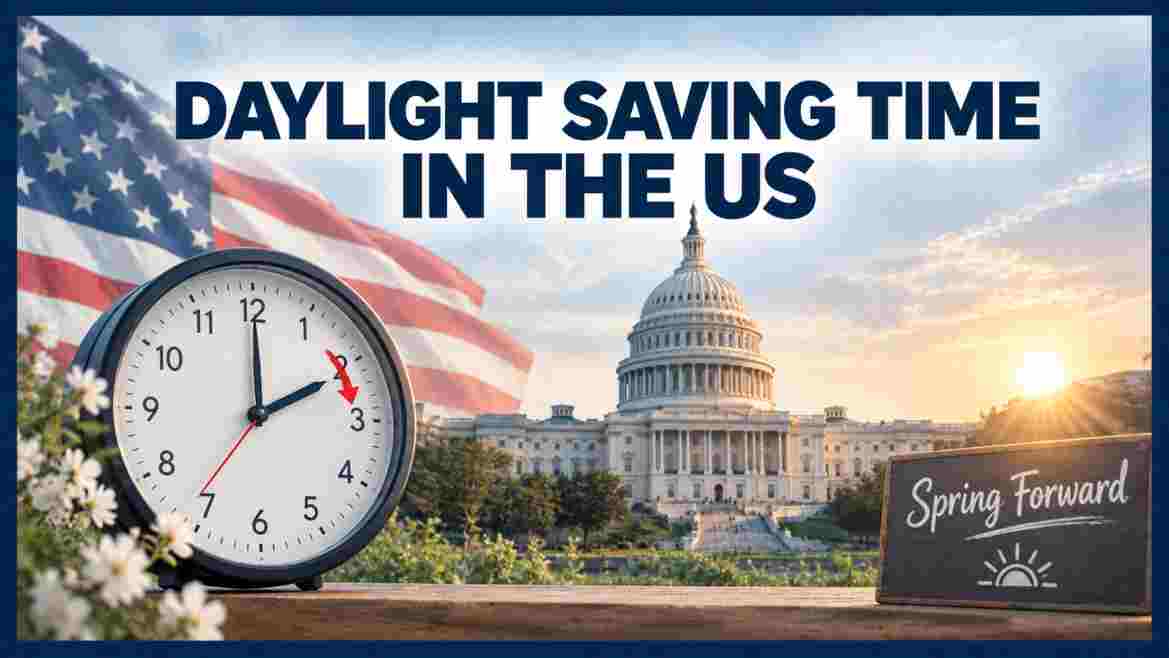
Daylight Saving Time in 2026 runs from Sunday, March 8 at 2 a.m. to Sunday, November 1 at 2 a.m., lasting 238 days, about 65% of the year. Only Hawaii and most of Arizona opt out among US states, while a federal AP-NORC poll found just 12% of Americans favor keeping the twice-yearly clock change system at all.
Daylight Saving Time in the US in 2026
Daylight Saving Time governs how most Americans set their clocks for roughly two-thirds of every year, and 2026 follows the same federal formula used since 2007: clocks spring forward on the second Sunday in March and fall back on the first Sunday in November. For 2026 specifically, that means DST began March 8 and ends November 1, the earliest possible start date the current law allows, giving the country its full 238-day run of daylight saving time for the year.
What makes 2026 different from recent years isn’t the dates themselves, it’s the political momentum building around ending the twice-yearly switch entirely. The House of Representatives passed the Sunshine Protection Act in July 2026, 19 states now have laws on the books ready to adopt permanent daylight saving time the moment Congress allows it, and public polling shows the current system is deeply unpopular even as Americans remain split on what should replace it. This report lays out the verified dates, state-by-state rules, legislative status, and health and safety data behind the ongoing daylight saving time debate, sourced to NIST, the Congressional Research Service, and named public opinion polls, not to independent estimates.
This report also separates two things that get frequently confused in casual coverage of the topic: the routine, predictable mechanics of how DST currently works, which don’t change year to year beyond the calendar date drifting by a week or so, and the genuinely unsettled political question of whether the twice-yearly switch will eventually be abolished. Both halves of the story matter for 2026 specifically, since this is the first year a permanent-DST bill has cleared a full chamber of Congress.
Interesting Facts About Daylight Saving Time in the US 2026
DST 2026 CALENDAR (days)
Standard Time, Jan 1 - Mar 7     █████████████ 66 days
Daylight Saving Time             █████████████████████████ 238 days
Standard Time, Nov 2 - Dec 31    ███████████ 61 days
| Fact | Detail |
|---|---|
| DST 2026 start | Sunday, March 8, 2026, at 2:00 a.m. |
| DST 2026 end | Sunday, November 1, 2026, at 2:00 a.m. |
| Total DST duration | 238 days, about 65% of the year |
| States that don’t observe DST | Hawaii and most of Arizona |
| Americans favoring the current twice-a-year system | 12% (AP-NORC, October 2025) |
| States with enacted permanent-DST legislation | 19, pending federal authorization |
| States that have enacted permanent standard time | 0 |
| Governing federal law | Energy Policy Act of 2005, effective 2007 |
Source: NIST Time and Frequency Division; AP-NORC Center for Public Affairs Research, October 2025; Congressional Research Service, April 2026.
The 238-day length of DST in 2026 reflects the Energy Policy Act of 2005, which extended the daylight saving period by about a month compared to the pre-2007 schedule, pushing the start into early March and the end into early November. Only Hawaii and most of Arizona sit outside this system among the 50 states, both choosing to remain on standard time year-round under an option the Uniform Time Act of 1966 explicitly grants states, though that same law does not let states unilaterally switch to permanent daylight saving time without Congress acting first.
That legal asymmetry, states can opt out of DST but can’t opt into making it permanent on their own, is central to why 19 states now have conditional permanent-DST laws sitting dormant on their books. Public appetite for ending the switch entirely is strong: an AP-NORC poll found just 12% of Americans favor keeping the current twice-yearly system, while 47% oppose it and 40% remain neutral, numbers that explain why the issue keeps resurfacing in Congress even though it has never yet resulted in a change to the underlying law.
When Does Daylight Saving Time Start and End in 2026
DST START DATE BY YEAR (day of March)
2024   ██████████ Mar 10
2025   █████████  Mar 9
2026   ████████  Mar 8
2027   ██████████████ Mar 14
| Year | DST Begins | DST Ends |
|---|---|---|
| 2024 | Sunday, March 10 | Sunday, November 3 |
| 2025 | Sunday, March 9 | Sunday, November 2 |
| 2026 | Sunday, March 8 | Sunday, November 1 |
| 2027 | Sunday, March 14 | Sunday, November 7 |
| 2028 | Sunday, March 12 | Sunday, November 5 |
Source: NIST Time and Frequency Division; Uniform Time Act of 1966, as amended by the Energy Policy Act of 2005.
By federal law, Daylight Saving Time always begins on the second Sunday in March and ends on the first Sunday in November, both changes occurring at 2:00 a.m. local time. In the spring, clocks skip forward from 2 a.m. directly to 3 a.m., meaning that specific day has only 23 hours; in the fall, clocks fall back from 2 a.m. to 1 a.m., repeating that hour and giving the day 25 hours. March 8, 2026 is the earliest possible date DST can begin under the current formula, since the second Sunday in March can fall no earlier than the 8th.
The actual calendar date shifts by roughly a week most years depending on which day of the week January 1 falls on, which is why 2027’s start date jumps forward nearly a full week to March 14. This annual drift is a routine, fully predictable feature of a rule tied to “the second Sunday” rather than a fixed calendar date, and NIST publishes the exact schedule years in advance for exactly this reason.
The same logic applies to the end date in November: because DST always ends on the first Sunday of that month, the latest the clocks can fall back is November 7, and the earliest is November 1, exactly where 2026 lands. Combined with the March 8 start date, 2026 sits at the earliest possible edge of both boundaries simultaneously, producing the longest DST period the current formula allows in a single calendar year.
Which US States Don’t Observe Daylight Saving Time
US POPULATION UNDER EACH DST STATUS, 2026
Observes DST (48 states + DC)         ██████████████████████  ~325M+
Does not observe (Hawaii + Arizona)   ███  ~8.8M
| Location | DST Status |
|---|---|
| Hawaii | Does not observe; permanent standard time |
| Arizona (most of state) | Does not observe; permanent standard time |
| Navajo Nation (within Arizona) | Does observe DST, unlike the rest of the state |
| American Samoa | Does not observe |
| Guam | Does not observe |
| Puerto Rico | Does not observe |
| US Virgin Islands | Does not observe |
| All other US states | Observe DST on the standard federal schedule |
Source: NIST Time and Frequency Division; Uniform Time Act of 1966.
Only Hawaii and most of Arizona opt out of Daylight Saving Time among the 50 states, both remaining on standard time year-round under authority the Uniform Time Act grants any state that chooses not to observe DST. Arizona’s exemption has a notable carve-out: the Navajo Nation, which extends into the northeastern part of the state, does observe DST even though the rest of Arizona does not, creating a genuine time-zone split within state lines for part of the year.
Several US territories, American Samoa, Guam, Puerto Rico, and the US Virgin Islands, also remain on standard time permanently, alongside Hawaii and Arizona. Hawaii’s proximity to the equator, where day length varies little across seasons, removes most of the practical benefit DST is designed to provide, while Arizona’s decision traces back to the state’s intense summer heat, where an extra hour of evening daylight was seen as adding an unwelcome hour of high temperatures rather than a benefit.
The practical effect of this patchwork shows up most noticeably during the DST months themselves. For roughly eight months of the year, Arizona effectively aligns its clock time with Pacific Time Zone neighbors rather than its usual Mountain Time Zone peers, since Mountain Time observes DST while Arizona does not, a quirk that regularly trips up travelers and businesses coordinating schedules across the Southwest.
State Legislation on Permanent Daylight Saving Time in 2026
STATE DST LEGISLATION STATUS (count of states)
Enacted permanent DST (pending Congress)   ████ 19
States that introduced DST-related bills   ██████████████ 47
Enacted permanent standard time            0
| Legislative Status | Number of States |
|---|---|
| Enacted permanent DST legislation (since 2018) | 19 |
| States that have introduced some DST-related legislation (2015-April 2026) | 47 |
| States that enacted permanent standard time legislation | 0 |
| Most recent state to enact permanent DST law | Texas (June 2025) |
| First state to enact permanent DST law | Florida (2018) |
Source: Congressional Research Service, Report R45208, updated April 2026; National Conference of State Legislatures.
Nineteen states, Alabama, Colorado, Delaware, Florida, Georgia, Idaho, Louisiana, Maine, Minnesota, Mississippi, Montana, Oklahoma, Oregon, South Carolina, Tennessee, Texas, Utah, Washington, and Wyoming, have enacted legislation or resolutions that would make daylight saving time permanent the moment Congress grants states that authority, according to the Congressional Research Service. Texas became the most recent addition in June 2025, while Florida’s 2018 Sunshine Protection Act was the first such state law and lent its name to the federal bill that followed.
What’s striking in the CRS data is the complete absence of the opposite approach: zero states have enacted legislation for permanent standard time, despite research suggesting standard time aligns more closely with human circadian rhythms. The imbalance reflects political reality rather than scientific consensus, lawmakers overwhelmingly favor the version of permanent time that preserves longer evening daylight, even though sleep researchers and several public health groups have argued the opposite choice would carry fewer health costs. For broader context on how sleep patterns affect the US population generally, the sleep facts report tracks how many Americans already fall short of recommended sleep duration even without a seasonal clock change compounding the problem.
Daylight Saving Time Health and Safety Statistics in 2026
| Health/Safety Metric | Reported Increase |
|---|---|
| Heart attack risk, Monday/Tuesday after spring transition | +24% (specific study finding) |
| Stroke risk, two days after spring transition | +8%, general population |
| Stroke risk, adults 65+ | +20% |
| Stroke risk, cancer patients | +25% |
| Estimated annual disease incidents linked to seasonal clock changes | ~150,000, 2020 study estimate |
| Fatal traffic accidents | Significant increase on the Sunday of spring transition |
Source: 2011 study cited in California Prop 7 voter guide; Journal of Clinical Medicine meta-analysis; 2020 disease-burden study cited in congressional testimony.
Multiple peer-reviewed studies have linked the spring “spring forward” transition specifically, not the fall change, to measurable short-term health risks. One frequently cited 2011 study found a 24% increase in heart attack risk on the Monday and Tuesday immediately following the spring transition, while a broader meta-analysis published in the Journal of Clinical Medicine described the effect as “modest but significant” across the body of available research, a more cautious characterization than the single-study figure implies.
Stroke risk shows a similar pattern: research cited in California’s own Proposition 7 voter guide found an 8% increase in stroke risk in the two days following a spring transition, rising to 20% among adults over 65 and 25% among cancer patients specifically, populations researchers describe as more vulnerable to acute circadian disruption. A 2020 study estimated the cumulative effect of these disruptions at roughly 150,000 additional disease incidents nationwide per year, and separate research has documented measurable increases in workplace injuries and fatal traffic accidents specifically on the Sunday of the spring transition. For the fuller national picture of how heart disease and stroke rank among US mortality causes generally, the leading causes of death report provides the baseline figures these seasonal spikes are measured against. None of this research claims the clock change itself directly causes these conditions in a mechanistic sense; rather, the studies describe a correlated short-term spike against each population’s normal baseline rate, consistent with sleep disruption acting as a trigger for underlying cardiovascular and cerebrovascular vulnerability rather than a standalone cause.
Public Opinion on Daylight Saving Time in 2026
WHAT AMERICANS WANT INSTEAD OF THE CURRENT SYSTEM (AP-NORC, Oct 2025)
Permanent Daylight Saving Time  ████████████████████████████ 56%
Permanent Standard Time         █████████████████████ 42%
| Poll | Finding |
|---|---|
| AP-NORC (Oct 2025): favor current twice-yearly system | 12% |
| AP-NORC: oppose current system | 47% |
| AP-NORC: neutral | 40% |
| AP-NORC: if forced to choose, prefer permanent DST | 56% |
| AP-NORC: if forced to choose, prefer permanent standard time | 42% |
| Gallup (2025): prefer permanent standard time | 48% |
| Gallup (2025): prefer permanent DST | 24% |
| Gallup (2025): prefer keeping the current system | 19% |
Source: AP-NORC Center for Public Affairs Research, October 9-13, 2025 poll; Gallup, 2025.
Public opinion polling shows broad agreement that the current system is unpopular but notably different results on what Americans want instead, a gap that itself tells an important part of this story. The AP-NORC poll, conducted October 9-13, 2025 among 1,289 adults, found that when forced to choose between the two permanent options, 56% preferred permanent daylight saving time and 42% preferred permanent standard time. Gallup’s separate 2025 survey found the opposite ordering entirely: 48% for permanent standard time versus just 24% for permanent DST, with 19% still preferring to keep switching.
That discrepancy is likely explained by question wording and framing rather than a genuine shift in public opinion between the two surveys, since both were fielded in the same year. Researchers who study the topic have noted that many people who say they prefer DST are actually responding to a preference for summer’s naturally longer days, without fully accounting for how dark winter mornings would become under a permanent daylight-saving schedule, a framing effect that may explain why head-to-head “pick one” polls like AP-NORC’s produce different results than three-option polls like Gallup’s that separately offer the status quo.
The Sunshine Protection Act and Federal Legislative Status in 2026
SUNSHINE PROTECTION ACT TIMELINE, 2026
Jan 2025             Bill introduced (H.R. 139)
Jul 14, 2026         House passes, 308-117
2026+                Senate: no vote scheduled
| Legislative Milestone | Detail |
|---|---|
| Bill name | Sunshine Protection Act of 2025 (H.R. 139) |
| House vote | 308-117, July 14, 2026 |
| Senate status | Referred to Commerce Committee; no vote scheduled |
| What the bill would do | Make daylight saving time the permanent, year-round standard |
| Prior Senate action (different Congress) | Passed by unanimous consent in 2022; stalled in the House |
Source: Congress.gov, H.R. 139, 119th Congress; U.S. House of Representatives roll call vote records.
The Sunshine Protection Act of 2025 passed the House of Representatives by a wide 308-117 margin on July 14, 2026, the furthest the measure has advanced in the current legislative push, but it remains stuck in the Senate Commerce Committee with no floor vote scheduled. The bill would require states to observe daylight saving time year-round unless they specifically exempt themselves, effectively flipping today’s default so that permanent DST, not the twice-yearly switch, becomes the national standard.
This isn’t the bill’s first trip through Congress: an earlier version passed the Senate by unanimous consent in 2022 but then stalled in the House and died at the end of that Congress. With the current Senate now in recess ahead of the November 2026 midterm elections, the bill’s fate for this Congress depends on whether leadership schedules a vote in the limited legislative days remaining, a decision that, as of this writing, has not been made.
That 2022 precedent is instructive: a bill can clear one chamber of Congress with overwhelming support and still fail to become law simply by running out of legislative calendar before the other chamber acts. The 2026 version has already gone further than the 2022 attempt in one respect, a recorded House floor vote with a specific, lopsided margin rather than a voice vote, but it faces the identical structural risk of dying in committee if the Senate doesn’t act before the current Congress ends.
Daylight Saving Time FAQs 2026: What People Are Asking
When does Daylight Saving Time start in 2026?
Sunday, March 8, 2026, at 2:00 a.m. local time, when clocks move forward one hour.
When does Daylight Saving Time end in 2026?
Sunday, November 1, 2026, at 2:00 a.m. local time, when clocks fall back one hour.
How long does Daylight Saving Time last in 2026?
238 days, about 65% of the calendar year.
Which US states don’t observe Daylight Saving Time?
Hawaii and most of Arizona remain on standard time year-round; Arizona’s Navajo Nation is an exception and does observe DST.
Do Americans support ending Daylight Saving Time?
Most oppose the current twice-yearly system: an AP-NORC poll found only 12% favor it, while 47% oppose it.
How many states have passed laws for permanent Daylight Saving Time?
19 states, though none can take effect until Congress changes federal law.
What is the Sunshine Protection Act?
A federal bill, H.R. 139, that would make daylight saving time permanent nationwide; it passed the House 308-117 on July 14, 2026 but remains stalled in the Senate.
Does the spring time change affect health?
Yes. Studies have linked the spring transition to short-term increases in heart attack and stroke risk, along with increased workplace injuries and traffic accidents.
Has any state passed a law for permanent standard time instead?
No. According to the Congressional Research Service, zero states have enacted permanent standard time legislation as of April 2026.
When did Daylight Saving Time begin in the United States?
It was first introduced in 1918 during World War I, repealed the following year, and later standardized nationwide under the Uniform Time Act of 1966.
Why does the DST start date change every year?
Because federal law ties it to “the second Sunday in March” rather than a fixed calendar date, so the exact date shifts depending on which day of the week January 1 falls on.
Did the Senate ever pass a permanent DST bill?
Yes, a version of the Sunshine Protection Act passed the Senate by unanimous consent in 2022, but it stalled in the House and did not become law.
Disclaimer: The data research report we present here is based on information found from various sources. We are not liable for any financial loss, errors, or damages of any kind that may result from the use of the information herein. We acknowledge that though we try to report accurately, we cannot verify the absolute facts of everything that has been represented.