The Chagos Archipelago covers roughly 56 square kilometers of land across 7 atolls and more than 60 islands in the Indian Ocean, with sovereignty formally transferred from the UK to Mauritius under a treaty signed May 22, 2025, while the UK retains a 99-year lease on Diego Garcia for £101 million a year.
Chagos Archipelago in 2026
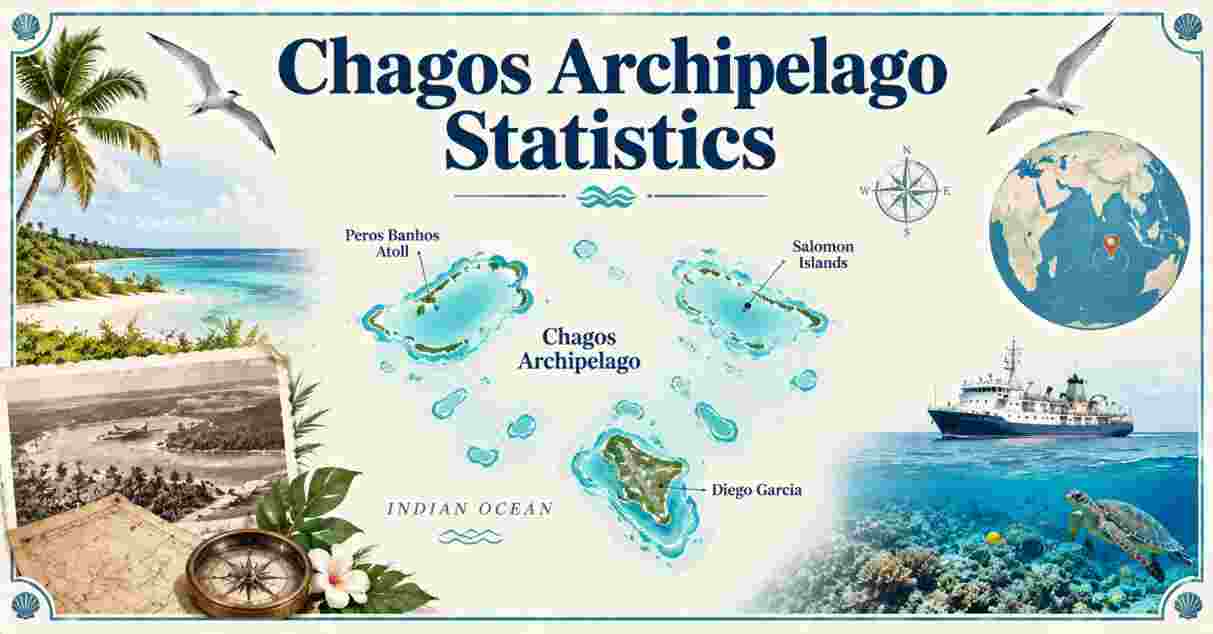
The Chagos Archipelago sits almost exactly at the center of the Indian Ocean, roughly 1,600 kilometers south of India’s southern tip and 2,150 kilometers northeast of Mauritius. It’s a tiny landmass by any measure — 56.13 square kilometers of dry land scattered across seven atolls — but it carries an outsized geopolitical weight because one of its islands, Diego Garcia, hosts one of the most strategically important joint UK-US military bases on the planet. For decades the archipelago sat at the center of a bitter sovereignty dispute between Britain and Mauritius, a dispute the International Court of Justice ruled on in 2019 and that finally reached a negotiated resolution in 2025.
That resolution reshapes almost every statistic worth tracking about the islands in 2026. Sovereignty now belongs to Mauritius, ending Britain’s administration of the territory since 1965, while the UK secured continued military access to Diego Garcia through a 99-year lease worth roughly £3.4 billion total. Meanwhile, the human story behind these numbers remains unresolved — the Chagossian people who were forcibly removed from these islands between 1967 and 1973 are still fighting, through courts and through direct action, for the right to return home. This article breaks down the confirmed Chagos Archipelago statistics for 2026: land area, population figures, the sovereignty treaty’s financial terms, and where the Chagossian resettlement movement stands right now.
Interesting Facts about Chagos Archipelago in 2026
| Interesting Fact | Detail |
|---|---|
| Total land area | 56.13 km² across the full archipelago |
| Number of atolls | 7 atolls, more than 60 individual islands |
| Largest island | Diego Garcia, roughly 30 km² |
| Sovereignty treaty signed | May 22, 2025, between the UK and Mauritius |
| Annual UK lease payment | £101 million per year for 99 years |
| Total treaty value | Approximately £3.4 billion |
| Diego Garcia population | Roughly 4,239–4,267, almost entirely military and contract personnel |
| Chagossian diaspora size | Approximately 10,000 people worldwide |
Reading these numbers together tells the story of a territory defined by contrast — a landmass smaller than most cities, generating a financial and military footprint measured in the billions. The 56.13 km² total land area is almost entirely uninhabited water once you exclude Diego Garcia; the archipelago’s total territorial area, including its surrounding waters, actually spans more than 54,000 square kilometers, meaning roughly 99.9% of the British Indian Ocean Territory’s historical footprint was always ocean rather than land.
The gap between the £3.4 billion treaty value and the tiny population figures above is what makes this such an unusual geopolitical case. Diego Garcia’s population of roughly 4,250 people consists almost entirely of American and British military personnel and contractors — essentially none of them are original Chagossian inhabitants, since the entire native population was expelled decades ago. The 10,000-person Chagossian diaspora, scattered mainly across Mauritius, Seychelles, and the UK, represents the human cost behind a base that today functions as critical infrastructure for both Western defense operations and, notably, the global GPS satellite network.
Chagos Archipelago 2026 Geography, Area and Islands
The archipelago’s geography explains why it became such a prized military asset — it sits almost perfectly positioned for power projection across the entire Indian Ocean basin, equidistant from East Africa, the Middle East, and South Asia.
Chagos Archipelago Land Distribution
Diego Garcia         ███████████████████████ 30 km² (largest)
Peros Banhos         █████████░░░░░░░░░░░░░░ ~13 km²
Salomon Islands      ███░░░░░░░░░░░░░░░░░░░░ ~5 km²
Egmont Islands       █░░░░░░░░░░░░░░░░░░░░░░ ~2 km²
Remaining islets     ███░░░░░░░░░░░░░░░░░░░░ ~6 km²
| Geographic Feature | Detail |
|---|---|
| Total land area | 56.13 km² (21.67 sq mi) |
| Number of atolls | 7 |
| Total individual islands | More than 60 |
| Largest island | Diego Garcia — approximately 30 km², horseshoe-shaped coral atoll |
| Diego Garcia lagoon | Roughly 70% of the atoll’s total area |
| Location | Central Indian Ocean, about 1,600 km south of India |
| Only inhabited island | Diego Garcia |
Source: Wikipedia geographic data cross-referenced with CIA World Factbook figures and tropical geography research literature.
Diego Garcia’s shape is genuinely unusual among coral atolls — a near-complete horseshoe enclosing a shallow lagoon that makes up roughly 70% of the island’s total footprint, with a land perimeter stretching about 64 kilometers and land width ranging from a few hundred meters up to 2.4 kilometers at its widest point. That geography, combined with the surrounding deep-water access, is precisely what made it so valuable as a naval and air base site during Cold War planning — the enclosed lagoon offers natural harbor protection unavailable at most remote Pacific or Indian Ocean atolls.
Every other atoll and island in the archipelago beyond Diego Garcia remains officially uninhabited today, though that’s beginning to change. Peros Banhos and the Salomon Islands, the second- and third-largest island groups, are where the earliest Chagossian resettlement attempts have concentrated, since they were historically home to sizable coconut plantation communities before the 1970s expulsions. The archipelago’s remote location — hundreds of kilometers from the nearest other landmass in any direction — remains both its greatest strategic asset and the single biggest obstacle facing anyone trying to rebuild a permanent civilian community there.
Chagos Archipelago 2026 Population and Diego Garcia Demographics
Population figures for the Chagos Archipelago look almost nothing like population figures for a typical inhabited territory, because the people currently living there are overwhelmingly foreign military and contract personnel rather than any indigenous population.
| Population Metric | Figure |
|---|---|
| Diego Garcia total population | 4,239–4,267 (varies by source year) |
| Ethnic composition, Diego Garcia | 95.88% British/American; 4.02% other nationalities; 0.10% Chagossian |
| Île du Coin population (2026) | 6 people — resettled Chagossians |
| Historical pre-expulsion population | Up to 2,000 Chagossians across all islands |
| 1966 Diego Garcia population | 924 (mostly coconut plantation contract workers) |
| Chagossian global diaspora | Approximately 10,000 |
Source: Wikipedia demographic data citing UK government and BIOT census figures; House of Commons Library briefings.
The 95.88% British and American share of Diego Garcia’s current population is the starkest statistic in this entire dataset — it means the island that gives its name to an entire indigenous people’s identity today houses almost none of that population. The 0.10% Chagossian representation on Diego Garcia itself reflects a handful of individuals working in support roles at the base, not any resettled community, since the 2025 treaty explicitly excludes Diego Garcia from the areas where Mauritius can permit Chagossian resettlement.
The 6 people recorded on Île du Coin in February 2026 represent something genuinely new: a small group of Chagossians who returned to the archipelago without formal government permission, attempting to reestablish permanent settlement on an island in the Peros Banhos atoll. That number is tiny in absolute terms, but it’s the first sustained on-the-ground civilian presence outside Diego Garcia since the 1970s expulsions, and it has already triggered legal action over the group’s right to remain — a case working its way through BIOT’s court system as of 2026.
Chagos Archipelago 2026 Sovereignty Treaty and Financial Terms
The sovereignty agreement signed by the UK and Mauritius in May 2025 is the single most consequential document governing the archipelago’s status in 2026, and its financial terms are unusually well documented for a bilateral defense arrangement.
Chagos Treaty Financial Breakdown (99-Year Total)
Diego Garcia lease payments   ████████████████████████ £3.4 billion
Mauritius development grants  ██████░░░░░░░░░░░░░░░░░░ £1.125 billion (£45m x 25 yrs)
Chagossian trust fund         █░░░░░░░░░░░░░░░░░░░░░░░ £40 million
| Treaty Term | Detail |
|---|---|
| Treaty signed | May 22, 2025 |
| Sovereignty transfer | Full sovereignty to Mauritius; UK retains Diego Garcia base rights |
| Lease duration | 99 years, with optional extension by 40 more years |
| Annual UK payment | £101 million (2025/26 prices) |
| Total treaty value | £3.4 billion net present value |
| Mauritius development grant | £45 million annually for 25 years |
| Chagossian trust fund | £40 million |
Source: UK House of Commons Library research briefing and House of Lords Library treaty analysis, 2025–2026.
The £101 million annual figure works out to roughly $136 million at prevailing exchange rates, and the UK government has repeatedly emphasized this represents less than 0.2% of the annual defense budget — cheaper, officials noted, than operating an aircraft carrier without aircraft for a single year. That framing matters politically because the treaty faced real domestic opposition; two Chagossians living in the UK filed a High Court application on the very day of signing in an attempt to block it, resulting in a brief injunction before the deal proceeded.
Layered underneath the headline lease payment are two additional funding streams that reveal how the treaty tries to address its human dimension. The £45 million annual grant to Mauritius, running for 25 years, is explicitly earmarked for economic development and welfare projects rather than folded into the lease payment itself, while the standalone £40 million Chagossian trust fund is meant to benefit the displaced diaspora directly. Critics, including the UN Committee on the Elimination of Racial Discrimination, have argued these sums remain inadequate given the scale and duration of the original displacement, and that the treaty still forecloses any Chagossian right to resettle on Diego Garcia itself.
Chagos Archipelago 2026 Chagossian Expulsion History and Diaspora
Understanding today’s population and legal disputes requires understanding what happened between 1967 and 1973, when Britain forcibly emptied the archipelago of its entire indigenous population to clear the way for the Diego Garcia base.
| Historical Metric | Figure |
|---|---|
| Expulsion period | 1967–1973 |
| Main Diego Garcia removal | July–September 1971 |
| Total people displaced | Up to 2,000 Chagossians |
| Primary resettlement destinations | Mauritius, Seychelles, United Kingdom |
| Current diaspora size | Approximately 10,000 worldwide |
| 2019 ICJ ruling | UK administration of the territory declared unlawful |
Source: UK Foreign, Commonwealth & Development Office historical records; International Court of Justice advisory opinion, 2019.
The scale of displacement here is small in absolute numbers — up to 2,000 people — but the manner and duration of the removal is what has kept this dispute alive for more than five decades. British officials at the time described the Chagossians as merely “contract workers” who could be relocated without special consideration, a characterization that British courts have repeatedly rejected in subsequent litigation as a legal fiction designed to avoid decolonization obligations. Most displaced families were resettled in Mauritius with smaller numbers in the Seychelles and the UK, and that original displacement pattern still roughly defines where the 10,000-person diaspora lives today.
The 2019 International Court of Justice advisory opinion marked the turning point that eventually forced the 2025 treaty into existence — the court found that decolonization of Mauritius had not been lawfully completed when the country gained independence in 1968, precisely because Britain had detached the Chagos Archipelago beforehand to create the BIOT. That legal finding, reinforced by subsequent UN General Assembly resolutions, put sustained international pressure on London that ultimately proved more effective than five decades of Chagossian litigation on its own. For a deeper look at Diego Garcia’s specific role in this arrangement, see Diego Garcia Location Statistics, which covers the base’s operational significance in more detail.
Chagos Archipelago 2026 Resettlement Movement and Legal Battles
The right to return has become the defining Chagossian issue of 2026, playing out simultaneously in courts, in direct political action, and in an unauthorized on-the-ground resettlement attempt.
| Legal/Political Development | Date | Detail |
|---|---|---|
| Chagossian Government established | December 2025 | Self-declared body opposing the UK-Mauritius treaty |
| BIOT Supreme Court ruling | April 2026 | Overturned decades-old restrictions on Chagossian settlement |
| Île du Coin resettlement | 2026 | Small group returned without government permission |
| Mauritius–Maldives diplomatic break | February 27, 2026 | Over rival claims tied to the Chagos dispute |
| Article 6 provision | Treaty text | Permits Mauritius to allow Chagossian settlement (excluding Diego Garcia) |
Source: BIOT court records as reported by Wikipedia; Mauritian government statements; House of Lords Library briefing.
The April 2026 BIOT Supreme Court ruling stands out as the most consequential legal development of the year — the court found that key provisions of the territory’s immigration regime were unlawful, ordering that removal orders against Chagossians be quashed and that permit applications be re-examined under fair procedure. That ruling effectively opened a legal pathway for exactly the kind of resettlement attempt that has already begun on Île du Coin, where a small group established a presence and immediately began legal action to secure permanent residency rights.
The formation of a self-declared Chagossian Government in December 2025, explicitly organized in opposition to the treaty’s terms, signals that a meaningful share of the diaspora views the UK-Mauritius agreement as having been negotiated over their heads rather than with their consent — Mauritius represents the former colonial administrator of the islands, not the Chagossian people directly, and critics argue the treaty’s Article 6 resettlement provisions still leave Mauritius, not Chagossians themselves, holding final decision-making authority over where and how any return can happen. That underlying tension — between state-level sovereignty and indigenous return rights — is likely to keep generating legal and political developments throughout the rest of 2026 and beyond. The UK’s broader defense budget picture, which frames how seriously London treats commitments like the Diego Garcia lease, is covered in Defence Spending Statistics in UK.
Chagos Archipelago 2026 Diego Garcia Military Base Facts
Diego Garcia’s importance goes well beyond the sovereignty dispute — it functions as genuinely critical infrastructure for both military operations and civilian technology systems used worldwide.
| Military & Strategic Fact | Detail |
|---|---|
| Base operator | Joint UK-US facility, predominantly American personnel |
| Historical operations supported | Gulf War (1990-91), Afghanistan strikes (2001), Iraq War (2003) |
| GPS infrastructure role | One of only five global GPS ground control stations |
| Lease security zone | 12 nautical miles surrounding the island reserved for UK/US use |
| Time zone | UTC+6 |
| Ramsar Wetland status | Designated July 4, 2001 |
Source: US Department of Defense operational history summaries; International GPS ground station network documentation; Ramsar Convention Secretariat records.
The GPS ground control station detail is easy to overlook next to the geopolitics, but it’s arguably the most consequential fact in this entire dataset for anyone outside the defense and diplomatic world — Diego Garcia is one of only five locations on Earth hosting ground infrastructure for the Global Positioning System, meaning it plays a small but continuous operational role in navigation for billions of devices worldwide, from smartphones to commercial aircraft to shipping fleets. That dual military-civilian function is part of why the 2025 treaty’s security provisions were negotiated so carefully, with the 12-nautical-mile buffer zone around the island specifically designed to prevent any foreign military presence from operating near infrastructure the US and its allies consider irreplaceable.
Diego Garcia’s role in supporting major US and UK military operations across three decades — the Gulf War, the post-9/11 Afghanistan campaign, and the Iraq War — is the strategic history that made the base non-negotiable during treaty talks, even as the UK ultimately agreed to give up formal sovereignty over the surrounding archipelago. Comparable US overseas installations facing their own sovereignty and access questions offer useful context here — see Pituffik Space Base Statistics for a look at how a similarly strategic Arctic base has become entangled in its own territorial dispute.
Frequently Asked Questions About Chagos Archipelago 2026
Who owns the Chagos Archipelago in 2026?
Mauritius holds sovereignty over the Chagos Archipelago following a treaty signed with the UK on May 22, 2025. The UK retains operational control of Diego Garcia under a 99-year lease.
How big is the Chagos Archipelago?
The archipelago covers 56.13 square kilometers of total land area, spread across 7 atolls and more than 60 individual islands. Diego Garcia, the largest island, accounts for roughly 30 square kilometers of that total.
How much does the UK pay Mauritius for Diego Garcia?
The UK pays £101 million annually for 99 years, a package with a total net present value of approximately £3.4 billion, according to UK government figures verified by the government’s actuary department.
How many people live in the Chagos Archipelago?
Diego Garcia has a population of roughly 4,239–4,267, almost entirely UK and US military personnel and contractors. A small group of resettled Chagossians, numbering 6 people as of February 2026, live on Île du Coin in the Peros Banhos atoll.
What happened to the original Chagossian population?
Britain forcibly displaced up to 2,000 Chagossians between 1967 and 1973 to clear the islands for the Diego Garcia military base. Most were resettled in Mauritius, with smaller numbers in the Seychelles and the UK.
Can Chagossians return to the islands now?
A April 2026 BIOT Supreme Court ruling overturned longstanding restrictions on Chagossian settlement, and a small group has already resettled on Île du Coin. However, the 2025 treaty explicitly excludes Diego Garcia from any resettlement, and legal battles over broader return rights remain ongoing.
Why is Diego Garcia strategically important?
Diego Garcia hosts a joint UK-US military base that has supported major operations including the Gulf War, the Afghanistan campaign, and the Iraq War. It also serves as one of only five global GPS ground control stations worldwide.
How large is the Chagossian diaspora today?
Approximately 10,000 Chagossians and their descendants live around the world, primarily concentrated in Mauritius, the Seychelles, and the United Kingdom.
Disclaimer: The data research report we present here is based on information found from various sources. We are not liable for any financial loss, errors, or damages of any kind that may result from the use of the information herein. We acknowledge that though we try to report accurately, we cannot verify the absolute facts of everything that has been represented.