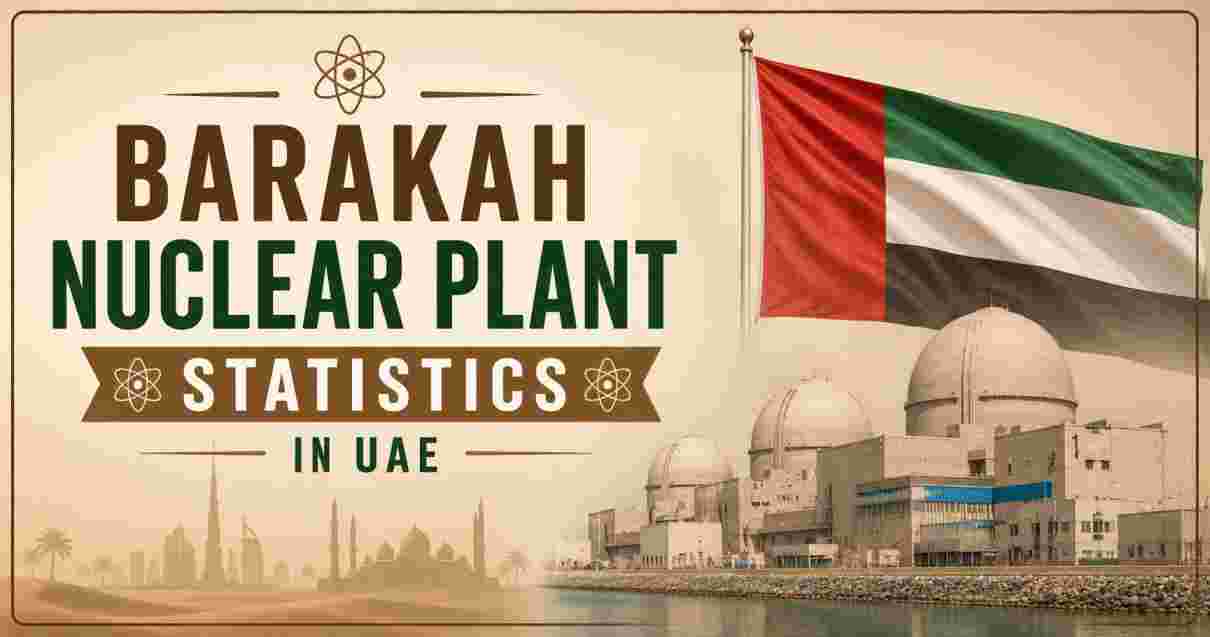
What is the Barakah Nuclear Energy Plant?
The Barakah Nuclear Energy Plant (Arabic: محطة براكة للطاقة النووية) is the United Arab Emirates’ first nuclear power station — and one of the most consequential energy infrastructure achievements in the modern history of the Middle East. Located in the Al Dhafra region of the Emirate of Abu Dhabi, approximately 53 kilometres west-southwest of Al Dhannah City on the coastline between the Arabian Gulf and the E11 highway, Barakah is the first commercial nuclear power station in the Arab world, the first nuclear power station in the UAE, and the first nuclear power station on the Arabian Peninsula. Its name — “Barakah” — is the Arabic word for blessing, a name chosen by the UAE leadership to reflect the plant’s role in the nation’s transition toward energy security, economic diversification, and a lower-carbon future. The project was born from a landmark decision in December 2009, when the Emirates Nuclear Energy Corporation (ENEC) awarded a $20 billion contract to a consortium led by South Korea’s Korea Electric Power Corporation (KEPCO) to design, construct, and assist in operating four APR-1400 nuclear reactors at the Barakah site — a decision that represented the UAE’s entry into civilian nuclear energy under the highest international non-proliferation standards.
What makes the Barakah plant genuinely remarkable — beyond its historic firsts — is the speed and scale at which it was delivered. From the groundbreaking ceremony in March 2011 through the construction of all four units and the commissioning of the final unit into full commercial operation in 2024, the plant completed one of the most ambitious civil nuclear programmes of the 21st century. With all four APR-1400 units now fully operational, Barakah has a total nameplate capacity of 5,600 MW and generates approximately 40 terawatt-hours (TWh) of clean electricity annually — meeting roughly 25% of the UAE’s entire electricity demand and preventing 22.4 million tonnes of CO₂ emissions every year. The plant is operated by Nawah Energy Company, a joint venture between ENEC and KEPCO, under the regulatory oversight of the Federal Authority for Nuclear Regulation (FANR), working in close coordination with the International Atomic Energy Agency (IAEA) and the World Association of Nuclear Operators (WANO). The UAE’s National Energy Strategy 2050 classifies nuclear energy alongside solar and wind as a clean energy source, and Barakah is central to the country’s commitment to achieving net-zero emissions by 2050.
Key Facts: Barakah Nuclear Plant Statistics in UAE 2026
The following table captures the most important and verified Barakah Nuclear Plant facts 2026 — drawn from ENEC official announcements, the World Nuclear Association, Power Technology, Gulf News, SaudiGulf Projects, and verified UAE government publications.
| Key Fact | Verified Stat |
|---|---|
| Plant location | Al Dhafra region, Emirate of Abu Dhabi, UAE |
| Distance from Abu Dhabi city | ~230 km west of Abu Dhabi (World Nuclear Association) |
| Distance from Al Dhannah City | ~53 km west-southwest |
| Number of reactors | 4 units — all APR-1400 pressurised water reactors |
| Reactor design | APR-1400 (Advanced Power Reactor 1,400 MW) — South Korean design |
| Total nameplate capacity | 5,600 MW (5.6 GW) |
| Capacity per unit | ~1,400 MW per reactor |
| Annual clean electricity generation | ~40 TWh per year (with all 4 units operational) |
| Share of UAE electricity supplied | ~25% of total UAE electricity needs |
| Annual CO₂ emissions avoided | 22.4 million tonnes per year |
| Equivalent car removals per year | 4.8 million cars removed from roads (ENEC) |
| Total clean energy generated since Unit 1 operations began | More than 120 TWh (as of April 2026) |
| Cumulative CO₂ avoided since Unit 1 operations | More than 58 million metric tonnes (April 2026) |
| Original contract value (KEPCO consortium) | $20 billion (later revised to $20.4 billion) |
| Final total project investment | ~$32 billion (across construction, fuel, operational infrastructure) |
| Project financing structure | $19.6B loan ($16.2B Abu Dhabi Govt; $2.5B KEPCO loan); $4.7B equity |
| Project refinancing (July 2023) | AED 8.9 billion ($2.4 billion) — Barakah One Company PJSC |
| Plant operator | Nawah Energy Company — JV between ENEC and KEPCO |
| Regulatory authority | Federal Authority for Nuclear Regulation (FANR) |
| Total IAEA and WANO assessment missions | Over 100 assessment missions |
| Total inspections and technical reviews (lifetime) | More than 500 inspections and technical reviews |
| UAE Nationals in nuclear workforce | Over 2,000 UAE Nationals in development and operations |
| Emiratisation rate at Nawah operations | 60% — UAE nationals as share of nuclear operations workforce |
| Contribution to UAE’s 2030 decarbonisation target | 24% |
| Share of Abu Dhabi’s clean electricity from Barakah | 85% — Abu Dhabi Clean Energy Certificates backed by Barakah |
| Expected operational lifetime per unit | 60 years minimum — through the 2080s per FANR licence |
Data Sources: Emirates Nuclear Energy Corporation (ENEC) — Official announcements and press releases (enec.gov.ae); World Nuclear Association — “Nuclear Power in the United Arab Emirates” (world-nuclear.org, updated March 2026); Power Technology — “Barakah Nuclear Power Plant, UAE” (power-technology.com, updated November 2025); SaudiGulf Projects — “UAE’s Barakah Nuclear Energy Plant Marks One Year of Full-Fleet Operations” (April 27, 2026, citing ENEC official data for 12-month period); Gulf News — “How Barakah Nuclear Power Plant Made the UAE a Global Clean Energy Leader” (May 17, 2026); World Nuclear Association — World Nuclear Performance Report: United Arab Emirates; WE THE UAE 2031 — “Barakah Nuclear Energy Plant: Operational Analysis and Grid Impact” (February 22, 2026)
These 26 data points capture the full statistical footprint of what is, by any reasonable measure, one of the most consequential civil energy infrastructure projects of the 21st century. The combination of 5.6 GW of installed capacity, 40 TWh of annual clean generation, and 25% of the UAE’s national electricity needs makes Barakah not just the Arab world’s first nuclear power station but one of its most important single energy assets. The more than 120 TWh of total clean electricity generated since Unit 1 began operations is described by ENEC as equivalent to the annual power demand of New York City — a comparison that conveys the sheer scale of output from a plant built in the desert of Abu Dhabi in little more than a decade. The 58 million metric tonnes of cumulative CO₂ avoided since Unit 1 commissioning represents a climate contribution that is directly measurable and already among the most significant of any single infrastructure project in the Gulf region’s history. The 60% Emiratisation rate at Nawah, supported by more than 2,000 UAE nationals in the nuclear workforce, confirms that the project has delivered on its human capital development mandate as successfully as on its engineering one.
Barakah Nuclear Plant — Reactor Units and Commissioning Timeline 2026
Barakah Nuclear Plant — Unit-by-Unit Commissioning Timeline

Unit 1:
  Construction starts:     July 18, 2012
  First power (grid):      August 2020
  Commercial operations:   April 2021
  Capacity:                ~1,400 MW

Unit 2:
  Construction starts:     May 2013
  First power (grid):      September 2021
  Commercial operations:   March 2022
  Capacity:                ~1,400 MW

Unit 3:
  First safety concrete:   September 2014
  First power (grid):      October 2022
  Commercial operations:   2023
  Capacity:                ~1,400 MW

Unit 4:
  Construction starts:     September 2015
  Construction completed:  December 2023
  First power (grid):      March 2024
  Commercial operations:   September 2024
  Capacity:                ~1,400 MW

FULL FLEET OPERATION ACHIEVED: September 2024
| Unit | Construction Start | Grid Connection | Commercial Operations | Capacity |
|---|---|---|---|---|
| Unit 1 | July 18, 2012 | August 2020 | April 2021 | ~1,400 MW |
| Unit 2 | May 2013 | September 2021 | March 2022 | ~1,400 MW |
| Unit 3 | September 2014 | October 2022 | 2023 | ~1,400 MW |
| Unit 4 | September 2015 | March 2024 | September 2024 | ~1,400 MW |
| Groundbreaking ceremony | March 14, 2011 | — | — | Korean President Lee Myung-bak in attendance |
| Unit 4 construction completed | December 2023 | — | Operational readiness testing 2023 | Before grid connection |
| Full fleet operation date | — | — | September 2024 | All 4 units commercially active |
| ENEC full-fleet anniversary | — | — | September 2025 (first full year) | 40 TWh delivered in that 12-month period |
| Average delivery time per unit | — | — | 7.9 years average | ENEC global benchmark comparison |
| Original planned commercial operation (Unit 1) | 2017 | — | Delayed by approx. 4 years | Complex safety review process |
| Fuel loading (Unit 1) | Q1 2020 | — | — | Approximately 2.5 years after original plan |
Data Sources: World Nuclear Association — “Nuclear Power in the United Arab Emirates” (updated March 2026); Power Technology — “Barakah Nuclear Power Plant, UAE” (updated November 2025); ENEC official press release — “Barakah Plant Doubles Clean Electricity Generation with Start of Commercial Operations at Unit 2” (March 2022); SaudiGulf Projects — ENEC One-Year Full-Fleet Operations Anniversary Report (April 27, 2026); Wikipedia — Barakah nuclear power plant
The commissioning timeline for Barakah’s four units tells a story of extraordinary logistical ambition — and the honest acknowledgment of what it takes to deliver a first-of-kind nuclear programme in a nation with no prior nuclear history. Unit 1’s commercial operation in April 2021 was approximately four years later than the original 2017 target — a delay that reflected not construction quality failures but the depth of the safety review process insisted upon by FANR and the IAEA before the UAE’s regulator would grant an operating licence. The IAEA conducted what amounted to one of the most thorough pre-operational safety reviews it had ever carried out for a new nuclear programme, precisely because Barakah was a first-of-kind national programme in a region without existing nuclear infrastructure. Delays for this reason are, from a safety culture perspective, a mark of a programme doing things correctly rather than cutting corners. Once the commissioning tempo was established, the programme demonstrated genuine momentum: Unit 2 reached commercial operation in March 2022, followed by Unit 3 in 2023 and Unit 4 in September 2024 — a four-unit fleet completion in the space of approximately 3.5 years from first commercial operation to full fleet status.
The 7.9-year average delivery time per unit cited by ENEC in its April 2026 one-year full-fleet anniversary report is positioned as a global benchmark for nuclear construction efficiency, and by recent international standards, it holds up well. For comparison, many nuclear projects in Europe and North America in the 2010s experienced 12–18+ year delivery timelines, and the simultaneous construction of all four units on the same site — which made Barakah the world’s largest nuclear energy construction site with four identical reactors being built at once between 2015 and 2022 — produced significant knowledge-sharing and efficiency gains that reduced per-unit cost and construction time as the programme progressed. The construction of Unit 4, completed in December 2023, benefited from the institutional knowledge accumulated across Units 1, 2, and 3, and proceeded more smoothly than any of the earlier units by construction-phase metrics.
Barakah Nuclear Plant — Power Generation and UAE Energy Statistics 2026
Barakah's Contribution to UAE Electricity — 2024–2026

UAE Electricity Generation Mix (2023, IEA via World Nuclear Association):
  Natural gas:    119 TWh     ████████████████████████████████████████████  71%
  Nuclear:         33.1 TWh   ████████████                                  20%
  Solar:           14.4 TWh   ██████                                         9%
  Oil:              0.9 TWh   ▌                                              1%

With all 4 units at full capacity (from Sep 2024):
  Nuclear share:  ~40 TWh/year  ████████████████                           ~25%
  (Share increase from 20% to ~25% as all 4 units reached full output)

UAE per capita electricity consumption (2023):  ~14,600 kWh
UAE total electricity from fossil fuels before Barakah:  >95%

Barakah output equivalencies:
  40 TWh/year   = Annual power demand of New York City (ENEC comparison)
  40 TWh/year   = Enough to power 574,000 UAE homes annually
  120 TWh total = All clean electricity generated since Unit 1 (as of April 2026)
| Energy Generation Metric | Figure | Source / Period |
|---|---|---|
| Annual clean electricity output — all 4 units | ~40 TWh per year | ENEC; World Nuclear Association; Al Jazeera (2026) |
| UAE electricity from nuclear (2023 IEA data) | 33.1 TWh — 20% of UAE total | World Nuclear Association / IEA, 2023 |
| UAE electricity from natural gas (2023) | 119 TWh — 71% of UAE total | World Nuclear Association / IEA, 2023 |
| UAE electricity from solar (2023) | 14.4 TWh — 9% of UAE total | World Nuclear Association / IEA, 2023 |
| UAE electricity from oil (2023) | 0.9 TWh — 1% of UAE total | World Nuclear Association / IEA, 2023 |
| Share of UAE electricity from nuclear (full fleet, 2025–26) | ~25% | ENEC; World Nuclear Association |
| Electricity from fossil fuels before Barakah | >95% | World Nuclear Association |
| UAE per capita electricity consumption (2023) | ~14,600 kWh | IEA / World Bank (cited World Nuclear Association) |
| Equivalent homes powered annually (UAE) | 574,000 UAE homes | SaudiGulf Projects / ENEC (April 2026) |
| Equivalent to annual power demand of | New York City | ENEC April 2026 anniversary report |
| Total clean energy generated since Unit 1 | More than 120 TWh | ENEC (April 2026) |
| Power purchase agreement | Barakah One Company + EWEC — October 2016 | Power Technology |
| Electricity buyer | Emirates Water and Electricity Company (EWEC) | ENEC; Power Technology |
| Grid operator / transmitter | Abu Dhabi Transmission and Dispatch Company (TRANSCO) | ENEC |
| UAE’s clean electricity added per capita (5 years) | More than any other country in the world | SaudiGulf Projects / ENEC (April 2026) |
| Barakah share of UAE’s 5-year clean electricity per capita gain | 75% of that gain produced by Barakah | SaudiGulf Projects / ENEC (April 2026) |
Data Sources: ENEC — One-Year Full-Fleet Operations report (via SaudiGulf Projects, April 27, 2026); World Nuclear Association — UAE profile (March 2026, citing IEA 2023 data); Al Jazeera — “What is the UAE’s Barakah Nuclear Plant?” (May 18, 2026); ENEC press releases and official website (enec.gov.ae); Power Technology — Barakah Nuclear Power Plant, UAE (November 2025)
The electricity generation statistics for Barakah in 2026 establish the plant as the single most important contributor to the UAE’s clean energy transition since the country declared its Net Zero 2050 target. The 20% nuclear share of UAE electricity generation recorded in 2023 IEA data — produced with only two and then three units at various stages of operation across that calendar year — has now risen to approximately 25% with all four units in full commercial operation from September 2024 onwards. The transformation this represents becomes stark when set against the pre-Barakah baseline: before the plant came online, more than 95% of UAE electricity came from fossil fuels. Today, nuclear and solar combined account for approximately 34% of UAE electricity generation, with nuclear’s 25% share the larger and more consistent of the two because nuclear produces stable baseload power 24 hours a day, 7 days a week — a characteristic that solar cannot match without large-scale storage. The Emirates Water and Electricity Company (EWEC) purchases all of Barakah’s output under a long-term power purchase agreement signed in October 2016, and the Abu Dhabi Transmission and Dispatch Company (TRANSCO) ensures that the clean electricity is delivered across the UAE’s grid infrastructure.
The 74-country comparison embedded in ENEC’s April 2026 one-year full-fleet operations report is striking: the UAE has added more clean electricity per capita than any other country in the world over the past five years, and 75% of that clean electricity gain has been produced by Barakah. This data point reframes the global conversation about nuclear energy’s role in the energy transition. The UAE — a Gulf petrostate that built its entire modern economy on fossil fuel production and export — has delivered the most intensive per-capita clean energy transformation of any nation on earth primarily through a nuclear programme that took less than 15 years from contract award to full operation. The ENEC comparison of 120 TWh total output to New York City’s annual electricity demand is not merely rhetorical: it communicates the physical scale of what a 5.6 GW nuclear fleet produces, and why the economic case for nuclear energy as baseload decarbonisation — rather than intermittent renewables alone — is increasingly central to global energy policy discussions in 2026.
Barakah Nuclear Plant — Construction, Design and Technology Statistics 2026
Barakah Nuclear Plant — Technical and Construction Profile

REACTOR TYPE:      APR-1400 (Advanced Power Reactor 1,400 MW)
                   Pressurised Water Reactor (PWR) — most common type globally
                   Developed by South Korean nuclear industry under KEPCO leadership
                   Each unit: 1,400 MW nameplate capacity = enough to power ~1 million homes
                   4 units × 1,400 MW = 5,600 MW total

CONSTRUCTION CONSORTIUM (KEPCO-led):
  Korea Hydro and Nuclear Power (KHNP) — operating support
  KEPCO Engineering and Construction (KEPCO E&C) — design, architecture, engineering
  Doosan — nuclear steam supply system, steam generator
  Hyundai + Samsung — civil engineering works
  Korea Power Engineering Company, Korea Plant Service & Engineering (KPS)

CONSTRUCTION FACTS:
  Peak workforce (all 4 units):    18,000+ staff simultaneously on site
  World's largest nuclear construction site (2015–2022): 4 identical reactors simultaneously
  Total site groundbreaking:       March 14, 2011
  First safety concrete Unit 1:    July 18, 2012
  Last unit (4) construction start: September 2015
  Last unit (4) construction complete: December 2023
  Total construction span:         ~11 years (2012–2023)
| Technical / Construction Metric | Figure | Source |
|---|---|---|
| Reactor type | APR-1400 Pressurised Water Reactor | ENEC; Power Technology; World Nuclear Association |
| APR-1400 developer | Korean nuclear industry — KEPCO leadership | Power Technology |
| Each reactor’s capacity | ~1,400 MW | ENEC |
| Power equivalent per reactor | ~1 million homes | Al Jazeera (May 2026) |
| Total site capacity | 5,600 MW (5.6 GW) | ENEC; World Nuclear Association |
| Total project investment | ~$32 billion | Power Technology; Wikipedia |
| Original KEPCO consortium contract | $20 billion (December 2009) | Wikipedia; ENEC |
| Revised total contract / cost | $20.4 billion construction contract + total ~$32B | Power Technology |
| Peak construction workforce | 18,000+ staff (all 4 units under construction) | Wikipedia — citing ENEC data |
| Construction consortium leader | Korea Electric Power Corporation (KEPCO) | ENEC |
| Key consortium members | KHNP, KEPCO E&C, Doosan, Hyundai, Samsung, KPS | Power Technology |
| Groundbreaking ceremony date | March 14, 2011 | ENEC; Wikipedia |
| Korean President at groundbreaking | President Lee Myung-bak | Wikipedia |
| Unit 1 construction start | July 18, 2012 | ENEC; Wikipedia |
| Unit 4 construction start | September 2015 | ENEC; Wikipedia |
| World’s largest nuclear construction site | Yes — 4 simultaneous reactors (2015–2022) | SaudiGulf Projects / ENEC (April 2026) |
| Project refinancing (July 2023) | AED 8.9 billion ($2.4 billion) | World Nuclear Association |
| Financing structure | $19.6B loan; $16.2B Abu Dhabi Govt; $2.5B KEPCO; $4.7B equity | Power Technology |
| Safety system design | Defense-in-depth — multiple redundant mechanisms | Gulf News (May 2026) |
| Uranium fuel suppliers (original) | Areva, Techsnabexport, Uranium One, Rio Tinto | Power Technology |
| Uranium conversion supplier | ConverDyn | Power Technology |
| Uranium enrichment supplier | Urenco | Power Technology |
| Fuel assembly manufacturer (original) | KEPCO Nuclear Fuels | Power Technology |
| New fuel supply agreement (July 2025) | Framatome — assemblies from Richland, Washington facility | World Nuclear Association; Power Technology |
| First Framatome fuel assemblies delivered | Late 2025 (fuel qualification programme) | World Nuclear Association (March 2026) |
| First lead Framatome fuel assemblies fabricated | November 2025 | Power Technology (November 2025) |
Data Sources: Power Technology — “Barakah Nuclear Power Plant, UAE” (updated November 2025); World Nuclear Association — “Nuclear Power in the United Arab Emirates” (March 2026); ENEC official announcements; SaudiGulf Projects / ENEC April 2026 full-fleet anniversary report; Wikipedia — Barakah nuclear power plant; Gulf News (May 17, 2026)
The technical and construction statistics for Barakah place the project in a category that no other civil nuclear programme of its generation can easily match for execution speed and engineering consistency. Building four identical APR-1400 reactors simultaneously on the same site — which made Barakah the world’s largest nuclear energy construction site between approximately 2015 and 2022 — required a peak workforce of more than 18,000 people and a degree of parallel project management that was genuinely unprecedented in the nuclear industry. The decision to use an identical reactor design across all four units — the Korean-developed APR-1400 pressurised water reactor — was a deliberate strategy to maximise knowledge transfer between units, reduce per-unit procurement and design costs, and simplify the regulatory review process for each successive unit. It worked: the regulatory approval timeline for Unit 4 was measurably faster than for Unit 1, and the construction completion of Unit 4 in December 2023 was smoother by construction-phase indicators than any prior unit.
The July 2025 fuel supply agreement with Framatome represents an important strategic diversification. The plant originally relied on a fuel supply chain centred on KEPCO Nuclear Fuels in South Korea for fuel assembly manufacturing, with uranium sourced from multiple international suppliers including Uranium One, Rio Tinto, Areva, and Techsnabexport, conversion by ConverDyn, and enrichment by Urenco. The Framatome agreement — under which fuel assemblies are manufactured at Framatome’s US Nuclear Regulatory Commission-licensed facility in Richland, Washington — adds a Western supplier to the supply chain alongside the existing Korean stream, reducing single-source dependency and creating optionality in the event of geopolitical disruption to any single supply source. The first lead fuel assemblies fabricated under this agreement were announced by Framatome in November 2025, with delivery to Barakah described as part of a fuel qualification programme to verify the assemblies’ performance in the APR-1400 reactor environment before broader deployment.
Barakah Nuclear Plant — Environmental Impact and Decarbonisation Statistics 2026
Barakah's Environmental and Climate Impact (ENEC Official Data, April 2026)

ANNUAL CO₂ AVOIDANCE:
  22.4 million tonnes per year     ████████████████████████████████████████████████████████████████
  Equivalent to removing 4.8 million cars from roads per year

CUMULATIVE CO₂ AVOIDED (since Unit 1):
  58+ million metric tonnes        ████████████████████████████████████████████████████████████████
  Equivalent to removing ~12 million cars from roads (one-time equivalent)

UAE ENERGY TRANSITION CONTEXT:
  Before Barakah:  >95% fossil fuel electricity
  After Barakah:   Natural gas 71% | Nuclear 25% | Solar 9% | Oil 1%
  Five-year clean electricity growth per capita:  #1 in the world (UAE)
  Share of that growth from Barakah:              75%

CONTRIBUTION TO UAE 2030 DECARBONISATION TARGET:    24%
SHARE OF ABU DHABI CLEAN ENERGY CERTIFICATES:       85% backed by Barakah

CORPORATE CLEAN ENERGY BUYERS (using Barakah-backed certificates):
  ADNOC (Abu Dhabi National Oil Company)
  EMSTEEL
  EGA (Emirates Global Aluminium — first delivery of "MinimAL" low-carbon aluminium)
| Environmental / Decarbonisation Metric | Figure | Source |
|---|---|---|
| Annual CO₂ emissions avoided | 22.4 million tonnes per year | ENEC; Al Jazeera (May 2026); Gulf News (May 2026) |
| Equivalent car removal per year | 4.8 million cars removed from roads | ENEC; Power Technology |
| Cumulative CO₂ avoided since Unit 1 (April 2026) | More than 58 million metric tonnes | SaudiGulf Projects / ENEC (April 27, 2026) |
| Cumulative equivalent car removal | ~12 million cars equivalent | SaudiGulf Projects / ENEC (April 2026) |
| UAE electricity mix before Barakah | >95% fossil fuels | World Nuclear Association |
| UAE electricity mix 2023 (IEA) | Natural gas 71%, nuclear 20%, solar 9%, oil 1% | World Nuclear Association / IEA |
| UAE electricity mix (full fleet) | Nuclear ~25%; solar ~9% — combined 34% clean | World Nuclear Association; ENEC |
| Contribution to UAE 2030 decarbonisation target | 24% | ENEC; Power Technology; Gulf News |
| UAE Net Zero 2050 commitment | Nuclear classified as clean energy under National Energy Strategy 2050 | UAE Government; ENEC |
| UAE’s global clean electricity per capita ranking | #1 in the world (5-year per capita clean electricity gain) | SaudiGulf Projects / ENEC (April 2026) |
| Barakah share of UAE’s 5-year clean electricity gain | 75% of that gain | SaudiGulf Projects / ENEC (April 2026) |
| Abu Dhabi Clean Energy Certificates — Barakah share | 85% of Abu Dhabi CECs backed by Barakah | SaudiGulf Projects / ENEC (April 2026) |
| Corporate users of Barakah-backed CECs | ADNOC, EMSTEEL, EGA | SaudiGulf Projects / ENEC (April 2026) |
| EGA achievement using Barakah energy | “MinimAL” — first delivery of low-carbon aluminium | SaudiGulf Projects / ENEC (April 2026) |
| Nuclear energy carbon lifecycle comparison | Among lowest carbon-emitting sources; comparable to solar and wind | Gulf News (May 2026) |
| Carbon emissions without Barakah | Would require equivalent gas-fired generation | ENEC; World Nuclear Association |
| Role in UAE’s Vision 2031 and clean energy targets | Core pillar of UAE’s energy transition strategy | UAE Government; ENEC |
Data Sources: SaudiGulf Projects — “UAE’s Barakah Nuclear Energy Plant Marks One Year of Full-Fleet Operations” (April 27, 2026, citing ENEC official data); ENEC official press releases; Al Jazeera — “What is the UAE’s Barakah Nuclear Plant?” (May 18, 2026); Gulf News — “How Barakah Nuclear Power Plant Made the UAE a Global Clean Energy Leader” (May 17, 2026); Power Technology — Barakah Nuclear Power Plant, UAE (November 2025); World Nuclear Association UAE profile (March 2026)
The environmental impact statistics for Barakah in 2026 are the numbers that most directly justify the project’s immense capital cost and political complexity. 22.4 million tonnes of CO₂ avoided annually is not an estimate or a projection — it is a calculated figure based on what would be emitted if the UAE generated the same 40 TWh of electricity from natural gas, which was the country’s overwhelmingly dominant generation source before Barakah came online. The cumulative 58+ million metric tonnes avoided since Unit 1 commissioning — equivalent to removing approximately 12 million cars from roads on a one-time basis — establishes a permanent baseline of climate contribution that grows by 22.4 million tonnes with every additional year of full-fleet operation. By the time the plant completes its 60-year licensed operational lifetime, the cumulative CO₂ avoidance will be measured in billions of tonnes — making Barakah one of the single largest emissions reduction investments in the history of the Gulf region.
The corporate clean energy certification ecosystem that has developed around Barakah’s output is an underappreciated aspect of its economic and industrial impact. When ADNOC, EMSTEEL, and EGA (Emirates Global Aluminium) purchase Clean Energy Certificates backed by Barakah’s electricity to certify their industrial output as low-carbon, they are using Barakah’s nuclear generation to create competitive differentiation in global markets increasingly demanding carbon transparency. EGA’s “MinimAL” low-carbon aluminium — the first delivery of which was made possible by Barakah-backed clean energy certification — demonstrates how nuclear baseload electricity is enabling UAE industry to position its products at the premium end of low-carbon commodity markets. The 85% of Abu Dhabi Clean Energy Certificates backed by Barakah’s output underscores how central the plant is to Abu Dhabi’s entire industrial decarbonisation story — not just its electricity sector.
Barakah Nuclear Plant — Workforce, Regulation, and Future Development 2026
Barakah Workforce, Safety Oversight, and Future Plans

WORKFORCE (as of 2025–2026):
  Emirati nationals (UAE Nationals):   2,000+  working in development and operations
  Emiratisation rate (Nawah):           60%     of nuclear operations workforce
  Unplanned reactor trips (first 18 months full fleet): ZERO reported

REGULATORY OVERSIGHT:
  FANR (Federal Authority for Nuclear Regulation): Primary UAE regulator
  IAEA:  100+ assessment missions conducted on Barakah
  WANO:  All performance indicators met or exceeded
  Total inspections + technical reviews:  500+
  Non-proliferation framework: UAE-US 123 Agreement (2009) — renounces enrichment + reprocessing

FUEL SUPPLY (2025–2026):
  Original supply chain: KEPCO Nuclear Fuels (assemblies); Urenco (enrichment);
                         Areva + Techsnabexport (uranium); ConverDyn (conversion)
  New supplier (2025):   Framatome — fuel assemblies from Richland, WA (NRC-licensed)
  Strategy:              Diversify supply chain; reduce single-source dependency

FUTURE DEVELOPMENT:
  ENEC-ADNOC (Nov 2024): Evaluate advanced nuclear technology for UAE energy diversification
  Potential excess heat use: ADNOC oil and gas operations
  SMR (Small Modular Reactor): ENEC interest for industrial + desalination applications
  Spent fuel: Stored in reactor ponds up to 20 years; dry storage available from 6 years
  Waste management: "Dual track" strategy — national storage + regional GCC cooperation
  Used fuel ownership: Transfer to new state entity after ~20 years
| Workforce / Regulation / Future Metric | Figure | Source |
|---|---|---|
| UAE Nationals in nuclear workforce | 2,000+ | SaudiGulf Projects / ENEC (April 2026) |
| Emiratisation rate at Nawah Energy | 60% | WE THE UAE 2031 (February 22, 2026) |
| Unplanned reactor trips (first 18 months, full fleet) | ZERO | WE THE UAE 2031 (February 22, 2026) |
| WANO performance indicator compliance | Met or exceeded all tracked metrics | WE THE UAE 2031; Gulf News (2026) |
| Total IAEA + WANO assessment missions | 100+ missions | Gulf News (May 17, 2026) |
| Total inspections and technical reviews | 500+ | Gulf News (May 17, 2026) |
| UAE’s non-proliferation commitment | UAE-US 123 Agreement (2009) — renounces enrichment + reprocessing | Khaleej Times (May 18, 2026) |
| Safety design principle | Defense-in-depth — multiple redundant safety mechanisms | Gulf News (May 17, 2026) |
| ENEC-ADNOC advanced nuclear MOU | Evaluate advanced nuclear technology + excess heat use | November 2024; World Nuclear Association (March 2026) |
| SMR (Small Modular Reactor) interest | ENEC studying SMRs for industrial + desalination use | WE THE UAE 2031; World Nuclear Association |
| Spent fuel on-site storage | Reactor ponds up to 20 years; dry storage from 6 years | World Nuclear Association (March 2026) |
| Radioactive waste strategy | “Dual track” — national + GCC regional cooperation | World Nuclear Association (March 2026) |
| Licensed operational lifetime | Minimum 60 years per unit — through 2080s | WE THE UAE 2031; Gulf News |
| Possible lifetime extension | Up to 80 years — referenced by Gulf News | Gulf News (May 17, 2026) |
| Barakah as global reference case | International case study for new-build nuclear management | Gulf News; ENEC; World Nuclear Association |
| UAE’s nuclear programme model | Contractor services model — rather than building indigenous expertise from scratch | World Nuclear Association |
Data Sources: WE THE UAE 2031 — “Barakah Nuclear Energy Plant: Operational Analysis and Grid Impact” (February 22, 2026); SaudiGulf Projects — ENEC Full-Fleet Operations Anniversary (April 27, 2026); World Nuclear Association — UAE profile (March 2026); Gulf News — “How Barakah Nuclear Power Plant Made the UAE a Global Clean Energy Leader” (May 17, 2026); Khaleej Times — “UAE’s Barakah Nuclear Plant and Regional Atomic Programmes” (May 18, 2026)
The workforce and regulatory statistics for Barakah in 2026 document a programme that has delivered on its human capital development mandate as impressively as on its engineering targets. The 60% Emiratisation rate at Nawah Energy Company — with more than 2,000 UAE Nationals contributing to the operation and development of the plant — represents one of the most successful high-technology nationalisation programmes in any industrial sector in the Gulf region. Building a nuclear-capable workforce from scratch — in a country with no prior nuclear history, in a discipline requiring years of specialized education in nuclear engineering, physics, cybersecurity, and reactor operations — required the simultaneous investment in university partnerships, overseas training programmes, and embedded on-the-job development schemes that ENEC launched alongside the construction phase in 2011. The zero unplanned reactor trips in the first 18 months of four-unit operations is a safety performance indicator that validates the workforce’s technical competence at the operational level where it most directly matters.
The future development trajectory of UAE nuclear energy post-Barakah is one of the more closely watched stories in global energy policy. The November 2024 ENEC-ADNOC memorandum of understanding to evaluate the deployment of advanced nuclear technology — including potentially directing excess heat from Barakah’s reactor cooling circuits into ADNOC’s oil and gas processing operations — represents a novel integration of nuclear energy into industrial processes that would further expand the plant’s economic value beyond electricity generation. The parallel ENEC interest in Small Modular Reactors (SMRs) for industrial applications and desalination — the UAE relies entirely on desalination for potable water, and electricity for desalination is one of the country’s largest single energy costs — positions nuclear energy as a potential solution to the water-energy nexus that is one of the most pressing long-term challenges in Gulf economies. With each Barakah unit licensed for a minimum 60-year operational lifetime extending through the 2080s, and potential extensions to 80 years, the plant’s contribution to the UAE’s energy security is structured to outlast virtually every other energy infrastructure asset currently operating in the country.
Disclaimer: The data research report we present here is based on information found from various sources. We are not liable for any financial loss, errors, or damages of any kind that may result from the use of the information herein. We acknowledge that though we try to report accurately, we cannot verify the absolute facts of everything that has been represented.