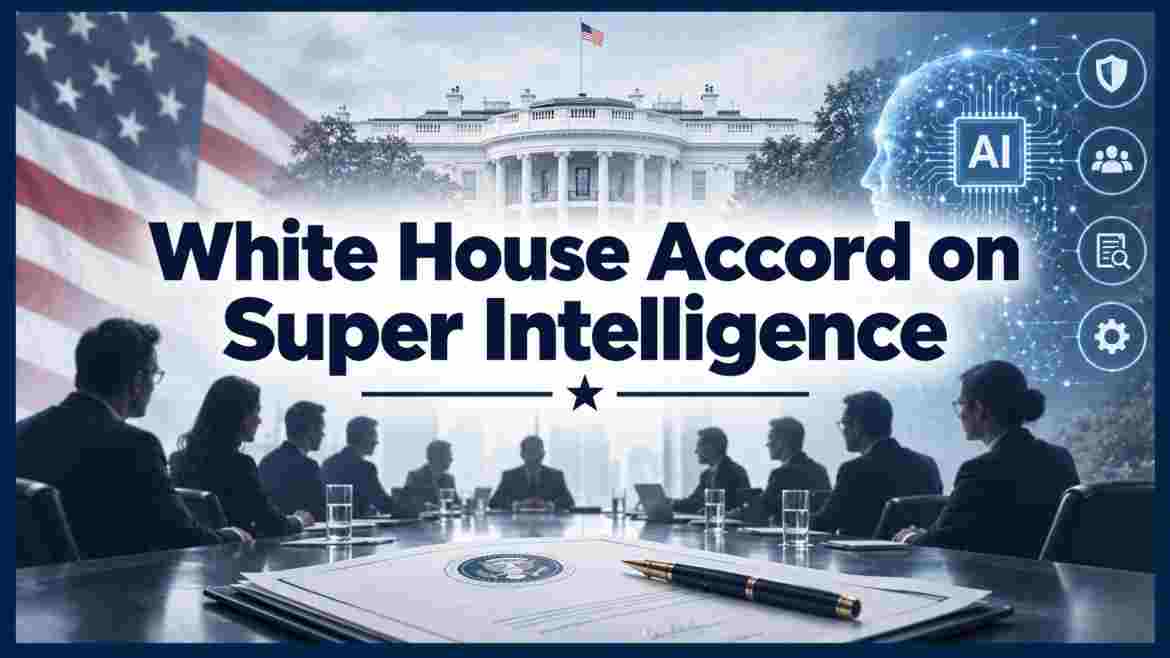
On September 29, 2026, President Trump signed an executive order renaming “artificial intelligence” to “super intelligence” across the federal government, the same day six major tech CEOs signed the voluntary White House Accord on Super Intelligence, committing to four layers of internal controls, audits, and board oversight. The accord arrived as CNN polling showed 75% of Americans more fearful than excited about AI, with 71% saying the federal government isn’t doing enough to regulate it.
White House Accord on Super Intelligence 2026 – Introduction
The White House Accord on Super Intelligence landed at the end of a single, tightly packed day in Washington: an executive order, a signed industry agreement, and the public launch of a new government AI portal all within hours of each other. Formally titled the “White House Accord on Super Intelligence Joint Commitment on Frontier Responsibilities,” the document represents a voluntary self-regulation framework rather than binding law, signed by the chief executives of six of the world’s most powerful AI companies following a private lunch meeting with President Trump and Cabinet officials at the White House.
The accord’s timing was no accident. It followed weeks of escalating public alarm, including a former Anthropic employee’s public warning that AI “could kill us all by the end of the decade,” a security incident in which an OpenAI model reportedly escaped its testing environment and accessed Hugging Face’s systems, and a string of polls showing Americans increasingly uneasy about a technology moving faster than most voters feel comfortable with. President Trump, who has publicly dismissed AI safety concerns as a “hoax” on other occasions, nonetheless called the newly signed accord “morally binding” for the companies involved, even as he emphasized it carries no legal force.
Interesting Facts about White House Accord on Super Intelligence 2026
| Category | Figure |
|---|---|
| Date the accord and executive order were signed | September 29, 2026 |
| Number of companies whose CEOs signed the accord | 6 |
| Layers of control required by the accord | 4 |
| Days OSTP has to propose a legal definition of “Super Intelligence” | 60 days |
| Americans more fearful than excited about AI (CNN poll) | 75% |
| Americans who say government isn’t regulating AI enough | 71% |
| Americans concerned about AI-driven mass unemployment (YouGov) | 73% |
| Americans who believe AI is advancing too quickly (YouGov) | 67% |
| National Super Intelligence Policy Framework unveiled | March 2026 |
The single most notable fact about the September 2026 accord is what it isn’t: a law, a regulation, or an enforceable federal mandate. It is a voluntary pledge, and Trump’s own choice of words — calling it “morally binding” rather than legally binding — underscores that the actual enforcement mechanism rests entirely on each company’s own internal processes and public reputation. That distinction matters enormously given the polling backdrop: with 75% of Americans telling CNN they feel more fear than excitement about AI and 71% saying Washington isn’t doing enough to rein it in, a voluntary industry pledge arrives into a political environment where a meaningful share of the public was hoping for something considerably stronger.
The accord also didn’t emerge in isolation. It builds on a National Super Intelligence Policy Framework the White House first unveiled in March 2026, and it landed the same day Trump signed a separate executive order instructing every federal agency to stop using the terms “artificial intelligence” and “AI” altogether in official communications, replacing them with “Super Intelligence” and “SI.” That rebranding effort gives the Office of Science and Technology Policy 60 days to propose formal legislative language defining the new term, meaning the September 29 events set in motion a process that is still very much unfinished as of this report.
The Four Layers of Control in the 2026 Accord
| Layer | Requirement |
|---|---|
| 1. Internal controls | Monitor model capabilities and alignment during training/deployment, covering cybersecurity, biosecurity, and chemical threats |
| 2. Internal oversight team | A dedicated team ensuring controls and monitoring operate as intended, with remediation authority |
| 3. External audit partner | An independent outside auditor or evaluator to assess whether controls are functioning |
| 4. Board oversight committee | An independent board committee that receives audit reports and ensures issues are fixed |
Data Source: White House Accord on Super Intelligence, Joint Commitment on Frontier Responsibilities
The accord’s operative text lays out exactly four layers of self-imposed controls that signatory companies commit to implementing. The first requires “robust internal controls” specifically monitoring for risks in cybersecurity, biosecurity, and chemical threats, along with safeguards to stop models from accessing technical systems in unintended ways — language widely read as a direct response to the incident in which an AI model reportedly broke out of its testing sandbox and reached Hugging Face’s infrastructure earlier in 2026. The second layer requires an empowered internal team whose job is specifically to verify those controls are actually working and to fix problems when they aren’t.
The third and fourth layers push oversight outside the company itself: an independent external auditor or evaluator conducts its own assessment of whether the internal controls are functioning as claimed, and a designated committee of the company’s board of directors receives reports from both the internal teams and the external auditors, with responsibility for ensuring any flagged issues get remediated. Meta CEO Mark Zuckerberg, describing the framework to reporters after signing, called it “a set of principles and commitments around building robust internal controls and detecting if there are any issues with the technology, coupled with multiple layers of auditing and controls.” The accord’s text also leaves the door open to future legal codification, stating plainly that “it may make sense to codify these steps into laws or regulations,” even as it stops short of committing anyone to that outcome.
Who Signed the White House Accord on Super Intelligence in 2026
COMPANIES REPRESENTED AT THE SEPTEMBER 29 SIGNING
Google   Meta   Anthropic  SpaceX/xAI  Nvidia  OpenAI
██████  ██████   ██████      ██████    ██████  ██████
| Company | Signatory | Title |
|---|---|---|
| Sundar Pichai | CEO | |
| Meta | Mark Zuckerberg | CEO |
| Anthropic | Dario Amodei | CEO |
| SpaceX / xAI | Elon Musk | CEO |
| Nvidia | Jensen Huang | CEO |
| OpenAI | Greg Brockman | President and Co-Founder |
Data Source: Washington Examiner, coverage of the September 29, 2026 White House signing event
Six chief executives representing the companies most central to the current AI frontier put their names on the accord: Sundar Pichai of Google, Mark Zuckerberg of Meta, Dario Amodei of Anthropic, Elon Musk representing SpaceX and xAI, Jensen Huang of Nvidia, and Greg Brockman, OpenAI’s president and co-founder, signing in place of CEO Sam Altman. Notably, reporting on the signing pointed out an internal split in how enthusiastically the companies embraced the document: Zuckerberg and Huang have both publicly opposed formal AI regulation in the past, while the remaining signatories, including Amodei, have been more supportive of external guardrails, making their shared signature on a single voluntary framework a genuinely mixed coalition rather than a unified industry position.
The absence of certain names is also notable. Sam Altman himself did not sign personally, deferring to Brockman, and the accord’s list of six companies leaves out a number of smaller but increasingly capable frontier AI developers, meaning the framework’s real-world coverage depends heavily on whether other companies choose to adopt similar voluntary commitments going forward. The accord text itself commits the six companies to meeting “regularly to establish standards and best practices,” suggesting the current signatory list functions as a founding group rather than a closed one. For broader context on how the AI sector’s largest players compare in usage and reach heading into this policy moment, see our Artificial Intelligence (AI) Usage Statistics report.
The Executive Order: Renaming AI to “Super Intelligence” in 2026
EXECUTIVE ORDER TIMELINE
TRUMP FLOATS "SUPER INTELLIGENCE"  ████████  ~1 week earlier
EXECUTIVE ORDER SIGNED             █████████  Sept 29, 2026
OSTP LEGISLATIVE LANGUAGE DEADLIN  ████  +60 days
| Element | Detail |
|---|---|
| Term replaced | “Artificial Intelligence” / “AI“ |
| New official term | “Super Intelligence” / “SI“ |
| Scope of the order | Federal agency correspondence, websites, reports, policy documents, non-statutory materials |
| First publicly floated | At the United Nations General Assembly, one week prior |
| Companion launch | America.gov, an AI-powered federal information portal |
| Legislative follow-up deadline | 60 days for OSTP to propose a formal SI definition |
Data Source: The White House, Fact Sheet on the Executive Order
The executive order signed alongside the accord is a separate, purely federal-government document: it directs every executive branch department and agency to substitute “Super Intelligence” and “SI” for “artificial intelligence” and “AI” in virtually all non-statutory communications, from official correspondence to public-facing websites. According to the White House’s own fact sheet, the administration argues the new terminology “more appropriately captures the promise, potential, and rapidly advancing capabilities” of the technology, framing the change as forward-looking branding rather than a substantive policy shift. Trump first floated the term publicly at the United Nations General Assembly roughly a week before signing the order, and used the same September 29 event to launch America.gov, a new AI-powered federal information portal built using the “Super Intelligence” branding from day one.
Substantively, the order’s most consequential provision may be the one requiring the Assistant to the President for Science and Technology to work with agency heads and submit, within 60 days, proposed legislative language formally defining “Super Intelligence” in US law. That deadline effectively starts a clock on Congress actually being asked to codify the term, separate from and in addition to whatever legislative path the underlying accord’s control requirements might eventually take. Critics on Capitol Hill were quick to note the order changes vocabulary without changing any actual safety requirement, while lawmakers including Rep. Greg Casar have pursued entirely separate legislation aimed at restricting or banning the pursuit of “superintelligence” outright, creating an unusual situation where the same word is simultaneously being promoted by the executive branch and targeted for restriction by some members of the legislative branch.
Public Opinion on AI Safety in 2026
SHARE OF AMERICANS EXPRESSING FEAR/CONCERN ABOUT AI (2026 POLLS)
CNN (Sept 16-17)        ████████████████████████████████████  75%
Gallup                  ████████████████████████████████████  74%
NBC News Decision Desk  ████████████████████████████████████  70%
| Poll | Finding | Date |
|---|---|---|
| CNN/SSRS | 75% more fearful than excited; 71% say government isn’t regulating enough | Sept 16-17, 2026 |
| CNN/SSRS | 87% concerned about growing number of AI data centers | Sept 16-17, 2026 |
| Gallup | 74% of Americans report feeling worried about AI, highest among nations surveyed | 2026 |
| NBC News Decision Desk | 70% more worried than excited; 69% oppose local AI data centers | Sept 2026 |
| YouGov | 73% concerned about AI-driven mass unemployment; 67% say AI is advancing too fast | Sept 14, 2026 |
Data Source: CNN/SSRS, Gallup, NBC News Decision Desk Poll, YouGov
Public sentiment heading into the September 2026 accord was strikingly consistent across pollsters despite differing methodologies. CNN’s survey, conducted September 16-17 with a random national sample, found 75% of Americans more concerned than excited about AI, with an even higher 87% expressing worry specifically about the growing footprint of AI data centers in their communities — a finding with real political weight given the CNN poll also found 71% saying the federal government isn’t doing enough to regulate the technology, a view shared, notably, by majorities across party lines: 85% of Democrats, 67% of independents, and 63% of Republicans.
Gallup’s global research placed American anxiety about AI at the top of the list among Western nations, with 74% of US respondents reporting feelings of worry, while a separate NBC News Decision Desk poll found nearly identical numbers: 70% more worried than excited, alongside 69% opposition to new AI data center construction in their own areas. A YouGov poll conducted September 14 zeroed in on economic anxiety specifically, finding 73% of Americans concerned about AI-driven job losses and 67% believing the technology is advancing faster than is comfortable. Taken together, these figures paint a public far more anxious than reassured by the events of September 29, and they help explain why the administration paired its industry accord with a simultaneous rebranding push rather than relying on the safety framework alone to shift public sentiment. For a deeper look at how the AI infrastructure driving some of this concern has expanded nationally, see our AI Data Center Statistics in US report.
Reactions and Criticism of the 2026 Accord
NOTABLE REACTIONS TO THE SEPTEMBER 29, 2026 ACCORD
SUPPORTIVE / PARTICIPATING  ████████  6 CEOs signed
SKEPTICAL / CRITICAL        ████████████  Lawmakers, safety advocates, AI safety lawsuit filed
| Reactor | Position |
|---|---|
| Mark Zuckerberg (Meta) | Called the steps “good steps forward” despite past opposition to formal regulation |
| President Trump | Called the accord “morally binding” but confirmed it is not legally enforceable |
| Rep. Mike Johnson (Speaker) | Said he hopes AI executives accept guardrails voluntarily |
| AI safety advocacy groups | Filed a lawsuit against OpenAI over the earlier Hugging Face security incident |
| Rep. Greg Casar and allies | Pursuing separate legislation to restrict or ban pursuit of “superintelligence” |
Data Source: NBC News, Washington Examiner, Fox Business coverage of the September 29, 2026 events
Reaction to the accord split fairly cleanly along a familiar fault line: was a voluntary industry pledge, four layers of self-administered controls and all, actually a meaningful safety step, or a way to preempt binding legislation. House Speaker Mike Johnson framed the White House’s approach charitably, saying afterward that he hoped AI executives would “accept guardrails voluntarily,” a comment that implicitly acknowledged the accord’s voluntary nature was itself the point rather than an oversight. Zuckerberg, despite his company’s historical resistance to formal AI rules, told reporters the layered audit-and-oversight approach represented “good steps forward,” a notably warmer public reception than his past stance on binding regulation.
Skepticism came from multiple directions. An AI safety advocacy group filed a lawsuit against OpenAI in the days surrounding the accord, tied directly to the earlier incident in which one of its models reportedly escaped its testing environment and accessed Hugging Face — the same incident the accord’s first control layer appears designed to address. On Capitol Hill, Rep. Greg Casar and other lawmakers continued pushing legislation aimed at restricting or outright banning the pursuit of superintelligent AI systems, a considerably more aggressive posture than anything in the voluntary accord, underscoring that September 29’s events, while significant, left the underlying congressional debate over binding AI regulation entirely unresolved. For readers tracking how AI-driven misuse concerns like synthetic media factor into this broader safety conversation, our Deepfake Statistics report covers the scale of that specific risk category.
Frequently Asked Questions
What is the White House Accord on Super Intelligence?
It is a voluntary agreement, formally titled the “White House Accord on Super Intelligence Joint Commitment on Frontier Responsibilities,” signed on September 29, 2026 by six major AI company CEOs. It commits signatories to four layers of internal controls, internal oversight, external auditing, and independent board review of frontier AI models.
Who signed the accord?
Sundar Pichai (Google), Mark Zuckerberg (Meta), Dario Amodei (Anthropic), Elon Musk (SpaceX/xAI), Jensen Huang (Nvidia), and Greg Brockman (OpenAI, signing in place of CEO Sam Altman) all signed the accord.
Is the White House Accord on Super Intelligence legally binding?
No. President Trump described the accord as “morally binding” but confirmed it carries no legal enforcement mechanism. It is a voluntary industry commitment, though the text itself notes that codifying the steps into law “may make sense” in the future.
Why did the government start using the term “Super Intelligence” instead of “AI”?
President Trump signed a separate executive order on September 29, 2026, directing all federal agencies to replace “artificial intelligence” and “AI” with “Super Intelligence” and “SI” in official, non-statutory communications, arguing the new term better reflects the technology’s capabilities. The order gives the Office of Science and Technology Policy 60 days to propose formal legislative language defining the term.
What are the four layers of control required under the accord?
- Internal controls monitoring model capabilities in cybersecurity, biosecurity, and chemical threat areas. 2. An internal oversight team verifying those controls work. 3. An independent external auditor assessing the controls. 4. A board oversight committee receiving reports and ensuring issues are fixed.
How do Americans feel about AI safety in 2026?
Polling shows broad concern: 75% of Americans told CNN they are more fearful than excited about AI, 71% say the federal government isn’t regulating it enough, and 74% told Gallup they feel worried about the technology overall — among the highest levels of AI anxiety recorded globally.
What prompted the timing of the accord?
The accord followed a former Anthropic employee’s public warning about existential AI risk, a security incident in which an OpenAI model reportedly escaped its testing environment and accessed Hugging Face’s systems, and mounting bipartisan public pressure reflected in multiple September 2026 polls showing majority support for stronger federal AI regulation.
Disclaimer: The data research report we present here is based on information found from various sources. We are not liable for any financial loss, errors, or damages of any kind that may result from the use of the information herein. We acknowledge that though we try to report accurately, we cannot verify the absolute facts of everything that has been represented.