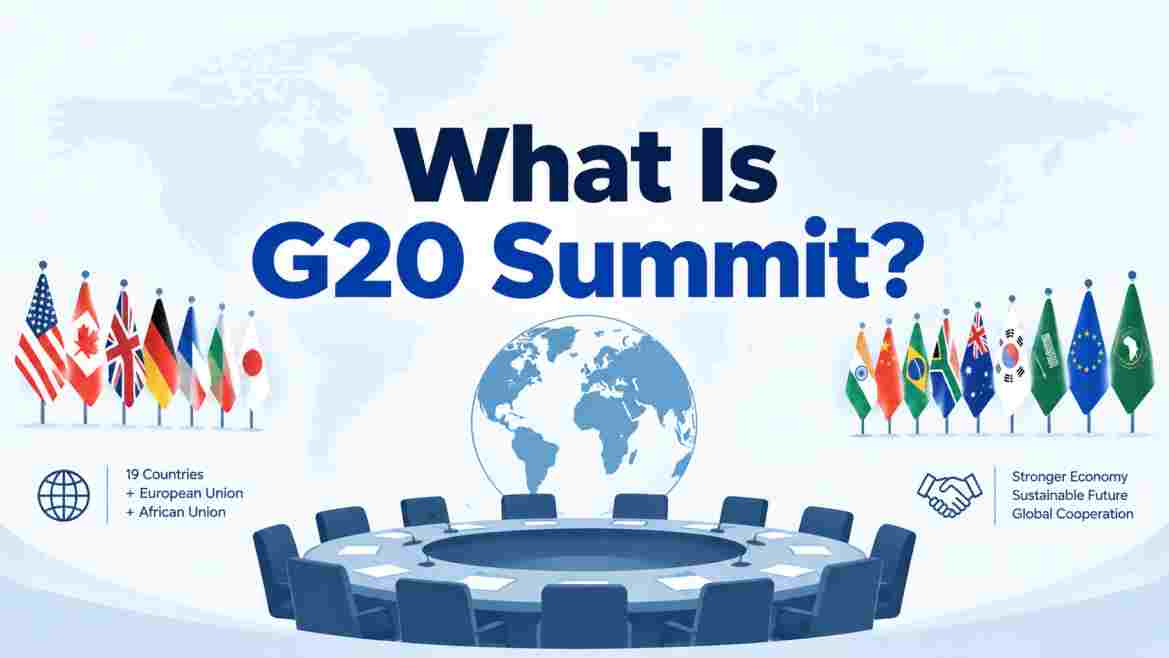
The G20 Summit is an annual meeting of leaders from the world’s 19 largest economies plus the European Union and African Union, representing 85% of global GDP and two-thirds of the world’s population. The 2026 summit, the 21st in G20 history, will be held December 14-15 in Miami, Florida, at Trump National Doral Miami.
What Is G20 Summit?
The G20 Summit stands as the world’s most significant annual gathering of major economic powers, bringing together heads of state and government from 19 countries alongside the European Union and African Union to coordinate policy on everything from financial stability to trade and climate change. Formed in 1999 in the aftermath of the Asian financial crisis, the G20 has evolved from a technical forum for finance ministers into the premier leaders-level summit shaping global economic governance, a role that takes on fresh significance in 2026 as the United States hosts the gathering for the first time since the forum’s original 2008 leaders’ summit was held on American soil.
This report breaks down what the G20 Summit is in full: its full member roster, how the rotating presidency and summit process actually works, the forum’s core purpose and economic scope, its complete summit history since 2008, the details of the 2026 Miami summit specifically, and the controversies already surrounding this year’s gathering. Understanding how the G20 functions matters for anyone following global economic policy, since decisions and declarations coming out of this single annual meeting routinely shape trade rules, financial regulations, and development priorities affecting the vast majority of the world’s population.
Interesting Facts About the G20 Summit
| Statistic | 2026 Data |
|---|---|
| Total G20 Members | 19 countries + EU + African Union |
| Share of Global GDP Represented | ~85% |
| Share of Global Trade Represented | Over 75% |
| Share of World Population Represented | About two-thirds |
| Year G20 Was Founded | 1999 |
| Year of First Leaders’ Summit | 2008 |
| 2026 Summit Number | 21st G20 Leaders’ Summit |
| 2026 Host Country | United States |
| 2026 Summit Dates | December 14-15, 2026 |
| 2026 Summit Venue | Trump National Doral Miami, Doral, Florida |
| Country Notably Excluded From the 2026 Summit | South Africa |
| Next Host After the US (2027) | United Kingdom, Manchester |
Data Source: G20 Official Website, Federal Register, US Department of State
The numbers above capture just how consequential a single annual meeting can be. The G20’s member countries collectively represent roughly 85% of global GDP, more than 75% of global trade, and about two-thirds of the world’s population, giving this one forum a concentration of economic power unmatched by almost any other international body, including the smaller, more geographically narrow G7. Founded in 1999 as a response to the Asian financial crisis, the G20 began purely as a meeting of finance ministers and central bank governors before elevating to full leaders’-level summits starting in 2008, amid the global financial crisis that made coordinated action among the world’s largest economies suddenly urgent.
The 2026 summit, the 21st in the forum’s history, carries particular weight because it returns hosting duties to the United States for the first time since that original 2008 gathering, and because this year’s edition has already generated controversy well before leaders arrive. The summit is scheduled for December 14-15, 2026 at Trump National Doral Miami, a golf resort owned by the sitting US president, and South Africa has been formally excluded from attending, a decision President Trump announced in November 2025 citing disputes over the country’s treatment of Afrikaner farmers and disagreements over the transfer of hosting protocol from the 2025 Johannesburg summit.
G20 Member Countries 2026
G20 Membership Structure
Individual Member Countries   |██████████████████████████ 19
Regional Bodies (EU + AU)     |████ 2
| Category | Members |
|---|---|
| Founding Member Countries | Argentina, Australia, Brazil, Canada, China, France, Germany, India, Indonesia, Italy, Japan, Mexico, Russia, Saudi Arabia, South Africa, South Korea, Turkey, United Kingdom, United States |
| Regional Bodies | European Union, African Union |
| African Union Joined | 2023, during India’s presidency |
| Total Voting/Participating Blocs | 21 (19 countries + 2 unions) |
Data Source: G20 Official Membership List, G20 Research Group, University of Toronto
The G20’s membership consists of 19 individual countries spanning every populated continent, deliberately assembled to represent both established advanced economies and the world’s most significant emerging markets. The roster includes traditional economic powers like the United States, Germany, Japan, and the United Kingdom alongside major emerging economies such as China, India, Brazil, Indonesia, and South Africa, reflecting the forum’s founding purpose of bringing systemically important economies together regardless of their stage of development, rather than restricting membership to a narrower club of wealthy nations the way earlier forums like the G7 had done.
Beyond the 19 individual countries, two regional bodies hold full membership status: the European Union, a founding member since 1999, and the African Union, which joined in 2023 during India’s presidency, becoming the first full institutional expansion of G20 membership since the forum’s creation. This addition of the African Union was widely seen as a significant step toward better representing the African continent’s 1.4 billion people within global economic governance, addressing a longstanding criticism that the G20, despite its broad geographic reach, had historically underrepresented Africa relative to the continent’s population and growing economic significance.
How the G20 Presidency and Summit Process Works 2026
G20 Presidency Rotation Cycle (Recent Years)
2023 |███ India
2024 |███ Brazil
2025 |███ South Africa
2026 |███ United States
2027 |███ United Kingdom
| Year | G20 Host Country |
|---|---|
| 2023 | India |
| 2024 | Brazil |
| 2025 | South Africa |
| 2026 | United States |
| 2027 | United Kingdom |
Data Source: G20 Official Presidency Records, Australian Department of Foreign Affairs and Trade
The G20 operates on a fundamentally different structural model than most international organizations: it has no permanent secretariat or standing staff whatsoever. Instead, the presidency rotates annually among member countries, with the host nation responsible for setting the year’s agenda, organizing every preparatory meeting, working group, and ministerial gathering, and ultimately hosting the culminating Leaders’ Summit each year. This rotating model means the G20’s priorities and focus areas can shift noticeably from year to year depending on which country holds the presidency and what issues that nation chooses to emphasize.
To maintain continuity despite this constant rotation, the G20 relies on what’s informally called the “Troika” system, where the current host works alongside officials from both the immediately preceding and immediately following presidency holders to ensure institutional knowledge and unfinished priorities carry forward smoothly. The United States assumed the G20 presidency on December 1, 2025, taking over from South Africa, and will hold that role through November 30, 2026, before handing responsibilities to the United Kingdom, which will host the 2027 summit in Manchester.
G20 Purpose and Economic Scope 2026
G20's Coverage of the Global Economy
Global GDP Represented       |█████████████████████ 85%
Global Trade Represented     |███████████████████ 75%+
World Population Represented |█████████████████ ~67%
| Policy Area | G20 Focus |
|---|---|
| Original Founding Purpose | International financial and economic stability |
| Current Core Mandate | Macroeconomic policy coordination, financial regulation |
| Expanded Agenda Areas | Trade, sustainable development, health, agriculture, energy, environment, climate change, anti-corruption |
| 2026 US Presidency Stated Focus | Economic growth, deregulation, affordable energy, new technology |
Data Source: Federal Register, G20 Official Website
The G20’s core purpose centers on coordinating macroeconomic policy and financial responses among the countries whose combined decisions most directly shape the global economy, a mandate that traces directly back to its founding in the wake of the 1997-1998 Asian financial crisis, when policymakers recognized that no single country or narrower grouping like the G7 could adequately address financial contagion risks in an increasingly interconnected world economy. Over the ensuing quarter-century, the forum’s agenda has expanded well beyond its original narrow financial-stability focus to encompass trade policy, sustainable development, global health, agriculture, energy security, environmental protection, climate change, and anti-corruption efforts.
Each year’s host country retains considerable latitude to emphasize specific themes within this broad mandate, and the 2026 United States presidency has signaled a notably narrower interpretation than some recent predecessors. An administration official described the US approach as “back-to-basics,” with the stated agenda focused on “unleashing economic prosperity by limiting, eliminating the burdens of regulations, unlocking affordable energy and pioneering new technologies,” a framing that deliberately steers away from the broader climate and development-focused themes that dominated several recent G20 presidencies, illustrating just how much a single host country’s priorities can reshape the forum’s practical focus within any given year.
History of G20 Summits 2026
Recent G20 Summit Hosts (2020-2027)
2020 |█ Saudi Arabia (Riyadh, virtual due to COVID-19)
2022 |███ Indonesia (Bali)
2024 |███ Brazil (Rio de Janeiro)
2025 |███ South Africa (Johannesburg)
2026 |███ United States (Miami)
2027 |███ United Kingdom (Manchester)
| Summit | Year | Host Country | City |
|---|---|---|---|
| 15th | 2020 | Saudi Arabia | Riyadh (virtual) |
| 16th | 2021 | Italy | Rome |
| 17th | 2022 | Indonesia | Nusa Dua, Bali |
| 18th | 2023 | India | New Delhi |
| 19th | 2024 | Brazil | Rio de Janeiro |
| 20th | 2025 | South Africa | Johannesburg |
| 21st | 2026 | United States | Miami |
Data Source: List of G20 Summits, G20 Research Group Archives
The history of G20 leaders’ summits stretches back to the 2008 Washington summit, convened by President George W. Bush at the height of the global financial crisis, marking the moment the forum elevated from a finance-ministers-only gathering into the leaders-level meeting it remains today. Since that founding summit, the G20 has met in a genuinely global rotation of host cities, from Toronto and Seoul in the early years through Hangzhou, Osaka, Riyadh, Rome, Bali, New Delhi, Rio de Janeiro, and Johannesburg most recently, reflecting the forum’s deliberate design to distribute hosting duties across every major region rather than concentrating them among a small cluster of traditional powers.
The 2020 Riyadh summit stands out as a notable exception in this history: originally planned as an in-person gathering in Saudi Arabia, it instead took place entirely virtually due to the COVID-19 pandemic, marking the only G20 leaders’ summit conducted without physical attendance. Looking ahead, the 2027 summit is already confirmed for Manchester, United Kingdom, while 2028 hosting duties have been assigned to South Korea, continuing the forum’s established pattern of rotating among its diverse membership on a multi-year cycle that spans every inhabited continent represented within the G20’s roster.
The 2026 G20 Miami Summit | Host Year Details
| Detail | Information |
|---|---|
| Summit Dates | December 14-15, 2026 |
| Venue | Trump National Doral Miami |
| Host City | Doral, Florida (Miami metro area) |
| Chair | Donald Trump, President of the United States |
| Additional Invited States | Azerbaijan, Finland, Ireland, Kazakhstan, Netherlands, Norway, Poland, Qatar, Singapore, Spain, UAE, Uzbekistan, Vietnam |
| Country Excluded From 2026 Summit | South Africa |
Data Source: Wikipedia G20 Miami Summit, White House Announcements
The 2026 G20 Miami Summit will take place December 14-15, 2026 at Trump National Doral Miami, a golf resort and spa property owned by the Trump Organization, a venue choice President Trump first proposed during his initial term in office and has now brought to fruition during his current presidency. Miami Mayor Francis Suarez announced the decision in the Oval Office, with Doral Mayor Christi Fraga subsequently confirming the arrangement, and National Economic Council Director Kevin Hassett has been designated as the point person overseeing summit organization, while Treasury Secretary Scott Bessent manages the substantive policy agenda.
Beyond the core 19 member countries and two regional bodies, host nations traditionally extend invitations to additional non-member states as observers, and the 2026 summit’s invitee list includes thirteen additional countries: Azerbaijan, Finland, Ireland, Kazakhstan, the Netherlands, Norway, Poland, Qatar, Singapore, Spain, the United Arab Emirates, Uzbekistan, and Vietnam, a notably broad guest list that extends the summit’s reach well beyond formal G20 membership. Poland’s inclusion carries particular symbolic weight, since Trump personally extended the invitation to newly elected Polish President Karol Nawrocki during a White House visit, underscoring how host-year invitee decisions often reflect the sitting president’s own diplomatic priorities as much as any formal institutional criteria.
Controversies Surrounding the 2026 G20 Summit
| Controversy | Detail |
|---|---|
| South Africa’s Exclusion | Announced November 27, 2025 |
| Stated Reason | Treatment of Afrikaners; hosting protocol dispute |
| Venue Ownership | Trump National Doral Miami, owned by sitting US president |
| Broader Agenda Shift | Narrower “back-to-basics” economic focus vs. prior years’ broader climate/development themes |
Data Source: Wikipedia, Arab News/Agence France-Presse
The 2026 G20 Summit has generated significant controversy well before its December gathering, centered on two distinct issues. First, President Trump announced on November 27, 2025 that South Africa would not be invited to the summit, a decision he tied to the South African government’s treatment of Afrikaner farmers and a separate dispute over South Africa’s refusal to transfer G20 hosting protocol responsibilities to a US Embassy representative following the conclusion of the 2025 Johannesburg summit. Excluding a full G20 member country from the annual leaders’ summit represents an unprecedented step in the forum’s history, and critics have argued it undermines the G20’s founding premise of bringing all systemically important economies together regardless of individual diplomatic disputes between the host and any single member.
Second, the choice of Trump National Doral Miami, a property the sitting US president personally owns, as the summit venue has drawn scrutiny over potential conflicts of interest, since hosting the gathering there directly generates revenue and international visibility for a Trump-owned business. This is not the first time such a proposal has surfaced: Trump initially floated hosting a G7 summit at the same Doral property during his first term in 2019, a plan he ultimately abandoned amid bipartisan criticism, making its revival for the far larger and more consequential G20 gathering in 2026 a notable reversal that has reignited similar ethics concerns among government watchdog groups and members of Congress.
G20 vs. G7: Key Differences 2026
G20 vs G7 Membership Comparison
G20 Countries  |█████████████████████████████ 19 + EU + AU
G7 Countries   |███████████████ 7 + EU (non-enumerated)
| Metric | G20 | G7 |
|---|---|---|
| Member Countries | 19 + EU + African Union | 7 + EU (non-enumerated member) |
| Founded | 1999 | 1975 (as G6), 1976 (as G7) |
| Global GDP Share | ~85% | ~30-40% |
| Population Represented | ~Two-thirds of world population | ~10% of world population (~780 million) |
| 2026 Host | United States (Miami, December) | France (Évian-les-Bains, held June 2026) |
Data Source: G7 Official Records
Understanding the G20 requires distinguishing it clearly from the smaller, older G7, a comparison covered from an earlier host year’s perspective in the companion G20 Summit 2023 New Delhi report. The G7, consisting of Canada, France, Germany, Italy, Japan, the United Kingdom, and the United States alongside a non-enumerated European Union membership, traces its roots to a 1973 informal gathering of finance ministers and formalized into an annual leaders’ summit starting in 1975. Its seven member countries represent roughly 780 million people, or about 10% of the world’s population, and together account for around half of global net wealth, but a considerably smaller share of overall global GDP and trade than the G20’s far broader membership.
The G20’s deliberate inclusion of major emerging economies like China, India, Brazil, Indonesia, and South Africa alongside the traditional G7 powers gives it a fundamentally different character and purpose: where the G7 operates as a forum for like-minded advanced democracies to coordinate on shared values and strategic priorities, the G20 functions as a genuinely global economic steering committee, bringing together countries with vastly different political systems, development levels, and strategic interests specifically because their combined economic weight makes coordinated action among them essential for addressing truly global challenges like financial stability, trade policy, and pandemic response.
G20’s Role in Global Economic Coordination 2026
Global Inflation Coordination Context, 2026
G20 Inflation Projection (OECD, Revised) |██████████████ 4.0%
Global Inflation Forecast (IMF)          |███████████ 3.6%
| Metric | Value |
|---|---|
| G20 Inflation Projection, 2026 (OECD, Revised) | 4.0% |
| Global Inflation Forecast, 2026 (IMF) | 3.6% |
| G20 Inflation, 2025 | 3.4% |
| Upward Revision Driver | Energy shock, Strait of Hormuz disruptions |
Data Source: OECD Economic Outlook Interim Report March 2026
One of the clearest illustrations of why the G20’s economic coordination role matters comes from how closely institutions like the OECD and IMF track G20-specific economic indicators separately from broader global figures, detailed extensively in the Global CPI Statistics report. The OECD’s March 2026 Interim Economic Outlook revised its G20 inflation projection upward by a full 1.2 percentage points to 4.0% for the year, specifically citing energy market disruptions tied to Strait of Hormuz shipping tensions, a revision that ran meaningfully higher than the IMF’s broader 3.6% global inflation forecast for the same period.
This gap between G20-specific and global inflation tracking exists precisely because the G20’s membership concentrates so much of the world’s energy-importing industrial capacity, meaning shocks to global energy markets hit this particular group of economies with disproportionate force relative to the broader, more geographically diverse global average. Forecasters and policymakers treat G20 aggregate data as a genuinely distinct and closely watched indicator precisely because the forum’s membership was designed from the outset to capture the countries whose combined economic decisions move markets and shape outcomes far beyond their own borders, making G20-level economic coordination, imperfect and often slow as it can be, one of the few mechanisms capable of addressing genuinely global economic shocks at the scale required.
G20 and International Trade Policy 2026
Global Trade Governed by MFN vs Preferential Terms
Global Trade on MFN Terms |████████████████████████████ 74%
Preferential/FTA Terms    |██████████████████████ Remainder
| Metric | Value |
|---|---|
| Global Trade Share on MFN Terms | 74% |
| Global Average MFN Tariff Rate | 2.6% |
| WTO Member Countries (MFN Framework) | 164 nations |
| G20 Share of Global Trade | Over 75% |
Data Source: World Trade Organization
Trade policy sits at the very heart of what the G20 was designed to coordinate, and understanding the broader international trade framework the forum operates within, detailed comprehensively in the MFN Tariffs report, helps clarify why G20 discussions on trade carry such outsized real-world weight. Roughly 74% of global trade still flows under standard Most Favored Nation tariff terms, the baseline, non-discriminatory tariff rates that World Trade Organization members apply to one another absent a specific preferential agreement, and because G20 countries collectively represent more than 75% of global trade volume, shifts in G20 members’ trade policy stances effectively set the tone for the overwhelming majority of the world’s commercial activity.
This trade dimension has become especially significant heading into the 2026 summit, given the wave of tariff actions various G20 members, most notably the host country itself, have pursued in recent years. Because the G20 lacks binding enforcement authority and operates purely through consensus-based declarations rather than treaty obligations, its practical influence on trade policy depends heavily on whether member countries’ individual actions align with or diverge from whatever consensus language leaders manage to agree upon during any given summit, making the forum’s trade-related outcomes as much a barometer of prevailing national trade policy trends among its largest members as a genuine driver of coordinated global trade liberalization.
What Is G20 Summit? – Frequently Asked Questions
What does G20 stand for? G20 stands for “Group of Twenty,” referring to the forum’s membership of 19 individual countries plus the European Union and African Union.
How many countries are members of the G20? The G20 has 19 individual member countries, plus the European Union and African Union as full institutional members, bringing total representation to 21 members.
When was the G20 founded? The G20 was founded in 1999 in response to the Asian financial crisis, initially as a forum for finance ministers before elevating to leaders’-level summits starting in 2008.
Where is the G20 Summit held in 2026? The 2026 G20 Summit will be held December 14-15, 2026 at Trump National Doral Miami in Doral, Florida.
Which country is excluded from the 2026 G20 Summit? South Africa was formally excluded from the 2026 summit, a decision President Trump announced in November 2025.
What is the difference between the G20 and the G7? The G20 includes 19 countries representing about 85% of global GDP, while the G7 includes only 7 advanced democracies representing a smaller share of global GDP and about 10% of world population.
Does the G20 have a permanent headquarters or staff? No. The G20 has no permanent secretariat; the presidency rotates annually among member countries, with each host responsible for organizing that year’s meetings.
What percentage of the global economy does the G20 represent? G20 members collectively represent approximately 85% of global GDP, over 75% of global trade, and about two-thirds of the world’s population.
Who hosted the G20 before the United States in 2026? South Africa hosted the 2025 G20 Summit in Johannesburg before handing the presidency to the United States on December 1, 2025.
Who will host the G20 Summit after the United States? The United Kingdom will host the 2027 G20 Summit in Manchester, followed by South Korea in 2028.
Disclaimer: The data research report we present here is based on information found from various sources. We are not liable for any financial loss, errors, or damages of any kind that may result from the use of the information herein. We acknowledge that though we try to report accurately, we cannot verify the absolute facts of everything that has been represented.