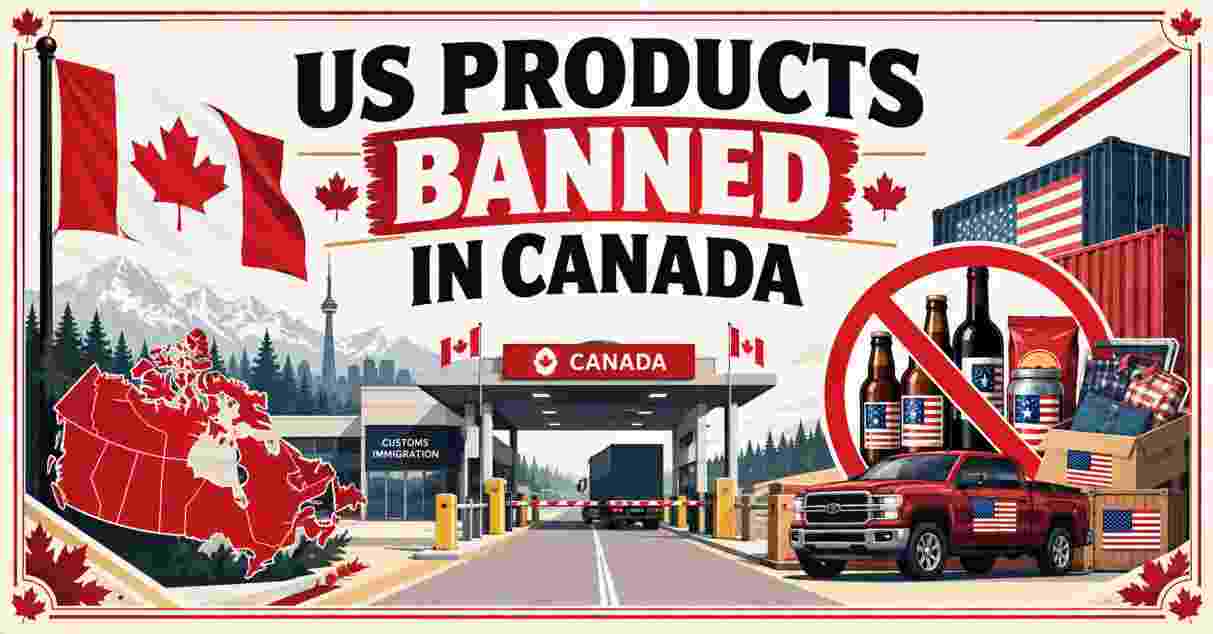
US Products Banned in Canada 2026 include American alcohol, which has been pulled from provincial liquor store shelves since March 2025, along with US companies barred from most government procurement contracts and more than 700 American goods facing new retaliatory tariffs as of September 8, 2026. Ontario, Quebec, British Columbia, and most other provinces continue enforcing the alcohol ban into 2026, while Canada’s federal counter-tariff package covers roughly $20 billion (C$27.6 billion) in US products.
US Products that are Banned by Canada 2026
US Products Banned in Canada became a defining feature of North American retail and government procurement starting in early 2025, when provinces began pulling American alcohol from shelves and restricting US companies from public contracts. What started as a coordinated provincial response to the first round of US tariffs on Canadian goods has since hardened into one of the longest-running trade retaliation campaigns in modern Canadian history, with most of the original restrictions still fully in force as of September 2026. The Liquor Control Board of Ontario, the Société des Alcools du Québec, and BC Liquor Stores all removed American spirits, wine, and beer from their catalogues within days of each other in March 2025, and only two provinces have reversed course since.
The scope of the restrictions has grown well beyond alcohol. Federal and provincial governments across Canada have layered procurement bans, a formal “Buy Canadian” policy, and a fresh round of retaliatory tariffs on top of the original alcohol removals, creating a patchwork of rules that American exporters and their Canadian distributors must now navigate product by product. This report breaks down every confirmed restriction, the provinces enforcing them, the dollar values involved, and the timeline that brought Canada and the United States to their current standoff, using verified government and institutional sources.
Interesting Facts About US Products Banned in Canada 2026
| Fact | Confirmed 2026 Data |
|---|---|
| US alcohol ban start date | March 4, 2025 (Ontario), still enforced in 2026 |
| Provinces that lifted the alcohol ban | Only Alberta and Saskatchewan (June 2025) |
| Ontario’s pre-ban US alcohol imports | Approximately $965 million |
| US products stocked by LCBO before the ban | Roughly 3,600 products from 35 states |
| Canada’s Sept 8, 2026 counter-tariffs | More than 700 US products, ~$20 billion (C$27.6 billion) |
| Federal procurement threshold for Buy Canadian rules | $25 million, reducing to $5 million on June 15, 2026 |
| US action in response | Canadian goods banned from US federal procurement (Sept 9, 2026) |
| Ontario-made alcohol sales increase | Approximately 22% one year after the ban |
| Canadian road trips to the US | Down roughly 35% over two years (as of April 2026) |
Source: Liquor Control Board of Ontario, Department of Finance Canada, Statistics Canada, U.S. Federal Register
Canada’s restrictions on American goods rest on two separate but connected tracks. The first, provincial control over alcohol sales, gave Ontario, Quebec, and British Columbia the power to remove roughly 3,600 US products worth close to $965 million in prior annual Ontario imports alone within days of the first US tariffs in March 2025. The second track, federal and provincial procurement policy, has taken longer to build but now carries real financial weight, with Buy Canadian rules applying to major federal contracts and set to reach smaller procurements worth as little as $5 million by mid-2026.
The $20 billion counter-tariff package that took effect September 8, 2026 marks the most direct escalation yet, targeting more than 700 individual US products with duties as high as 50%. Washington’s response arrived within 24 hours: on September 9, 2026, the White House directed federal procurement officials to remove Canadian-origin products from government purchasing schedules, citing Canada’s own procurement restrictions as the justification. The sections below walk through each restriction category, the provinces and agencies enforcing them, and the trade and travel data showing how deeply the standoff has reshaped commerce between the two countries.
Full List of US Products Banned in Canada 2026
Restriction Type Breakdown - Canada's Actions on US Goods (2026)
Provincial alcohol ban       |||||||||||||||||||||||||||||||||  Beer, wine, spirits, coolers
Federal/provincial procurement ban |||||||||||||||||||||||||||  US-based suppliers, contractors
Sept 8 retaliatory tariffs   |||||||||||||||||||||||||||||||||||||||||||||  700+ goods, 15/25/50% duty
Local content requirements   |||||||||||||||||||||||||||        Steel, aluminum, wood in federal contracts
| Restriction Type | Products or Entities Covered | Effective Date |
|---|---|---|
| Provincial alcohol ban | Beer, wine, spirits, ready-to-drink coolers, non-alcoholic US beverages | March 4-11, 2025, ongoing in most provinces |
| Government procurement ban | US-headquartered companies with fewer than 250 Canadian employees | March 4, 2025 (Ontario), expanding through 2025-2026 |
| Retaliatory tariffs (15-50%) | More than 700 US goods including steel, aluminum, food, electronics, appliances | September 8, 2026 |
| Local content requirements | Steel, aluminum, and wood products in major federal defence and construction contracts | December 16, 2025, tightening through 2026 |
Source: Government of Ontario, Department of Finance Canada, Government of Canada procurement policy documents
Canada’s restrictions on US products operate across four distinct legal channels, a structure that mirrors the layered approach the United States later took against Canadian goods. Provincial governments hold the authority over alcohol distribution, which is why the alcohol ban rolled out province by province rather than as a single national policy, with Ontario, Quebec, and British Columbia moving first and most other provinces and territories following within the same week in March 2025. The procurement ban operates on a separate legal basis, since public purchasing rules fall under both provincial and federal jurisdiction, producing a patchwork where Ontario’s rules differ in scope and threshold from Manitoba’s Buy Canadian Act or Saskatchewan’s capital project guidelines.
The September 8, 2026 retaliatory tariffs represent Canada’s most direct dollar-for-dollar response to the escalating US measures, applying rates between 15% and 50% depending on the product category, with steel and aluminum duties doubling from 25% to 50% as part of the same package. The local content requirements added in December 2025 work differently again, since they do not ban US products outright but instead require that Canadian-produced steel, aluminum, and wood be used in qualifying federal contracts, a rule set to tighten as the procurement value threshold drops from $25 million to $5 million by June 15, 2026.
Canadian Alcohol Ban on US Products 2026
LCBO and Provincial Alcohol Ban Impact (Ontario, 2025-2026)
Pre-ban annual US alcohol imports (Ontario)   |||||||||||||||||||||||||||||| $965M
Ontario-made alcohol sales increase           |||||||||||||||||||||||||       22%
Craft product sales increase                  |||||||||||||||||||||||||||||||  35%
VQA Ontario wine sales increase                |||||||||||||||||||||||||||||||||||||||| 52%
| Metric | Confirmed Figure |
|---|---|
| Ban announcement date (Ontario) | March 4, 2025 |
| BC Liquor Stores ban date | March 11, 2025 |
| US products previously listed at LCBO | Roughly 3,600 products from 35 states |
| Ontario’s pre-ban US alcohol imports | Approximately $965 million annually |
| Provinces that lifted the ban | Alberta and Saskatchewan only, June 2025 |
| Ontario-made alcohol sales increase (1 year later) | Approximately 22% |
| VQA Ontario wine sales increase | Approximately 52% |
| Value of unsold US alcohol stock (1 year later) | Approximately $2 million |
Source: Liquor Control Board of Ontario official press release, Government of Ontario Ministry of Finance
The LCBO’s own March 4, 2025 announcement confirmed it had “ceased the purchase of all US products” and removed American spirits, wine, cider, beer, and ready-to-drink coolers from both retail stores and its wholesale catalogue used by grocery stores, bars, and restaurants. Quebec’s SAQ and British Columbia’s government-run liquor stores followed within days, and by mid-March 2025 every Canadian province and territory had suspended the purchase, distribution, or retailing of US alcoholic beverages, according to the US Federal Register’s own account of the dispute. Only Alberta and Saskatchewan have since reversed their bans, doing so in June 2025, leaving the country’s two largest alcohol markets, Ontario and Quebec, still fully enforcing the restriction well into 2026.
The economic effect inside Ontario has been substantial in both directions. Ontario’s Ministry of Finance reported that domestic alcohol sales rose roughly 22% in the year following the ban, with craft producers seeing gains of 35% and VQA Ontario wine sales climbing 52%, much of that growth coming directly at the expense of California wine and other US labels that once filled the same shelf space. At the same time, roughly $2 million worth of US alcohol inventory sat unsold and eventually expired inside LCBO warehouses a year after the ban began, a detail Ontario’s finance minister has cited as evidence the province’s “resolve is firm” and that American alcohol will not return to shelves until the underlying US tariffs are removed entirely.
Canada’s Retaliatory Tariffs on US Goods 2026
Canada's Sept 8, 2026 Counter-Tariff Package
Total US products targeted     |||||||||||||||||||  700+ tariff lines
Total countermeasure value     |||||||||||||||||||  $20B (C$27.6B)
Steel/aluminum tariff rate     ||||||||||||||||||||||  50% (doubled from 25%)
Standard tariff range          ||||||||||||||||||||||||||       15%-50%
| Metric | Confirmed Figure |
|---|---|
| Effective date | September 8, 2026 |
| US products targeted | More than 700 tariff line items |
| Total value of countermeasures | Approximately $20 billion USD (C$27.6 billion) |
| Standard tariff rate range | 15%, 25%, or 50%, depending on the product |
| Steel and aluminum tariff rate | Doubled from 25% to 50% |
| List length | Nearly 99 pages of covered goods |
| Product categories included | Steel, aluminum, fish, cheese, smartphones, furniture, tools, appliances |
Source: Department of Finance Canada
Canada’s Finance Minister Francois-Philippe Champagne confirmed the $20 billion counter-tariff package on August 25, 2026, structured as a direct, dollar-for-dollar response to the US Section 338 duties that had taken effect three days earlier. The list, spanning nearly 99 pages, doubled existing tariffs on American steel and aluminum from 25% to 50% and added fresh duties on consumer goods ranging from fish and cheese to smartphones, furniture, and household appliances, hitting more than 700 individual tariff lines when the measures took effect at midnight on September 8, 2026.
The structure of the retaliation closely tracks the pattern Canada established in March 2025, when the first 25% duty was paired with a promise to expand coverage if US measures continued, a promise Ottawa has now made good on twice over. Within hours of the September 8 tariffs taking effect, President Trump announced the removal of all Canadian-origin products from US federal government procurement schedules, framing the move as a direct response to what he described on social media as Canada’s own restrictions on American small businesses, a reference to the same procurement policies detailed in the next section.
Buy Canadian Federal Procurement Policy 2026
Buy Canadian Procurement Threshold Timeline
Interim Reciprocal Procurement Policy (Jul 2025)   ||||||||||||||||||||||
Strategic Procurement Policy launch (Dec 2025)     |||||||||||||||||||||||||||  $25M threshold
Threshold reduction (Jun 15, 2026)                 |||||||||||||||||||||||||||||||||||||||||||||  $5M threshold
| Policy Milestone | Detail |
|---|---|
| Interim Policy on Reciprocal Procurement | Effective July 14, 2025; limits federal access to reciprocal trading partners |
| Ontario’s Procurement Restriction Policy | Retroactive to March 4, 2025; bans most US-based suppliers |
| Toronto’s local procurement threshold | C$350,000 for goods/services, C$8.8 million for construction |
| Strategic Federal Procurement Policy launch | Effective December 16, 2025 |
| Federal procurement threshold (initial) | $25 million |
| Federal procurement threshold (from June 15, 2026) | $5 million |
| Required Canadian-sourced materials | Steel, aluminum, wood products in defence and construction contracts |
Source: Government of Canada, Government of Ontario, City of Toronto procurement policy filings
Ontario moved first among Canadian jurisdictions, with Premier Doug Ford announcing on March 4, 2025 that US-headquartered companies with fewer than 250 Canadian employees would be banned from provincial government procurement for as long as US tariffs remained in place, a policy applied retroactively to that same date. The City of Toronto followed within days, disallowing non-Canadian bidders on contracts below C$350,000 for goods and services and C$8.8 million for construction, while Manitoba, Saskatchewan, British Columbia, and the Yukon each introduced their own versions of “Buy Canadian” procurement rules through March and April 2025. Readers tracking the broader tariff relationship can review Canada’s tariffs on US goods for how these procurement measures fit alongside the September 2026 counter-tariff package.
The federal government took a more gradual path, introducing an Interim Policy on Reciprocal Procurement in July 2025 before formally launching the Strategic Federal Procurement Policy in December 2025. That policy currently applies to federal procurements over $25 million across defence, health, infrastructure, and technology sectors, and requires that steel, aluminum, and wood used in qualifying defence and construction contracts be Canadian-produced. The threshold is scheduled to drop to just $5 million on June 15, 2026, a change that will pull thousands of smaller federal contracts into the policy’s scope and, according to US officials, was a central factor behind the September 9, 2026 decision to ban Canadian products from American federal procurement in return.
Canadian Boycott of US Products and Travel Statistics 2026
Canadian Consumer and Travel Shift Away From the US (2025-2026)
Road trips to the US (2-year decline)       |||||||||||||||||||||||||||||||||||||  ~35%
Consecutive months of travel decline        |||||||||||||||||||||||||||||||||||||||||| 14 months
Estimated US visitor spending lost          |||||||||||||||||||||||||||||||||   $4.5B
Business travel to the US (Jan-Jul 2026)    |||||||||||||||||||||   +4.8% (up)
| Metric | Confirmed Figure |
|---|---|
| Canadian road trips to the US (2-year change) | Down approximately 35% |
| Consecutive months of year-over-year travel decline | 14 months (as of the most recent report) |
| Estimated cumulative US visitor spending lost | Approximately $4.5 billion |
| Canceled travel plans (Longwoods International survey) | Roughly 23% of Canadian travelers |
| Business travel to the US (Jan-Jul 2026) | Up 4.8% year-over-year |
| First quarter 2026 overall travel decline | 3.3% |
Source: Statistics Canada, Longwoods International traveler tracking study
Statistics Canada’s monthly travel data has recorded consecutive year-over-year declines in Canadian visits to the United States for well over a year, with road trips, the most common form of cross-border travel, down roughly 35% compared with two years earlier as of the most recent reporting period in 2026. A Longwoods International tracking survey found that nearly 23% of Canadian travelers have canceled a previously planned US trip, while a separate poll found that a majority now cite US government policy and trade practices as their primary reason for staying away, a sentiment that has held steady even as the underlying tariff and procurement disputes have escalated further.
The consumer boycott has not been uniform across every segment of travel. While leisure travel and road crossings have fallen sharply, business air travel between Canada and the US actually rose 4.8% year-over-year between January and July 2026, according to corporate booking data, suggesting that commercial and professional travel has proven more resistant to the broader boycott sentiment than personal trips. The cumulative effect on US tourism-dependent businesses is estimated at roughly $4.5 billion in lost visitor spending, a figure state and local tourism boards in border states have cited repeatedly while lobbying Washington for a resolution to the underlying trade dispute. For context on how Canada’s population and consumer base compares with other countries, the Canada population statistics report offers useful background on the market size behind these travel and spending figures.
US-Canada Trade War Timeline 2026
Key Escalation Milestones (2025-2026)
Mar 2025 - Provincial alcohol bans begin        ||||||||||||||||
Jul 2025 - Interim reciprocal procurement policy ||||||||||||||||||
Dec 2025 - Strategic federal procurement policy  ||||||||||||||||||||||
Aug 25, 2026 - Canada confirms $20B retaliation  ||||||||||||||||||||||||||
Sep 8, 2026 - Canada's counter-tariffs take effect |||||||||||||||||||||||||||||
Sep 9, 2026 - US bans Canadian federal procurement ||||||||||||||||||||||||||||||||
| Date | Event | Details |
|---|---|---|
| March 4-11, 2025 | Provincial alcohol bans begin | Ontario, Quebec, and BC pull all US alcohol from shelves |
| July 14, 2025 | Interim Reciprocal Procurement Policy | Federal procurement access limited to reciprocal trading partners |
| December 16, 2025 | Strategic Federal Procurement Policy launches | Buy Canadian rules apply to contracts over $25 million |
| August 25, 2026 | Canada confirms retaliation list | More than 700 US products, worth roughly $20 billion |
| September 8, 2026 | Canada’s counter-tariffs take effect | Dollar-for-dollar match on US Section 338 duties |
| September 9, 2026 | US bans Canadian products from federal contracts | Directive issued to US General Services Administration |
Source: Government of Ontario, Department of Finance Canada, The White House
This timeline shows a dispute that began with a narrow, provincially controlled measure, the alcohol ban, and gradually widened into a full federal procurement and tariff standoff spanning more than eighteen months. The gap between the March 2025 alcohol bans and the December 2025 federal procurement policy reflects the different legal pathways each level of Canadian government had to follow, provinces moved almost overnight using existing liquor board authority, while the federal government needed most of 2025 to build a formal procurement framework capable of withstanding legal and trade challenges.
The final two entries on the timeline, separated by just 24 hours, mark the moment both governments abandoned any remaining restraint. Canada’s $20 billion counter-tariff package on September 8 was framed explicitly as retaliation for the US Section 338 duties that took effect in August, and the US procurement ban announced the following day was, in turn, framed as retaliation for Canada’s own Buy Canadian policy, a cycle of matched escalation that trade analysts say leaves little room for either side to de-escalate without a broader negotiated settlement.
US Products Banned in Canada 2026: Frequently Asked Questions
What US products are currently banned in Canada in 2026?
American alcohol, including beer, wine, and spirits, has been pulled from most provincial liquor store shelves since March 2025 and remains banned in Ontario, Quebec, British Columbia, and most other provinces into 2026. Separately, more than 700 US products face new retaliatory tariffs of 15% to 50% as of September 8, 2026.
Is American alcohol still banned in Canada in 2026?
Yes. Only Alberta and Saskatchewan have lifted their bans, doing so in June 2025. Ontario, Quebec, British Columbia, and the remaining provinces and territories continue enforcing the restriction.
Can US companies bid on Canadian government contracts in 2026?
Access is heavily restricted. Ontario’s Procurement Restriction Policy bans most US-headquartered companies from provincial contracts, while the federal Strategic Procurement Policy prioritizes Canadian suppliers for contracts over $25 million, a threshold dropping to $5 million on June 15, 2026.
Why did Canada retaliate with new tariffs on September 8, 2026?
The $20 billion counter-tariff package was Canada’s dollar-for-dollar response to the US Section 338 duties that took effect on August 22, 2026, applying to Canadian dairy, alcohol, and dozens of other product categories.
Did the US respond to Canada’s procurement restrictions?
Yes. On September 9, 2026, the White House directed the US General Services Administration to remove all Canadian-origin products from federal procurement schedules, citing Canada’s Buy Canadian policy as the reason.
How much has the Canadian travel boycott cost the US economy?
Statistics Canada data shows Canadian road trips to the US down roughly 35% over two years, with cumulative lost US visitor spending estimated at approximately $4.5 billion.
Are Canadian steel and aluminum products required in Canadian government contracts?
Yes, for qualifying defence and construction contracts. The Strategic Federal Procurement Policy, effective December 16, 2025, requires Canadian-produced steel, aluminum, and wood in major federal projects.
How much US alcohol did Ontario import before the ban?
Ontario imported approximately $965 million worth of American alcohol annually before the LCBO ban took effect on March 4, 2025.
Has the alcohol ban helped Canadian producers?
Ontario’s Ministry of Finance reported domestic alcohol sales rose roughly 22% in the year following the ban, with craft producer sales up 35% and VQA Ontario wine sales up 52%.
What is the total value of the US-Canada retaliatory tariff dispute in 2026?
Canada’s September 2026 counter-tariffs cover roughly $20 billion in US goods, matching the $27.6 billion in Canadian goods covered by the US Section 338 duties imposed the month before.
Disclaimer: The data research report we present here is based on information found from various sources. We are not liable for any financial loss, errors, or damages of any kind that may result from the use of the information herein. We acknowledge that though we try to report accurately, we cannot verify the absolute facts of everything that has been represented.