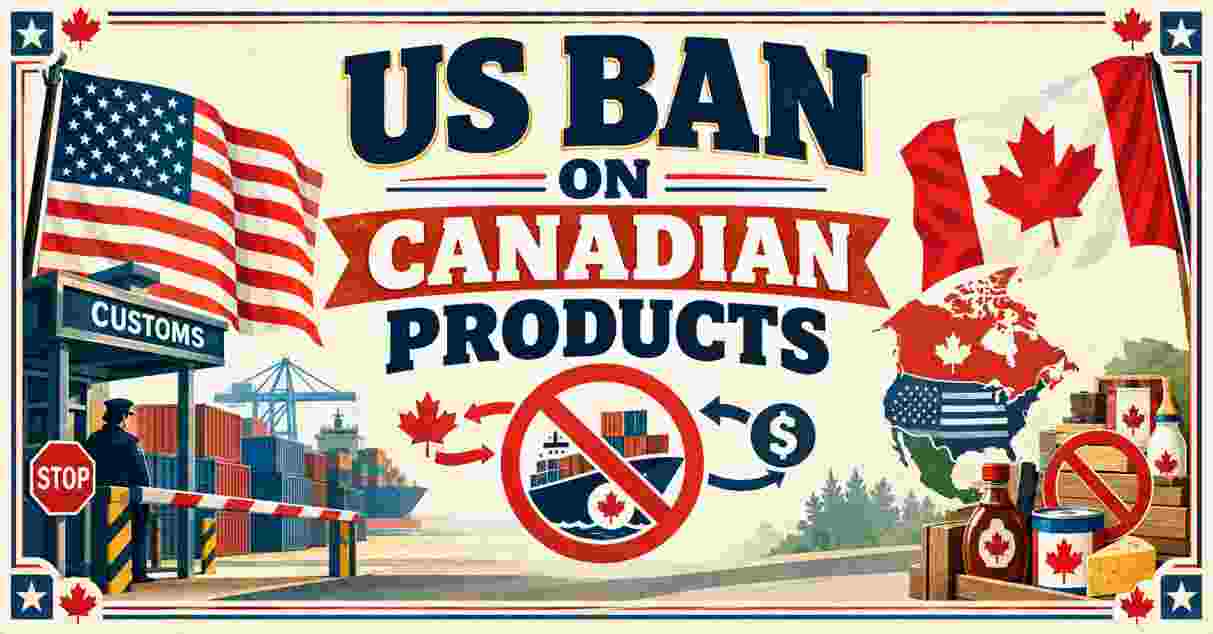
The US Ban on Canadian Products 2026 covers dairy goods, most alcoholic beverages, and motorcycles, banned outright under a White House order announced September 9, 2026, and taking effect roughly three weeks later. A separate 50% Section 338 tariff already covers Canadian dairy, alcohol, motor vehicle products, chemicals, plastics, and electronics as of August 22, 2026, while mattresses, motorboats, and golf carts face a new 50% surcharge starting September 15, 2026.
Canadian Products that are Banned by US 2026
The US Ban on Canadian Products became one of the most searched trade terms in North America after the White House confirmed on September 9, 2026, that dairy products, most alcoholic drinks, and motorcycles from Canada would be prohibited from entering the United States outright. This move builds on months of escalating duties that started with a 25% tariff in early 2025 and climbed through 35%, then to an additional 50% under a rarely used trade law, before reaching the current outright prohibition on select categories. The decision followed the collapse of trade talks in late August 2026, when Canadian Prime Minister Mark Carney recalled his country’s negotiating team and confirmed that Ottawa would match every US measure dollar for dollar.
Shoppers and importers on both sides of the border are now trying to work out exactly which goods fall under the ban, which face a steep surcharge instead, and which remain untouched under the United States-Mexico-Canada Agreement (USMCA). Canadian dairy producers, distillers, brewers, and motorcycle manufacturers face the sharpest impact, since their goods are now barred from US shelves rather than simply taxed. Meanwhile, a wider list of goods, from furniture to industrial machinery, carries an additional 50% duty that raises the landed cost for American importers substantially. The sections below break down every confirmed category, every effective date, and every dollar figure tied to this trade dispute using verified government and institutional data.
Interesting Facts About the US Ban on Canadian Products 2026
Below is an ASCII visual comparing the scale of the major 2026 trade actions between the two countries, followed by the confirmed facts table.
| Fact | Confirmed 2026 Data |
|---|---|
| Outright ban announced | September 9, 2026 |
| Ban effective date | ~3 weeks after announcement (late September 2026) |
| Categories banned outright | Dairy, most alcoholic beverages, motorcycles |
| 50% surcharge categories | Mattresses, motorboats, golf carts (effective September 15, 2026) |
| Section 338 tariff rate | 50% additional ad valorem duty |
| Section 338 effective date | August 22, 2026, 12:01 a.m. ET |
| Value of goods under Section 338 | $27.6 billion |
| Canada’s counter-tariff value | Approximately $20 billion USD (C$27.6 billion) |
| US products on Canada’s retaliation list | More than 700 tariff line items |
| Government contract restriction | Canadian goods barred from long-term US federal contracts |
Source: The White House, Department of Finance Canada, U.S. Customs and Border Protection
The scale of the US Ban on Canadian Products stands out most clearly when compared with the overall size of the bilateral relationship. A $27.6 billion slice of Canadian goods fell under the initial 50% Section 338 duty in August, while Canada’s dollar-for-dollar response covers roughly $20 billion in American goods across more than 700 tariff lines. These figures represent a meaningful share of a trading relationship that moved close to $872 billion in combined goods and services in 2025, according to the Office of the United States Trade Representative.
What makes the September 9 announcement different from earlier tariff rounds is the shift from taxation to prohibition. A 50% duty still allows a shipment to clear customs at a higher cost; an outright ban does not. Dairy cooperatives, craft distillers, and motorcycle makers in Ontario and Quebec now face a closed US market rather than a more expensive one, a distinction that trade lawyers say carries far greater long-term consequences for those specific industries. Some of these producers had already absorbed multiple rounds of rising duties since early 2025, and a full market closure removes the option of simply raising prices to stay competitive, forcing many to look toward European and Asian buyers instead.
US Ban on Canadian Products 2026: The Full List of Restricted Goods
| Restriction Type | Products Covered | Effective Date |
|---|---|---|
| Outright import ban | Dairy products, most alcoholic drinks, motorcycles | Late September 2026 (three weeks after Sept 9 order) |
| 50% import surcharge | Mattresses, motorboats, golf carts, and related goods | September 15, 2026 |
| 50% Section 338 duty | Dairy, alcohol, motor vehicle products, chemicals, plastics, metals, machinery, cosmetics, wood/paper goods, electronics | August 22, 2026 |
| Federal procurement exclusion | All Canadian-origin products in large, long-term contracts | Announced September 9, 2026 |
Source: The White House, U.S. General Services Administration, U.S. Customs and Border Protection
The US Ban on Canadian Products operates on four separate tracks rather than one single rule, which is why so much confusion has surrounded the topic online. The outright ban targets three consumer categories directly tied to two of Canada’s most protected industries, dairy and alcohol, plus motorcycles, a category the White House linked to broader automotive trade grievances. The 50% surcharge track, covering mattresses, motorboats, and golf carts, takes a different legal path and applies on top of any existing duty rather than replacing the product’s market access altogether.
The Section 338 duty is the broadest of the four measures by dollar value, since it reaches far beyond consumer goods into chemicals, plastics, machinery, and electronics used throughout US manufacturing supply chains. Because Section 338 applies even to goods that are certified as USMCA-compliant, it removes a protection that Canadian exporters had relied on since 2020. The federal procurement exclusion adds a fourth layer of pressure by cutting Canadian firms out of a major buyer, the US government itself, regardless of whether their specific product category faces a tariff.
Import brokers on both sides of the border describe the current environment as the most complex compliance challenge in decades, since a single shipment can now be subject to a base duty, a Section 338 surcharge, and a country-of-origin ban depending on exactly what it contains. Customs classification specialists report that even long-established Canadian exporters are re-checking Harmonized System codes line by line to confirm whether a given product falls under the outright prohibition, the 50% surcharge, or remains untouched. That level of granularity is exactly why the White House and CBP have issued repeated implementation guidance updates since the July proclamations were first signed.
Section 338 Tariff Coverage on Canadian Goods 2026
Section 338 Duty Coverage by Category (Aug 22, 2026)
Dairy & alcohol            ||||||||||||||||||||||
Motor vehicle products     |||||||||||||||||||||||||
Chemicals & plastics       ||||||||||||||||||||||||||||
Metals & machinery         |||||||||||||||||||||||||||||
Wood, paper & electronics  ||||||||||||||||||||||||||
| Category | Examples of Covered Goods | Additional Duty |
|---|---|---|
| Dairy | Milk, cream, whey, cheese ingredients | 50% |
| Alcoholic beverages | Beer, wine, spirits | 50% |
| Motor vehicle products | Electronics, furniture, building materials sold under the “motor vehicles” heading | 50% |
| Chemicals and plastics | Industrial chemicals, packaging plastics | 50% |
| Metals, machinery, wood and paper | Metal items, industrial equipment, lumber, plywood, cement | 50% |
Source: U.S. Customs and Border Protection, CBP Trade Guidance, Proclamations under Section 338 of the Tariff Act of 1930
Section 338 of the Tariff Act of 1930 had never been used against a major US trading partner in this way before July 20, 2026, when three separate proclamations invoked it against Canada. Trade attorneys describe it as an unusually blunt instrument because it authorizes duties of up to 50% on any country found to discriminate against US commerce, with no expiration date built into the statute itself. That detail matters for importers, since standard tariff actions under other legal authorities typically carry a review period or a sunset clause, while Section 338 measures remain in force until a future president or Congress acts.
The “motor vehicle products” heading is the most misunderstood part of this list. Despite the name, CBP guidance confirms it contains no passenger cars at all; instead, it covers electronics, telecom equipment, furniture, home goods, building materials, plastics, packaging, clothing, footwear, luggage, toys, sporting goods, machinery, cosmetics, and select agricultural goods such as flowers and plants. This naming choice has caused significant confusion among smaller Canadian exporters who assumed the measure targeted only the auto sector.
US-Canada Trade War Timeline 2026
| Date (2026) | Event | Details |
|---|---|---|
| July 20 | Section 338 proclamations signed | Trump signs three proclamations targeting dairy, alcohol, motor vehicle products |
| August 22 | 50% Section 338 duty takes effect | Applied to $27.6 billion in Canadian goods |
| August 24 | Future auto/steel hike announced | Rates on Canadian autos, trucks, parts and steel set to rise to 50% on January 1, 2027 |
| August 25 | Canada confirms retaliation list | More than 700 US products, worth roughly $20 billion, to face 15-50% tariffs |
| September 8 | Canada’s counter-tariffs take effect | Dollar-for-dollar match on $27.6 billion in Canadian countermeasures |
| September 9 | Outright ban and procurement exclusion announced | Dairy, most alcohol, motorcycles banned; Canadian goods barred from federal contracts |
Source: The White House, Department of Finance Canada, Congressional Research Service
This timeline shows a dispute that accelerated sharply across a single summer. What began as a 25% tariff tied to fentanyl-related border concerns in early 2025 rose to 35% by July 2025, then jumped to an additional 50% under Section 338 by August 2026, before crossing into outright prohibition by September 2026. Each escalation triggered a matching response from Ottawa, culminating in the September 8 tariffs that doubled Canada’s existing steel and aluminum duties from 25% to 50%.
Prime Minister Carney’s decision to recall Canada’s negotiating team in late August marked the moment both governments effectively abandoned near-term compromise. His public framing, that the retaliatory strategy is “about ensuring that no country can hold us hostage,” signals that Ottawa now treats reduced US dependence as a standing policy goal rather than a temporary bargaining position, a shift that carries implications well beyond the products named in either country’s tariff schedule.
US-Canada Trade Value Statistics 2026
| Metric (2025) | Value (USD) |
|---|---|
| Total goods and services trade | $872.3 billion |
| US goods exports to Canada | $333.6 billion |
| US goods imports from Canada | $381.9 billion |
| Goods trade deficit | $48.3 billion |
| Services trade surplus | $27.7 billion |
| Energy trade (2024) | $151.0 billion |
Source: Office of the United States Trade Representative, U.S. Energy Information Administration
These figures establish just how much economic weight sits behind the current dispute. Canada remains the second-largest US trading partner, with $872.3 billion in combined goods and services trade in 2025, trailing only Mexico. The $48.3 billion goods deficit has actually narrowed compared with 2024, a trend the Congressional Research Service attributes partly to reduced Canadian shipments in tariff-exposed categories even before the newest measures took hold. Readers researching broader trade deficit rankings by country can see how Canada compares with other major US partners across the same period.
Energy remains the backbone of the relationship regardless of the current dispute, with $151.0 billion in cross-border trade in 2024 and the bulk of it flowing as US imports of Canadian crude, natural gas, and electricity. Both the Section 338 duties and Canada’s retaliatory tariffs specifically exclude energy products and potash, a carve-out that has allowed pipeline and utility trade to continue largely unaffected while consumer goods and manufacturing inputs absorb the impact of the new measures.
Canada’s Retaliatory Tariff Package 2026
| Metric | Confirmed Figure |
|---|---|
| US products targeted | More than 700 tariff line items |
| Total value of countermeasures | Approximately $20 billion USD (C$27.6 billion) |
| Tariff rates applied | 15%, 25%, or 50%, depending on the product |
| Steel and aluminum tariff rate | Doubled from 25% to 50% |
| Canada’s 2024 steel exports to the US | Approximately $7.1 billion |
| Canada’s 2024 aluminum exports to the US | Approximately $9.4 billion |
| Drop in US steel imports since the 25% tariff | Approximately 30% |
Source: Department of Finance Canada
Finance Minister Francois-Philippe Champagne released a nearly 99-page list of affected goods on August 25, doubling existing duties on American steel and aluminum while adding new levies on fish, cheese, smartphones, furniture, tools, and appliances. The dollar-for-dollar structure means every escalation from Washington produces a matching Canadian response within days, a pattern that has held consistently since the March 2025 round of tariffs, when Ottawa first paired a 25% duty with a promise to expand coverage if US measures continued.
The 30% drop in US steel imports since Canada’s earlier 25% tariff illustrates how quickly trade flows respond to sustained duties, and manufacturers on both sides of the border are already adjusting sourcing strategies. Business groups tracking the fallout have also pointed to indirect effects on sectors like generic pharmaceuticals, where the broader pattern of tariff impact on drug pricing in the US offers a useful comparison for how cross-border cost increases eventually reach consumers.
US Ban on Canadian Products 2026: Frequently Asked Questions
What products are included in the US ban on Canadian products in 2026?
The outright ban covers dairy products, most alcoholic beverages, and motorcycles. A separate 50% surcharge applies to mattresses, motorboats, and golf carts, while a broader 50% Section 338 duty covers chemicals, plastics, metals, machinery, cosmetics, wood and paper goods, and electronics.
When does the 2026 US ban on Canadian dairy and alcohol take effect?
The White House announced the ban on September 9, 2026, with an effective date roughly three weeks later, placing implementation in late September 2026.
Is Canadian beer, wine, and spirits banned in the US in 2026?
Most alcoholic beverages from Canada are banned outright under the September 2026 order, though the White House has not published a full line-by-line exemption list at the time of the announcement.
Are Canadian cars and trucks banned in the US in 2026?
No. Passenger vehicles are not part of the outright ban. However, tariffs on Canadian autos, trucks, parts, and steel are scheduled to rise to 50% starting January 1, 2027, under a separate announcement made August 24, 2026.
Why did Canada retaliate with tariffs on September 8, 2026?
Canada’s Department of Finance confirmed its countermeasures were a dollar-for-dollar match to the US Section 338 tariffs that took effect August 22, targeting more than 700 US products worth roughly $20 billion.
Does the US ban on Canadian products affect USMCA-compliant goods?
Yes, in the case of Section 338. Unlike most previous tariff actions, the 50% Section 338 duty applies even to goods certified as USMCA-compliant, removing a protection Canadian exporters had relied on for years.
Are Canadian energy products included in the 2026 trade restrictions?
No. Energy products, along with potash, are specifically excluded from both the Section 338 duties and Canada’s retaliatory tariff package, keeping the $151 billion energy trade relationship largely intact.
What is the total value of goods affected by the US-Canada trade dispute in 2026?
Combined, the US Section 338 action covers $27.6 billion in Canadian goods, while Canada’s response covers roughly $20 billion in US goods, against a backdrop of $872.3 billion in total annual bilateral trade.
Can Canadian companies still bid on US government contracts in 2026?
Canadian-origin products are now excluded from large, long-term US federal contracts following the September 9, 2026 directive to the General Services Administration, unless Canada grants reciprocal access to American products.
How does the 2026 dispute compare with earlier US-Canada tariff rounds?
The dispute escalated from a 25% tariff in February 2025 to 35% by July 2025, then to an additional 50% under Section 338 by August 2026, before reaching outright prohibition on select goods by September 2026, a faster and steeper escalation than any prior round in the modern trade relationship. For a closer look at how Ottawa structured its own retaliatory measures, Canada’s tariffs on US goods breaks down the September 8 countermeasures in full.
Will prices rise for American consumers because of the 2026 Canadian product ban?
Economists tracking the dispute expect the sharpest price pressure in dairy, alcohol, and furniture categories, since substitute supply from domestic producers or other countries typically takes months to scale up. Retailers carrying Canadian dairy and spirits brands are already adjusting shelf assortments ahead of the late-September ban date, while importers of goods under the 50% Section 338 duty are passing much of the added cost through to wholesale pricing.
Disclaimer: The data research report we present here is based on information found from various sources. We are not liable for any financial loss, errors, or damages of any kind that may result from the use of the information herein. We acknowledge that though we try to report accurately, we cannot verify the absolute facts of everything that has been represented.