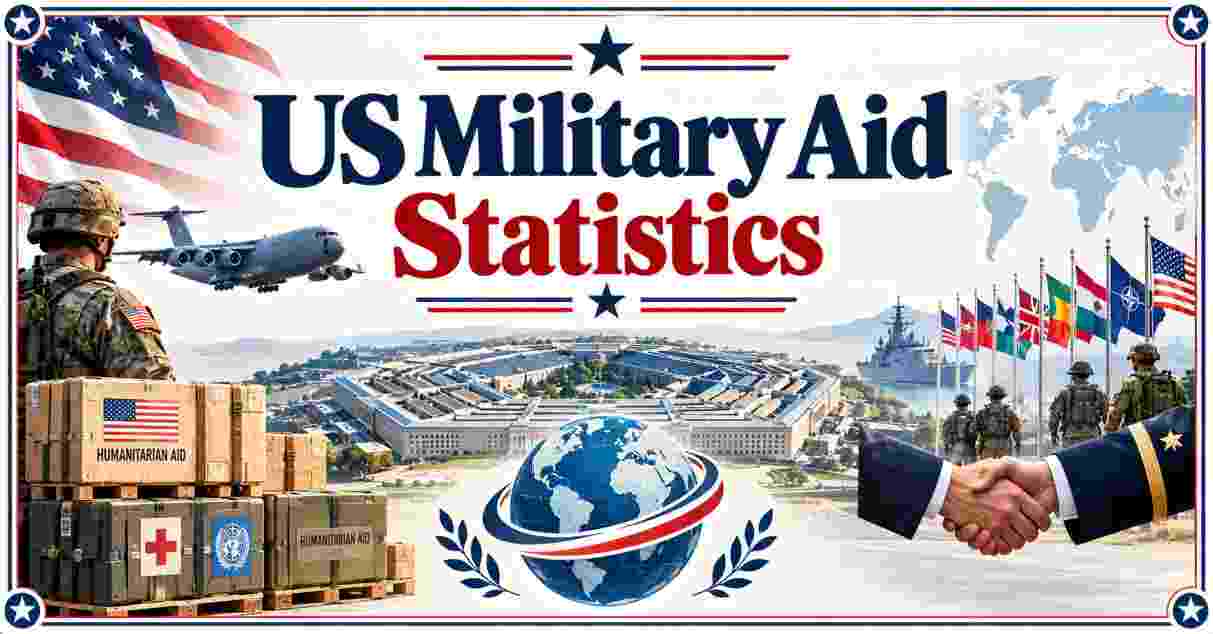
US Military Aid in 2026 totals $8.9 billion in enacted international security assistance under Public Law 119-75, signed February 3, 2026, of which the Foreign Military Financing Program alone accounts for $6.16 billion — the single largest security aid account in the federal budget. Israel receives $3.3 billion in FMF grants, Egypt $1.375 billion, Taiwan $300 million, while Ukraine has received no new appropriation since 2024 and instead draws on $4.96 billion in remaining drawdown authority plus $6.3 billion in NATO-funded PURL purchases of American weapons.
US Military Aid in 2026
US Military Aid in 2026 sits at a turning point. Congress enacted $8.9 billion for international security assistance in the FY2026 National Security, Department of State, and Related Programs Act — a 1% increase over FY2025 and 45% above what the administration originally requested. That number holds steady while almost everything around it shrinks. The wider International Affairs Budget fell to $51.3 billion, a 16% cut worth $9.8 billion. Development accounts were merged and reduced by 21%. Humanitarian assistance dropped 37%. Military aid did not. Congress protected it deliberately, and the voting record shows it: an amendment to strip up to $500 million in support for Jordan’s armed forces failed 30-400.
The composition of that money changed more than the total. USAID was dissolved, its functions folded into the State Department, and its operating account cut 93%. Six legacy aid accounts collapsed into two new ones. A new $850 million America First Opportunity Fund gave the Secretary of State discretionary reach across security accounts. Meanwhile the delivery mechanism for the largest wartime recipient flipped entirely — allies now pay cash for American weapons bound for Kyiv rather than Washington gifting them. The result is a 2026 picture where grant aid concentrates on a handful of treaty-adjacent partners while everything else moves toward sales, loans, and third-party financing.
Interesting Facts about US Military Aid
US Military Aid — Core Security Accounts, FY2026 Enacted ($ Billions)
FMF (Foreign Military Financing) |████████████████████████████ 6.16
INCLE (Narcotics/Law Enforcement)|██████ 1.40
NADR (Nonprolif/Antiterrorism)   |████ 0.87
PKO (Non-UN Peacekeeping)        |█ 0.34
IMET (Training & Education)      |▌ 0.12
                                 +----+----+----+----+----+----+
0 1 2 3 4 5 6| Metric | 2026 Confirmed Figure |
|---|---|
| Total international security assistance (enacted) | $8.9 billion |
| Foreign Military Financing Program | $6.16 billion |
| Largest single recipient (Israel FMF) | $3.3 billion |
| Second largest recipient (Egypt FMF) | $1.375 billion |
| Enacting statute | P.L. 119-75, signed February 3, 2026 |
| Total International Affairs Budget | $51.3 billion (−16%) |
| DoD appropriation for comparison | $839.2 billion |
| Military aid as share of DoD budget | ≈1.06% |
| Ukraine defense articles committed since 2022 | $67.8 billion |
| IMET training account | $119 million |
Source: U.S. Global Leadership Coalition FY26 International Affairs Budget Analysis; Congressional Research Service reports on FY2026 appropriations; House and Senate Appropriations Committee bill summaries.
The $6.16 billion FMF figure carries an easily missed detail: it rose by only $25 million, or 0.4%, over FY2025. In nominal terms that is flat. In real terms, against 2025-26 inflation, it is a quiet cut. Every dollar of headline growth in security assistance came from elsewhere in the $8.9 billion basket, and even that growth was $50 million total. The three supporting accounts — INCLE at $1.4 billion, NADR at $870 million, and IMET at $119 million — were all frozen at prior-year levels, not increased. Only PKO moved meaningfully, falling $75 million or 18%.
The 1.06% ratio between US Military Aid and the $839.2 billion Department of Defense appropriation is the number that reframes most public debate. Foreign military assistance is routinely described as a major budget line. It is roughly one penny of every defense dollar. Even the full $51.3 billion International Affairs Budget — diplomacy, health, humanitarian aid, and security assistance combined — equals about 6% of what the Pentagon spends on itself. The $382.4 billion in unobligated prior-year funds the Pentagon carried into FY2026 was, by itself, more than seven times the entire civilian foreign affairs budget.
US Military Aid Spending Statistics 2026
US Military Aid Funding Path — FY2026 ($ Billions)
FY25 Enacted        |████████████████████████████████████ 8.85
Admin FY26 Request  |█████████████████████████ 6.15
House FY26 Bill     |█████████████████████████████████████████ 10.07
FY26 Final Enacted  |████████████████████████████████████ 8.90
                    +------+------+------+------+------+------+
0 2 4 6 8 10 12| Account | FY2026 Enacted | Change vs FY2025 |
|---|---|---|
| Foreign Military Financing (FMF) | $6.16 billion | +$25 million (+0.4%) |
| Intl. Narcotics & Law Enforcement | $1.40 billion | Flat |
| Nonproliferation & Antiterrorism | $870 million | Flat |
| Peacekeeping Operations (non-UN) | $335 million | −$75 million (−18%) |
| Intl. Military Education & Training | $119 million | Flat |
| Security assistance total | $8.90 billion | +$50 million (+1%) |
Source: U.S. Global Leadership Coalition FY26 analysis; Congressional Research Service, Department of State, Foreign Operations, and Related Programs FY2026 appropriations report.
The gap between the $6.15 billion request and the $8.9 billion enacted level is the most politically loaded figure in the table. The administration proposed cutting the five Title IV security accounts by 31.2%, with the deepest reduction — 92.7% — aimed at peacekeeping. The House Appropriations Committee went the opposite direction, writing a bill at $10.07 billion, which was 63.9% above the request and 12.8% above FY2025. The final conference number landed almost exactly on the prior year. Congress rejected the executive branch’s restructuring of US Military Aid priorities and reasserted appropriations control, a pattern repeated across nearly every account in the bill.
Three accounts holding flat while one falls tells you where discretion now lives. IMET at $119 million is the smallest account and the one with the widest reach — it funds foreign officers attending American war colleges and staff courses, and its cost per participating country is trivial compared with hardware grants. INCLE at $1.4 billion funds police, border, and counter-narcotics capacity, much of it in the Western Hemisphere, and its freeze arrived alongside a separate $150 million fentanyl-interdiction line. The 18% cut to PKO hit non-UN operations in Africa hardest, where American funding often underwrites regional forces rather than American ones. Congress also rescinded $179 million in prior-year INCLE money, so the flat topline masks a real reduction in available balances.
Top Countries Receiving US Military Aid in 2026
Top US Military Aid Recipients — FY2026 FMF Grants ($ Millions)
Israel     |████████████████████████████████████ 3,300
Egypt      |███████████████ 1,375
Jordan     |█████ 425*
Taiwan     |███ 300
Philippines|█ 100
Lebanon    |▌ 45*
           +-------+-------+-------+-------+-------+
           0      700    1400   2100   2800   3500
*approximate allocation level| Recipient | FY2026 FMF Grant | Share of FMF | Status |
|---|---|---|---|
| Israel | $3.3 billion | 53.6% | MOU commitment through FY2028 |
| Egypt | $1.375 billion | 22.3% | $320 million conditioned |
| Jordan | ~$425 million | ~6.9% | Part of $1.45 billion package |
| Taiwan | $300 million | 4.9% | Plus $2 billion loan authority |
| Philippines | ~$100 million | ~1.6% | Indo-Pacific priority |
| All other countries | ~$660 million | ~10.7% | Residual allocation |
Source: Congressional Research Service country reports on Israel, Egypt, and Jordan; Senate and House Appropriations Committee FY2026 bill summaries; Foundation for Middle East Peace legislative analysis.
Two countries take roughly 76% of all US Military Aid grant funding. Israel at $3.3 billion and Egypt at $1.375 billion together consume $4.675 billion of the $6.16 billion FMF account, leaving under $1.5 billion for every other partner on earth. Add Jordan’s roughly $425 million and the top three exceed 83%. This concentration is not new — it traces to the 1979 Camp David framework — but the 2026 numbers sharpen it, because the residual pool shrank while the earmarks did not. When Congress writes “not less than” floors for three countries inside a flat account, every unnamed recipient absorbs the squeeze.
Egypt’s $1.375 billion deserves a second look: it is $75 million above the $1.3 billion baseline the country had held for decades, the first increase in a generation. The catch is that $320 million of it is withheld from obligation unless the Secretary of State makes human rights determinations — and in a notable drafting change, those conditions no longer appear in statutory text at all. They sit in the Joint Explanatory Statement, with a national-interest waiver available. Egypt also holds $12 billion in notified Foreign Military Sales cases, over nine years of FMF appropriations at current rates, financed through a cash-flow arrangement only Egypt and Israel are permitted to use.
US Military Aid to Israel Statistics 2026
US Military Aid to Israel — MOU Structure ($ Billions per year)
FMF Grant Aid        |█████████████████████████████████ 3.30
Missile Defense (DoD)|█████ 0.50
Extra Cooperative    |██ 0.202
                     +------+------+------+------+
                     0     1.0    2.0    3.0   4.0
Total annual package: $4.0 billion| Metric | 2026 Figure |
|---|---|
| Annual FMF grant | $3.3 billion |
| Missile defense (defense appropriations) | $500 million |
| Cooperative programs outside the MOU | $202 million |
| Current MOU total | $38 billion (FY2019–FY2028) |
| MOU expiry | FY2028 |
| Cumulative aid since 1948 | Over $300 billion (inflation-adjusted) |
| Share of total FMF account | 53.6% |
Source: Congressional Research Service, Possible Changes in U.S. Military Aid to Israel; Council on Foreign Relations aid analysis; FY2026 appropriations bill text.
The $38 billion memorandum of understanding covering FY2019 through FY2028 is the third such agreement, following $26.7 billion for FY1999-FY2008 and $30 billion for FY2009-FY2018. Its structure splits $33 billion in FMF grants from $5 billion routed through defense appropriations for missile defense — meaning the widely cited $3.8 billion annual figure is actually two separate appropriations from two separate committees. The FY2026 addition of $202 million for cooperative defense programs sits outside the MOU entirely, pushing the real annual total above $4 billion. Israel is the largest cumulative recipient of American foreign aid in history at over $300 billion adjusted for inflation.
The MOU’s FY2028 expiry makes 2026 a negotiation year, and the terms under discussion would reshape US Military Aid mechanics. The current agreement phases out Off-Shore Procurement, the benefit letting Israel spend a share of American grant dollars with Israeli defense firms rather than American ones. Proposals to replace FMF grants with joint programming through “Procurement, Defense-Wide” and “RDT&E, Defense-Wide” accounts would change the oversight picture substantially: sales financed with Israeli national funds may fall outside Leahy Law human rights restrictions under executive branch interpretation, and shifting money out of FMF would move congressional jurisdiction from the appropriations subcommittee that currently earmarks it. For readers tracking the recipient side of this relationship, our breakdown of Israel’s military budget, force structure and defense exports covers how the $44.8 billion Israeli defense budget absorbs and multiplies these transfers.
US Military Aid to Ukraine Statistics 2026
US Military Aid to Ukraine — Pipeline Status, mid-2026 ($ Billions)
Total committed since Feb 2022 |████████████████████████████ 67.8
US military support (EUCOM)    |█████████████████████ 50.8
Allied PURL commitments        |███ 6.3
PDA authority remaining        |██ 4.96
Allied JUMPSTART contributions |█ 2.8
FMF disbursed to Ukraine       |█ 2.4
New FY2026 appropriation       |  0.0
                               +-----+-----+-----+-----+
0 20 40 60 80| Mechanism | 2026 Status | Value |
|---|---|---|
| New FY2026 appropriation | None enacted | $0 |
| Total defense articles committed since 2022 | Through March 2026 | $67.8 billion |
| Presidential Drawdown Authority remaining | As of June 30, 2026 | $4.96 billion |
| FMF disbursed to Ukraine | As of June 2026 | $2.4 billion |
| USAI articles actually delivered | As of August 2026 | 57.3% of appropriations |
| Allied PURL purchases of US weapons | As of June 2026 | $6.3 billion committed |
| PURL funds received by US Treasury | As of June 2026 | $4.8 billion |
| JUMPSTART contributions (six allies) | As of June 2026 | $2.8 billion |
Source: Special Inspector General for Operation Atlantic Resolve quarterly reports; Congressional Research Service, U.S. Security Assistance to Ukraine Since 2022; NATO official statements on PURL.
The defining 2026 statistic for Ukraine is a zero. No significant new US Military Aid has been authorized since the last Biden-era supplemental, and the $67.8 billion committed since February 2022 is a backward-looking total, not an active flow. What remains is pipeline: $4.96 billion in unused Presidential Drawdown Authority, $2.4 billion in FMF disbursed of the amount allocated, and a USAI delivery rate of 57.3% — meaning over four years, barely more than half of appropriated Ukraine Security Assistance Initiative funding has produced delivered equipment. The Defense Department declined to specify USAI funding in the FY2026 act, though the explanatory statement added $400 million for “European capacity building” that senators were told would go to Ukraine.
PURL is the structural innovation worth understanding. Under the Prioritized Ukraine Requirements List, NATO allies pay for American-manufactured weapons that are then transferred to Ukraine — allied money, American industrial base, Ukrainian end use. Allies committed roughly $6.3 billion by June 2026, with $4.8 billion reaching the Treasury, split $2.3 billion to replenish Pentagon stocks and $2.5 billion for new procurement. PURL now supplies an estimated 75% of Patriot interceptors and 90% of other air-defense missiles Ukraine receives. The mechanism is not aid in the grant sense at all; it is export revenue. Reporting in 2026 that the Pentagon intended to redirect about $750 million of PURL funds toward its own stockpiles illustrates how blurred the line has become. The scale of the American infrastructure making these transfers possible is covered in our report on US troop numbers and bases across Europe, where roughly 68,064 permanently stationed personnel anchor the logistics chain.
US Military Aid to Egypt and Jordan Statistics 2026
Egypt & Jordan — FY2026 Aid Composition ($ Millions)
Egypt FMF            |████████████████████████████ 1,375
Egypt economic (NSIP)|███ 125
Jordan budget support|█████████████████ 845
Jordan FMF (approx)  |█████████ 425
Jordan defense-bill  |██████████ up to 500
                     +------+------+------+------+
0 400 800 1200 1600| Country | Total FY2026 Aid | Military Component | Key Condition |
|---|---|---|---|
| Egypt | $1.5 billion | $1.375 billion FMF | $320 million withheld pending determinations |
| Jordan | ~$1.45 billion assured | ~$425 million FMF | $845 million direct budget support |
| Lebanon | Sustained | FMF and INCLE | Barred if LAF/ISF controlled by an FTO |
Source: Congressional Research Service reports RL33003 (Egypt) and RL33546 (Jordan); Foundation for Middle East Peace FY2026 bill analysis; American Task Force on Lebanon appropriations review.
Egypt’s $1.5 billion total and Jordan’s roughly $1.45 billion make the two countries the anchor of American security policy in the region outside Israel. Egypt’s package is 92% military, with only $125 million in economic assistance earmarked for democracy programs, Sinai development, and higher education including $15 million for scholarships. Jordan’s mix runs the other way: $845 million flows as direct budget support to the treasury rather than as weapons financing, a structure that makes Jordanian fiscal stability itself the security objective. Jordan also secured Washington’s assurance in 2025 that the bulk of the $1.45 billion annual package remains intact despite the wider aid restructuring.
Congressional protection of both relationships was explicit and recorded. The Rescissions Act of 2025 exempted FY2025 Economic Support Funds for Jordan and Egypt from cancellation. The FY2026 NDAA added a $1 million authorization for US-Jordan cyberspace cooperation and required a report on all available authorities for assisting Jordan and Lebanon. When the House considered stripping up to $500 million in Jordanian armed forces support from the defense appropriations bill, the amendment failed 30-400 — a 93% rejection rate that leaves little ambiguity. The Lebanon line is the conditional one: funding is barred outright if the Lebanese Armed Forces or Internal Security Forces come under the control of a designated foreign terrorist organization.
US Military Aid to Taiwan and the Indo-Pacific 2026
Indo-Pacific Security Funding — FY2026 ($ Millions)
Indo-Pacific Strategy total |████████████████████████████████████ 1,800
Countering PRC Influence    |████████ 400
Taiwan FMF (enacted)        |██████ 300
Philippines FMF             |██ 100
Taiwan loan authority       |████████████████████████████████████████ 2,000
                            +-----+-----+-----+-----+-----+
0 500 1000 1500 2000 2500| Program | FY2026 Level | Instrument |
|---|---|---|
| Indo-Pacific Strategy allocation | $1.8 billion | Economic and security assistance |
| Countering PRC Influence Fund | $400 million | Flat vs FY2025 |
| Taiwan security assistance | $300 million | Grant (House sought $500 million) |
| Taiwan loans and guarantees | Up to $2 billion | Credit authority, not grant |
| Philippines FMF | $100 million | Grant |
Source: Senate Appropriations Committee FY2026 NSRP bill summary; House Appropriations Committee FY2026 press materials; U.S. Global Leadership Coalition account analysis.
Taiwan’s $300 million is the number to watch, because it landed below the $500 million the House committee wrote and well below rhetoric about deterrence across the Strait. The compensating instrument is credit: up to $2 billion in loans and loan guarantees, which is roughly 6.7 times the grant figure but costs the Treasury only the subsidy value rather than the principal. This is the clearest expression of how US Military Aid is evolving in 2026 — grants stay flat or fall, while loan authority, financing guarantees, and allied-funded procurement expand. Taipei buys the same weapons either way; the budgetary accounting and the political optics differ entirely.
The $1.8 billion Indo-Pacific allocation and the $400 million Countering PRC Influence Fund sit alongside these grants as directed spending rather than country earmarks, giving the State Department latitude across the region. The $100 million for the Philippines reflects renewed base access agreements, and Congress preserved the PRC fund at its prior level despite cutting the Democracy Fund by 41% and the Millennium Challenge Corporation by 11%. That selective protection reveals the 2026 hierarchy plainly: China-facing programs survive, development programs do not. The physical corollary — where American forces actually sit across the Pacific and worldwide — is detailed in our report on the global network of US military bases and overseas installations, which tracks roughly 750 to 800 sites across more than 80 countries.
US Military Aid Programs and Delivery Mechanisms 2026
How US Military Aid Reaches Partners — FY2026 Mechanisms
Grant (FMF)          |████████████████████████████████ dominant
Allied-funded (PURL) |███████████ growing fast
Loans/guarantees     |███████ expanding
Drawdown (PDA)       |████ depleting
Training (IMET) |█ small, wide reach| Mechanism | How It Works | 2026 Scale |
|---|---|---|
| Foreign Military Financing | Grant funds partner purchases of US equipment | $6.16 billion |
| Foreign Military Sales | Partner pays, US government brokers | $12 billion notified for Egypt alone |
| Presidential Drawdown Authority | Transfers from existing US stocks | $4.96 billion remaining for Ukraine |
| PURL | Allies fund US-sourced weapons for Ukraine | $6.3 billion committed |
| JUMPSTART | Foreign contributions finance FMS | $2.8 billion from six allies |
| IMET | Foreign officer training in US institutions | $119 million |
Source: Defense Security Cooperation Agency program descriptions; Congressional Research Service security assistance analyses; Special Inspector General for Operation Atlantic Resolve reporting.
The mechanism mix matters more than the topline in 2026, because grants and sales produce different accountability. FMF dollars are appropriated, earmarked, and subject to Leahy Law human rights vetting. Foreign Military Sales financed with a partner’s own money move through the same Defense Security Cooperation Agency pipeline but face different restrictions, and executive branch interpretation holds that some human rights conditions may not attach at all. When US Military Aid shifts from the first category to the second — as the Taiwan loan authority and the Israel MOU renegotiation both contemplate — congressional oversight thins even when the weapons flow is identical.
Cash-flow financing is the exception worth naming. Israel and Egypt are the only partners permitted to sign Letters of Offer and Acceptance exceeding their annual FMF appropriation and pay over multiple years. That privilege explains how Egypt accumulated $12 billion in notified FMS cases against a $1.375 billion annual grant — more than nine years of appropriations committed in advance. IMET at $119 million is the opposite model: tiny per-country cost, decades-long relationship yield. Foreign officers trained at American staff colleges become the interlocutors of the next generation, which is why an account worth under 2% of FMF survives every budget cycle intact.
US Military Aid vs Total US Defense Spending 2026
Scale Comparison — FY2026 ($ Billions, log-style)
DoD appropriation        |████████████████████████████████████ 839.2
DoD unobligated carryover|████████████████ 382.4
Intl. Affairs Budget     |██ 51.3
Security assistance      |▌ 8.9
FMF only                 |▍ 6.16
                         +------+------+------+------+------+
0 200 400 600 800 1000| Budget Line | FY2026 Amount | Ratio to FMF |
|---|---|---|
| DoD appropriation (P.L. 119-75, Div. A) | $839.2 billion | 136 : 1 |
| DoD prior-year unobligated balances | $382.4 billion | 62 : 1 |
| Total International Affairs Budget | $51.3 billion | 8 : 1 |
| International security assistance | $8.9 billion | 1.4 : 1 |
| Foreign Military Financing | $6.16 billion | 1 : 1 |
Source: Congressional Research Service, FY2026 Department of Defense Appropriations: In Brief; Department of Defense Agency Financial Report FY2025; U.S. Global Leadership Coalition budget analysis.
The 136 : 1 ratio between the Pentagon’s $839.2 billion and the $6.16 billion FMF account is the context most US Military Aid coverage omits. Foreign military assistance is not a competing claim on defense resources; it is a rounding error against them. The Pentagon entered FY2026 carrying $382.4 billion in unexpired, unobligated appropriations from prior acts — funding it drew on during the 42-day shutdown from October 1 to November 12, 2025. That carryover alone exceeds the entire International Affairs Budget by more than seven times and exceeds FMF by 62 times.
A second comparison sharpens the point. The FY2026 appropriations process cut the International Affairs Budget by $9.8 billion while the defense bill moved in the opposite direction. The $9.8 billion removed from diplomacy, development, health, and humanitarian accounts is slightly more than the $8.9 billion the same bill spent on all security assistance worldwide — and slightly over 1% of the defense appropriation. Congress cut, in absolute dollars, an amount from civilian foreign policy roughly equal to everything it spends arming and training every partner nation on the planet.
Frequently Asked Questions About US Military Aid 2026
How much military aid does the US give in 2026?
The United States enacted $8.9 billion in international security assistance for FY2026, including $6.16 billion in Foreign Military Financing, $1.4 billion in narcotics and law enforcement assistance, $870 million in nonproliferation and antiterrorism programs, $335 million in non-UN peacekeeping, and $119 million in military education and training.
Which country receives the most US military aid in 2026?
Israel receives the most, at $3.3 billion in Foreign Military Financing grants plus $500 million in missile defense funding and $202 million in cooperative programs outside the memorandum of understanding — roughly $4 billion annually and 53.6% of the entire FMF account.
Is the US still sending military aid to Ukraine in 2026?
No new appropriation has been enacted since 2024. Deliveries continue from prior funding, with $4.96 billion in Presidential Drawdown Authority remaining as of June 30, 2026, and NATO allies purchasing American weapons for Ukraine through PURL at roughly $6.3 billion committed.
What is Foreign Military Financing?
Foreign Military Financing is the grant program that funds partner nations’ purchases of American defense equipment and services. At $6.16 billion, it is the largest security assistance account in the FY2026 budget and represents 69% of all international security assistance.
How much military aid does Egypt get in 2026?
Egypt receives $1.5 billion in total aid for FY2026, of which $1.375 billion is Foreign Military Financing — $75 million above the $1.3 billion baseline held for decades. Of that, $320 million is withheld pending human rights determinations by the Secretary of State.
How much military aid does Taiwan get in 2026?
Taiwan received $300 million in enacted security assistance, below the $500 million the House committee proposed, alongside authority for up to $2 billion in loans and loan guarantees for defense procurement.
What percentage of the US budget is military aid?
Foreign Military Financing at $6.16 billion equals about 0.73% of the $839.2 billion Department of Defense appropriation. All international security assistance at $8.9 billion equals about 1.06% of the defense budget.
How much military aid has Ukraine received since 2022?
The United States committed $67.8 billion in defense articles and services to Ukraine from February 2022 through March 2026, plus $50.8 billion in US military support largely for European Command operations through March 31, 2026.
What is PURL in US military aid?
PURL is the Prioritized Ukraine Requirements List, launched in 2025, under which NATO allies pay for American-manufactured weapons transferred to Ukraine. As of June 2026, $6.3 billion had been committed and $4.8 billion received by the US Treasury.
Did US military aid get cut in 2026?
Security assistance rose 1% to $8.9 billion, making it the only major foreign aid category to increase. The broader International Affairs Budget fell 16% to $51.3 billion, with humanitarian aid down 37% and development assistance down 21%.
How much military aid does Jordan receive in 2026?
Jordan received assurances that at least $1.45 billion annually remains intact, including roughly $425 million in Foreign Military Financing and $845 million in direct budget support. A House amendment to strike up to $500 million in Jordanian armed forces support failed 30-400.
What law authorizes US military aid in 2026?
Public Law 119-75, the Consolidated Appropriations Act, 2026, signed February 3, 2026, provides FY2026 foreign assistance funding. Division A of the same law provides $839.2 billion for Department of Defense national defense activities.
When does the Israel military aid agreement expire?
The current $38 billion memorandum of understanding covers FY2019 through FY2028 and expires at the end of FY2028. It comprises $33 billion in FMF grants and $5 billion in defense appropriations for missile defense programs.
How many countries receive US military aid in 2026?
Precise country counts vary by account, but the top three recipients — Israel, Egypt, and Jordan — absorb over 83% of Foreign Military Financing, leaving under $1.1 billion distributed across all remaining partner nations worldwide.
Is US military aid a grant or a loan?
Both, and increasingly the latter. Foreign Military Financing is grant funding at $6.16 billion, but 2026 expanded credit instruments significantly, including up to $2 billion in loan authority for Taiwan and $2 billion in loan guarantees, alongside allied-funded purchase mechanisms like PURL and JUMPSTART.
Disclaimer: The data research report we present here is based on information found from various sources. We are not liable for any financial loss, errors, or damages of any kind that may result from the use of the information herein. We acknowledge that though we try to report accurately, we cannot verify the absolute facts of everything that has been represented.