
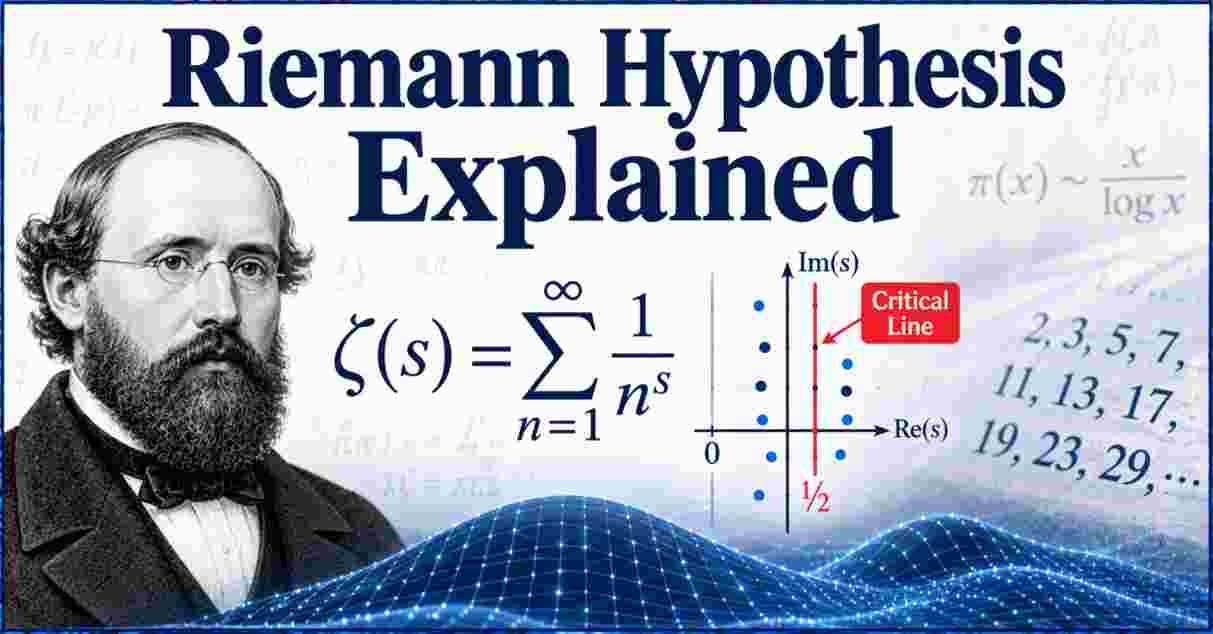
The Riemann Hypothesis is a 167-year-old conjecture, posed in 1859, that every nontrivial zero of the Riemann zeta function lies on the line where the real part equals 1/2, and the Clay Mathematics Institute offers $1,000,000 for a proof. On November 20, 2026, Levent Alpöge, a mathematician at Anthropic, claimed a proof found with Claude, but outside experts have not verified it and the Clay Institute still lists the problem as unsolved.
Riemann Hypothesis Explained 2026 – Introduction
The Riemann Hypothesis Explained in one line: it predicts where a special function equals zero, and those zeros control how prime numbers are spread along the number line. Bernhard Riemann stated it in 1859. Mathematicians have tested it on the first 10 trillion zeros and found no exception, yet no accepted proof exists. The problem sits on David Hilbert’s 1900 list and on the Clay Millennium list of 7 prize problems.
This week the problem returned to the news. Levent Alpöge posted a four-page note on November 20, 2026, saying he believes he found a proof working with Claude. The claim rests on a very large Lean file, which a computer can check. Reports describe the claim as unverified, and the formal prize rules require years of review. This report explains the mathematics, the timeline, the prize and the current status, using reported facts with clear attribution.
Interesting Facts About the Riemann Hypothesis 2026
Years each problem has stayed open as of 2026 (each █ = 5 years)
Riemann Hypothesis (1859)   | █████████████████████████████████ 167
Hilbert's problems (1900)   | █████████████████████████ 126
Millennium list (2000)      | █████▏ 26
| Fact | 2026 Data |
|---|---|
| Year proposed | 1859 |
| Age of the problem | 167 years |
| Proposer | Bernhard Riemann |
| Clay Institute prize | $1,000,000 |
| Zeros checked on the critical line | First 10 trillion |
| First nontrivial zero | About 14.1347 on the imaginary axis |
| Latest proof claim | November 20, 2026 |
| Claimant | Levent Alpöge, with Claude |
| Clay Institute status | Listed as unsolved |
| Prize review rule | 2 years after publication |
Source: Clay Mathematics Institute; Hilbert’s 1900 problem list; news reports of November 20 and 21, 2026 (Scientific American, Associated Press, Washington Post).
The headline number is 167 years. Riemann posed the problem in 1859, and it has outlasted Hilbert’s 1900 list by 41 years. Computers have confirmed the first 10 trillion zeros, which all sit on the line, and the first sits near 14.1347. That evidence is strong but is not a proof, because the claim covers infinitely many zeros.
The $1,000,000 prize and the 2-year review rule decide what happens next. The November 20, 2026 claim by Levent Alpöge and Claude has not been verified by outside experts. The Clay Institute still lists the problem as unsolved. A claim is not a prize award, and the review period means no award can come in 2026.
What Is the Riemann Hypothesis 2026: Plain-English Explanation
The critical strip (zeros plotted by height; real part runs left to right)
Imaginary
part
 37.6 |              ●
 30.4 |              ●
 25.0 |              ●
 21.0 |              ●
 14.1 |              ●   <- first nontrivial zero
    0 +--------------|---------------+
      0.0           0.5            1.0   real part
| Term | Plain-English Meaning |
|---|---|
| Riemann zeta function | A sum of 1/n^s over whole numbers, extended to complex numbers |
| Trivial zeros | -2, -4, -6 and so on |
| Nontrivial zeros | Zeros inside the strip between real part 0 and 1 |
| Critical line | Real part equal to 1/2 |
| The hypothesis | Every nontrivial zero sits on the critical line |
| First nontrivial zero | 1/2 + 14.1347i |
| Zeros checked | First 10 trillion |
Source: Clay Mathematics Institute problem description; Riemann, “On the Number of Primes Less Than a Given Magnitude” (1859).
The zeta function takes a complex number and returns a complex number. Euler studied it first, and Riemann extended it. It equals zero at the trivial zeros -2, -4, -6, and these cause no dispute. The nontrivial zeros all lie in a strip between real part 0 and 1. The hypothesis says they all sit on the single line at 1/2, as the chart shows.
Each zero encodes information about primes. The first zero, 1/2 + 14.1347i, is where the pattern starts. Every zero that has been computed, 10 trillion of them, lies on the line. The hypothesis claims the same holds for the infinite remainder. One zero off the line would break it, which is why a proof must cover all of them at once.
Riemann Hypothesis Timeline 2026: From 1859 to the November 2026 Claim
Years after 1859 for each milestone (each █ = 5 years)
1900 Hilbert's list    | ████████ 41
1914 Hardy             | ███████████ 55
1974 Levinson          | ███████████████████████ 115
2000 Clay prize        | ████████████████████████████ 141
2004 Gourdon           | █████████████████████████████ 145
2026 Claim             | █████████████████████████████████ 167
| Date | Milestone |
|---|---|
| 1859 | Riemann publishes the paper stating the hypothesis |
| 1900 | Hilbert lists it among his 23 problems |
| 1914 | Hardy proves infinitely many zeros lie on the line |
| 1974 | Levinson proves more than one-third lie on the line |
| 2000 | Clay Institute offers $1,000,000 for a solution |
| 2004 | Gourdon checks the first 10 trillion zeros |
| August 2026 | A Claude-assisted result raises the proven share above two-thirds |
| November 20, 2026 | Alpöge announces a claimed full proof |
Source: Clay Mathematics Institute; American Mathematical Society historical records; developer research notes (August 2026); news reports (November 2026).
Progress came in steps. Hardy showed in 1914, 55 years after Riemann, that infinitely many zeros lie on the line. Levinson raised the proven share to more than one-third in 1974. The Clay Institute set the $1,000,000 prize in 2000, and Gourdon’s computation in 2004 covered 10 trillion zeros. Hilbert had already named the problem in 1900, 41 years after the original paper.
The last two rows are recent. In August 2026, a Claude-assisted result lifted the proven share above two-thirds, according to the developer’s own research notes. On November 20, 2026, Alpöge claimed the full proof. Both of those entries come from the company and the claimant. Neither has completed independent review, so treat them as reported rather than settled.
Riemann Hypothesis Zeros on the Critical Line 2026: How Much Has Been Proven
Share of zeros proven on the critical line (each █ = 2 percentage points)
Levinson 1974        | █████████████████ 34.7%
Conrey 1989          | ████████████████████ 40.8%
Pratt and others 2020| █████████████████████ 41.7%
Claude-assisted 2026 | █████████████████████████████████ 66.7%
| Year | Result | Proven Share of Zeros |
|---|---|---|
| 1974 | Levinson | More than 34.7% |
| 1989 | Conrey | More than 40.8% |
| 2020 | Pratt, Robles, Zaharescu and Zeindler | More than 41.7% (5/12) |
| August 2026 | Claude-assisted result (reported) | More than 66.7% (2/3) |
| Full hypothesis | Not yet accepted | 100% |
Source: Mathematics literature (Levinson 1974, Conrey 1989, Pratt et al. 2020); developer research release and Lean files (August 2026). The 2026 result was released by its developer and has not been independently published in a journal.
Researchers have measured progress by the share of zeros proven to lie on the line. Levinson reached more than 34.7% in 1974. Conrey pushed that to more than 40.8% in 1989. The 2020 result by Pratt, Robles, Zaharescu and Zeindler reached 41.7%, or five-twelfths. Each step took years of human effort and gained a few points.
The August 2026 figure is a large jump, from 41.7% to above 66.7%. It comes from the company that built Claude, with Lean files for outside checking, and it is not yet a peer-reviewed publication. Even if it holds, the target is 100%. The gap between two-thirds and all zeros is the difference between a partial result and the hypothesis itself.
Riemann Hypothesis $1 Million Prize 2026: Clay Institute Rules and Status
Clay Millennium Prize Problems by status, 2026 (each █ = 1 problem)
Solved   | █ 1
Unsolved | ██████ 6
| Item | 2026 Detail |
|---|---|
| Prize amount | $1,000,000 per problem |
| Problems on the list | 7 |
| List announced | 2000 |
| Problems solved | 1 (Poincaré conjecture) |
| Publication rule | Qualifying outlet, then general acceptance |
| Waiting period | 2 years after publication |
| Riemann Hypothesis status | Listed as unsolved on November 21, 2026 |
Source: Clay Mathematics Institute Millennium Prize Problems rules and problem page; news reports citing the institute (November 2026).
The Clay Institute announced 7 problems in 2000 and attached $1,000,000 to each. One has been solved, the Poincaré conjecture, which leaves 6. The institute’s rules are strict. A solution must appear in a qualifying outlet and then survive 2 years of general acceptance before the committee considers an award.
Applied to the Riemann Hypothesis, the rules mean no payment can occur in 2026, whatever the claim’s merit. On November 21, 2026, the problem was still listed as unsolved. A separate AI-company claim on another Millennium problem was reported earlier in 2026, and this report did not verify its status. The 2-year clock only starts after a publication that meets the rules.
Claude AI Riemann Hypothesis Proof Claim 2026: What Is Reported So Far
Verification steps completed for the claim (each █ = 1 step)
Lean files compiled by outside party | █ done
Lean kernel replay reported passed   | █ done
Statement match confirmed            | ░ pending
Journal publication                  | ░ pending
Clay 2-year review                   | ░ pending
Completed: 2 of 5
| Detail | Reported Information |
|---|---|
| Date announced | November 20, 2026 |
| Claimant | Levent Alpöge, working with Claude |
| Note length | 4 pages |
| Scope | Riemann Hypothesis and the generalized version |
| Proof format | Lean code posted on a personal website |
| Size of the Lean release | Reports range from about 17 million lines to 175,187 files |
| Outside check | Andrew Sutherland of MIT compiled the code |
| Expert comment | James Maynard says he suspects it is correct, but checking takes time |
| Clay Institute | Still lists the problem as unsolved |
Source: News reports on November 20 and 21, 2026 (Washington Post, Boston Globe, Scientific American, Associated Press, SiliconANGLE); Alpöge’s public note.
Alpöge wrote that he believes he found a proof working with Claude. His note covers the classical hypothesis and the generalized version for Dirichlet L-functions. He released Lean code rather than a conventional paper. Reports differ on its size, from about 17 million lines to 175,187 files, and one outlet cites a 250,000-page equivalent. The code compiles, according to outside mathematicians including Andrew Sutherland of MIT.
Compiling does not equal acceptance. Kevin Buzzard raised the key question of whether the Lean statement matches the real hypothesis, and that question was not formally settled in early reports. James Maynard said he suspects the proof is correct but that checking will take time. The announcement came in the same week as the company’s stock market debut, according to press reports, which is one more reason outside review matters.
Why the Riemann Hypothesis Matters 2026: Prime Counting Error Bounds
Maximum prime-counting error if RH is true, as a share of the prime count (each █ = 0.05%)
x = 1 million     | ██████████████ 0.70%
x = 1 billion     | █ 0.051%
x = 1 trillion    | ▏ 0.0029%
| Range (x) | Primes up to x | Error Bound Under RH | Bound as Share |
|---|---|---|---|
| 1 million | 78,498 | About 550 | 0.70% |
| 1 billion | 50,847,534 | About 26,075 | 0.051% |
| 1 trillion | 37,607,912,018 | About 1.1 million | 0.0029% |
Source: Schoenfeld (1976) bound, √x·ln(x)/(8π) for x ≥ 2,657, assuming the hypothesis; prime counts from standard tables. Error bounds are this report’s calculation.
If the hypothesis is true, the number of primes up to x differs from a smooth estimate by at most about √x·ln(x)/(8π). At 1 million, that is about 550 on a count of 78,498, or 0.70%. At 1 billion, the bound is about 26,075 on 50,847,534 primes, or 0.051%. The guaranteed accuracy improves as x grows.
At 1 trillion, the bound reaches about 1.1 million against 37,607,912,018 primes, only 0.0029%. That tight control over primes is the practical prize. A proof would turn this conditional statement into a theorem. It would not break encryption, because common cryptography does not depend on the hypothesis.
Generalized Riemann Hypothesis 2026: What the Claimed Proof Covers
Versions of the hypothesis and the 2026 claim (each █ = 1 version)
Classical Riemann Hypothesis | █ claimed
Generalized (Dirichlet L)    | █ claimed
Extended Riemann Hypothesis  | ░ not claimed
Claimed: 2 of 3 versions
| Version | Functions Covered | Status in the November 2026 Claim |
|---|---|---|
| Classical Riemann Hypothesis | The Riemann zeta function | Claimed proven |
| Generalized Riemann Hypothesis | Dirichlet L-functions | Claimed proven in the same note |
| Extended Riemann Hypothesis | Wider families of functions | Hoped for with more time, not claimed |
Source: News reports of Alpöge’s note (November 20, 2026); Clay Mathematics Institute problem description.
The note covers 2 of 3 versions. The classical hypothesis concerns the single zeta function. The generalized version asks the same question for Dirichlet L-functions, close relatives that govern primes inside arithmetic progressions, such as primes ending in 3. Alpöge says his method covers both. He writes that the 3rd version, the extended hypothesis, may fall to the same approach with more time, but he does not claim it.
The generalized version matters on its own. Number theorists already assume it in many results. One example is Miller’s 1976 primality test, which runs in deterministic polynomial time if the generalized hypothesis holds. A verified proof would remove that assumption from a long list of theorems. Until review finishes, those results stay conditional, exactly as they were before November 20, 2026.
Frequently Asked Questions About the Riemann Hypothesis 2026
Has the Riemann Hypothesis been proved in 2026?
Not in an accepted sense. Levent Alpöge claimed a proof on November 20, 2026, working with Claude, but outside experts have not verified it and the Clay Institute lists the problem as unsolved.
Did Claude AI prove the Riemann Hypothesis in 2026?
That is the claim. The proof was released as Lean code, which compiled for outside mathematicians. The remaining questions are whether the Lean statement matches the real hypothesis and whether the argument passes review.
Who is Levent Alpöge?
A mathematician employed by Anthropic who posted the 4-page note on November 20, 2026.
Will the $1 million Riemann Hypothesis prize be awarded in 2026?
No. The Clay Institute requires publication in a qualifying outlet and then 2 years of general acceptance. No award can follow within 2026.
What is the Riemann Hypothesis in simple terms?
It says every nontrivial zero of the zeta function has real part 1/2. Those zeros control how primes are spread among the whole numbers.
How many zeros have been checked in 2026?
The first 10 trillion nontrivial zeros all lie on the critical line. That supports the hypothesis but does not prove it.
What is Lean and why does it matter for the 2026 proof claim?
Lean is a proof assistant that checks every logical step by computer. A Lean-compiled proof removes arithmetic errors, but people must still confirm the stated theorem is the Riemann Hypothesis.
Would a proof of the Riemann Hypothesis break encryption in 2026?
No. Common encryption does not rely on the hypothesis. A proof would tighten results about primes rather than expose private keys.
What is the generalized Riemann Hypothesis?
It extends the same claim to related functions called Dirichlet L-functions. Alpöge’s note says his approach covers it.
How long has the Riemann Hypothesis been unsolved in 2026?
167 years, counting from Riemann’s 1859 paper.
What did the August 2026 Claude result show?
A developer research release reported that more than two-thirds, or 66.7%, of nontrivial zeros lie on the critical line. The previous published figure was 41.7%.
What are the Millennium Prize Problems in 2026?
They are 7 problems chosen by the Clay Institute in 2000, each with a $1,000,000 prize. One, the Poincaré conjecture, has been solved.
Who checked the Lean code for the 2026 Riemann Hypothesis claim?
Outside mathematicians compiled it, including Andrew Sutherland of MIT. Reports say a Lean kernel replay passed, while the full review continues.
Why does the Lean statement matter in the 2026 proof claim?
Lean confirms that a proof is valid for the statement it was given. Reviewers must still confirm that the statement is the real Riemann Hypothesis and not a nearby variant.
What did Hardy prove about the Riemann Hypothesis?
In 1914, G. H. Hardy proved that infinitely many nontrivial zeros lie on the critical line. That does not show all of them do.
Where can readers follow updates on the 2026 Riemann Hypothesis claim?
The Clay Mathematics Institute problem page lists the official status. Mathematics departments and major science news desks are also publishing expert reviews as they arrive.
How big is the Lean release in the 2026 Riemann Hypothesis claim?
Reports differ. One outlet counted 175,187 Lean files and about 239 million bytes. Another described 17 million lines of code. The numbers use different units.
Is the 2026 Riemann Hypothesis claim peer reviewed?
No. As of November 21, 2026, the claim exists as a four-page note and Lean files. No journal has published it, and the 2-year Clay review period has not started.
Disclaimer: The data research report we present here is based on information found from various sources. We are not liable for any financial loss, errors, or damages of any kind that may result from the use of the information herein. We acknowledge that though we try to report accurately, we cannot verify the absolute facts of everything that has been represented.