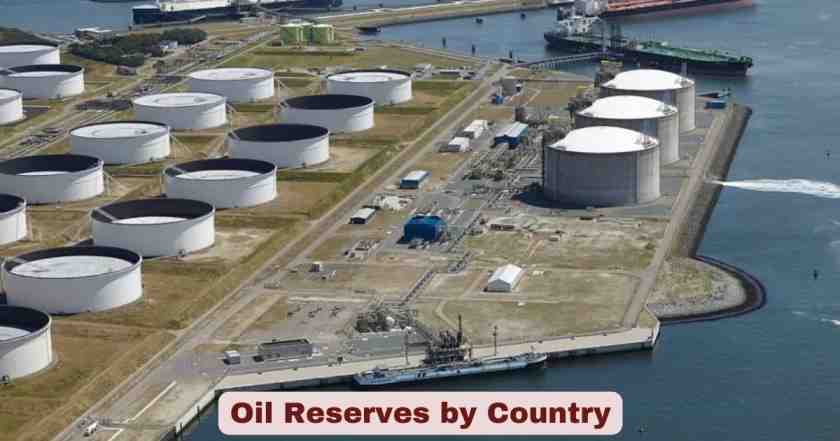
Oil Reserves by Country 2026
Proven oil reserves by country represent the single most important dataset in global energy economics — a measure of how much commercially recoverable crude oil each nation holds beneath its soil and seabeds, calculated under current technology, engineering assessments, and prevailing oil prices. Unlike the broader concept of “resources” (which captures every drop of oil that might theoretically exist in a formation), proven reserves — formally defined as “1P” or “P90” reserves — refer specifically to oil that can be extracted with a 90% or greater probability of commercial recovery under existing conditions. This distinction matters enormously: a country like Venezuela can hold the world’s largest reserve base yet produce a fraction of what smaller reserve holders pump every day, because the technical and economic cost of extracting heavy Orinoco Belt crude is vastly different from lifting Saudi light crude near the surface. As of year-end 2024, the world’s total proven crude oil reserves stood at approximately 1,567 billion barrels according to the OPEC Annual Statistical Bulletin 2025 — a figure large enough to meet current global demand for approximately 47 years at today’s consumption rate of 103.84 million barrels per day.
What makes the 2026 oil reserves picture uniquely significant is the collision of long-established geological data with fast-moving geopolitical reality. The reserve rankings themselves have barely shifted in over a decade — Venezuela, Saudi Arabia, Iran, Canada, and Iraq have occupied the top five positions since at least 2012. But in the space of fewer than 90 days between January and March 2026, two of those top-five reserve holders have been thrown into dramatic political and military upheaval. The US military operation in Venezuela on January 3, 2026, which captured President Nicolás Maduro and prompted President Trump to announce that American oil companies would rebuild and control the country’s 303-billion-barrel reserve base, was followed just 56 days later by the US-Israel war on Iran beginning February 28, 2026 — placing the world’s third-largest reserve holder directly in the crosshairs of military conflict and closing the Strait of Hormuz, the chokepoint through which ~20% of global oil demand normally flows every single day. In 2026, oil reserves by country are no longer just a geological statistic — they are ground zero for the most consequential geopolitical confrontation in the global energy system since the 1973 oil crisis.
Interesting Facts — Oil Reserves by Country 2026
| Fact Category | Key Data Point |
|---|---|
| World Total Proven Crude Oil Reserves (Year-End 2024) | ~1,567 billion barrels (OPEC ASB 2025) |
| Alternative World Total (incl. oil sands/NGPLs) | ~1,765–1,770 billion barrels (OGJ / Worldometer methodology) |
| Years of Supply Remaining at Current Demand | ~47 years at 103.84 million b/d consumption |
| OPEC Share of World Proven Reserves | 79.1% — ~1,241 billion barrels across 13 OPEC members |
| Top 5 Countries’ Combined Share | Approximately 63% of all global proven reserves |
| Top 10 Countries’ Combined Share | Over 85% of all global proven reserves |
| #1 Venezuela | ~303 billion barrels — world’s single largest reserve base |
| #2 Saudi Arabia | ~267 billion barrels |
| #3 Iran | ~209 billion barrels |
| #4 Canada | ~163–170 billion barrels |
| #5 Iraq | ~145 billion barrels |
| #6 Kuwait | ~101.5 billion barrels |
| #7 UAE | ~97.8–113 billion barrels |
| #8 Russia | ~80–108 billion barrels |
| #9 Libya | ~48.4 billion barrels |
| #10 United States | ~38.2–46 billion barrels |
| #11 Nigeria | ~36.9–37.5 billion barrels |
| #12 Kazakhstan | ~30 billion barrels |
| #13 China | ~26 billion barrels |
| #14 Brazil | ~12.7–13.4 billion barrels |
| #15 Algeria | ~12.2 billion barrels |
| World’s #1 Oil Producer (2025) | United States — 13.6 million b/d despite ranking #10 in reserves |
| World’s #1 Oil Exporter | Saudi Arabia — over 6 million b/d exported |
| Global Oil Production (2025 EIA) | ~106 million b/d |
| World Oil Demand Growth (2024) | +1.49 million b/d year-on-year to 103.84 million b/d |
| Middle East Share of Global Reserves | ~50% of all proven world reserves |
| Middle East Share of Global Production | ~29% — far below its reserve share |
| North America Share of Global Production | ~30% — far above its reserve share |
| Canada Oil Sands as % of Canada’s Reserves | ~97% — almost entirely Alberta oil sands |
| Venezuela’s Current Output vs. Reserves | Holds 19% of world reserves yet produces <1% of global daily supply |
| Saudi Arabia Extraction Cost | ~$35/barrel — among the cheapest in the world |
| Venezuela Extraction Cost | $20–$40+/barrel for heavy Orinoco crude requiring upgraders |
| US Permian Breakeven | ~$61–62/barrel (Dallas Fed Energy Survey) |
| Canada Oil Sands Breakeven | ~$50–60/barrel |
| OPEC Total Crude Production (2024) | 72.58 million b/d — down 1.0% from 2023 |
| Global Oil Production Change (2024) | Down 0.77 million b/d — first annual decline after 3 consecutive increases |
| Guyana Production (2025 avg) | ~750,000 b/d — tenfold increase from 2020 |
| Brazil Monthly Production Peak (Oct 2025) | First time ever above 4.0 million b/d |
| Argentina Vaca Muerta Output | 4th-largest South American producer — growing fast |
| Iran War Impact on Gulf Production | Gulf output fell ~6.7 million b/d by March 10, 2026 |
| Hormuz Closure Daily Flow Lost | ~20 million b/d — ~20% of global oil demand |
| Brent Crude Price (March 11, 2026) | $91.98/barrel — up ~23% above pre-war levels |
Source: OPEC Annual Statistical Bulletin 2025 (July 2, 2025); EIA Short-Term Energy Outlook (February 2026); GlobalFirepower.com Proven Oil Reserves 2026; Visual Capitalist / OPEC ASB 2025 (January 27, 2026); Worldometer Oil Reserves by Country (2025); Newsweek (January 4, 2026); Gulf News (January 5, 2026); EIA Today in Energy – Brazil, Guyana, Argentina (December 2025)
The facts above lay bare one of the most fascinating paradoxes in all of global economics: the countries that sit on the most oil are not the countries that pump the most oil, and the countries that pump the most oil are not always the ones with the most economic or military power derived from it. Venezuela holds ~19% of all proven oil on Earth but contributes less than 1% of global daily supply. The United States ranks only #10 in proven reserves yet has been the world’s largest oil producer for seven consecutive years, powered not by reserve abundance but by shale technology and drilling efficiency. Saudi Arabia ranks second in reserves and manages to combine that geological wealth with low extraction costs (~$35/barrel), world-class infrastructure, and the swing-producer flexibility to intentionally adjust output by millions of barrels per day — making it the true center of gravity in global oil markets in a way that Venezuela and Iran, despite their larger reserve bases, simply cannot match. The ongoing Hormuz crisis makes these distinctions more urgent than ever: it is not reserves in the ground but flowing barrels per day that determine energy security outcomes.
The 2026 reserve data also forces a conversation about what proven reserves actually measure. The OPEC ASB 2025 figure of 1,567 billion barrels and the OGJ/Worldometer figure of ~1,765–1,770 billion barrels differ significantly because they use different methodologies — OPEC’s data reflects year-end 2024 conventional crude plus oil sands, while OGJ figures incorporate broader definitions of what is economically recoverable. Even more strikingly, neither figure captures the trillions of barrels of technically-but-not-yet-commercially-recoverable resources sitting in tight shale formations, ultra-deep water, and Arctic basins — resources that the Institute for Energy Research estimates at 3+ trillion barrels in North America alone. Proven reserves, in short, are a snapshot of what is economically viable today, not a permanent geological ceiling — and high oil prices (now above $90/barrel following the Iran war) have already begun expanding what is economically viable, particularly in the United States, Canada, and Brazil.
Oil Reserves by Country — Full Global Ranking 2026
| Rank | Country | Proven Reserves (Billion Barrels) | % of World Total | OPEC Member | 2025 Production (b/d) |
|---|---|---|---|---|---|
| 1 | Venezuela | 303.8 | ~19.4% | Yes | ~934,000 |
| 2 | Saudi Arabia | 267.0 | ~17.0% | Yes | 9,600,000 |
| 3 | Iran | 208.6 | ~13.3% | Yes | 3,100,000 |
| 4 | Canada | 163–170.3 | ~10.4–10.9% | No | 5,688,000 |
| 5 | Iraq | 145.0 | ~9.2% | Yes | 4,448,000 |
| 6 | Kuwait | 101.5 | ~6.5% | Yes | 2,700,000 |
| 7 | UAE | 97.8–113.0 | ~6.2–7.2% | Yes | 4,020,000 |
| 8 | Russia | 80.0–108.0 | ~5.1–6.9% | No (OPEC+ partner) | 10,750,000 |
| 9 | Libya | 48.4 | ~3.1% | Yes | 1,245,000 |
| 10 | United States | 38.2–46.4 | ~2.4–3.0% | No | 13,600,000 |
| 11 | Nigeria | 36.9–37.5 | ~2.4% | Yes | 1,541,000 |
| 12 | Kazakhstan | 30.0 | ~1.9% | No (OPEC+ partner) | 1,955,000 |
| 13 | China | 26.0 | ~1.7% | No | 4,111,000 |
| 14 | Brazil | 12.7–13.4 | ~0.8% | No | 3,800,000 |
| 15 | Algeria | 12.2 | ~0.8% | Yes | 1,443,000 |
| 16 | Ecuador | 8.3 | ~0.5% | Yes (rejoined) | ~480,000 |
| 17 | Norway | 8.1 | ~0.5% | No | 2,020,000 |
| 18 | Angola | ~7.8 | ~0.5% | Yes | ~1,105,000 |
| 19 | Azerbaijan | ~7.0 | ~0.4% | No (OPEC+ partner) | ~660,000 |
| 20 | Mexico | ~7.0 | ~0.4% | No (OPEC+ partner) | 2,101,000 |
| 21 | Qatar | ~2.5 | ~0.2% | Yes | 1,818,000 |
| 22 | Oman | ~5.4 | ~0.3% | No (OPEC+ partner) | ~1,070,000 |
| 23 | India | ~4.4 | ~0.3% | No | ~760,000 |
| 24 | Guyana | ~11.0 | ~0.7% | No | ~750,000 |
| 25 | Argentina | ~2.5 | ~0.2% | No | ~680,000 |
| — | World Total | ~1,567 billion | 100% | — | ~106,000,000 |
Source: OPEC Annual Statistical Bulletin 2025 (July 2, 2025); GlobalFirepower.com Proven Oil Reserves 2026; Visual Capitalist / OPEC ASB 2025 (January 27, 2026); EIA International Energy Statistics; Worldometer Oil Reserves by Country (2025); EIA Short-Term Energy Outlook (February 2026); EIA Today in Energy — Guyana (December 2025)
The complete global ranking of oil reserves by country tells a story in sharp contrasts. The top of the table is dominated by the Middle East and Latin America — regions defined by either cheap, easily accessible conventional crude (Saudi Arabia, Iraq, Kuwait, UAE) or abundant but technically challenging heavy and extra-heavy oil (Venezuela). The Middle East holds roughly five times the reserves of North America in proven terms, yet North America leads the world in actual production by a significant margin — the clearest illustration of why reserve rankings must always be read alongside production data, extraction cost, and geopolitical context. Russia’s wide range of 80–108 billion barrels across different sources reflects the genuine opacity of its reporting: the OPEC ASB 2025 uses a lower figure, while sources incorporating broader definitions of proven reserves and Russian government disclosures can come in higher. In an energy market shaped by sanctions, data manipulation, and strategic non-disclosure, Russia’s reserve figure is one of the least independently audited of any major producer.
The lower half of the table is where the future supply growth story is being written most actively in 2026. Guyana’s ~11 billion barrels of proven reserves — essentially discovered and delineated only since 2015 — represent the most rapid transformation from exploration frontier to significant producer in recent oil history. Brazil’s reserves underpin an FPSO-led deepwater expansion that broke through 4.0 million b/d for the first time in October 2025. Norway, with just 8.1 billion barrels, produces over 2 million b/d through world-class North Sea infrastructure and petroleum management that extracts maximum value from every barrel. Nigeria’s 37+ billion barrels of reserve wealth, meanwhile, should in theory make it a top-five producer — but chronic infrastructure decline, pipeline theft, and political instability mean it actually produces only 1.5 million b/d, a fraction of what its reserve base suggests. The gap between reserves and production in Nigeria is among the largest in the world, and it illustrates most clearly why resource wealth alone has never been sufficient to guarantee energy prosperity or development.
OPEC Members — Reserves & Production Deep Dive 2026
| OPEC Member | Proven Reserves (bn bbl) | 2025 Production (b/d) | Reserve-to-Production Ratio | Oil as % of Govt Revenue |
|---|---|---|---|---|
| Venezuela | 303.8 | ~934,000 | >800 years | ~90% |
| Saudi Arabia | 267.0 | 9,600,000 | ~76 years | ~70–80% |
| Iran | 208.6 | 3,100,000 | ~184 years | ~50–60% |
| Iraq | 145.0 | 4,448,000 | ~89 years | >90% |
| Kuwait | 101.5 | 2,700,000 | ~103 years | ~90% |
| UAE | 97.8 | 4,020,000 | ~67 years | ~30–40% (diversified) |
| Libya | 48.4 | 1,245,000 | ~107 years | >95% |
| Nigeria | 37.0 | 1,541,000 | ~66 years | ~65% |
| Algeria | 12.2 | 1,443,000 | ~23 years | ~60% |
| Ecuador | 8.3 | ~480,000 | ~47 years | ~30% |
| Angola | ~7.8 | ~1,105,000 | ~19 years | ~50% |
| Gabon | ~2.0 | ~210,000 | ~26 years | ~40% |
| OPEC Total | ~1,241 billion | ~72.58 million | — | — |
| OPEC % of World Reserves | 79.1% | ~68% | — | — |
Source: OPEC Annual Statistical Bulletin 2025 (July 2, 2025); OPEC.org Reserve Data; EIA International Production Data; GlobalFirepower.com 2026; Worldpopulationreview.com Oil Producing Countries 2025
The OPEC reserve and production deep dive reveals something fundamental about how oil wealth translates — or fails to translate — into economic power. The Reserve-to-Production (R/P) ratio is perhaps the most telling single metric in this table: it tells you not how much oil a country has, but how long that oil will last at current extraction rates. Venezuela’s R/P ratio exceeds 800 years — meaning at its current production rate, it would take more than eight centuries to extract its proven reserves. This is not a sign of conservation wisdom; it is a measure of production collapse. The country simply cannot pump its oil at commercially meaningful rates due to infrastructure decay, skilled workforce emigration, and until recently, political isolation. By contrast, Algeria’s 23-year R/P ratio is among the tightest in OPEC — a signal that its Saharan fields are maturing and that the country faces a genuine medium-term challenge around reserve replacement and long-term production sustainability.
The government revenue dependency column is where the geopolitical vulnerability of OPEC’s reserve-rich nations becomes most visible. Libya at >95%, Iraq at >90%, Kuwait at ~90%, and Venezuela at ~90% are all nations whose entire public finance systems rest on a single commodity whose price they cannot fully control. When oil prices fell below $60/barrel in early 2026 — even briefly, in the wake of the Venezuela operation — these nations experienced immediate fiscal pressure. The UAE is the notable outlier, having used its Vision 2021 and subsequent diversification plans to reduce oil’s share of government revenue to roughly 30–40%, building financial services, tourism, aviation, and technology industries that give Abu Dhabi and Dubai real economic buffers against oil price shocks. It is instructive that the UAE — despite holding fewer reserves than Venezuela, Iran, or Iraq — consistently ranks among the most economically stable and geopolitically influential of all OPEC members, precisely because it has used its oil window to build something beyond oil.
Top Non-OPEC Oil Reserve Holders 2026
| Country | Proven Reserves (bn bbl) | 2025 Production (b/d) | Reserve Type | 2026 Production Trend |
|---|---|---|---|---|
| Canada | 163–170.3 | 5,688,000 | ~97% oil sands (Alberta) | Record — 5.0 million b/d in Dec 2025 |
| Russia | 80–108 | 10,750,000 | Conventional Siberian + Arctic | Sanctions-constrained; exports to Asia |
| United States | 38.2–46.4 | 13,600,000 | Shale/tight oil dominant | World #1 producer; record 2025 |
| Kazakhstan | 30.0 | 1,955,000 | Tengiz, Kashagan megafields | Overproducing vs. OPEC+ quota |
| China | 26.0 | 4,111,000 | Conventional + some tight oil | Flat; massive net importer |
| Brazil | 12.7–13.4 | 3,800,000 | Deepwater pre-salt (Santos Basin) | First 4.0 million b/d in Oct 2025 |
| Guyana | ~11.0 | ~750,000 | Deepwater Stabroek Block | 10x growth since 2020; Uaru project 2026 |
| Norway | 8.1 | 2,020,000 | North Sea conventional | Mature; stable; world-class extraction |
| Azerbaijan | ~7.0 | ~660,000 | Caspian conventional | OPEC+ partner; stable |
| Mexico | ~7.0 | 2,101,000 | Gulf of Mexico conventional | Pemex in structural decline |
| Oman | ~5.4 | ~1,070,000 | Conventional Omani fields | OPEC+ partner; steady |
| India | ~4.4 | ~760,000 | Rajasthan, Mumbai offshore | Stagnant; heavy net importer |
| Argentina | ~2.5 | ~680,000 | Vaca Muerta shale (growing fast) | 4th-largest S. American producer in H2 2025 |
Source: GlobalFirepower.com Proven Oil Reserves 2026; EIA Short-Term Energy Outlook (February 2026); Visual Capitalist (January 27, 2026); EIA Today in Energy – Brazil, Guyana, Argentina (December 2025); PeakOilBarrel.com (July 2025)
The non-OPEC reserve table contains some of the most instructive contrasts in global energy. Canada ranks #4 globally in proven reserves with 163–170 billion barrels, yet this enormous figure carries an asterisk: 97% of it is oil sands — bitumen that must be mined, heated, or injected with steam to flow, then processed in upgraders before it can be refined. The cost and carbon intensity of this extraction has made Canada’s reserve base a constant source of controversy, as environmental and regulatory pressure constrains how quickly Alberta’s oil sands can be developed. Yet Canada’s production still hit a record 5.0 million barrels per day in December 2025, driven by the expanded Trans Mountain pipeline system and ongoing oil sands project completions — a reminder that even expensive, carbon-intensive resources can be developed at scale when price signals are strong and political support is maintained. Russia’s wide range — anywhere from 80 to 108 billion barrels depending on the source — is a function of how differently Western auditing firms and Russian government statistics count recoverable reserves in Siberia and the Arctic, where vast resources exist but independent verification is limited.
The growth trio of Brazil, Guyana, and Argentina represents the most exciting frontier development in non-OPEC supply, and their significance in 2026 is amplified by the Hormuz crisis. With Middle Eastern supply disrupted, Brazil’s deepwater pre-salt fields — now producing above 4.0 million b/d for the first time — and Guyana’s Stabroek Block — where production has grown tenfold since 2020 and the Uaru project is set to add ~250,000 b/d in 2026 — are among the few sources of near-term supply that can partially offset the Gulf disruption. Argentina’s Vaca Muerta shale formation became the fourth-largest oil producer in South America in the second half of 2025, using hydraulic fracturing technology largely developed by US operators in the Permian Basin and transferred to Argentine conditions. These three nations together are forecast by the EIA to contribute 0.4 million b/d of global production growth in 2026 — not enough to fill the Hormuz gap, but a meaningful structural addition to the non-OPEC supply base that permanently increases the world’s production diversity.
Middle East Oil Reserves by Country 2026
| Middle East Country | Proven Reserves (bn bbl) | % of World Total | 2025 Production (b/d) | Key Oil Field |
|---|---|---|---|---|
| Saudi Arabia | 267.0 | ~17.0% | 9,600,000 | Ghawar (world’s largest onshore) |
| Iran | 208.6 | ~13.3% | 3,100,000 | Ahvaz, Marun, Bangestan |
| Iraq | 145.0 | ~9.2% | 4,448,000 | Rumaila, West Qurna, Majnoon |
| Kuwait | 101.5 | ~6.5% | 2,700,000 | Greater Burgan (world’s 2nd largest) |
| UAE | 97.8 | ~6.2% | 4,020,000 | Upper Zakum, Umm Shaif, Murban |
| Qatar | ~2.5 | ~0.2% | 1,818,000 | Al Shaheen; mostly gas-condensate |
| Oman | ~5.4 | ~0.3% | ~1,070,000 | Yibal, Khazzan tight gas (non-OPEC) |
| Yemen | ~3.0 | ~0.2% | <100,000 | Severely curtailed by civil war |
| Syria | ~2.5 | ~0.2% | <90,000 | Severely curtailed by conflict |
| Bahrain | ~0.1 | Minimal | ~200,000 | Abu Saafa (shared with Saudi Arabia) |
| Middle East Total | ~831 billion | ~53% | ~26.5 million b/d | — |
Source: OPEC Annual Statistical Bulletin 2025; GlobalFirepower.com 2026; EIA International Energy Statistics; Visual Capitalist (January 27, 2026); Ballast Markets Analysis (October 2025)
The Middle East’s combined reserve dominance — roughly 53% of all proven oil on Earth within a region representing less than 4% of the world’s land area — is the defining geological fact of the modern energy system. Five supergiant fields within this region account for an extraordinary share of it: Ghawar in Saudi Arabia (the world’s largest onshore oil field, estimated at 70+ billion barrels original oil in place), Greater Burgan in Kuwait (second-largest conventional field globally), Rumaila in Iraq, Ahvaz in Iran, and Zakum in the UAE — all of them discovered between the 1930s and 1970s, all of them still producing heavily five to eight decades later. The sheer longevity and productivity of these fields, combined with the region’s geology that places oil at relatively shallow depths in high-permeability reservoirs, is what makes Middle Eastern extraction costs among the lowest anywhere — Saudi Arabia’s lifting cost is often cited at under $3–10/barrel, a number that makes even the most efficient US shale well look expensive by comparison.
The Iran war’s impact on Middle Eastern reserves is not about the reserves themselves — they remain in the ground regardless of what happens above it — but about the infrastructure, investment, and geopolitical conditions required to convert those reserves into flowing production. Iran’s production at 3.1 million b/d in 2025 was already running well below the 4.0 million b/d peak of 2007, reflecting the cumulative damage of decades of sanctions, underinvestment, and aging field infrastructure. With the US-Israel military campaign now underway, that production faces further acute disruption — and the longer infrastructure sits idle or is damaged, the more expensive it becomes to restart. Iraq, Kuwait, and the UAE — also behind the closed Strait of Hormuz — are collectively producing ~11.2 million b/d of oil that is now struggling to reach international markets through normal routing. The Saudi Yanbu pipeline to the Red Sea offers a partial workaround, and the UAE’s Fujairah terminal on the Gulf of Oman provides another bypass option — but neither route can carry full export volumes, and the longer the Hormuz crisis persists, the more visible the physical limits of these workarounds become.
Americas Oil Reserves by Country 2026
| Americas Country | Proven Reserves (bn bbl) | % of World Total | 2025 Production (b/d) | 2026 Outlook |
|---|---|---|---|---|
| Venezuela | 303.8 | ~19.4% | ~934,000 | Under US control post-Maduro; slow recovery |
| Canada | 163–170.3 | ~10.4–10.9% | 5,688,000 | Record Dec 2025; TMX pipeline driving growth |
| United States | 38.2–46.4 | ~2.4–3.0% | 13,600,000 | World #1 producer; war-driven prices boost drilling |
| Brazil | 12.7–13.4 | ~0.8% | 3,800,000 | Hit 4.0 million b/d Oct 2025; Buzios FPSO growth |
| Guyana | ~11.0 | ~0.7% | ~750,000 | Uaru project adds ~250,000 b/d in 2026 |
| Ecuador | 8.3 | ~0.5% | ~480,000 | OPEC member; stable but limited growth |
| Mexico | ~7.0 | ~0.4% | 2,101,000 | Pemex structural decline; reform efforts ongoing |
| Argentina | ~2.5 | ~0.2% | ~680,000 | Vaca Muerta shale — fastest-growing Latin American producer |
| Trinidad & Tobago | ~0.24 | Minimal | ~60,000 | Mature; declining |
| Colombia | ~2.0 | ~0.1% | ~780,000 | Moderate; export partner to US refineries |
| Peru | ~0.74 | Minimal | ~60,000 | Minimal; primarily domestic consumption |
| Americas Region Total | ~610 billion | ~39% | ~28 million b/d | Fastest-growing supply region globally |
Source: GlobalFirepower.com Proven Oil Reserves 2026; EIA Short-Term Energy Outlook (December 2025 and February 2026); EIA Today in Energy – Brazil, Guyana, Argentina (December 2025); Visual Capitalist (January 27, 2026); Al Jazeera Venezuela analysis (January 5, 2026)
The Americas as a combined reserve region hold approximately ~610 billion barrels — close to 39% of global proven reserves — making it the single largest reserve region on Earth when Venezuela’s 303.8 billion barrels are included in the tally. This is a relatively recent phenomenon: Venezuela’s reserves jumped sharply in the late 2000s when the heavy oil of the Orinoco Belt was formally reclassified from resources to proven reserves as extraction technology and price levels made commercial development credible. The result is a region of extraordinary reserve wealth sitting alongside the world’s most technologically advanced and productive oil industry — a combination that, if Venezuela’s reserves could be developed at scale, would shift the global balance of oil power fundamentally away from the Middle East. That is precisely the strategic logic underlying President Trump’s January 2026 declaration that US companies would take control of Venezuelan oil infrastructure — and why JPMorgan analysts estimated that effective US influence over Venezuelan reserves could give Washington sway over up to 30% of global proven reserves simultaneously.
The production growth story of the Americas in 2026 is, however, being written not by Venezuela but by the three high-growth non-OPEC producers that the EIA spotlighted in its December 2025 report. Brazil crossed 4.0 million b/d for the first time in October 2025 using FPSO vessels in the Santos Basin pre-salt fields, with additional units scheduled for 2026. Guyana hit 750,000 b/d on average in 2025 — up tenfold from 2020 — with ExxonMobil’s Uaru project expected to push output above 1.0 million b/d by 2027. Argentina’s Vaca Muerta shale became the fourth-largest South American oil producer in H2 2025, using US fracking technology and attracting major international investment. Together, Brazil, Guyana, and Argentina are forecast to contribute 0.4 million b/d of the 0.8 million b/d total global production growth projected for 2026 — making the Americas not just the world’s largest reserve region but its most dynamic growth engine, even before Venezuela’s potential is considered.
Africa & Rest of World — Oil Reserves by Country 2026
| Country / Region | Proven Reserves (bn bbl) | 2025 Production (b/d) | Key Characteristic | 2026 Status |
|---|---|---|---|---|
| Libya (Africa) | 48.4 | 1,245,000 | Light sweet crude; low extraction cost | Ongoing political instability |
| Nigeria (Africa) | 36.9–37.5 | 1,541,000 | Largest African reserve base | Theft/sabotage suppressing output |
| Algeria (Africa) | 12.2 | 1,443,000 | Declining Saharan fields | Tightest R/P in OPEC Africa |
| Angola (Africa) | ~7.8 | ~1,105,000 | Deepwater offshore dominant | Production stabilizing; new projects |
| Republic of Congo (Africa) | ~1.8 | ~275,000 | Emerging; OPEC member | Limited infrastructure |
| Equatorial Guinea (Africa) | ~1.1 | ~85,000 | Small but significant for country GDP | Declining mature fields |
| Gabon (Africa) | ~2.0 | ~210,000 | Mature onshore and offshore | Slow decline |
| Africa Total | ~125 billion | ~8.0 million b/d | 2nd-largest regional reserve after Middle East + Americas | — |
| Kazakhstan (Eurasia) | 30.0 | 1,955,000 | Tengiz + Kashagan megafields | Overproducing OPEC+ quota; Tengiz expansion |
| Azerbaijan (Eurasia) | ~7.0 | ~660,000 | Caspian ACG field | Declining; Shah Deniz gas dominant |
| Russia (Eurasia) | 80–108 | 10,750,000 | World’s #3 producer; vast Siberian fields | Sanctions; pivot to China/India exports |
| China (Asia) | 26.0 | 4,111,000 | Domestic production vs massive imports | Flat production; 72% import-dependent |
| India (Asia) | ~4.4 | ~760,000 | Mumbai High and Rajasthan fields | Stagnant; world’s 3rd-largest oil importer |
| Vietnam (Asia) | ~4.4 | ~190,000 | Declining offshore fields | Increasingly import-dependent |
| Malaysia (Asia) | ~3.6 | ~650,000 | Offshore Sarawak and Sabah | OPEC+ partner; moderate |
| Indonesia (Asia) | ~2.5 | ~620,000 | Former major producer; now net importer | Production in long-term decline |
| Norway (Europe) | 8.1 | 2,020,000 | North Sea mature fields | Stable; world-class management |
| UK (Europe) | ~2.5 | ~740,000 | North Sea declining | Mature; declining long term |
Source: GlobalFirepower.com Proven Oil Reserves 2026; EIA International Energy Statistics; OPEC Annual Statistical Bulletin 2025; PeakOilBarrel.com (July 2025); Worldpopulationreview.com Oil Producing Countries 2025
Africa’s combined reserve base of ~125 billion barrels makes it the world’s fourth-largest reserve region — larger than the non-OPEC Americas (excluding Venezuela) or all of Asia — yet the continent’s production of roughly 8.0 million b/d consistently underperforms what its reserve base should theoretically support. The reason is not geological but institutional: Nigeria’s 37+ billion barrels of light oil in the Niger Delta should make it a top-five global producer, but the world’s energy community has watched for years as a combination of pipeline vandalism, oil bunkering (theft at industrial scale), government corruption, and community conflict has suppressed output to just 1.5 million b/d — a level that even OPEC’s production quota system struggles to hold steady. Libya’s 48.4 billion barrels — the ninth-largest reserve base on Earth, in a country of under 7 million people — would make Libya extraordinarily wealthy if its oil could be produced consistently, but the political fragmentation between Tripoli and Benghazi-based governments has meant output has swung wildly, sometimes collapsing to near zero during force majeure events.
Russia’s production resilience since Western sanctions were imposed in 2022 is one of the most closely watched stories in global oil markets. Despite losing access to Western drilling technology, oilfield services companies, and financial markets, Russia maintained production at approximately 10.75 million b/d in 2025 — still the world’s third-largest producer — primarily by redirecting exports to India and China, which have absorbed the bulk of Russian crude at discounted prices. The Trump administration’s March 2026 decision to waive Russian crude oil sanctions to ease the global oil price spike triggered by the Iran war is a striking policy reversal that illustrates how quickly geopolitical calculations can shift when consumer pain thresholds are breached. Kazakhstan’s Tengiz expansion — where the Chevron-operated project came online in 2025 and drove the country to chronic overproduction relative to its OPEC+ quota — is another signal that in the real world of oil economics, commercial incentives to produce frequently override multilateral agreements to restrain output, particularly when breakeven prices are well below prevailing market rates.
Oil Reserves vs. Production — The Great Decoupling 2026
| Country | Reserve Rank (Global) | Production Rank (Global) | Gap | Core Reason |
|---|---|---|---|---|
| Venezuela | #1 | ~#20 | 19 ranks below reserves | Infrastructure collapse; sanctions; Orinoco heavy oil cost |
| Saudi Arabia | #2 | #2 | Even | Cheap, shallow conventional crude; Aramco efficiency |
| Iran | #3 | #8 | 5 ranks below reserves | Decades of sanctions; aging infrastructure |
| Canada | #4 | #4 | Even | Oil sands expensive but developed at scale |
| Iraq | #5 | #5 | Even | Low-cost fields; still developing frontier areas |
| Russia | #8 | #3 | 5 ranks above reserves | Advanced technology; Siberian basin scale |
| United States | #10 | #1 | 9 ranks above reserves | Shale revolution; technology over geology |
| Norway | #17 | #12 | 5 ranks above reserves | Exceptional extraction efficiency; North Sea |
| China | #13 | #6 | 7 ranks above reserves | State-driven production; declining efficiency |
| Guyana | #24 | ~#25 | Broadly even | Rapid ramp-up from zero; still building capacity |
| Libya | #9 | #17 | 8 ranks below reserves | Ongoing civil conflict; infrastructure underinvestment |
| Nigeria | #11 | ~#18 | 7 ranks below reserves | Theft, sabotage, corruption suppressing output |
Source: GlobalFirepower.com Proven Oil Reserves 2026; GlobalFirepower.com Crude Oil Production 2026; EIA International Energy Statistics; Visual Capitalist (January 27, 2026); Worldpopulationreview.com Oil Producing Countries 2025
The reserve-versus-production ranking gap is the single most revealing analytical framework for understanding the global oil market in 2026. The table above lays out the full extent of the great decoupling between geological wealth and operational production capability — and it shows, unambiguously, that technology, political stability, infrastructure investment, and market access matter far more than raw reserve volume in determining a country’s actual contribution to global supply. The most extreme examples sit at opposite ends of the spectrum: Venezuela holds more proven oil than any nation on Earth yet ranks roughly #20 in production — a gap of 19 positions between reserve rank and production rank that represents the largest such divergence in the world. The United States presents the mirror image: ranking only #10 in proven reserves yet sitting at #1 in production — a gap of 9 positions above its reserve rank, driven entirely by the shale revolution’s ability to unlock resources that traditional reserve accounting did not capture until they were actually being drilled and produced.
The 2026 Iran war adds a new layer to this decoupling story. Iran — ranking #3 in reserves but only #8 in production due to sanctions — now faces production pressure that will widen this gap further. The combined effect of a 6.7 million b/d decline in Gulf region production by March 10 means that the Middle East’s reserve dominance is being temporarily neutralized, and the production-intensive economies — the United States, Canada, Brazil, Guyana — are the ones the market is turning to for supply. This is perhaps the clearest illustration of a principle that energy economists have articulated for years but that market participants seem to rediscover in every crisis: it is not the size of the reserve that matters in the short term; it is the volume of the flow. And in 2026, the flow increasingly comes from nations whose reserve rankings would never have predicted their current indispensability to the global energy system.
Disclaimer: The data research report we present here is based on information found from various sources. We are not liable for any financial loss, errors, or damages of any kind that may result from the use of the information herein. We acknowledge that though we try to report accurately, we cannot verify the absolute facts of everything that has been represented.