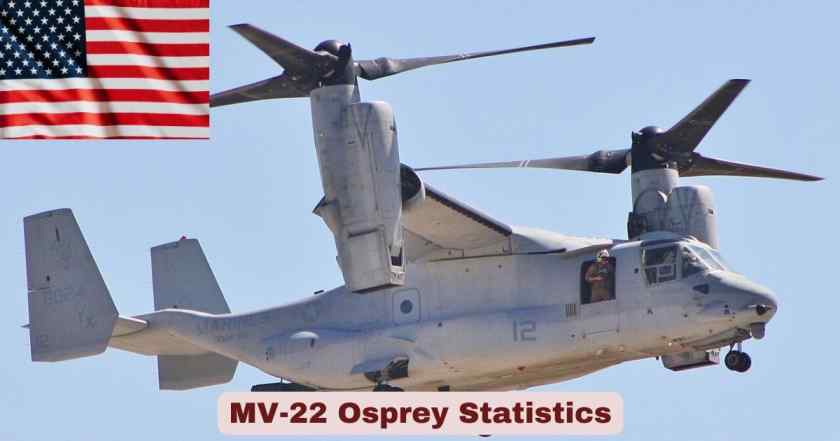
What is MV-22 Osprey?
The MV-22 Osprey is the United States Marine Corps’ primary medium-lift assault transport aircraft — and one of the most technologically audacious, operationally transformative, and politically controversial military aircraft programmes in American aviation history. It is a tiltrotor: a type of aircraft that defies the conventional binary between helicopter and fixed-wing plane by doing both simultaneously. Its two massive 38-foot (11.6-metre) proprotors can rotate from a vertical position — allowing it to take off and land like a helicopter from a ship deck, a forest clearing, or a mountain plateau — to a horizontal position, converting it into a high-speed turboprop aircraft capable of cruising at over 445 km/h (277 mph), nearly twice the speed of the CH-46 Sea Knight helicopter it replaced, at six times the range and with three times the payload — figures confirmed by NAVAIR as the official performance comparison. The conversion from hover mode to forward flight takes just 12 seconds, and the wings become aerodynamically effective between 100 and 120 knots — the brief transition window that pilots describe as the most demanding phase of every flight. The MV-22B’s combat performance means it can carry 24 Marines twice as fast and five times farther than the helicopters it replaced — a formulation used by Marine commanders testifying before Congress that captures why the aircraft survived every cancellation attempt.
The MV-22 variant specifically designates the Marine Corps assault and presidential transport role, though the broader V-22 family includes the CV-22B for US Air Force Special Operations Command and the CMV-22B for US Navy carrier onboard delivery. Its roots lie directly in the failure of Operation Eagle Claw — the April 1980 Iran hostage rescue attempt in which helicopter range and reliability limitations led to catastrophe in the Iranian desert, killing eight servicemembers and forcing President Carter to abandon the mission entirely. That disaster underscored with brutal clarity that the US military needed an aircraft with superior range, speed, and VTOL capability simultaneously — and the JVX programme launched in 1981 was the direct institutional response. Built through a joint venture between Bell Helicopter Textron in Fort Worth, Texas and Boeing Defense, Space & Security in Philadelphia and Texas, the MV-22 entered Marine Corps service in 2007 after one of the longest, costliest, and most turbulent development programmes in US military aviation history — consuming over $35 billion in total programme costs, and resulting in a platform that, despite earning the early nickname “Widowmaker” among test pilots for its developmental crash record, the Marine Corps has committed to operating until the 2050s through an active modernisation programme announced in January 2025.
As of March 14, 2026, the MV-22 Osprey sits at a defining moment in its operational life. On the one hand, 588,000+ flight hours across 109 operational deployments confirm its status as the most heavily utilised medium-lift platform in Marine Corps history — flying more hours per year than any other Marine rotary-wing aircraft, deploying to Iraq, Afghanistan, Libya, Nepal, the Philippines, and now the Middle East as part of Operation Epic Fury. The aircraft’s battlefield impact has been described by a Marine commander in Iraq who told USMC leadership that the Osprey had turned his battlespace “from the size of Texas to the size of the United States” — a quote that went on to be cited in every MV-22 procurement defence before Congress for a decade. Elements from the 31st Marine Expeditionary Unit and the amphibious assault ship USS Tripoli ordered to the Middle East on March 13, 2026 carry MV-22s as their primary troop delivery system — the aircraft that would land 2,500 Marines onto any contested coastline or facility.
The platform has also evolved well beyond its original assault transport mission: Block C upgrades have added improved radar, electronic warfare systems, and cockpit displays; the Marine Corps has demonstrated the MV-22B launching AN/SSQ-62F DICASS sonobuoys for anti-submarine warfare in the Indo-Pacific against the Chinese submarine threat; and in August 2013, two MV-22s completed the longest Osprey tanking mission on record — flying from MCAS Futenma, Okinawa to the Philippines to Darwin and Townsville, Australia before rendezvousing with USS Bonhomme Richard, a total distance logged as part of what became USMC’s Indo-Pacific crisis response planning. On the other hand, the V-22 fleet remains under flight restrictions imposed after the fatal November 2023 CV-22 crash off Japan, with full unrestricted operations not expected to resume until spring 2026 following a critical proprotor gearbox upgrade involving a new manufacturing process that reduces metal impurity inclusions by ~90%. The final MV-22 fuselage was accepted by DCMA on October 8, 2025 — closing a two-decade production programme whose last aircraft is projected to complete final assembly and acceptance later in 2026, even as the fleet it joins is being modernised to serve for another 30 years.
Interesting Facts About the MV-22 Osprey 2026
| Fact | Detail |
|---|---|
| Full Designation | MV-22B Osprey — “M” prefix = Marine Corps; “V” = vertical take-off/landing; “22” = programme number |
| Aircraft Type | Tiltrotor — unique hybrid combining helicopter and turboprop aircraft in one airframe |
| Named After | Osprey — a large raptor (fish hawk) known for hovering, diving, and long-range flight |
| Manufacturers | Bell Helicopter Textron (Fort Worth, TX) + Boeing Defense, Space & Security (Ridley Park, PA; Fort Worth, TX) — Bell-Boeing joint venture |
| Bell’s Production Responsibilities | Wing, nacelles, rotors, drive system, tail surfaces, aft ramp, Rolls-Royce engine integration, final assembly |
| Boeing’s Production Responsibilities | Fuselage, cockpit, avionics, flight controls, crew systems |
| Programme Origin | JVX — Joint-service Vertical Take-Off/Landing Experimental programme — officially began 1981 under DoD |
| Bell-Boeing Development Contract | 3 May 1986 — US$1.714 billion awarded for full-scale development |
| V-22 Designation Date | 15 January 1985 |
| First Flight | 19 March 1989 (prototype MV-22A) |
| MV-22B First Flight | 5 February 1997 |
| Marine Corps IOC Date | June 2007 — Initial Operational Capability |
| First Combat Deployment | October 2007–April 2009 — Iraq (VMM-263, VMM-162, VMM-266) |
| First Shipboard Deployment | May 2009 — USS Bataan (LHD-5); 22nd MEU |
| Replaced Aircraft | CH-46E Sea Knight (Marine Corps) |
| CV-22 IOC | 2009 — US Air Force Special Operations Command |
| CMV-22B IOC | 2020 — US Navy carrier onboard delivery |
| 500,000 Flight Hours Milestone | Surpassed October 2019 |
| USMC Fleet Size (authorised) | 360 MV-22Bs — 16 active squadrons, 2 reserve squadrons, 1 fleet replacement, executive transport, test units |
| USAF Fleet (CV-22Bs) | 50 CV-22Bs — US SOCOM long-range special operations |
| USN Fleet (CMV-22Bs) | 48 CMV-22Bs — Combat SAR, special warfare, carrier onboard delivery |
| Total V-22 Family Fleet | ~400+ aircraft (US services combined) |
| Japan Fleet | 17 MV-22s — Japan Ground Self-Defense Force (JGSDF); based at Saga Airport, Kyushu from 2025 |
| Production Line Closure | Production line open until ~2026 to complete final orders; final MV-22 fuselage accepted October 8, 2025 |
| Final Assembly Location | Final assembly for last aircraft: DCMA Vertical Lift Texas, Fort Worth — projected completion later in 2026 |
| US Suppliers in Programme | Hundreds — Bell-Boeing cites a nationwide supplier base supporting production and sustainment |
| Presidential Transport | MV-22 operates in “Marine One”-adjacent executive transport detachment — VMX-1 detachment |
| USS Tripoli Deployment (March 2026) | MV-22s from 31st MEU embarked on USS Tripoli — ordered to Middle East March 13, 2026 for Operation Epic Fury |
| Nickname (Early Programme) | “Widowmaker” — earned by test pilots during developmental testing due to early accident record; four crashes in 1991–2000 caused 30 fatalities |
| Operation Eagle Claw Connection | MV-22 programme directly triggered by the April 1980 failure of Operation Eagle Claw — Iran hostage rescue; helicopter range/reliability limitations killed 8 servicemembers and aborted the mission |
| Hover-to-Forward Flight Conversion | Just 12 seconds — nacelles rotate from vertical to horizontal; wings become lift-effective at 100–120 knots |
| NAVAIR Performance Comparison | “Twice the speed, six times the range, and three times the payload of the CH-46E” — NAVAIR official product page |
| Battlefield Commander Quote (Iraq) | Senior Marine commander after first Iraq deployment: the Osprey turned his battlespace “from the size of Texas to the size of the United States” |
| Longest Osprey Tanking Mission (2013) | August 2–5, 2013 — two MV-22s flew Okinawa → Philippines → Darwin, AU → Townsville, AU → USS Bonhomme Richard; longest-distance Osprey tanking mission at that date |
| Anti-Submarine Warfare Capability | MV-22Bs now deploying AN/SSQ-62F DICASS sonobuoys for ASW missions — a new Indo-Pacific role against Chinese submarine threat |
| Block C Upgrades | Improved radar, electronic warfare (EW) systems, and cockpit displays — positions MV-22B for multi-domain Indo-Pacific operations |
| Special Purpose MAGTF-Africa | 2013 — USMC formed first intercontinental crisis response force (SP-MAGTF-CR-AF) using V-22s with specialised comms gear; rapid response to Africa crises |
| Presidential Support Role | 2013 — several MV-22s modified with communications and seating upgrades to support Marine One presidential transport squadron (HMX-1); urgent need driven by CH-53E demand in Afghanistan |
| Flight Deck Exhaust Myth Debunked | Early concern that MV-22 engine exhaust would damage ship flight decks; testing confirmed no damage with proper procedures — portable heat shields in first deployment found unnecessary for LHA/LHD decks |
| Afghanistan Special Operations | VMM-263 Afghanistan deployment: delivered 4,069 special operations assaulters on 68 direct-action INFIL/EXFIL missions — enabled capture of 231 suspected terrorists |
| CASEVAC Record (Mombasa) | An MV-22 flew a CASEVAC across a ship-to-shore expanse that MEU commander said “The V-22 is the only aviation asset that can bridge” — mission from waters near Mombasa, Kenya |
| Total V-22s Built (all variants) | ~400 aircraft — all variants (MV-22B, CV-22B, CMV-22B) combined |
| Training Squadron | VMMT-204 — Marine Medium Tiltrotor Training Squadron 204, MCAS New River, NC — trains both Marine and Air Force Osprey pilots |
Source: Wikipedia (Bell Boeing V-22 Osprey — January 12, 2002, updated), Army Recognition (January 29, 2025), DVIDS/DCMA (October 8, 2025), Breaking Defense (April 30, 2025), Bell-Boeing official website (boeing.com/defense/military-rotorcraft/v-22-osprey), NAVAIR MV-22B product page, Congressional Research Service R48703 (September 12, 2025), Navy V-22 Fact Sheet (NAVAIR)
The development history of the MV-22 is a masterclass in what happens when a genuinely revolutionary technology meets an institutional procurement process that was never designed to handle revolutionary technologies. The JVX programme’s 1981 start to 2007 IOC spans 26 years — encompassing three presidential administrations that tried to cancel the programme (including Dick Cheney as Secretary of Defense, who cancelled it in 1989 only for Congress to restore funding), two crashes during developmental testing that killed 30 servicemembers in 2000 alone, a major fraud investigation into testing data falsification by Bell-Boeing employees, and a total programme cost that ultimately exceeded $35 billion. The “Widowmaker” nickname — applied to the aircraft by test pilots during the 1990s when four developmental crashes in less than a decade claimed 30 lives — was the public relations albatross that the programme carried for years. Yet the same performance that made the aircraft technically indispensable also made it irreplaceable: when an MV-22 can fly a Marine rifle company from the deck of an amphibious assault ship to a target 926 kilometres inland in the same time a CH-46 could travel 250 kilometres, the operational implications are so profound that no cost or political obstacle ultimately proved sufficient to kill it. The Operation Eagle Claw connection is particularly telling — the same Iranian desert that witnessed the catastrophic failure of the helicopter-only rescue mission in 1980 now potentially hosts the consequences of the technology directly born from that failure, as MV-22s aboard USS Tripoli approach Iranian waters in 2026.
The Bell-Boeing production division — where Bell builds the wings, nacelles, rotors, drive system, and performs final assembly while Boeing builds the fuselage and avionics — is the physical embodiment of what was once a controversial “workshare” agreement designed to spread the programme’s political constituency across multiple congressional districts and states. What began as political engineering to protect the programme from cancellation became, over two decades, a genuinely efficient production methodology where the two companies’ specialisations aligned naturally. The Afghanistan special operations record — 68 direct-action INFIL/EXFIL missions delivering 4,069 assaulters and enabling 231 captures — confirmed the platform’s combat relevance in the most unambiguous terms available, while the Mombasa CASEVAC and the longest tanking mission in August 2013 demonstrated its sheer range versatility in peacetime crisis response. The Block C anti-submarine warfare capability — adding sonobuoy deployment to a troop transport aircraft — signals that the Marine Corps intends MV-22 to contribute to the full spectrum of Indo-Pacific operations including maritime domain awareness missions against Chinese submarines, making it simultaneously an assault transport, a crisis response aircraft, a presidential support platform, and now an ASW asset. The October 8, 2025 acceptance of the final MV-22 fuselage by DCMA at Ridley Park, Pennsylvania — after over two decades of production — marks the quiet end of an extraordinary industrial programme, even as the aircraft itself is only at the midpoint of its operational life.
MV-22 Osprey Technical Specifications Statistics 2026
| Specification | Data |
|---|---|
| Aircraft Configuration | Tiltrotor — high-mounted wing with two rotating nacelles; conventional fixed tail |
| Proprotor Diameter | 11.6 metres (38 feet) each — two proprotors |
| Total Rotor Span | 25.55 metres (83 ft 10 in) |
| Fuselage Length | 17.47 metres (57 ft 4 in) |
| Height | 5.61 metres (18 ft 5 in) |
| Wing Span (extended) | 14.0 metres (45 ft 10 in) |
| Wing Span (folded / stowed) | 5.6 metres (18 ft 5 in) — wings rotate 45° and fold for shipboard storage |
| Maximum Gross Weight | 27,400 kg (60,500 lb) — maximum vertical takeoff weight |
| Self-Deploy Gross Weight | Higher — rolling takeoff allows greater fuel/payload for long transit missions |
| Fuselage Construction | Corrosion-resistant composite materials — reduces weight, enhances maritime durability |
| Cargo Bay Dimensions | 6.1 m × 1.68 m × 1.83 m (20 ft × 5.5 ft × 6 ft) — pressurised |
| Troop Capacity | 24 fully equipped combat troops or 32 floor-seated personnel |
| Internal Cargo Capacity | 4,100 kg (9,000 lb) |
| External Cargo Capacity | 4,500 kg (10,000 lb) — via cargo hook |
| Engines | 2 × Rolls-Royce Allison AE1107C Liberty turboshaft engines |
| Engine Power | Each: 6,150 shp — combined 12,300 shp |
| Interconnecting Drive Shaft | Connects both engines — allows either engine to power both proprotors in event of single engine failure |
| Maximum Speed | 445–509 km/h (277–316 mph) — varies by source and configuration |
| Cruise Speed | ~446 km/h (277 mph) at altitude |
| Range (combat assault) | 926 km (575 miles) |
| Range (self-deploy / ferry) | 3,336 km (2,073 miles) with internal auxiliary fuel |
| Service Ceiling | 7,925 metres (26,000 ft) |
| Rate of Climb | ~7.93 m/s (1,560 ft/min) |
| Crew | 4 — pilot, copilot, 2 flight engineers/crew chiefs |
| Armament | M240 7.62mm machine gun (rear ramp); XM218 .50 cal (belly turret, optional); GAU-17/A 7.62mm (optional) |
| Landing Gear | Retractable tricycle — rough field and ship deck compatible |
| Cockpit | Seats 2 pilots; crew chief/loadmaster in cabin |
| Access | Rear ramp with clamshell doors; port-side crew access door with retractable ladder; emergency exits and jettisonable windows |
| Aerial Refuelling | Equipped with aerial refuelling probe — extends ferry range dramatically; Navy not pursuing inflight tanking capability (confirmed May 2025) |
| vs CH-46 Sea Knight (predecessor) | MV-22 delivers: 2× speed, 3× range, 3× payload |
Source: Army Recognition (January 29, 2025), Wikipedia (Bell Boeing V-22 Osprey), Bell-Boeing official specs, NAVAIR MV-22B product page, Congressional Research Service R48703 (September 12, 2025)
The performance comparison to the CH-46 Sea Knight — 2× speed, 3× range, 3× payload — is the MV-22’s most important operational statistic, because it translates directly into a fundamental expansion of Marine amphibious warfare capability. A CH-46 ferrying troops from a ship 50 kilometres offshore could deliver them to a landing zone and return for another load in roughly 40 minutes, limiting the radius of effective operations to a narrow coastal band. An MV-22 operating from the same ship can deliver troops 600 kilometres inland in the same timeframe — transforming the “vertical envelopment” doctrine from a coastal operation into a genuinely strategic capability that denies any adversary the comfort of knowing that positions 200+ kilometres from the coast are safe from Marine assault. That is why the programme survived every cancellation attempt: the performance gain was not incremental but paradigmatic.
The interconnecting drive shaft that links both engines through the gearbox system is simultaneously the MV-22’s most important safety feature and the component that has generated its most serious accident history. Because either engine can power both proprotors through this shaft, the aircraft can continue flying on a single engine — a critical redundancy for over-water operations. However, the proprotor gearbox (PRGB) that forms the heart of this interconnecting system has proved the most mechanically challenging component in the entire aircraft. The metal inclusions — tiny particles of unwanted material embedded in the high-stress gear alloys during manufacturing — that caused the November 2023 crash killing all eight crew members off Japan’s coast, and that the triple-melt upgrade is designed to eliminate, represent not a design flaw in the gearbox architecture but a materials manufacturing quality problem that accumulated over decades of production before its consequences became catastrophically apparent. The new X-53 triple-melt alloy process, expected to reduce inclusions by ~90%, is the fix that the V-22 Joint Program Office believes will finally allow the aircraft to achieve truly unrestricted operations.
MV-22 Osprey & Operation Epic Fury Iran War Statistics 2026
| Metric | Data |
|---|---|
| MV-22 Deployment Order Date | March 13, 2026 — US officials confirmed 31st MEU and USS Tripoli ordered to Middle East |
| 31st MEU Marine Count | ~2,200–2,500 Marines — three US Navy amphibious ships |
| Three Amphibious Ships | USS Tripoli (LHA-7) + USS New Orleans + USS San Diego |
| Aviation Assets Confirmed | “A squadron of F-35 fighter jets and a squadron of MV-22 tiltrotor Osprey aircraft” — two US officials to ABC News, March 13, 2026 |
| MV-22 Squadron Composition (typical 31st MEU) | VMM squadron — 12 MV-22Bs; provides assault support, troop delivery, resupply, CASEVAC |
| Departure Point | Okinawa, Japan — 31st MEU’s permanent Indo-Pacific homeport |
| Distance to Conflict Zone | ~6,000+ nautical miles — transit of at least one week or more (SOF News, March 14, 2026) |
| Transit Route | Through South China Sea → Indian Ocean → Arabian Sea / Persian Gulf approaches |
| MV-22 Role on Arrival | Primary troop and vehicle delivery aircraft — amphibious landings, inland assaults, NEO (Non-Combatant Evacuation Operations), CASEVAC |
| MV-22 Assault Range vs Tripoli Position | MV-22’s 926 km combat assault range means Tripoli can standoff hundreds of kilometres from Iranian anti-ship threats while MV-22s still reach any target on Iran’s southern coast |
| MV-22 vs Kharg Island | Kharg Island is ~25 km from Iranian coast — MV-22s can fly the full transit from USS Tripoli deck to Kharg and back multiple times with fuel reserves; round trip ~50 km |
| MV-22 Speed Advantage (troop delivery) | At 445 km/h vs helicopter ~250 km/h — MV-22 cuts troop insertion time in half, reducing exposure during the most dangerous phase of amphibious operations |
Source: ABC30/ABC7 (March 14, 2026), SOF News (March 14, 2026: “Epic Fury Update”), Wikipedia — 2026 Iran conflict (updated March 14, 2026), Jerusalem Post (March 13, 2026), PJ Media (March 13, 2026), Kurdistan 24 (March 13, 2026), The Diplomat (March 2026: “Operation Epic Fury Moves East”), Fortune/AP (March 13, 2026), The War Zone (March 13, 2026), CENTCOM official statements (March 3–14, 2026)
The Operation Epic Fury statistics surrounding the MV-22 Osprey place the aircraft at the centre of what may become the most consequential US military deployment decision of the decade. When US officials confirmed to ABC News on March 13, 2026 that the 31st MEU’s package includes “a squadron of F-35 fighter jets and a squadron of MV-22 tiltrotor Osprey aircraft”, they were describing the exact amphibious aviation combination that US war planners have always identified as the minimum requirement for a contested island seizure operation. The F-35Bs provide air superiority and close air support over the objective; the MV-22s deliver the Marines — the people who actually secure and hold terrain. Without both elements together, neither the air strikes nor the ground force can achieve their objectives. The fact that both are now aboard USS Tripoli heading toward the Persian Gulf makes the deployment package qualitatively different from a show-of-force posture and operationally credible as a seizure-capable amphibious force.
The Kharg Island arithmetic demonstrates why the MV-22’s specific performance envelope makes it irreplaceable for this scenario. Kharg Island sits 25 kilometres off Iran’s coast — a distance that, at MV-22 cruise speed of 445 km/h, represents less than 4 minutes of flight time once the aircraft clears the ship’s deck. Even if USS Tripoli must remain 200 kilometres from Iranian anti-ship missiles to protect the ship, the MV-22’s 926 km combat assault range means it can fly to Kharg Island and back nine times on a single fuel load from that standoff distance. This is precisely why analysts cited by Axios confirmed the seizure option was “on the table”: no other rotary-wing platform in the US inventory — not the CH-53K, not the UH-1Y, not a helicopter of any kind — could execute a rapid mass troop insertion under fire from a carrier-group standoff distance with the speed, range, and payload the MV-22 provides. The aircraft that began its existence as the most controversial programme in USMC history may be about to deliver the operational vindication its advocates always promised it would.
MV-22 Osprey Programme Cost & Procurement Statistics 2026
| Metric | Data |
|---|---|
| Original Development Contract | $1.714 billion — Bell-Boeing, 3 May 1986 (full-scale development) |
| Total Programme Cost (estimated) | Over $35 billion — US Government Accountability Office and Congressional analyses |
| Unit Flyaway Cost (FY2016 est.) | ~$72 million per aircraft — based on procurement lots |
| Multi-Year Procurement Contract 1 (MYP I) | $10.3 billion — signed 28 March 2008; FY08–FY12; 141 MV-22Bs + 26 CV-22Bs; saved $427 million |
| Multi-Year Procurement Contract 2 (MYP II) | $6.4 billion — signed 12 June 2013; FY13–FY17; 93 MV-22Bs + 7 CV-22Bs; saved ~$1 billion |
| $4.9 Billion Contract (June 2013) | Covered 99 V-22s in production Lots 17–18 (92 MV-22s for USMC); completion September 2019 |
| Cumulative Contract Value (June 2013) | $6.5 billion total all contracts placed to that date |
| Production Peak Rate | 40 aircraft per year (2012) |
| Production Rate (2015 planned) | 22 per year — halved from 2012 peak |
| All V-22s in US Military (2019) | 375 aircraft — fleet size at 500,000 flight hour milestone, October 2019 |
| USMC Planned Fleet | 360 MV-22Bs |
| USAF Planned Fleet | 50 CV-22Bs |
| USN Planned Fleet | 48 CMV-22Bs |
| Total Planned US V-22 Fleet | ~458 aircraft |
| Japan Fleet (purchased) | 17 MV-22s — JGSDF |
| FY2026 HASC Budget | House Armed Services Committee recommended full V-22 line items — nacelle improvement, digital interoperability, sustainment (H.Rept. 119-231) |
| Final MV-22 Fuselage Accepted | October 8, 2025 — DCMA Vertical Lift Philadelphia, Ridley Park, PA |
| Final Aircraft Delivery | Projected 2026 — final assembly at Fort Worth, TX |
| 2025 Marine Corps Aviation Plan | Released January 29, 2025 — commits to MV-22B service until the 2050s; outlines modernisation roadmap |
| VMM-264 Reactivation | Planned FY2026 — initial operational capability by FY2027 |
| ODSSHI Programme | Osprey Drive System Safety and Health Instrumentation — predictive maintenance system for drivetrain monitoring |
| VeCToR Programme | V-22 Enhanced Cockpit Technology Replacement — addressing avionics obsolescence |
| Class A Mishap Rate (10-year) | 3.15 per 100,000 flight hours — lower than Marine Corps average (3.24) and 4 other USMC aircraft |
Source: DVIDS/DCMA (October 8, 2025), Army Recognition (January 29, 2025), Wikipedia, Congressional Research Service R48703 (September 12, 2025), Bell-Boeing official website, HASC Report H.Rept. 119-231 (2025), NAVAIR MV-22B product page
The programme cost statistics for the MV-22 Osprey capture the full weight of a 45-year commitment from initial concept to the last aircraft delivery in 2026. The $35 billion+ total programme cost spread across four and a half decades of development, production, and upgrades makes the V-22 one of the most expensive rotary-wing programmes in aviation history — but that figure needs to be contextualised against the 360+ aircraft delivered and the 588,000+ flight hours accumulated by the Marine Corps fleet alone. The $427 million saved through the first multi-year procurement contract and the ~$1 billion saved through the second multi-year contract — both through fixed-price arrangements that protected taxpayers from cost overruns — demonstrate that the programme’s later production years were managed with considerably more financial discipline than its early development decades.
The January 2025 Marine Corps Aviation Plan’s commitment to MV-22 service until the 2050s is perhaps the most operationally significant recent programme announcement. It means that an aircraft that entered service in 2007 will serve for nearly 50 years — a service life comparable to the legendary B-52 bomber. The planned modernisation suite — ODSSHI predictive maintenance monitoring, VeCToR avionics replacement, nacelle improvements, potential new engine cores, and the PRGB triple-melt gearbox upgrade — represents an investment that signals the Marine Corps regards the fundamental design as sound and the performance envelope as irreplaceable rather than merely adequate. VMM-264’s planned FY2026 reactivation — adding a sixteenth active MV-22 squadron to 2nd Marine Aircraft Wing — reflects the Corps’ continued commitment to tiltrotor density as a core amphibious capability, even as the fleet navigates its most significant safety challenge since the developmental crashes of 2000.
MV-22 Osprey Safety & Flight Restriction Statistics 2026
| Metric | Data |
|---|---|
| Total Fatalities in V-22 Mishaps (as of July 2025) | 65 people killed — all V-22 variants, all causes, since programme began |
| Fatal Mishaps (2022–2025) | 4 fatal mishaps — killed 20 servicemembers, injured another 20 |
| November 2023 Crash | CV-22B off Yakushima Island, Japan — 29 November 2023; 8 killed |
| November 2023 Crash Cause | Proprotor Gearbox (PRGB) component failure — metal inclusion in high-stress gear alloy |
| Contributing Factors | (1) PRGB component failure; (2) crew continued flying after warning lights activated; (3) programme office failure to communicate data to services |
| Fleet Grounding Post-Crash | All V-22s grounded ~3 months — December 2023 to March 2024 |
| Japan Suspension | Japan JGSDF suspended all 14 (later 17) MV-22 flights following crash; resumed March 2024 |
| Return-to-Flight Restrictions | Aircraft must remain within 30 minutes of a landing site at all times when flying |
| Services Affected by Restrictions | US Navy and US Air Force fleets remain restricted (as of September 2025); Marine Corps flying under modified restrictions |
| USMC Restriction Details | Marine Corps flying “one notch below full mission capability” — modified operating procedures |
| Full Unrestricted Operations Target | Spring 2026 — V-22 Program Manager Marine Corps Col. Robert Hurst (Breaking Defense, April 30, 2025) |
| Hurst Quote | “We had some learning in the middle, and that learning in the middle took us from the summer of ’25 to start in the spring of ’26.” |
| Root Cause of Inclusions | Metal manufacturing inclusions in double-melt X-53 alloy gears — tiny unwanted particles that weaken metal under high cyclic stress |
| Triple-Melt Upgrade | X-53 triple-melt alloy process — third melting cycle removes inclusions; reduces inclusions by ~90% |
| Triple-Melt Components Affected | High-speed planetary pinion gears, low-speed planetary pinion gears, bull gears, sun gears — all critical PRGB internals |
| NAVAIR Triple-Melt Decision Date | October 2024 — NAVAIR announced switch to triple-melt alloy for all identified components |
| February 2025 Expansion | Navy announced triple-melt process to be applied to all gears made from double-melt X-53 — broader than October 2024 scope |
| Hardware Delivery Target | Parts planned available to fleet by May 2025; delays pushed fleet delivery to January 2026 onwards |
| Additional PRGB Fix | Cadmium plating on upper PRGB mast being upgraded to prevent flaking |
| Congressional Oversight | House Armed Services Committee requested all Class A accident reports since 1991; as of September 2025, DoD had not transmitted information |
| Congress.gov CRS Report | CRS R48703 (September 12, 2025) — comprehensive Congressional Research Service review of V-22 safety, restrictions, upgrades |
| ODSSHI | Osprey Drive System Safety and Health Instrumentation — real-time predictive monitoring of drivetrain to detect anomalies before failures occur |
| Bell-Boeing Statement (2025) | “Working in lockstep with the V-22 Joint Program Office to enhance Osprey safety and reliability. We fully support the program office’s diligent approach, ensuring these solutions are implemented correctly for the long-term health and safety of the fleet.” |
Source: Congressional Research Service R48703 (September 12, 2025), Breaking Defense (April 30, 2025), Wikipedia (Bell Boeing V-22 Osprey), Army Recognition (January 29, 2025), DVIDS/DCMA (October 8, 2025), NAVAIR official statements 2024–2025
The safety and restriction statistics for the MV-22 in 2025–2026 represent the most serious operational crisis in the aircraft’s post-development service life — and the most consequential effort to resolve it. The 65 total fatalities across the V-22 programme’s history, including 20 servicemembers killed in just four mishaps between 2022 and 2025, have created genuine public and congressional anxiety about a platform that the Marine Corps simultaneously acknowledges as indispensable and admits cannot currently fly its full mission profile. The 30-minute landing site proximity restriction — which means no V-22 in Navy or Air Force service can fly more than 30 minutes from an airfield, ship deck, or emergency landing area — effectively eliminates much of the over-water range advantage that defines the platform’s strategic value. For an aircraft designed to deliver special operations forces deep into denied territory or to fly 900 kilometres from a carrier strike group, being chained to a 30-minute proximity window is not an operational restriction — it is a capability negation.
The triple-melt alloy upgrade is the specific engineering intervention that program officials believe will resolve the root cause permanently. The distinction between double-melt and triple-melt X-53 alloy lies in how many times the metal is remelted and purified before being cast into gear blanks: double-melt removes most impurities but leaves a residual inclusion rate that, under the extreme cyclic stress loads of a PRGB operating at high RPM for thousands of hours, eventually produces fatigue cracks that initiate at inclusion sites. Triple-melting adds one more purification cycle, reducing inclusion probability by approximately 90% according to NAVAIR’s testing. The February 2025 decision to apply triple-melt to all gears made from double-melt X-53 — rather than just the originally identified subset — reflects the program office’s determination not to create a future scenario where a different gear in the same gearbox fails for the same reason. Col. Hurst’s spring 2026 target for unrestricted operations represents the first time the program office has attached a specific public timeline to the resolution of the crisis.
MV-22 Osprey Operational Deployment Statistics 2026
| Metric | Data |
|---|---|
| Total Flight Hours (USMC fleet, as of 2025) | Over 588,000 flight hours — more than any other USMC rotary-wing platform per year |
| Total Operational Deployments | 109 deployments — across all regions and mission types |
| Flight Hours per Aircraft per Year | Highest of any USMC rotary-wing aircraft — specific figure not publicly disclosed |
| First Combat Deployment | Iraq, October 2007 – April 2009 — VMM-263, VMM-162, VMM-266 |
| Afghanistan Deployments | Multiple VMM squadrons; MEDEVAC, assault support, resupply |
| Libya (2011) | Operated in support of Operation Odyssey Dawn |
| Nepal Earthquake (2015) | Humanitarian disaster relief |
| Philippines Typhoon Relief | Multiple humanitarian operations |
| Africa (Djibouti) | MV-22Bs stationed in Djibouti support mobility across Africa continent |
| Asia (Hawaii) | MV-22Bs at Hawaii support Indo-Pacific operations |
| Indo-Pacific (Okinawa) | 31st MEU MV-22Bs based Okinawa — USS Tripoli deployment area |
| Japan (JGSDF) | 17 MV-22s based at Saga Airport, Kyushu from 2025 — with Black Hawks and Apache Longbows for Nansei Islands defence |
| Presidential / Executive Transport | VMX-1 executive transport detachment — operates MV-22 for USMC senior personnel |
| USS Bataan (2009) | First shipboard deployment — 22nd MEU |
| Operation Epic Fury (Feb 28, 2026) | US-Israel war vs Iran; 31st MEU MV-22s embarked on USS Tripoli ordered to Middle East March 13, 2026 |
| Operation Epic Fury Significance | Tripoli’s 2,500 Marines + MV-22s = primary amphibious assault and troop-delivery capability in the region |
| Hostage Rescue Role | CV-22 variant deployed in multiple JSOC hostage rescue operations globally |
| MEDEVAC Role | Critical medical evacuation at speeds and ranges impossible for traditional helicopters |
| Carrier Onboard Delivery (CMV-22B) | Replaces C-2A Greyhound for carrier logistics — can transport F-35 engine power modules and priority cargo |
| Active Squadrons (USMC) | 15 active + 2 reserve + fleet replacement + test units |
| Planned New Squadron | VMM-264 — reactivation FY2026, IOC FY2027 |
| F-35 Engine Module Transport | MV-22 can carry F-35 power modules between ship and shore — critical logistics capability for carrier air wings |
| Exercise Cutlass Express 2025 | MV-22 refuelled at Kilimanjaro International Airport, Tanzania — troop transport flight — February 12, 2025 |
Source: Army Recognition (January 29, 2025), Wikipedia (Bell Boeing V-22 Osprey), DVIDS (multiple 2025–2026 releases), Fortune/AP (March 13, 2026), The War Zone (March 13, 2026), Bell-Boeing official website, NAVAIR MV-22B product page
The operational deployment statistics confirm what the raw performance numbers imply but cannot fully convey: the MV-22 has fundamentally altered what the US Marine Corps can achieve in the first hours and days of a crisis. The ability to deploy a 24-man Marine rifle section from a ship 500 kilometres offshore directly onto an inland objective — without the helicopter’s range limitation requiring multiple refuelling stops — has been demonstrated in every major USMC operation since 2007. The 109 operational deployments across Iraq, Afghanistan, Libya, Nepal, the Philippines, Africa, and now the Middle East represent a continuous operational record that is, by any objective measure, the most intense deployment tempo of any US rotary-wing platform in the same period. The fact that the MV-22 has accumulated more flight hours per aircraft per year than any other USMC rotary-wing platform while simultaneously being described as “troubled” in the press reflects the paradox at the heart of the programme: no one who actually flies combat missions in it wants it cancelled, even as its gearbox failures kill people.
The March 13, 2026 order to deploy USS Tripoli and its 31st MEU — with MV-22 Ospreys as the primary troop-delivery aircraft — to the Middle East for Operation Epic Fury places the MV-22 at the centre of the most potentially consequential US amphibious operation since the 2003 Iraq War. If the scenarios being discussed — including the possible seizure of Kharg Island — ever transition from contingency planning to execution, it will be MV-22 Ospreys that carry Marines from USS Tripoli’s flight deck across 25 kilometres of Persian Gulf to land on the island’s defended terrain. The aircraft’s 926-kilometre combat assault range means that even if USS Tripoli must remain outside Iran’s anti-ship missile engagement envelopes, the MV-22s can still reach almost any target on Iran’s southern coastline. For all the programme’s controversy and cost, in the spring of 2026, the Marines heading toward the Persian Gulf are very glad to have it.
Disclaimer: The data research report we present here is based on information found from various sources. We are not liable for any financial loss, errors, or damages of any kind that may result from the use of the information herein. We acknowledge that though we try to report accurately, we cannot verify the absolute facts of everything that has been represented.