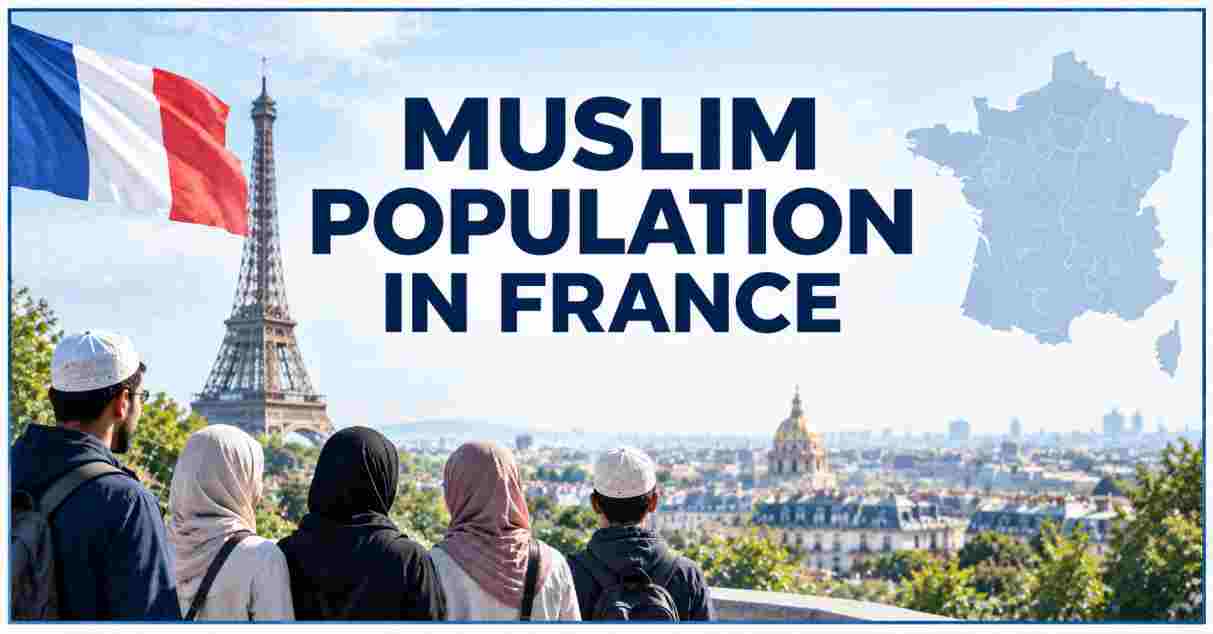
The Muslim Population in France stands at an estimated 5.5 million to 6.9 million people in 2026, or 8% to 10% of the 69.1 million residents INSEE counted on 1 January 2026. Pew Research Center put the figure at 5.7 million (8.8%) in 2016, while a 2025 Ifop poll found 7% of residents aged 15 and over.
Muslim Population in France 2026 – Introduction
The Muslim Population in France is the largest in Europe in Pew’s 2016 count, yet no official headcount exists. French law does not allow the national census to count people by religion. Researchers rely on surveys and models instead. Results shift with the age group, the survey year and the question wording.
This report pulls the best available numbers into one place. It uses INSEE’s population count of 69.1 million, Pew Research Center’s 2016 baseline and 2050 scenarios, the INED–INSEE Trajectoires et Origines survey, and Ifop’s November 2025 poll. Each table shows one angle: headcount, history, projections, affiliation, practice, demographics and the European comparison. Every figure carries its source and its limits.
Interesting Facts About the Muslim Population in France 2026
MUSLIM SHARE OF FRANCE: KEY ESTIMATES (%)
Ifop 2025, ages 15+         ██████████████░░░░░░   7.0
Pew 2016, all residents     ██████████████████░░   8.8
INED-INSEE, ages 18-59      ████████████████████  10.0
| Metric | 2026 Data Point |
|---|---|
| France population (1 January 2026) | 69.1 million |
| Metropolitan France population | 66.8 million |
| Working range, Muslim Population in France | 5.5–6.9 million |
| Central estimate (Pew 2016 share on 2026 population) | 6.1 million |
| Share range used in this report | 8%–10% |
| Ifop 2025 share, ages 15+ | 7% |
| Total fertility rate, 2025 | 1.56 |
| Births in 2025 | 645,000 |
| Natural balance in 2025 | –6,000 |
| Islam’s rank among French religions | Second |
Data source: INSEE (Insee Première No. 2087, January 2026); Pew Research Center (2017); INED–INSEE Trajectoires et Origines 2 (2019–2020); Ifop (November 2025); report calculations.
INSEE counted 69.1 million residents on 1 January 2026, with 66.8 million in metropolitan France. The Muslim Population in France working range of 5.5–6.9 million applies the 8% and 10% shares to that total. The 6.1 million central figure applies Pew’s 8.8% share from 2016. These are report calculations, not census counts. Pew’s 2016 baseline remains the most cited national count.
The demographic rows show a country near zero natural growth. France recorded 645,000 births and 651,000 deaths in 2025, so the natural balance fell to –6,000, the first negative reading since World War II. The fertility rate dropped to 1.56. The 7% Ifop share covers residents aged 15 and over, which explains why it sits below Pew’s whole-population share. Islam ranks second among French religions in both INSEE and Ifop data.
Muslim Population in France 2026 Estimate by Percentage Scenario
IMPLIED MUSLIM POPULATION IN FRANCE, 2026 (MILLIONS)
7.0% share   ████████████████████████░░░░░░░░░░░   4.8
7.5% share   ██████████████████████████░░░░░░░░░   5.2
8.0% share   ████████████████████████████░░░░░░░   5.5
8.8% share   ██████████████████████████████░░░░░   6.1
10.0% share  ███████████████████████████████████   6.9
| Share Scenario | Source Basis | Applied to 69.1 Million |
|---|---|---|
| 7.0% | Ifop 2025 (ages 15+) | 4.8 million |
| 7.5% | Pew 2010 | 5.2 million |
| 8.0% | Unofficial estimates in 2026 media coverage | 5.5 million |
| 8.8% | Pew 2016 | 6.1 million |
| 10.0% | INED–INSEE 2019–2020 (ages 18–59) | 6.9 million |
Data source: INSEE population estimate (1 January 2026); Pew Research Center; INED–INSEE; Ifop; report calculations.
Each row multiplies a published share by INSEE’s 69.1 million total. The 7.0% row gives 4.8 million, but Ifop measured only residents aged 15 and over in metropolitan France, so treat that row as a comparison point, not a headcount. The 7.5% row reflects Pew’s 2010 baseline. The 8.8% row reflects Pew’s 2016 update and produces the report’s central estimate of 6.1 million.
The 8.0% row matches unofficial 2026 coverage that cites more than 5.5 million Muslims. The 10.0% row comes from the INED–INSEE survey of ages 18 to 59. That survey leaves out the roughly 20 million French residents over 60, so applying its share to everyone gives an upper bound. Use the central figure for headlines and the full range for any claim that needs precision. The Muslim Population in France therefore sits most plausibly between 5.5 million and 6.9 million.
Muslim Population in France Growth 2026: Share of Residents From 1985 to 2025
MUSLIM SHARE OF FRANCE BY SURVEY YEAR (%)
1985 Ifop (adults)      █░░░░░░░░░░░░░░░░░░░   0.5
2010 Pew                ███████████████░░░░░   7.5
2016 Pew                ██████████████████░░   8.8
2019-20 INED-INSEE      ████████████████████  10.0
2025 Ifop (ages 15+) ██████████████░░░░░░ 7.0| Year | Source | Group Measured | Muslim Share |
|---|---|---|---|
| 1985 | Ifop | Adults | 0.5% |
| 2010 | Pew Research Center | All residents | 7.5% |
| 2016 | Pew Research Center | All residents | 8.8% (5.7 million) |
| 2019–2020 | INED–INSEE | Ages 18–59, metropolitan France | 10% |
| 2025 | Ifop | Ages 15+, metropolitan France | 7% |
Data source: Ifop (testimony to the French National Assembly, 18 November 2025); Pew Research Center; INED–INSEE Trajectoires et Origines 2.
The Muslim Population in France grew from 0.5% of adults in 1985 to 7% in 2025 by Ifop’s measure. That is a 14-fold rise in 40 years. Pew counted 7.5% in 2010 and 8.8% in 2016, a gain of 1.3 points in six years. The 2016 count equals 5.7 million people. Ifop’s testimony to the National Assembly said its researchers found no earlier survey of Muslim affiliation than 1985.
The 2025 figure of 7% looks lower than 2016, but the surveys differ. Pew modeled all residents, children included. Ifop polled people aged 15 and over. The INED–INSEE survey found 10% among ages 18 to 59. Different age bases and methods make a direct trend line unreliable. Compare each source only with itself.
Muslim Population in France Projections 2026 to 2050: Pew Migration Scenarios
PEW 2050 PROJECTION: MUSLIM SHARE OF FRANCE (%)
2016 baseline    █████████░░░░░░░░░░░   8.8
Zero migration   █████████████░░░░░░░  12.7
Medium           █████████████████░░░  17.4
High             ██████████████████░░  18.0
| Scenario | Muslims in 2050 | Share of Population |
|---|---|---|
| 2016 baseline | 5.7 million | 8.8% |
| Zero migration | 8.6 million | 12.7% |
| Medium migration | 12.6 million | 17.4% |
| High migration | 13.2 million | 18.0% |
Data source: Pew Research Center, “Europe’s Growing Muslim Population” (2017).
Pew built three scenarios from its 2016 baseline. Zero migration lifts the Muslim Population in France to 8.6 million, or 12.7%. Pew ties that rise to a younger age structure and higher fertility. Medium migration, which assumes pre-2015 flows, reaches 12.6 million and 17.4%. High migration, which extends the 2014–2016 refugee surge, reaches 13.2 million and 18.0%.
These are projections, not forecasts, and they date from 2017. France’s fertility rate has since fallen to 1.56. Three INSEE researchers judged in June 2026 that the national population will very likely fall by 3.2 million between 2026 and 2070. No Pew scenario produces a Muslim majority in France. Pew built the scenarios on 2016-era fertility and migration data. Read the 2050 numbers as a range of possible outcomes.
Religion in France 2026: Muslim Share Versus Catholics and No Religion
RELIGIOUS AFFILIATION, INED-INSEE 2019-2020 (AGES 18-59, %)
No religion      ██████████████████████████  51
Catholic         ███████████████░░░░░░░░░░░  29
Muslim           █████░░░░░░░░░░░░░░░░░░░░░  10
Other religions  █████░░░░░░░░░░░░░░░░░░░░░  10
| Group | INED–INSEE 2019–2020 (Ages 18–59) | Ifop 2025 (Ages 15+) |
|---|---|---|
| No religion | 51% | 37% |
| Catholic | 29% | 43% |
| Muslim | 10% | 7% |
| Other religions | 10% | Not reported here |
Data source: INSEE, Immigrés et descendants d’immigrés en France (2023 edition), from the INED–INSEE Trajectoires et Origines 2 survey; Ifop (November 2025).
The INED–INSEE survey shows 51% of people aged 18 to 59 in metropolitan France reporting no religion. 29% call themselves Catholic. 10% say Muslim, and another 10% belong to other faiths. INSEE concludes that Islam is the second religion in France and that the number of declared Muslims is rising.
The Ifop poll uses a different base and finds a different mix: 43% Catholic, 37% no religion and 7% Muslim. The gap between 51% and 37% for “no religion” shows how much age range and method matter. Ifop included residents over 60, whom the INED–INSEE survey excludes. Both sources place Muslims well behind Catholics and the non-religious.
Muslim Religious Practice in France 2026: Mosque Attendance, Prayer and Fasting
MUSLIM PRACTICE IN FRANCE (% OF MUSLIMS)
Alcohol abstention (Ifop)      ████████████████  79
Strict fasting (INED-INSEE)    ███████████████░  75
Daily prayer (Ifop)            ████████████░░░░  62
Mosque attendance (Ifop)       ███████░░░░░░░░░  35
Regular mosque (INED-INSEE)    ████░░░░░░░░░░░░  20
| Indicator | Value | Source and Year |
|---|---|---|
| Strict Ramadan fasting | 75% | INED–INSEE 2019–2020 |
| Regular mosque attendance | 20% | INED–INSEE 2019–2020 |
| Religion central to identity | 30% | INED–INSEE 2019–2020 |
| Mosque attendance | 35% (16% in 1989) | Ifop 2025 |
| Daily prayer | 62% (41% in 1989) | Ifop 2025 |
| Alcohol abstention | 79% | Ifop 2025 |
| Fasting, ages 18–24 | 83% | Ifop 2025 |
Data source: INSEE reporting on the INED–INSEE Trajectoires et Origines 2 survey (2019–2020); Ifop, “État des lieux du rapport à l’islam et à l’islamisme des musulmans de France” (November 2025).
Two surveys measure practice, and the numbers differ. INSEE found that 20% of Muslims go to a mosque regularly, 75% fast strictly and 30% rank religion as central to identity, a share that fell over 11 years. Ifop reports 35% mosque attendance, up from 16% in 1989, and 62% daily prayer, up from 41%.
Wording and samples drive the gap between the two. Ifop also reports 79% alcohol abstention and 83% fasting among 18 to 24-year-olds. Four Muslim associations filed a complaint against the Ifop poll in November 2025, and the Conseil français du culte musulman called its analysis contestable. Both surveys rely on self-reporting. Treat Ifop’s figures as one contested data point beside the INSEE results.
France Demographic Context 2026: Births, Fertility and Ageing
FRANCE POPULATION MOVEMENT, 2025 (THOUSANDS)
Births           ████████████████████████████   645
Deaths           █████████████████████████████  651
Natural balance  ▏                               -6
| Metric | Value |
|---|---|
| Population, 1 January 2026 | 69.1 million |
| Annual growth | 0.25% |
| Births, 2025 | 645,000 |
| Deaths, 2025 | 651,000 |
| Natural balance, 2025 | –6,000 |
| Fertility rate, 2025 | 1.56 children per woman |
| Population aged 65 and over | 22% |
| Life expectancy, women / men | 85.9 / 80.3 years |
| Age gap, Muslims vs non-Muslims in Europe | 13 years younger |
Data source: INSEE (Insee Première No. 2087, January 2026); Pew Research Center (2017).
France grew by only 0.25% in 2025, to 69.1 million. Deaths (651,000) exceeded births (645,000), leaving a natural balance of –6,000. The fertility rate of 1.56 is the lowest since the end of World War I. 22% of residents are 65 or older, almost equal to the share under 20. Women live 85.9 years on average and men 80.3.
Pew found that Muslims in Europe average 13 years younger than non-Muslims. It links that gap to faster Muslim growth in its zero-migration scenario. With a negative natural balance, net migration accounts for the whole 2025 population gain. Because the census cannot count religion, analysts lack birth and migration figures by faith. That gap keeps every Muslim Population in France projection uncertain. Any 2026 headcount rests on survey shares applied to a total, not on counted individuals.
Muslim Population in France vs Europe 2026: Pew Country Comparison
MUSLIM SHARE OF POPULATION, 2016 (%)
France   █████████░░░░░░░░░░░  8.8
Germany  ██████░░░░░░░░░░░░░░  6.1
Europe   █████░░░░░░░░░░░░░░░  4.9
| Region | Muslims (2016) | Share (2016) |
|---|---|---|
| France | 5.7 million | 8.8% |
| Germany | 5.0 million | 6.1% |
| Europe (EU-28, Norway, Switzerland) | 25.8 million | 4.9% |
Data source: Pew Research Center, “Europe’s Growing Muslim Population” (2017).
Pew counted 25.8 million Muslims across Europe in 2016, or 4.9%. France held 5.7 million of them, about 22%, the largest national total. Germany followed with 5.0 million, or 6.1%. The Muslim Population in France share of 8.8% sits well above the continental average.
That ranking rests on 2016 data, so a newer count could reorder the countries. Pew defines Europe as the 28 EU members at the time plus Norway and Switzerland, so the United Kingdom sits inside the comparison. Pew projects Europe’s Muslim share at 11.2% by 2050 under medium migration, against 17.4% for France. If arrivals stopped entirely, France would still hold Europe’s largest Muslim community. Under medium migration, Britain would pass France.
Muslim Population in France 2026 Estimates Differ: Survey Sample and Method Facts
IFOP 2025 SAMPLE (RESPONDENTS)
All respondents  ████████████████████████████  14,244
Muslim sample    ██░░░░░░░░░░░░░░░░░░░░░░░░░░   1,005
| Source | Year | Population Covered | Sample or Method |
|---|---|---|---|
| INED–INSEE Trajectoires et Origines 2 | 2019–2020 | Ages 18–59, ordinary housing, metropolitan France | Household survey, religion self-declared |
| Ifop | 2025 | Ages 15 and over, metropolitan France | 14,244 respondents, including 1,005 Muslims |
| Pew Research Center | 2016 | All residents, EU-28, Norway, Switzerland | Demographic modeling from government data and other studies |
| INSEE population estimate | 2026 | All residents of France | Census-based estimate, no religion question |
Data source: INSEE; INED; Ifop (November 2025); Pew Research Center (2017).
Four sources measure four different populations. INED–INSEE covers ages 18 to 59 in ordinary housing, so it misses older residents and people in collective housing. Ifop interviewed 14,244 people, including 1,005 Muslims. The Muslim sample equals 7.1% of all respondents, which matches Ifop’s headline share of 7%. A simple random sample of 1,005 carries a margin of error near 3 points at 95% confidence (report calculation), and subgroup results carry wider margins.
Pew did not interview anyone for its France figure. It modeled the Muslim Population in France from government data and other studies, then projected forward. INSEE’s 69.1 million total is the only row built on an official population count, and it contains no religion data. Quote the source and the group measured every time you cite a number. That habit prevents the most common error in coverage of the Muslim Population in France: comparing a survey of adults with a model of all residents.
Muslim Population in France 2026 FAQ
How Many Muslims Live in France in 2026?
Estimates run from 5.5 million to 6.9 million, or 8% to 10% of 69.1 million residents. Pew’s 2016 count of 5.7 million (8.8%) is the most cited baseline.
What Percentage of France Is Muslim in 2026?
Most sources land between 7% and 10%. Ifop found 7% of residents aged 15 and over in 2025. INED–INSEE found 10% of people aged 18 to 59 in 2019–2020.
Does France Count Muslims in Its Census in 2026?
No. French law does not allow the census to count people by religion. Researchers use surveys such as the INED–INSEE Trajectoires et Origines survey instead. That survey excludes residents over 60.
Is Islam the Second Largest Religion in France in 2026?
Yes. Both INSEE and Ifop rank Islam second, behind Catholicism. INED–INSEE found 10% of people aged 18 to 59 declared Islam, against 29% for Catholicism. Ifop found 7% against 43%, a wider gap.
Will France Become Majority Muslim by 2050?
No Pew scenario shows it. The highest projection reaches 18.0%, or 13.2 million people, in 2050.
Which Country Has the Largest Muslim Population in Europe in 2026?
France led Europe in Pew’s 2016 count with 5.7 million, ahead of Germany at 5.0 million. Pew’s medium-migration scenario would put Britain ahead by 2050.
Why Do Muslim Population in France 2026 Numbers Differ?
Sources measure different groups. INED–INSEE covers ages 18 to 59 and excludes about 20 million older residents. Ifop covers ages 15 and over. Pew models all residents.
How Fast Is the Muslim Population in France Growing in 2026?
Ifop’s adult share rose from 0.5% in 1985 to 7% in 2025. Pew’s share rose from 7.5% to 8.8% between 2010 and 2016. France’s fertility rate has fallen to 1.56.
Are Young Muslims in France More Religious in 2026?
Ifop reports 87% of Muslims aged 15 to 24 call themselves religious, against 80% of all Muslims. Critics dispute the poll’s framing. INSEE found that religion’s place in Muslim identity declined over 11 years.
What Is the Total Population of France in 2026?
INSEE estimated 69.1 million residents on 1 January 2026, up 0.25% in a year.
How Many People in France Report No Religion in 2026?
INED–INSEE found 51% of people aged 18 to 59 reported no religion in 2019–2020. Ifop’s 2025 poll of residents aged 15 and over found 37%.
What Share of Muslims in France Attend Mosque Regularly in 2026?
INED–INSEE found 20% attend regularly. Ifop reports 35%, up from 16% in 1989. The two surveys define attendance and sample respondents differently.
How Large Is the Margin of Error in Muslim Population in France 2026 Surveys?
A random sample of 1,005 Muslims, the size of Ifop’s 2025 Muslim subsample, carries a margin of about 3 points at 95% confidence. Pew’s figures are model outputs, so they carry assumptions rather than sampling error.
How Do French People View Muslims in 2026?
The most recent comparable figure found for this report comes from a Pew poll fielded before the 2015 Charlie Hebdo attack. It found 72% of French respondents viewed Muslims favorably and 27% unfavorably. Treat it as dated.
How Does the Muslim Population in France Compare With Germany in 2026?
Pew’s 2016 count gave France 5.7 million (8.8%) and Germany 5.0 million (6.1%). No newer Pew country count was available for this report.
Disclaimer: The data research report we present here is based on information found from various sources. We are not liable for any financial loss, errors, or damages of any kind that may result from the use of the information herein. We acknowledge that though we try to report accurately, we cannot verify the absolute facts of everything that has been represented.