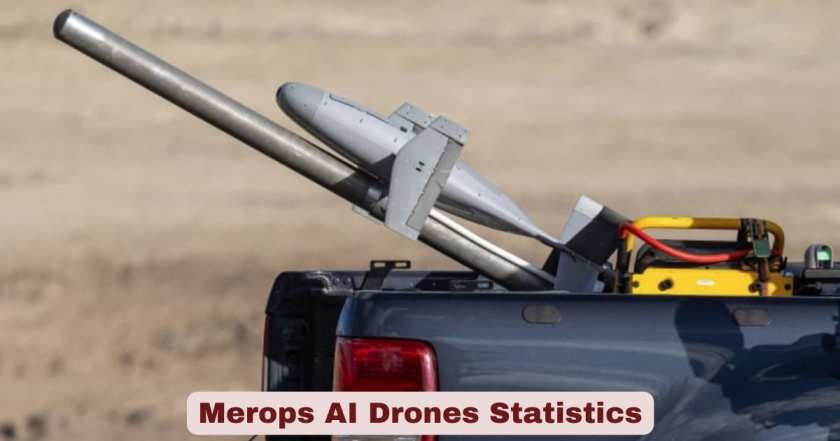
What is the Merops AI Drone System?
The Merops AI drone system is one of the most consequential counter-drone technologies to emerge from the modern era of warfare — a compact, AI-powered interceptor built by a Silicon Valley-backed defence startup and battle-proven across two active conflict zones on opposite sides of the world within the space of two years. Developed by Project Eagle, a California-based defence venture funded by Eric Schmidt, the former CEO and Executive Chairman of Google, the Merops system was designed from its inception to solve one of the most urgent and economically destabilising problems in contemporary military operations: the catastrophic cost asymmetry between cheap enemy attack drones and the expensive missile systems currently used to destroy them. When a Russian Shahed-136 loitering munition costing between $20,000 and $30,000 can force a defending army to fire a Patriot missile worth $3 million or more to intercept it, the attacker wins the financial war even when losing the physical engagement. Merops was built to break that equation — launching a $14,000–$15,000 AI-guided interceptor drone against the incoming threat, turning drone warfare’s cost advantage on its head and forcing the attacker to spend more than the defender for the first time. The system’s interceptor drone is called “Surveyor” — a three-foot, fixed-wing, propeller-driven aircraft capable of reaching speeds exceeding 175 mph (282 km/h) — and it was named after the bee-eater bird genus Merops, known in ornithology for its agile, acrobatic aerial hunting of insects in flight. It is an apt metaphor for what the technology does.
As of March 14, 2026, Merops has been deployed in three distinct conflict environments across two continents — Ukraine against Russian Shaheds, NATO’s eastern flank (Poland, Romania) against Russian drone incursions into alliance airspace, and now the Middle East against Iranian ballistic missiles and Shahed drones as part of Operation Epic Fury. The US Army sent 10,000 Merops interceptors to the Middle East within five days of the start of the US-Israel war against Iran on February 28, 2026 — a deployment speed that itself signals the system’s operational readiness. By November 2025, Merops had already destroyed more than 1,900 Russian drones in Ukraine, accounting for approximately 40% of all Shaheds downed by Ukrainian forces — a combat record that the 10th Army Air and Missile Defense Command’s Brigadier General Curtis King described as making it “one of the most effective Shahed killers on the planet right now.” The system has also been called by Ukraine’s First Deputy Prime Minister a weapon achieving kill rates as high as 95% in certain engagements. What began as a secretive Silicon Valley moonshot tested quietly in a Menlo Park courtyard in 2024 has, within two years, become a frontline strategic asset in the most dangerous military confrontation since the Cold War.
Interesting Facts About Merops AI Drones 2026
| Fact | Detail |
|---|---|
| Full System Name | Merops Counter-Unmanned Aerial System (C-UAS) |
| Interceptor Drone Name | “Surveyor” — fixed-wing, propeller-driven interceptor |
| Name Origin | Named after the Merops bee-eater bird genus — known for agile aerial hunting |
| Developer / Company | Project Eagle — California-based defence venture |
| Previous Company Name | White Stork (until Forbes exposed it in January 2024; renamed to Project Eagle in February 2024) |
| Funder | Eric Schmidt — former CEO and Executive Chairman of Google; estimated net worth ~$25 billion |
| Headquarters | Menlo Park, California (tested at Hillspire, Schmidt’s 25,000 sq ft family office complex) |
| Also Known As | Associated companies in corporate structure: Merops LLC, Aurelian Industries, Swift Beat, Volya Robotics |
| Merops LLC Incorporated By | Jared Vander Lind (former SpaceX engineer) and a second former SpaceX engineer — 2023 |
| Key Hire: Will Roper | Former US Air Force acquisition chief and Pentagon innovation head — joined Project Eagle |
| Key Hire: Mark Stonich | Former VP sourcing & supply chain at Google — heads operations at Project Eagle |
| Team Background | Employees poached from Apple, SpaceX, Google, Schmidt Futures — at least a dozen by mid-2024 |
| Eric Schmidt’s Ukraine Visits | Made multiple personal visits to the front lines in Ukraine; praised by Ukrainian Digital Minister Mykhailo Fedorov as “bold and heroic” |
| First Ukraine Test Site | Hillspire HQ, Menlo Park (courtyard tests, 2024) and simultaneously Ukraine frontlines, 2024 |
| Category | Counter-Unmanned Aerial System (C-UAS) — drone-on-drone interception |
| Primary Target | Iranian-designed Shahed-136 loitering munitions (used by Russia in Ukraine and Iran in Middle East) |
| Transport / Platform | Entire system fits in the bed of a standard midsize pickup truck (e.g., Ford Ranger — used in Nowa Deba demo) |
| System Classification | “Shoot and scoot” — highly mobile; designed for rapid repositioning |
| Crew Required | 4 personnel: commander, pilot, 2 technicians |
| Operator Training Time | 2 weeks — designed specifically for minimal training requirement |
| NATO Designation (Poland) | AS-3 MEROPS (Polish Armed Forces designation) |
| NATO Eastern Sentry | Merops is a key capability within NATO’s Operation Eastern Sentry (launched September 2025 after Russian drone incursions into Polish airspace) |
| NATO “Drone Wall” Initiative | EU officials discussing a “drone wall” framework for Europe’s eastern border — Merops is featured in this initiative |
| Eric Schmidt’s Co-Author on Warfare | Co-authored an article in Foreign Affairs with former Chairman of the Joint Chiefs Gen. Mark Milley, warning America is “unprepared” for drone warfare |
| Eric Schmidt’s WSJ Op-Ed | Co-authored with Will Roper: described “ruthless swarms of AI-empowered” drones remaking warfare — warned of a “Dr. Strangelove situation” with fully autonomous lethal weapons |
Source: Wikipedia (Merops weapon, updated March 14, 2026), Forbes (June 6, 2024), Ukrainska Pravda (July 23, 2025), Stars and Stripes (November 18, 2025), Defence Blog (March 13, 2026), NATO official video (December 9, 2025), Bloomberg (March 13, 2026), Medium/Haye Kesteloo (January 6, 2026), UAS Vision, Notes from Poland (November 7, 2025), Grey Dynamics
The origin story of Project Eagle / Merops is one of the most remarkable in modern defence technology: a secretive initiative funded by a Silicon Valley billionaire that was deliberately hidden from public view behind a constellation of obscurely named LLCs, tested quietly in the courtyard of a Menlo Park office building between a row of houses and a Caltrain station, and simultaneously battle-tested on the most active drone-warfare front on earth before any military procurement bureaucracy had even reviewed it. The sequence of names — D3 accelerator → White Stork → Project Eagle → Merops — reflects Eric Schmidt’s approach to defence technology: move at Silicon Valley speed, avoid the Pentagon procurement cycle, and iterate on real battlefield data rather than laboratory models. When Forbes broke the story of White Stork in January 2024, the company quietly renamed itself Project Eagle within weeks and accelerated development. The fact that Ukraine’s Digital Transformation Minister called Schmidt “bold and heroic” for visiting the front lines personally — and that Schmidt reportedly watched Ukrainian drone operators use Google Meet (a product he created) to coordinate strikes — captures the deeply personal nature of his involvement in this space.
The team composition Schmidt assembled for Project Eagle is itself a statement of intent. Hiring Will Roper, the former US Air Force acquisition chief who built the Air Force’s Agility Prime drone programme, signalled that this was not a hobbyist’s project but a serious institutional effort with deep knowledge of Pentagon procurement and military requirements. Pairing Roper with engineers from SpaceX, Apple, Google, and Schmidt Futures created an unusual hybrid of aerospace hardware expertise and consumer technology AI talent — exactly the combination needed to build an interceptor that is simultaneously rugged enough for battlefield conditions and sophisticated enough to run real-time AI target recognition under GPS and communications jamming. The two-week training timeline was a deliberate design constraint, not an afterthought: in a battlefield environment where units rotate constantly, any capability requiring months of specialist training is operationally useless. Merops was engineered from day one for the soldier who has never seen it before.
Merops Surveyor Interceptor Technical Specifications 2026
| Specification | Data |
|---|---|
| Interceptor Type | Fixed-wing, propeller-driven drone (not a quadcopter) |
| Length | 3 feet (~0.9 metres) |
| Configuration | Small, sleek airframe — designed for high-speed aerodynamic performance |
| Maximum Speed | Over 175 mph (282 km/h) — exceeds 150 mph confirmed at Nowa Deba demo |
| Operational Interception Range | 5 to 20 kilometres from launch point |
| Warhead / Payload | 2 kg fragmentation warhead — detonates on direct impact or proximity; or can ram target directly without warhead |
| Alternative to Warhead | Can operate as kinetic ram — physically collides with target drone to destroy it |
| Parachute Recovery | If it misses its target, deploys a parachute to return to earth for reuse — reduces per-engagement cost |
| Unit Cost (current procurement) | $14,000–$15,000 USD per interceptor |
| Unit Cost (bulk order projection) | $3,000–$5,000 USD per interceptor — confirmed by US Army Secretary Dan Driscoll (Bloomberg, March 13, 2026) |
| Cost vs Shahed-136 (target) | Merops: ~$14,500 vs Shahed: ~$20,000–$30,000 — Merops is cheaper than the threat it destroys |
| Cost vs Patriot missile | Merops: ~$14,500 vs Patriot interceptor: $3 million+ — Merops is ~200× cheaper |
| Cost vs THAAD interceptor | Merops: ~$14,500 vs THAAD: $4 million+ — Merops is ~275× cheaper |
| Flight Control (normal) | Human operator guides drone toward threat zone — “human in the loop” initial guidance |
| Terminal Guidance Mode | Once target acquired visually, transitions to fully autonomous AI terminal homing |
| AI Guidance Sensors | Electro-optical (EO/IR cameras), thermal imaging, radio-frequency sensors, radar |
| Jamming Resistance | Terminal phase uses AI machine vision only — no GPS or external radio links required; immune to GPS jamming and electronic warfare |
| Target Identification | AI algorithms filter noise, identify drone signature, and execute intercept even in contested electromagnetic spectrum environments |
| Integration Capability | Can receive targeting data from external radar systems — demonstrated interoperability with Italy’s RPS-42 radar at Nowa Deba |
| Data Pass | Sensors pass targeting data to the Surveyor or to other friendly C2 systems — net-centric design |
| Max Kill Rate Reported | Up to 95% — stated by Ukraine’s First Deputy Prime Minister Mykhailo Fedorov |
Source: Wikipedia (Merops weapon, March 14, 2026), Stars and Stripes (November 18, 2025), NATO official video (December 9, 2025), RAGE X technical specifications (March 14, 2026), EurAsian Times (March 14, 2026), Bloomberg (March 13, 2026), Ukrainska Pravda (March 13, 2026), Medium/Haye Kesteloo (January 6, 2026), Grey Dynamics, Defence One (November 25, 2025)
The technical specification statistics for the Surveyor interceptor reveal an engineering philosophy that deliberately inverts the assumptions of conventional air defence. Traditional air defence systems — Patriot, THAAD, Iron Dome — are designed around the threat model of high-speed ballistic missiles and cruise missiles: fast, high-altitude, radar-trackable threats where the premium is on precision and reliability, not cost. Against this threat profile, spending $3 million to $4 million per intercept is defensible because the incoming missile itself costs hundreds of millions of dollars to launch and the assets it protects are irreplaceable. Against a $25,000 Shahed drone flying at 120 mph at low altitude, the same calculus produces absurdity — the defender bankrupts themselves while the attacker manufactures more drones on assembly lines. The 3-foot fixed-wing design of the Surveyor, rather than the more intuitive quadcopter configuration, was a deliberate aerodynamic choice: a fixed-wing airframe at 175+ mph can chase down, overtake, and intercept both slow propeller-driven Shaheds and certain faster threats, while quadcopters top out at speeds that could not close on many targets.
The parachute recovery feature — allowing a Surveyor that misses its target to deploy a parachute, descend safely, and be recovered for reuse — is a small engineering detail with large economic consequences. In training environments like Nowa Deba, Poland, every interceptor used in a demonstration can be recovered, refurbished, and relaunched, dramatically reducing the cost of operator training. In combat, the recovery feature provides a secondary economic benefit: a miss does not automatically mean a lost asset. The 2 kg fragmentation warhead — delivering lethal shrapnel in a radius sufficient to destroy a Shahed-class drone’s avionics and airframe on impact or close proximity — was sized specifically for the Shahed threat profile rather than over-engineered for larger targets. This size-and-cost optimisation reflects Project Eagle’s core philosophy: build the minimum capability needed to solve the actual problem at hand, at the minimum cost, rather than building a general-purpose system that is more expensive than the threats it faces.
Merops Ukraine Combat Performance Statistics 2026
| Metric | Data |
|---|---|
| First Deployment in Ukraine | ~June 2024 (classified; confirmed by Jane’s, November 25, 2025) |
| Duration of Ukraine Service (as of Nov 2025) | Over 18 months — combat-proven before NATO allies received it |
| Total Russian Drones Destroyed in Ukraine (Nov 2025) | Over 1,900 incoming Russian drones — confirmed by US Army officials |
| Share of All Shaheds Downed (Ukraine) | ~40% of all downed Shaheds — confirmed by Brig. Gen. Curtis King (10th AAMDC) |
| Losses Inflicted on Russia (USD) | Over $200 million in destroyed Russian drones |
| Value of Interceptors Used | Approximately $15 million worth of Merops interceptors |
| Cost-Exchange Ratio | Russia lost $200M for every $15M of Merops deployed — 13:1 kill-value ratio |
| Max Hit Rate Claimed | Up to 95% — stated by Ukraine’s First Deputy PM Mykhailo Fedorov |
| Primary Target in Ukraine | Shahed-136 loitering munitions (Iranian-designed; Russian-built/supplied) |
| Also Targeted | Geran-2 drones (Russian designation for Shahed-136 domestic production variant) |
| Brig. Gen. Curtis King Quote | “One of the most effective Shahed killers on the planet right now” |
| Ukraine’s Additional AI Tools (same programme) | Bumblebee quadcopter (Perennial Autonomy) — explosive quadcopter; 70%+ direct hit rate; 1,000+ combat flights by spring 2025 |
| Bumblebee vs Armoured Vehicle | Two Bumblebees destroyed a Russian armoured vehicle covered with anti-drone protective measures in April 2025 |
| Bumblebee Contract (US Army, Jan 2026) | $5.2 million — procured via Joint Interagency Task Force 401 |
| Complementary US System | Coyote interceptor (RTX Corp) — also deployed to CENTCOM alongside Merops in March 2026 |
| Drone Radar Detection Challenge | Drones are hard to detect on radar calibrated for missiles — can be mistaken for birds or planes; Merops EO/IR sensors solve this |
| Ukrainian Anti-Jamming Testimony | Russian soldiers outside Kupiansk and Kharkiv reported Bumblebees (same programme) “seemed impervious to jamming” — the only sure way to stop them was to shoot them down |
| Lessons for Middle East | The same Shahed-136 drone Iran used to attack US forces in the Middle East is the same drone Merops was combat-designed and proven against in Ukraine |
Source: Wikipedia (Merops weapon, March 14, 2026), Stars and Stripes (November 18, 2025), NATO official video (December 9, 2025), EurAsian Times (March 14, 2026), Bloomberg (March 13, 2026), Medium/Haye Kesteloo (January 6, 2026), Jane’s (November 25, 2025, via Wikipedia citation), Ukrainska Pravda (July 23, 2025 and March 13, 2026), ABC30 (March 13, 2026)
The Ukraine combat performance statistics for Merops represent something rare in modern defence procurement: a system that was not only fielded in a live war zone before being formally sold to allied governments, but one that accumulated a verified kill record of over 1,900 drones — representing a total destruction value of over $200 million — while the interceptors themselves cost only $15 million in aggregate. That 13:1 kill-value ratio is the metric that drove Poland, Romania, Denmark, and ultimately the US Army’s Middle East deployment decision. When Brig. Gen. Curtis King of the 10th Army Air and Missile Defense Command told reporters at Nowa Deba that Merops accounts for ~40% of all downed Shaheds in Ukraine, he was delivering the single most important procurement argument any US defence official has made for a new system in years: not a laboratory test result or a contractor’s performance claim, but a real battlefield statistic derived from 18 months of continuous combat use.
The direct operational relevance to the Iran conflict is the critical bridge between Ukraine and the Middle East. The Shahed-136 that Iran used to attack US military facilities across the Gulf in March 2026 is the same drone — or a close derivative — that Merops was specifically designed to destroy. The design was not adapted from an anti-aircraft system or converted from a surveillance drone; it was engineered from the ground up, tested against live Shaheds in Ukraine, refined based on those results, and then immediately deployed against the same threat in a new theatre. This intelligence feedback loop — from Ukrainian drone operators to Schmidt’s engineers to new software versions to more effective interceptions — is exactly the model that Defence Secretary Hegseth referenced when he told reporters the US had “ensured that the maximum possible defense and maximum possible force protection was set up before we went on offense.” The 10,000 Merops interceptors sent to the Middle East within five days of the conflict’s start were not improvised — they were a pre-positioned asset waiting for the order to move.
Merops NATO Deployment Statistics 2026
| Metric | Data |
|---|---|
| NATO Mission Context | Operation Eastern Sentry — launched following September 2025 Russian drone incursions into Poland/Romania |
| Russian Drone Incursions Triggering Deployment | ~20 Russian drones entered Polish airspace on night of September 9–10, 2025 alone |
| Polish Airspace Violations | Multiple incursions; Polish/NATO jets scrambled; expensive jets + missiles used to shoot down cheap drones |
| Romania Airspace Violation | Russian drone incursion into Romanian airspace days after Polish incident |
| Decision to Purchase | Poland and Romania purchased Merops systems following airspace violations |
| First Poland/Romania Systems Received | November 2025 |
| First Training Exercise | November 18, 2025 — Nowa Deba military training area, southeastern Poland (~100 km from Ukraine border) |
| Countries at Nowa Deba Demo | US, Polish, Romanian soldiers; observed by Italian army officers |
| Polish Military Designation | AS-3 MEROPS |
| US Contribution | Merops deployed to Poland as an “American contribution” to NATO eastern flank security — came via US bases in Germany (not purchased by Poland initially) |
| Poland Longer-Term Plan | Build a national counter-drone network for 2026–2027; ultimately field own domestically built C-UAS systems |
| Romania Operational Status (Jan 2026) | Romania Chief of Defense Gen. Gheorghiță Vlad confirmed system received, crews trained, operational integration “very soon” (January 20, 2026) |
| Denmark | Declared intent to acquire Merops — confirmed by NATO military officials to AP, November 6, 2025 |
| NATO LANDCOM Assessment | Brig. Gen. Thomas Lowin (Deputy Chief of Staff Operations, NATO Allied Land Command): deployment is the “first phase” of a 2–5 year effort to build defences to deter Russian invasion |
| Col. Mark McLellan Quote | “Very accurate detection”; “It’s a lot cheaper than flying an F-35 into the air to take them down with a missile” |
| Brig. Gen. Curtis King Quote (Nowa Deba) | “It’s very lethal, very effective, but the key piece here is that it’s cost effective” |
| Radar Integration Demo | At Nowa Deba: Merops linked with Italian-produced RPS-42 radar — proving interoperability with existing NATO systems |
| NATO “Drone Wall” Framework | EU officials actively discussing drone wall across Europe’s eastern border — Merops featured as key component |
| Train-the-Trainer Model | US soldiers from 1st Battalion, 57th Air Defense Artillery Regiment trained Polish and Romanian crews — who become national training teams |
| Polish Deputy Chief of Staff Quote | Lt. Gen. Stanislaw Czosnek: “The airspace violation we witnessed recently forced us to accelerate” |
| France | French aircraft carrier now in region; reports of Iraqi militia threats following arrival |
| Global Expansion Signal | US Army also studying Indo-Pacific deployment — Defense One confirmed Army taking counter-drone experimentation to INDOPACOM following European success |
Source: Stars and Stripes (November 18, 2025), NATO official video (December 9, 2025), Notes from Poland (November 7, 2025), UNITED24 Media (November 6, 2025 and January 22, 2026), Defence Blog (March 13, 2026), Army Recognition (November 2025), Grey Dynamics, Defence One (November 25, 2025), AP (November 6, 2025)
The NATO deployment statistics tell a story of crisis-driven adoption at a speed that the traditional alliance procurement process would never normally allow. The trigger — 20 Russian drones entering Polish airspace in a single night on September 9–10, 2025, followed days later by a Romanian airspace incursion — created a political and military urgency that compressed what would normally be a multi-year capability gap assessment, RFP, evaluation, and contract process into a matter of weeks. The fact that Merops arrived in Poland not through a formal Polish government procurement but as an “American contribution” routed via US bases in Germany is a measure of how seriously Washington treated the escalation risk: the US Army essentially loaned the systems to Poland to plug an immediate gap rather than waiting for Warszawa to complete its own acquisition cycle. Poland’s longer-term plan to develop a national counter-drone network for 2026–2027 and ultimately build its own domestic C-UAS systems reflects a commitment to not remaining permanently dependent on borrowed American hardware — but the short-term dependency was accepted without hesitation.
The Nowa Deba demonstration on November 18, 2025 — with US, Polish, Romanian, and Italian military observers watching a Surveyor interceptor shot from the bed of a pickup truck, close in on a target drone, and deploy its parachute for recovery — represents a public unveiling that Eric Schmidt’s team had specifically sought to avoid during the system’s first 18 months of classified Ukraine combat service. The demonstration was deliberately designed to signal to Russia that NATO’s eastern flank now has a cost-effective, mobile, AI-enabled counter-drone capability deployed in depth. Col. Mark McLellan’s comparison — “a lot cheaper than flying an F-35 into the air to take them down with a missile” — condenses years of alliance debate about drone defence economics into a single sentence. The train-the-trainer model adopted at Nowa Deba, where US instructors from the 1st Battalion, 57th Air Defense Artillery Regiment qualified Polish and Romanian crews who will then train others, is the fastest possible way to distribute a new capability across multiple allied militaries — and reflects the urgency with which both NATO and Project Eagle view the proliferation of this technology across the alliance.
Merops Middle East Deployment & Iran War Statistics 2026
| Metric | Data |
|---|---|
| Operation Name | Operation Epic Fury — US-Israel war against Iran, commenced February 28, 2026 |
| Deployment Decision Date | March 6, 2026 — US officials told AP system would be sent to Middle East |
| Actual Deployment Date | Within 5 days of February 28, 2026 — confirmed by US Army Secretary Dan Driscoll (Bloomberg, March 13, 2026) |
| Number of Drones Deployed | 10,000 Merops interceptors |
| Authorising Official | US Army Secretary Dan Driscoll — confirmed deployment in Bloomberg interview |
| Receiving Command | US Central Command (CENTCOM) |
| Deployment Context | Counter-drone response to Iran’s use of Shaheds against US/allied forces and infrastructure across the Gulf |
| Iranian Threat Being Countered | Shahed-136 loitering munitions — the same drone Merops was designed to destroy in Ukraine |
| Shahed Cost vs Merops Cost | Shahed: $20,000–$30,000 vs Merops: $14,000–$15,000 — Merops cheaper than the threat |
| Driscoll Quote on Cost Curve | “We’re actually on the better end of the cost curve there. So each time Iran launches one that we are able to take down, they are losing a meaningful amount of money.” |
| Complementary Systems Deployed | Coyote interceptor (RTX Corp); Bumblebee quadcopter (Perennial Autonomy; $5.2M US Army contract, Jan 2026) |
| Bumblebee Contract Vehicle | Joint Interagency Task Force 401 — newly created Pentagon body to fast-track C-UAS acquisition |
| Alternative Missile Cost (Patriot) | $3 million per intercept — what US was spending before Merops |
| Alternative Missile Cost (THAAD) | $4 million per intercept |
| Pentagon Admission | Officials conceded in closed-door congressional briefings they were “struggling to stop waves of drones” — Fortune (March 7, 2026) |
| Hegseth Statement | “We ensured that maximum possible defense and maximum possible force protection was set up before we went on offense” |
| Gulf State Complaints | Persian Gulf countries complained they were “not given adequate time to prepare” for Iranian drone swarms |
| Ukraine-Middle East Link | Zelenskyy offered Ukraine’s help in counter-drone operations; Trump told Fox News Radio: “No, we don’t need their help on drone defense” |
| AUVSI President Quote | Michael Robbins: “Our forces can defend bases and populations without spending a million dollars to stop a $50,000 threat” |
| Reduced Failure Rate Projection | Merops’ AI reduces interception failure rate from estimated 10–20% (missile systems) to near zero — EurAsian Times analysis |
| Kill Web Integration | Merops can be paired with F-35 radars for early warning — creating a “kill web” that minimises collateral damage |
| Iran Drone Production Context | Iran manufactures Shaheds domestically and supplied them to Russia; same supply chain now being used against US forces |
| Driscoll Quote on Strategy | With 10,000 Merops: “The cost-effective approach means we can sustain this at scale without depleting expensive missile inventory” |
Source: Bloomberg (March 13, 2026), Fortune (March 7, 2026), EurAsian Times (March 14, 2026), Ukrainska Pravda (March 13, 2026), ABC30 (March 13, 2026), Kurdistan 24 (March 13, 2026), Wikipedia (March 14, 2026), News-Pravda.com (March 13, 2026)
The Middle East deployment statistics for Merops represent the most direct confirmation yet that the age of drone-on-drone warfare has arrived as the dominant tactical paradigm in major-power conflict. The deployment of 10,000 interceptors — at a total procurement cost of roughly $140 million to $150 million at current prices — within five days of conflict initiation is a logistical feat that would have been impossible without the pre-positioning and production scale that Project Eagle had been building since 2024. For comparison: 10,000 Patriot interceptors at $3 million each would cost $30 billion — an amount that exceeds the entire US Army procurement budget for several years. The Pentagon’s closed-door admission to congressional briefers that they were “struggling to stop waves of drones” before Merops arrived captures how dramatically the threat environment had outpaced the existing missile-centric air defence paradigm. Merops was not a nice-to-have — it was an emergency solution to a capability gap that was actively costing the US military tactical defeats in real time.
The strategic context created by the 2026 Iran war will define Merops’ legacy beyond any single deployment. The combination of Iran’s industrial Shahed production capacity, its supply relationships with Russia, Hezbollah, Houthi forces, and other proxies, and the global proliferation of cheap drone technology to non-state actors means that what the US Army is learning from Merops operations in the Persian Gulf in March 2026 will directly shape counter-drone doctrine, procurement, and international arms sales for the next decade. The AUVSI president’s formulation — “our forces can defend bases and populations without spending a million dollars to stop a $50,000 threat” — is not just a cost argument; it is the doctrinal statement of a new era. When the history of the 2026 Iran conflict is written, Merops — a three-foot drone built by a Silicon Valley billionaire’s startup and tested quietly in a Menlo Park courtyard — may stand as one of its most consequential technological actors.
Disclaimer: The data research report we present here is based on information found from various sources. We are not liable for any financial loss, errors, or damages of any kind that may result from the use of the information herein. We acknowledge that though we try to report accurately, we cannot verify the absolute facts of everything that has been represented.