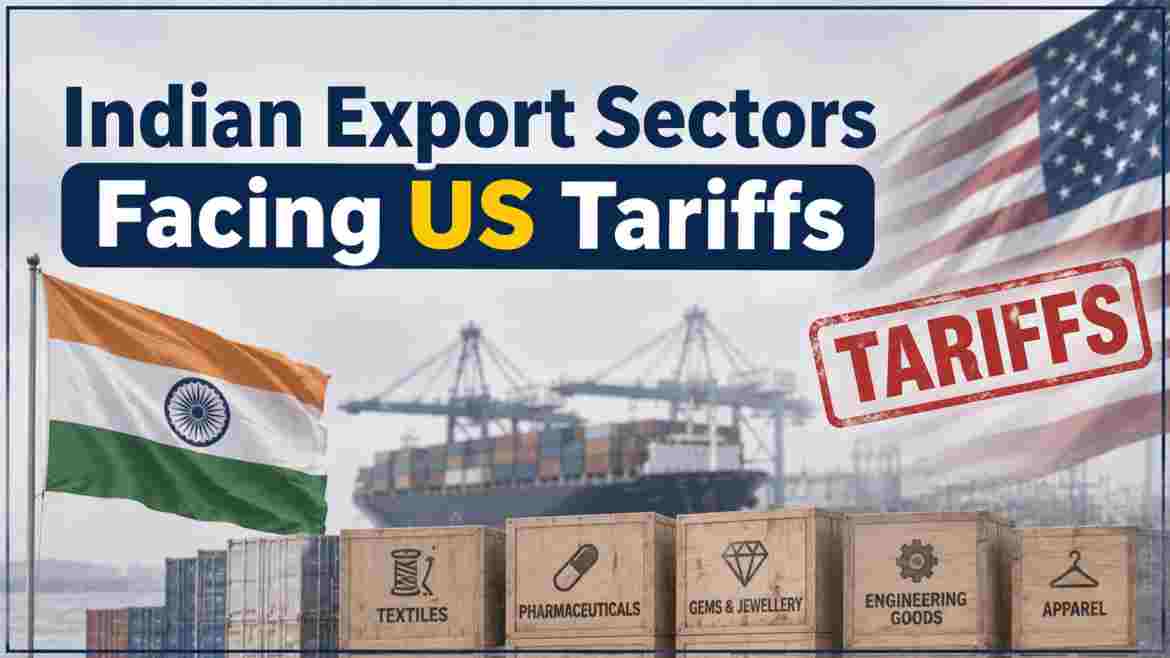
Indian Export Sectors Facing US Tariffs – Key Statistics & Quick Answer
Indian export sectors facing US tariffs now confront a proposed duty of up to 25%, announced by the US Trade Representative on November 25, 2026. A 17% rate applies only if India signs a trade deal. Most Indian goods already pay a 10% Section 301 duty, while about 45% of exports sit outside it.
- Proposed duty: up to 25% on all Indian goods, net of existing Section 301 tariffs (not final)
- Trade-deal rate: 17% if India concludes a responsive agreement
- Extra duty in force: 10% since July 24, 2026
- India’s goods exports to the US: $87.31 billion in FY2025-26, up 0.9%
- Deadlines: comments due January 5, 2027; hearings start January 25, 2027
Indian export sectors facing US tariffs are living through their third tariff regime in under two years. Electronics, engineering goods, pharmaceuticals, gems and jewellery, garments, chemicals and seafood all ship to the American market, and the US treats each one differently. Some sit behind exemptions. Others carry the full duty.
The newest proposal sets a 25% ceiling on Indian goods and offers 17% as a reward for a signed trade deal. It is not law yet. Exporters are now working out which US tariffs on Indian products by sector will bite, which Indian exports affected by US tariffs 2026 will escape, and what the impact of US tariffs on Indian exporters has been so far.
Interesting Facts About Indian Export Sectors Facing US Tariffs 2026
Rate on Indian goods (extra duty, %)
Current duty (Jul 24, 2026)  █████ 10%
Trade-deal rate (proposed)   ████████ 17%
Proposed ceiling (Nov 25)    ████████████ 25%
Table 1: Indian Export Sectors Facing US Tariffs 2026 – Key Facts
| Metric | Figure | Period / Status |
|---|---|---|
| Proposed US duty on Indian goods | Up to 25% | Proposed Nov 25, 2026 |
| Rate if India signs a deal | 17% | Conditional |
| Extra duty in force today | 10% | Since Jul 24, 2026 |
| Exports outside the 10% duty | About 45% | Ministry estimate, Jul 2026 |
| India’s goods exports to US | $87.31 billion | FY2025-26 |
| US goods imports from India | $103.8 billion | Calendar 2025 |
| Smartphone exports to US | $19.7 billion | FY2025-26 |
| Gems and jewellery exports to US | $5.09 billion, down 44.92% | FY2025-26 |
| Economies in the USTR proposal | 14 | Nov 25, 2026 |
Source: Office of the US Trade Representative, Ministry of Commerce and Industry, ICRIER, Gem and Jewellery Export Promotion Council
The table shows a split picture. The 10% duty already in force reaches roughly 55% of what India ships to the US, while about 45% is exempt, mainly because steel, aluminium, auto parts, smartphones and generic medicines sit outside it. The new 25% ceiling would be applied net of that existing duty, so it should not be read as a simple add-on.
Scale matters too. India shipped $87.31 billion of goods to the US in FY2025-26, about 20% of all its merchandise exports. Growth was overwhelmingly concentrated in smartphones at $19.7 billion, which is why headline export numbers look calmer than the labour-intensive sectors feel.
What Tariffs Do Indian Export Sectors Facing US Tariffs Pay in 2026?
Most Indian goods pay the normal US customs duty plus a 10% Section 301 duty. Steel, aluminium, autos and parts pay Section 232 rates instead, while smartphones and many medicines pay no extra duty.
Extra duty on most Indian goods (1 block = 2%)
Aug 27, 2025 - Feb 6, 2026  █████████████████████████ 50%
Feb 24 - Jul 23, 2026       █████ 10%
Jul 24, 2026 - today        █████ 10%
Proposed ceiling            ████████████ 25%
Table 2: US Tariff Timeline for Indian Export Sectors
| Date | Measure | Rate on India | Status |
|---|---|---|---|
| Apr 2, 2025 | Reciprocal tariff announced | 26% | Suspended Apr 9 |
| Aug 7, 2025 | Emergency-law reciprocal tariff | 25% | Ended Feb 20, 2026 |
| Aug 27, 2025 | Russian-oil penalty added | 50% total | Removed Feb 7, 2026 |
| Feb 24, 2026 | Section 122 global duty | 10% | Expired Jul 24 |
| Jul 24, 2026 | Section 301 forced-labor action | 10% | In force |
| Nov 25, 2026 | Section 301 excess-capacity proposal | Up to 25% / 17% | Proposed |
Source: Business Standard, Multibagg, Office of the US Trade Representative
The February 2026 deal promised an 18% rate and removal of the extra 25% Russian-oil duty, which was lifted on February 7. But the 18% never took effect. On February 20, the Supreme Court ruled the emergency-powers law could not support those tariffs, and Washington moved to a 10% global duty under Section 122, then a 10% India-specific Section 301 duty.
Two other threats stay in the background. A law signed on September 18, 2026 allows duties of up to 100% on buyers of Russian energy, but the President waived it on October 16. The Section 232 duties, such as 25% on many auto parts, run separately from all of this. For the 2025 background, see our report on US tariffs on India statistics.
How Much Do Indian Exports to the US Add Up To?
India shipped $87.31 billion of goods to the US in FY2025-26, up from $86.51 billion a year earlier. US records show $103.8 billion of goods imports from India in calendar 2025.
Goods trade with the US ($ billion, 1 block = $4B)
India data FY2024-25   ██████████████████████ 86.51
India data FY2025-26   ██████████████████████ 87.31
US data 2025 imports   ██████████████████████████ 103.8
Table 3: Indian Exports to the US – India and US Data
| Indicator | Figure | Basis |
|---|---|---|
| India’s exports to US, FY2024-25 | $86.51 billion | Indian fiscal year |
| India’s exports to US, FY2025-26 | $87.31 billion (+0.9%) | Indian fiscal year |
| Share of India’s merchandise exports | About 20% | FY2025-26 |
| US goods imports from India | $103.8 billion (+18.9%) | Calendar 2025 |
| US goods exports to India | $45.4 billion | Calendar 2025 |
| US goods deficit with India | $58.4 billion (+27.8%) | Calendar 2025 |
Source: Ministry of Commerce and Industry, KPMG and AMCHAM, Office of the US Trade Representative
The Indian and American numbers do not match, and they are not meant to. India reports on an April-March fiscal year, the US reports on a calendar year, and the two governments record shipments differently.
On either measure, the US is India’s largest goods market. US-recorded imports from India rose 18.9% in 2025, helped by front-loaded shipments. India’s own data show growth of only 0.9% in FY2026, a year that included months under a 50% duty.
[Chart/Infographic Idea: Horizontal bar chart of FY2025-26 Indian exports to the US by sector | Alt Text: US tariffs on Indian products by sector with electronics, engineering goods and pharmaceuticals leading]
Which Indian Export Sectors Face the Biggest US Tariff Exposure?
Electronics, engineering goods and pharmaceuticals lead India’s US exports, but exposure runs the other way. Garments, jewellery and seafood carry the most risk because few of their products appear in the exemption lists.
FY2025-26 exports to US ($ billion, 1 block = $1B)
Electronic goods     ████████████████████████ 24.41
Engineering goods    ███████████████████ 19.61
Drugs & pharma       █████████ 9.47
Gems & jewellery     █████ 5.08
Readymade garments   █████ 4.83
Chemicals            ████ 4.00
Seafood              ██ 2.32
Table 4: US Tariffs on Indian Products by Sector
| Sector | Exports to US | Proposed treatment |
|---|---|---|
| Electronic goods | $24.41 billion | Smartphones (code 8517.13.00) exempt |
| Engineering goods | $19.61 billion | Section 232 steel, aluminium, copper, auto parts excluded; other lines exposed |
| Drugs and pharma | $9.47 billion | Patented drugs excluded; many pharma lines in annex |
| Gems and jewellery | $5.08 billion | Precious metals in annex; finished-jewellery lines unconfirmed |
| Readymade garments | $4.83 billion | Mostly in scope; worn clothing exempt |
| Chemicals | $4.00 billion | In scope unless listed in annex |
| Seafood (provisional) | $2.32 billion | No exemption found in sources reviewed |
Source: India Brand Equity Foundation, Marine Products Export Development Authority, Holland & Knight, Nation Press
Electronics is now India’s biggest line into the US, and 50.9% of all Indian electronics exports go there. Pharmaceuticals matter just as much: the US takes 30.41% of India’s pharma exports. Both lean on exemptions, so the headline 25% ceiling touches them less than the table’s size suggests.
Garments, gems and seafood are the exposed ones. The US takes 32% to 33% of India’s apparel exports, and most new fabrics and garments are not in the exemption annex. The USTR notice names India’s pharmaceuticals and medical devices, steel, solar and ICT as the sectors behind its excess-capacity finding, which India rejects.
Which Indian Goods Are Exempt From the Proposed US Tariff?
Smartphones, goods already under Section 232 duties, many pharmaceutical products, books, donations and certain raw materials are exempt. Most new garments and fabrics are not.
Smartphones          [EXEMPT]
Patented pharma      [EXEMPT]
Steel / aluminium    [EXEMPT - Section 232 rates apply]
Auto parts (232)     [EXEMPT - 25% Section 232 rate]
New garments         [IN SCOPE]
Table 5: India US Tariff Exemptions 2026
| Category | What it covers | Status |
|---|---|---|
| Section 232 goods | Steel, aluminium, copper, vehicles and parts, wood, patented drugs, semiconductors | Excluded |
| Annex products | Raw materials, goods the US cannot make in volume | Excluded |
| Smartphones | Tariff code 8517.13.00 | Excluded |
| Pharmaceuticals | Medicines in measured doses or retail packs | Excluded |
| Other | Books, donations, baggage, iron ore agglomerates, worn clothing | Excluded |
| Textiles and apparel | Most new fabrics and garments | In scope; volume-based lower rate under comment |
Source: Nation Press, Holland & Knight, Business Standard
The exemption logic is the same in 13 of the 14 notices. Goods already hit by Section 232 duties are carved out, along with books, donations, accompanied baggage and certain iron ores. A separate annex lists raw materials and products the US cannot easily produce. The India notice uses a single product list with no country-specific additions.
Exemption is not the same as zero tariff. Steel, aluminium and auto parts keep paying Section 232 rates, and ACMA says nearly half of India’s auto-parts exports to the US fall under the 25% rate. Many machinery and plastics lines are exempt only for civil aircraft or pharmaceutical use. Check the tariff code before assuming relief.
[Chart/Infographic Idea: Decision tree showing which Indian exports are exempt from the proposed US tariff | Alt Text: India US tariff exemptions 2026 for smartphones, pharmaceuticals, steel and auto parts]
How Do Indian Goods Facing the 25% US Tariff Compare With Rivals?
India’s proposed ceiling is the second-highest of 14 economies, behind Vietnam at 35%. Bangladesh, Cambodia, Indonesia, Malaysia and Thailand each face up to 18%.
Proposed ceiling (%, 1 block = 2%)
Vietnam    ██████████████████ 35
India      ████████████ 25
China      ██████████ 20
Singapore  ██████████ 20
Five Asian █████████ 18
EU / Japan ████████ 15
Table 6: Proposed Section 301 Rates by Economy, Nov 25, 2026
| Economy | Proposed ceiling | Alternative |
|---|---|---|
| Vietnam | 35% | 20% with a deal |
| India | 25% | 17% with a deal |
| China | 20% | Up to 40% if talks fail |
| Singapore | 20% | 10% with a deal |
| Bangladesh | 18% | Up to 20% |
| Cambodia, Indonesia, Malaysia, Thailand | 18% | Up to 25% |
| EU, Japan, Switzerland | 15% | Up to 20% |
| Korea, Taiwan | 15% | Up to 25% |
Source: Holland & Knight, Lexology
India’s ceiling sits above the 18% group and below Vietnam. For the EU, Japan, Korea, Switzerland and Taiwan, the 15% is net of normal customs duty as well, so it works as a combined cap.
The 17% deal rate would put India just under the 18% group. That is the logic of the offer. Singapore and Vietnam also get lower deal rates, 10% and 20%, so Washington is pulling the same lever on all three.
What Impact Have US Tariffs Had on Indian Exporters So Far?
Total exports to the US held steady in FY2025-26, but tariff-hit products fell 11.2% while exempt products rose 24.5%. Gems, seafood and apparel took the damage.
Reported change, FY2025-26 (1 block = 2%)
Exclusion-list goods  +24.5% ████████████
All exports to US      +0.9% █
Tariff-hit goods      -11.2% ██████
Seafood (value)       -14.5% ███████
Gems & jewellery      -44.9% ██████████████████████
Table 7: Impact of US Tariffs on Indian Exporters
| Indicator | Figure | Source |
|---|---|---|
| Smartphone exports to US | $10.6 billion to $19.7 billion | ICRIER |
| Gems and jewellery to US | $9.24 billion to $5.09 billion | GJEPC |
| Seafood to US, value | $2.32 billion, down 14.5% | MPEDA |
| Seafood to US, volume | Down 19.8% | MPEDA |
| Apparel to US, Apr-Dec FY26 | Down about 6% | ICRA |
| Exports to China | Up 36.6% to $5.2 billion | ICRIER |
Source: ICRIER, Gem and Jewellery Export Promotion Council, Marine Products Export Development Authority, ICRA
The aggregate hides the damage. Smartphones nearly doubled as China’s share of US smartphone imports dropped from 81% in 2024 to 45.2% in 2025. That single product, which was exempt, masked weakness elsewhere. The UAE overtook the US as the top market for Indian gems and jewellery at $8.70 billion.
Diversification helped some sectors, not all. Frozen shrimp and gold jewellery grew overall as other markets made up the US loss, but unwrought gold and tankers fell by more than the US loss. ICRIER says the China growth only weakly matched the products lost in the US. These figures include months at 50%, so they do not measure today’s 10%.
What Happens Next for Indian Export Sectors Facing US Tariffs?
Written comments are due January 5, 2027, and hearings begin January 25, 2027 in Washington.
Nov 25 --> Dec 14-15 --> Jan 5 --> Jan 25 --> final action (no date)
Table 8: Key Dates for Indian Exporters
| Date | Event |
|---|---|
| Dec 14-15, 2026 | G20 leaders’ summit, Miami |
| Jan 5, 2027 | Comments and hearing requests due |
| Jan 25, 2027 | Public hearings begin, 10 a.m. ET |
| Not announced | Final determination and start date |
Source: Holland & Knight, Nation Press
USTR’s Jamieson Greer said he does not expect any proposed duty to take effect for at least a couple of months, and that after netting out existing tariffs they would add only a few percentage points overall. He gave no India-specific figure, and no start date has been announced.
India says it has no structural excess capacity in any sector and wants the issue settled in bilateral trade talks. Consultations on May 14 failed to close the gap. A senior US official indicated more agreements could be finalized around the G20 summit on December 14-15, so the 17% window may be short.
FAQs on Indian Export Sectors Facing US Tariffs
Which Indian export sectors face US tariffs in 2026?
Most Indian goods pay a 10% Section 301 duty, with exemptions for smartphones, generic medicines and Section 232 goods. A proposed duty of up to 25% would hit garments, textiles, gems, seafood, chemicals and non-exempt engineering goods hardest. The rate is not final. Electronics and pharmaceuticals carry the largest export values but the most exemptions.
What is the proposed US tariff on Indian goods?
USTR proposed up to 25% on all Indian goods on November 25, 2026, net of existing Section 301 tariffs, with exemptions. It would consider 17% if India reaches a responsive trade agreement. No start date exists. Comments close January 5, 2027, and hearings begin January 25, 2027. It is a proposal, not a final tariff.
Which Indian exports are exempt from US tariffs?
Smartphones under code 8517.13.00, steel, aluminium, copper, vehicles and parts already under Section 232, patented drugs, semiconductors, many pharmaceutical products, books, donations and certain iron ores are exempt from the proposal. Most new fabrics and garments are not listed. Check each product’s tariff code in the India annex. Confirm with a customs broker.
How much do Indian exports to the US total?
India reported $87.31 billion in goods exports to the US in FY2025-26, up 0.9% from $86.51 billion. US records show $103.8 billion of goods imports from India in calendar 2025. The figures differ because of fiscal versus calendar years and recording methods, so compare trends instead. Both are official figures.
How can India get the 17% US tariff rate?
The 17% rate applies only if India reaches an Agreement on Reciprocal Trade that addresses USTR’s excess-capacity findings. India denies any structural excess capacity and says concerns belong in its bilateral trade agreement talks. A US official said more deals could be finalized around the December 14-15 G20 summit. No deal has been signed yet.
Disclaimer: The data research report we present here is based on information found from various sources. We are not liable for any financial loss, errors, or damages of any kind that may result from the use of the information herein. We acknowledge that though we try to report accurately, we cannot verify the absolute facts of everything that has been represented.