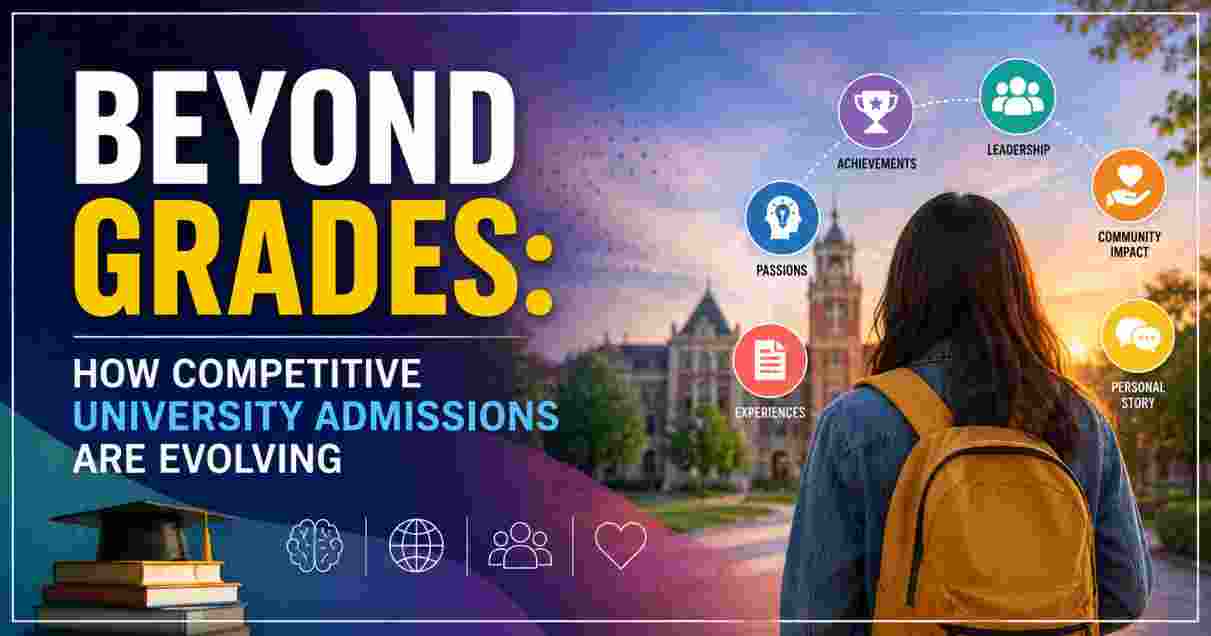
For years, university admissions were seen as a numbers game. Strong grades, high test scores, and a polished application were often viewed as the main route into competitive institutions. While academic achievement still matters, admissions teams are now looking at a much broader picture of who a student is, how they think, and what they could contribute to a university community.
This shift is especially clear at highly selective universities, where many applicants already have excellent academic records. When thousands of students meet or exceed the expected grade profile, admissions teams need other ways to understand potential. As a result, the strongest applications now go beyond results on paper.
Academic Ability Is Still Important
Grades remain a key part of the admissions process because they show whether a student can cope with demanding university-level work. Competitive courses still expect applicants to demonstrate subject knowledge, consistency, and intellectual discipline.
However, grades alone rarely tell the full story. A student may achieve top marks but struggle to explain why they are genuinely interested in their chosen subject. Another may have slightly less conventional academic results but show impressive curiosity, resilience, and independent thought. Modern admissions processes increasingly try to identify these deeper qualities.
Universities Want Evidence of Curiosity
One major change is the growing emphasis on academic curiosity. Admissions teams want to see that students engage with their subject outside the classroom. This could include wider reading, independent research, relevant projects, lectures, competitions, or work experience.
The key is not simply listing activities. Applicants need to show what they learned, how their thinking developed, and why the experience strengthened their interest in the subject. This is where personal statements, interviews, and written work can become powerful tools.
Students applying to especially competitive institutions often benefit from structured guidance. For example, families exploring Oxbridge preparation may turn to William Clarence for support in understanding how to build a more thoughtful, academically focused application.
Skills Matter More Than Ever
Admissions are also evolving to place more value on transferable skills. Critical thinking, communication, problem-solving, independence, and adaptability are increasingly important. Universities want students who can handle challenging material, contribute to discussions, and manage the demands of independent study.
This is particularly relevant as courses become more interdisciplinary and career paths less predictable. A strong applicant is not just someone who can pass exams. They are someone who can ask good questions, respond to feedback, and think creatively when faced with complex ideas.
Context Is Becoming More Significant
Many universities now consider an applicant’s background and educational context more carefully. This does not mean lowering standards. Instead, it means recognizing that opportunity is not evenly distributed. Admissions teams may look at the school environment, personal circumstances, or barriers a student has overcome.
This broader approach helps universities identify potential, not just polish. It can also make the admissions process fairer by acknowledging that achievement looks different depending on the opportunities available.
The Future of Competitive Admissions
The evolution of admissions reflects a wider change in education. Universities are looking for students who are academically capable, personally motivated, and ready to contribute meaningfully to their field.
For applicants, this means preparation should start earlier than filling out forms. Building a strong application involves exploring interests, reflecting on experiences, and learning how to communicate genuine enthusiasm. Grades may open the door, but it is often curiosity, clarity, and potential that help an applicant stand out.