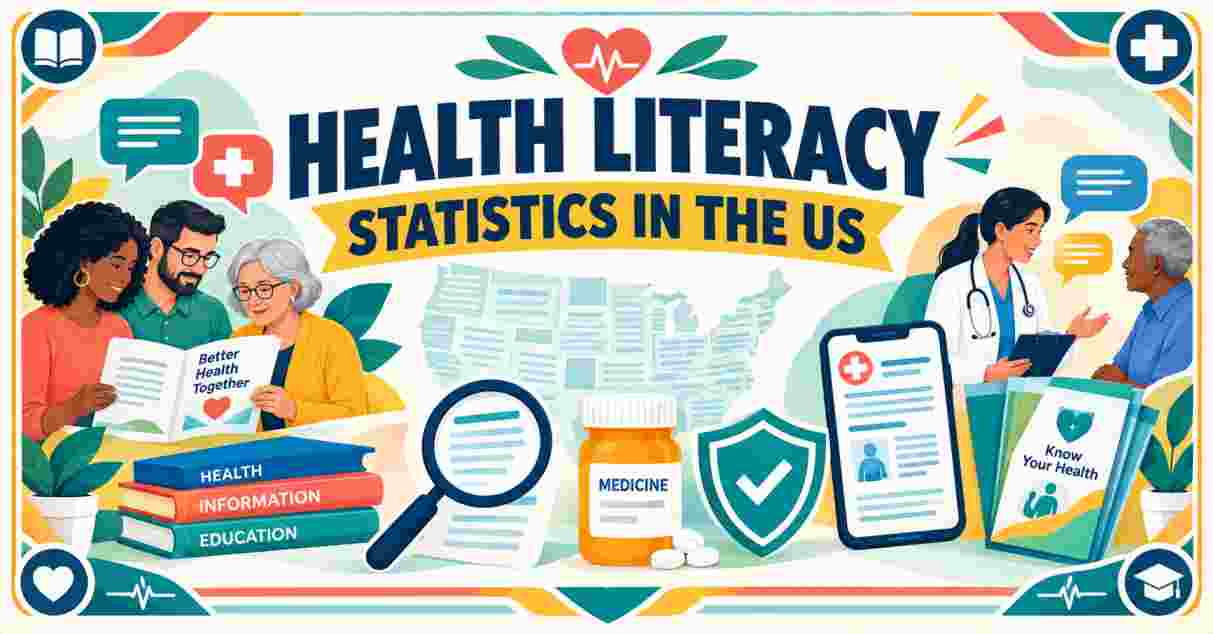
Health Literacy in the US show that only 12% of adults have proficient health literacy, according to the National Assessment of Adult Literacy, the most recent large-scale federal measurement of the skill. More than 77 million adults fall into the basic or below-basic categories, low health literacy costs the economy up to $238 billion annually, and adults over 65 show the lowest proficiency of any age group at just 2%.
Health Literacy in the US 2026
Health Literacy in the US reveal a gap between how healthcare information gets written and how well the average adult can actually use it. The National Assessment of Adult Literacy, still the most comprehensive federal study of this specific skill, found that just 12% of US adults demonstrate proficient health literacy, meaning nearly nine out of ten adults may struggle to fully manage prescription labels, insurance paperwork, appointment scheduling, or basic treatment instructions. The Program for the International Assessment of Adult Competencies later confirmed a nearly identical proficiency rate, showing the skill gap has barely moved over more than a decade of federal tracking.
The consequences of that gap show up everywhere in the healthcare system, from missed appointments to longer hospital stays to billions of dollars in avoidable costs. Health Literacy in the US compiled below break the issue down by proficiency level, race, age, insurance type, and economic impact, using verified federal data and peer-reviewed research rather than estimates. Healthy People 2030, the government’s current national health objective framework, has elevated health literacy to one of its five overarching goals, a sign of how seriously federal health agencies now treat the issue.
Personal health literacy and organizational health literacy now sit side by side in federal policy, a shift that changes where responsibility for the problem lands. Rather than treating low health literacy purely as an individual skill deficit, Healthy People 2030 asks healthcare systems, insurers, and providers to simplify their own materials and communication practices. That reframing matters because it shifts part of the solution toward organizations that can redesign forms and instructions, rather than placing the entire burden on patients to improve their own reading and numeracy skills.
Interesting Facts About Health Literacy in the US 2026
| Fact | Detail |
|---|---|
| Adults With Proficient Health Literacy | 12% |
| Adults With Basic or Below Basic Health Literacy | 77 million |
| Older Adults (65+) With Proficient Health Literacy | 2% |
| Annual Economic Cost of Low Health Literacy | Up to $238 billion |
| Share of Total Healthcare Spending Tied to Low Health Literacy | 7% to 17% |
| Per-Person Annual Cost of Low Health Literacy | $1,434 to $7,798 |
| Hispanic Adults With Basic/Below Basic Health Literacy | 65% |
| Increased Mortality Risk in Elderly With Low Health Literacy | 50% higher |
Source: National Assessment of Adult Literacy, U.S. Department of Education, and peer-reviewed health services research.
The Health Literacy Statistics in the US in this table come from the federal government’s most comprehensive assessment of the topic, a study that intentionally separated general literacy from the more specific ability to read, interpret, and act on health-related information. That distinction matters because someone can read a newspaper comfortably while still misunderstanding a prescription label or a discharge summary, which is exactly the pattern researchers found across the national sample.
The $238 billion economic cost figure represents one of the higher estimates in circulation, and researchers note the true cost likely falls somewhere within the $1,434 to $7,798 per-person range once regional healthcare pricing and insurance status are factored in. Given that roughly a third of the adult population sits in the basic or below-basic categories, even the lower end of that per-person range adds up to a substantial share of total US healthcare spending.
Health Literacy Proficiency Levels in the US 2026
Adult Health Literacy Proficiency Distribution
Proficient      |████████ 12%
Intermediate    |████████████████████████████████████ 53%
Basic           |███████████████ 21%
Below Basic     |██████████ 14%
| Proficiency Level | Share of Adults | Approximate Number |
|---|---|---|
| Proficient | 12% | ~22 million |
| Intermediate | 53% | ~89 million |
| Basic | 21% | ~47 million |
| Below Basic | 14% | ~30 million |
Source: National Assessment of Adult Literacy (NAAL), U.S. Department of Education.
The 53% of adults classified as “intermediate” represent the largest single group and the one most likely to be overlooked in public health messaging. Adults at this level can generally complete moderately challenging tasks, like finding one piece of information in a straightforward document, but they still struggle with materials that combine multiple steps, dense medical terminology, or numerical calculations such as dosage conversions.
At the other end of the scale, the 14% of adults with below-basic health literacy represent roughly 30 million people who may be unable to perform even simple tasks, such as identifying a specific date on an appointment slip or understanding a straightforward pamphlet. Combined with the basic-level group, that puts 35% of the adult population, or 77 million people, at meaningful risk of misunderstanding routine healthcare communication.
Health Literacy Statistics by Race and Ethnicity in the US 2026
Adults With Basic or Below-Basic Health Literacy, by Group
White adults                 |████████████████ 28%
Hispanic adults              |████████████████████████████████████ 65%
Asian adults (proficient)    |████████████████████████ 44%
Hispanic adults (proficient) |██████ 10%
| Group | Statistic |
|---|---|
| White adults with basic/below-basic literacy | 28% |
| Hispanic adults with basic/below-basic literacy | 65% |
| Asian adults reaching proficient level | 44% |
| Hispanic adults reaching proficient level | 10% |
| Every racial/ethnic group represented | Basic or below-basic levels found in all groups |
Source: U.S. Department of Education, National Assessment of Adult Literacy racial and ethnic breakdown.
The gap between 28% and 65% shown in this table represents one of the widest disparities in the entire health literacy dataset. Every racial and ethnic group in the NAAL sample included adults at the basic or below-basic level, but the rate more than doubles between White adults and Hispanic adults, a pattern researchers link to language barriers, unequal access to health education, and differences in formal schooling completion rates rather than any single explanatory factor.
Asian adults showed the highest rate of proficient health literacy among the groups measured, at 44%, more than four times the 10% proficiency rate recorded among Hispanic adults. Researchers caution against reading these figures as fixed racial traits; both education access and English-language instructional history correlate strongly with the scores, meaning the gap reflects structural and educational conditions more than any inherent difference between groups.
Health Literacy Statistics by Age and Insurance Coverage in the US 2026
Adults With Below-Basic Health Literacy, by Coverage Type
Medicare beneficiaries                   |███████████████████████████ 27%
Medicaid beneficiaries                   |██████████████████████████████ 30%
Uninsured adults w/ proficient literacy  |██████████████ 28%
Adults 65+ with proficient literacy      |██ 2%
| Group | Statistic |
|---|---|
| Medicare beneficiaries with below-basic health literacy | 27% |
| Medicaid beneficiaries with below-basic health literacy | 30% |
| Adults with below-basic literacy who lack health insurance | 28% |
| Adults 65+ with proficient health literacy | 2% |
| Adults with below-basic literacy reporting poor health | 42% |
Source: NAAL federal survey data cross-referenced with Medicare and Medicaid beneficiary health literacy studies.
Age turns out to be one of the strongest predictors of low health literacy in the entire dataset. Only 2% of adults aged 65 and older reach the proficient category, a figure dramatically lower than the 12% national average across all ages. That gap has real consequences given how frequently older adults interact with the healthcare system, manage multiple prescriptions, and navigate Medicare paperwork that even younger, more literate adults often find confusing. You can see how this pattern connects to broader senior care access issues in this overview of doctor and surgeon shortage statistics, which covers how limited appointment availability compounds communication gaps for older patients.
Insurance status tells a related but distinct story. Medicaid beneficiaries show a slightly higher rate of below-basic health literacy than Medicare beneficiaries, 30% versus 27%, and both groups report notably worse self-assessed health than the general population. Adults with below-basic health literacy overall are also more likely to lack insurance entirely, at 28%, creating a compounding cycle where limited understanding of the healthcare system and limited access to it reinforce each other.
Economic Cost of Low Health Literacy in the US 2026
Annual Economic Impact (USD)
Total National Cost         |████████████████████████████████████████ up to $238 billion
Healthcare Spending Share   |███████████████ 7-17%
Per-Person Cost (high end)  |███ $7,798
| Cost Metric | Figure |
|---|---|
| Total annual economic cost, nationally | Up to $238 billion |
| Share of total personal healthcare expenditures | 7% to 17% |
| Per-person annual cost, low end | $1,434 |
| Per-person annual cost, high end | $7,798 |
| Extra hospital days per admission (low literacy patients) | 2 days |
Source: Peer-reviewed health economics research and National Assessment of Adult Literacy cost-impact analyses.
The $238 billion ceiling on low health literacy’s economic impact reflects a combination of avoidable emergency room visits, medication errors, missed preventive screenings, and extended hospital stays. Because the 7% to 17% range represents a share of total personal healthcare expenditures rather than a narrow subset, even a conservative reading suggests low health literacy touches a meaningful fraction of every healthcare dollar spent in the country, not just costs tied to a small group of patients.
The per-person range of $1,434 to $7,798 annually helps explain why hospital systems and insurers have started investing directly in plain-language patient materials and health literacy training for clinical staff. Patients with low health literacy stay in the hospital an average of 2 days longer per admission than patients with adequate literacy skills, a gap that adds directly to both individual medical bills and the total cost burden carried by the broader healthcare system.
Health Outcomes Linked to Low Health Literacy in the US 2026
| Outcome | Statistic |
|---|---|
| Increased likelihood of a poor health outcome | 1.5 to 3 times more likely |
| Increased mortality rate among elderly patients | 50% higher |
| Below-basic literacy adults reporting poor health | 42% |
| Adults unable to correctly interpret a simple appointment time | 50% of low-literacy adults |
Source: BMC Health Services Research cohort studies and National Assessment of Adult Literacy health-status data.
The clinical stakes behind these numbers go well beyond inconvenience. Patients with low health literacy are 1.5 to 3 times more likely to experience a given poor health outcome compared with patients who have adequate skills, a range wide enough to reflect how much outcome risk depends on the specific condition and care setting involved. Among elderly patients specifically, low health literacy is associated with a 50% higher mortality rate, one of the starkest figures in the entire dataset and a strong argument for prioritizing plain-language communication in geriatric care.
Even simple comprehension tasks reveal the scale of the problem. Roughly half of adults with low health literacy do not understand that a 1:00 PM appointment falls one hour after noon, a finding researchers use to illustrate just how basic some of the misunderstood information actually is. These aren’t complex medical concepts failing to land; they’re everyday scheduling and instruction details that, when missed, cascade into missed appointments, medication errors, and the broader poor-outcome statistics already cited.
Digital Health Literacy Statistics in the US 2026
Digital Health Literacy (eHEALS Score, out of 40)
Weighted Mean Score     |██████████████████████ 24.3
Lowest Reported Score   |████████████ 12.6
Highest Reported Score  |███████████████████████████████████ 35.1
| Metric | Figure |
|---|---|
| Weighted mean eHEALS digital health literacy score (out of 40) | 24.3 |
| Lowest reported study mean score | 12.6 |
| Highest reported study mean score | 35.1 |
| Studies reporting scores of 30 or higher | 9 of 20 reviewed |
| Healthy People 2030 objectives tied to health literacy | 6 |
Source: Systematic review of eHealth Literacy Scale (eHEALS) studies, 2020–2025, and Healthy People 2030 federal objectives.
Digital health literacy adds a newer layer on top of the traditional print-based measurements. A systematic review of 20 published studies using the eHealth Literacy Scale found a weighted mean score of 24.3 out of 40, sitting roughly in the middle of the scale and suggesting most adults have moderate, rather than strong or weak, comfort navigating electronic health information, patient portals, and telehealth platforms. For more on how virtual care access intersects with this comfort gap, see this breakdown of telehealth statistics covering adoption trends across the US healthcare system.
The federal government has responded to this shift by building digital and organizational health literacy directly into national policy. Healthy People 2030 includes six objectives tied specifically to health literacy, including goals around whether patients understand their online medical records and whether healthcare providers check patient understanding during visits. That framework reflects a broader redefinition of health literacy as something healthcare organizations are responsible for enabling, not just a skill individual patients either have or lack.
Health Literacy and Education Level Statistics in the US 2026
Adults With Below-Basic Health Literacy, by Education
No High School Diploma  |██████████████████████████████████ ~50%
High School Graduate    |██████████████████ moderate rate
College Graduate        |█████ low but present
| Education Level | Health Literacy Pattern |
|---|---|
| Adults without a high school diploma | Roughly half have below-basic health literacy |
| High school graduates | Meaningfully lower below-basic rate than non-graduates |
| College graduates | Can still show limited health literacy |
| Adults overall reporting a related health task struggle | Tied to income and education access broadly |
Source: National Assessment of Adult Literacy educational-attainment cross-tabulations.
Formal education correlates strongly with health literacy, but the relationship isn’t as clean as it might first appear. Roughly half of adults without a high school diploma scored at the below-basic level, the single strongest predictor found anywhere in the national dataset. That said, the same NAAL data shows that even high school and college graduates can score at basic or below-basic levels, a reminder that general educational attainment doesn’t automatically translate into the specific skill of reading and applying health information. This gap shows up clearly in access-related research too, including this analysis of dental care access statistics, where health literacy and educational background both factor into whether patients follow through on preventive care recommendations.
That disconnect matters for how healthcare organizations design patient materials. A discharge instruction sheet written at a tenth-grade reading level might seem reasonable on paper, but if even college-educated adults occasionally misread specialized medical terminology or numeric dosage instructions, the safest approach for any public-facing health material is plain, direct language regardless of the audience’s presumed education level.
Income adds another layer to the education pattern rather than replacing it. Adults in lower-income households are more likely to have completed fewer years of formal schooling, less likely to have consistent access to a primary care provider who can walk through unfamiliar paperwork, and more likely to rely on emergency or urgent care settings where time for patient education runs short. Together, these overlapping factors mean that education-based health literacy gaps rarely exist in isolation from broader access and income-related barriers.
Frequently Asked Questions About Health Literacy in the US 2026
What percentage of US adults have proficient health literacy?
Only 12% of US adults have proficient health literacy, according to the National Assessment of Adult Literacy.
How many Americans struggle with health literacy?
Roughly 77 million adults fall into the basic or below-basic health literacy categories, representing about 35% of the adult population.
Which racial or ethnic group has the lowest health literacy rate?
Hispanic adults show the highest rate of basic or below-basic health literacy at 65%, compared with 28% among White adults.
How much does low health literacy cost the US economy?
Low health literacy is estimated to cost the US economy up to $238 billion annually, accounting for 7% to 17% of total personal healthcare expenditures.
Do older adults have lower health literacy than younger adults?
Yes. Only 2% of adults aged 65 and older have proficient health literacy, compared with 12% across all age groups combined.
Does low health literacy affect health outcomes?
Yes. Patients with low health literacy are 1.5 to 3 times more likely to experience a poor health outcome, and elderly patients face a 50% higher mortality rate.
How does education level relate to health literacy?
Roughly half of adults without a high school diploma have below-basic health literacy, though even college graduates can show limited health literacy skills.
What is digital health literacy?
Digital health literacy refers to a person’s ability to find, understand, and use electronic health information, such as patient portals and telehealth platforms, measured using tools like the eHealth Literacy Scale (eHEALS).
Is health literacy part of federal health policy goals?
Yes. Healthy People 2030 includes six specific objectives tied to health literacy, and the initiative treats it as one of its five overarching national health goals.
Do Medicare and Medicaid beneficiaries have different health literacy rates?
Yes. Medicaid beneficiaries show a slightly higher rate of below-basic health literacy at 30%, compared with 27% among Medicare beneficiaries.
Has US health literacy improved over the past decade?
Not meaningfully. Comparisons between the 2003 National Assessment of Adult Literacy and later Program for the International Assessment of Adult Competencies data show proficiency rates have remained close to 12% across more than a decade of federal measurement, indicating the gap is structural rather than a temporary, easily reversed trend.
Disclaimer: The data research report we present here is based on information found from various sources. We are not liable for any financial loss, errors, or damages of any kind that may result from the use of the information herein. We acknowledge that though we try to report accurately, we cannot verify the absolute facts of everything that has been represented.