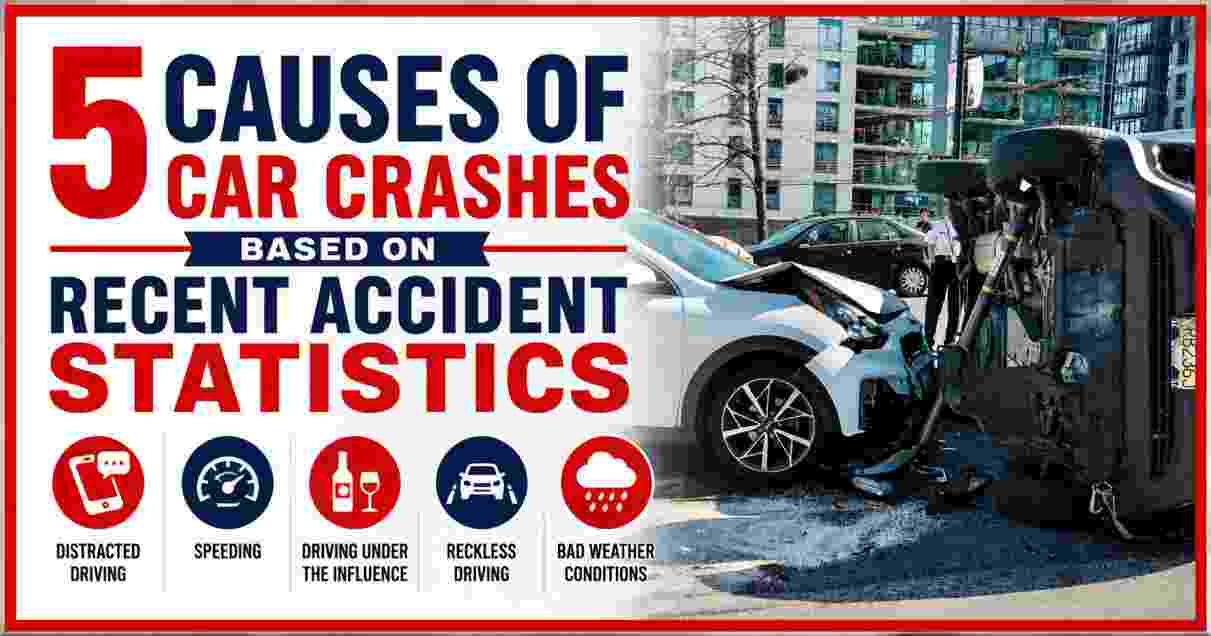
Car accidents are one of the leading causes of injuries and deaths on U.S. roads. When a crash happens, drivers, passengers, and their families often want to understand what caused the collision. Some of the most common causes include distracted driving, speeding, impaired driving, reckless driving, and failing to obey traffic laws.
Understanding what causes car accidents is an important step toward preventing them. That is why many drivers, safety organizations, and transportation agencies study car crash statistics to identify accident trends, reduce roadway risks, and promote safer driving habits.
What Are the Most Common Causes of Car Crashes?
Car accidents often occur from preventable driving behaviors. Some of the most common causes include:
Distracted Driving
According to the National Highway Traffic Safety Administration (NHTSA), distraction-affected crashes account for approximately 5% of all fatal collisions, 13% of injury crashes, and 12% of all police-reported traffic accidents.
Distracted driving remains one of the leading causes of car crashes. Any activity that takes your eyes, hands, or attention away from driving can reduce your ability to react to changing traffic conditions and increase the risk of a collision.
Common distractions include:
- Texting
- Using a mobile phone
- Eating
- Adjusting a GPS
- Changing music
- Talking to passengers
For example, a driver who looks down to respond to a text message may fail to notice that traffic has stopped ahead, resulting in a rear-end collision that could have been avoided.
Impaired Driving
Under the Uniform Vehicle Code, all US states prohibit operating a motor vehicle while under the influence of alcohol, drugs, or a combination of both. For most adult drivers, the legal blood alcohol concentration (BAC) limit is 0.08%. Driving while impaired can significantly reduce judgment, coordination, vision, and reaction time.
Even small amounts of impairment can affect a driver’s ability to make safe decisions behind the wheel. Impaired drivers are more likely to misjudge distances, drift between lanes, ignore traffic signals, or react too slowly to avoid a collision.
For example, a driver who has consumed alcohol may fail to stop at a red light and collide with another vehicle lawfully crossing the intersection.
Speeding
Under California Vehicle Code § 22350, no driver may operate a vehicle at a speed greater than is reasonable or prudent given the conditions of the road. Driving above the speed limit reduces the amount of time you have to react to hazards and increases the severity of a crash when one occurs.
Higher speeds also make it more difficult to control a vehicle when encountering curves, heavy traffic, or unexpected obstacles on the road.
For example, a driver traveling well above the speed limit may be unable to stop in time for a vehicle making a lawful turn, leading to a high-impact crash.
Reckless Driving
Reckless driving involves dangerous behaviors that put everyone on the road at risk. Aggressive actions often reduce a driver’s ability to respond safely to traffic conditions and increase the likelihood of a serious accident.
Examples of reckless driving include:
- Tailgating
- Unsafe lane changes
- Running red lights
- Illegal passing
- Road rage
For example, a driver who changes lanes aggressively without checking blind spots may sideswipe another vehicle or force another driver off the road.
Failure to Obey Traffic Laws
Traffic laws are designed to reduce conflicts between drivers and keep roads safe for everyone. Ignoring these rules continues to be a common factor in many preventable crashes.
Violations such as running stop signs, ignoring traffic signals, failing to yield the right of way, or making illegal turns can create dangerous situations that leave other drivers with little time to react.
For example, a driver who runs a stop sign at a residential intersection may collide with a vehicle that has the legal right of way, causing injuries to everyone involved.
Final Takeaways
- Recent accident statistics identify distracted driving, speeding, impaired driving, reckless driving, and traffic violations as leading causes of car crashes.
- Car accident statistics help researchers and safety agencies understand accident trends and develop prevention strategies.
- Many crashes are preventable when drivers avoid risky behaviors and remain attentive behind the wheel.
- Following traffic laws and driving responsibly can significantly reduce the risk of an accident.
- Understanding the most common causes of crashes helps motorists make safer decisions every time they drive.