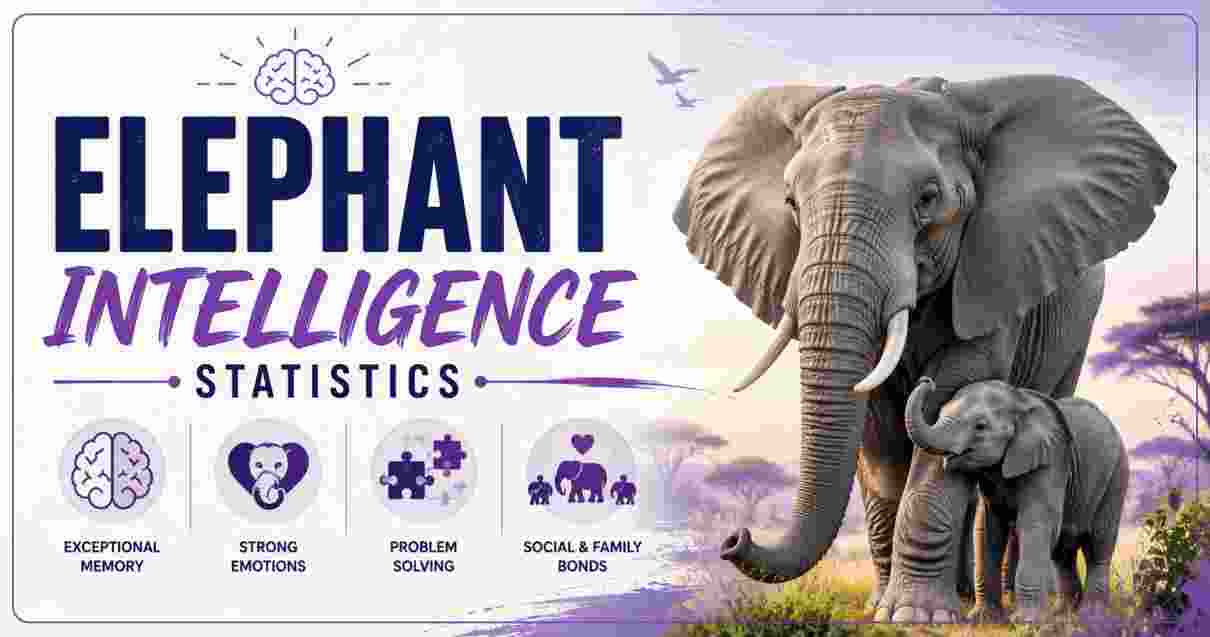
How Smart Are Elephants in 2026
Few questions in the field of animal cognition carry more scientific weight — or more public fascination — than the question of how intelligent elephants truly are. The popular phrase “an elephant never forgets” has circulated for generations, but the peer-reviewed data behind it is more nuanced, more remarkable, and more humbling than the casual phrase suggests. Elephants possess the largest brain of any land animal on Earth, weighing between 4.4 and 5.6 kilograms depending on species and sex — roughly three to four times heavier than the average human brain at 1.4 kilograms. A landmark study published in PNAS Nexus in May 2025 by researchers from Humboldt-Universität zu Berlin and the Leibniz Institute for Zoo and Wildlife Research added a striking new finding to the field: Asian elephants have brains approximately 20% heavier than their larger-bodied African counterparts, and elephant brains triple in weight after birth — a postnatal growth trajectory comparable to humans and far exceeding that of nonhuman primates. That massive brain development over years of childhood and adolescence is not incidental; it is the biological foundation of one of the most sophisticated animal minds ever studied.
What makes elephant intelligence in 2026 such a rich area of scientific inquiry is the breadth of cognitive domains elephants master. They pass the mirror self-recognition test — joining only humans, great apes, dolphins, and a handful of other species in demonstrating measurable self-awareness. They use and manufacture tools, cooperate on complex tasks that require understanding a partner’s role, communicate across distances of up to 10 kilometres using infrasound frequencies below the range of human hearing, demonstrate grief-like responses to the deaths of herd members, and maintain detailed social memories of hundreds of individual elephants and humans across decades of their lives. A 2025 study published in PNAS Nexus, cited in Nature India, found that Asian elephants integrate memory, mood, and brainpower to guide decision-making — a cognitive flexibility previously documented more in humans and primates than in non-primate mammals. The story of elephant intelligence is not simply that elephants are smart. It is that they arrived at their extraordinary cognitive capacity through an independent evolutionary path that diverged from our own more than 60 million years ago — and still arrived at remarkably similar outcomes.
Key Elephant Intelligence Facts 2026
| Fact | Detail |
|---|---|
| Brain weight — African elephant (female avg) | ~4,400 g (4.4 kg) — largest brain of any land animal |
| Brain weight — Asian elephant (female avg) | ~5,300 g (5.3 kg) — 20% heavier than African female (PNAS Nexus, May 2025) |
| Brain weight — Human (avg) | ~1,400 g (1.4 kg) — roughly 3× smaller than elephant |
| Total neurons — African elephant brain | ~257 billion — 3× more than human brain (~86 billion) |
| Neurons in elephant cerebral cortex | ~5.6 billion — only ⅓ of human cortex neurons (16.3 billion) |
| Neurons in elephant cerebellum | ~251 billion — 97.5% of all elephant neurons |
| Postnatal brain growth | Elephant brains triple in weight after birth (PNAS Nexus, 2025) |
| Evolutionary divergence from humans | Over 60 million years ago — intelligence evolved independently |
| Self-awareness (mirror test) | Elephants pass — one of only ~5 species groups to do so |
| Species that share this test | Humans, great apes, bottlenose dolphins, elephants (and some corvids) |
| Infrasound communication range | Up to 10 kilometres through air; also via seismic ground waves |
| Infrasound frequency range | 14–35 Hz — below human hearing threshold of 20 Hz |
| Lifespan in the wild | 60–70 years (African); up to 80 years in captivity |
| Gestation period | ~22 months — longest of any land mammal |
| Family unit size | 6–20 individuals — matriarchal, multigenerational |
| Social memory capacity | Recognise hundreds of individuals across decades of separation |
| Calving interval | Every 4–5 years per female (WWF) |
| Elephant poaching rate (annual est.) | 20,000–30,000 African elephants killed per year |
| African savanna elephant IUCN status | Endangered |
| African forest elephant IUCN status | Critically Endangered |
Source: PNAS Nexus — Brecht, Hildebrandt et al. (May 2025, Humboldt-Universität zu Berlin / Leibniz-IZW); Frontiers in Neuroanatomy — Herculano-Houzel et al. (2014); ElephantVoices.org; WWF Elephant Species Profile; Think Elephants International (2026); IUCN Red List
The facts table above distils what decades of field research and laboratory cognition studies have established about elephant intelligence. The neurological architecture is the best starting point for understanding why elephants think the way they do. At 257 billion total neurons, the African elephant brain contains more than three times the neurons of the human brain — yet the cerebral cortex, which is the seat of higher cognition, contains only 5.6 billion neurons, just one-third of the human cortex’s 16.3 billion. The distinction matters enormously: it is why elephants are extraordinarily sophisticated in long-term processing, sensorimotor coordination, and social intelligence, while showing different — rather than simply inferior — profiles in tasks that demand rapid insight or abstract reasoning. The 2025 PNAS Nexus brain study also confirmed that the elephant’s cerebellum is proportionally larger in African elephants (22.3% of total brain weight) than in Asian elephants (19.1%), likely reflecting the more complex trunk motor demands of the African species, which possesses two trunk fingers compared to the Asian elephant’s one.
The postnatal brain tripling documented in the same 2025 study is perhaps its most significant finding for understanding elephant intelligence. It directly parallels human brain development — and stands in sharp contrast to most nonhuman primates — implying that social learning, experience accumulation, and environmental shaping play a central role in constructing the elephant’s adult cognitive architecture. Matriarchs, as the oldest and most experienced females in any herd, are the living repositories of this accumulated knowledge: routes to waterholes accessible only during rare droughts, the identities of hundreds of elephants and humans encountered over 60+ years of life, and the behavioral responses that have kept herds alive across generations.
Elephant Brain & Neurological Intelligence in 2026
Elephant vs Human Brain — Key Neurological Comparisons
=======================================================

Brain Weight:
African Elephant (female)  |████████████████████████████████████████| ~4,400 g
Asian Elephant (female)    |█████████████████████████████████████████████████| ~5,300 g
Human (avg)                |█████████████                            | ~1,400 g

Total Neurons:
African Elephant           |████████████████████████████████████████| ~257 billion
Human                      |█████████████                            | ~86 billion

Cerebral Cortex Neurons (Key to Higher Cognition):
Human                      |████████████████████████████████████████| ~16.3 billion
African Elephant           |█████████████                            | ~5.6 billion

Cerebellum % of Brain:
African Elephant           |████████████████████████████████████████| 22.3%
Asian Elephant             |████████████████████████████████         | 19.1%
Human                      |██████████                               | ~10%
| Neurological Metric | African Elephant | Asian Elephant | Human |
|---|---|---|---|
| Brain weight (female avg) | ~4,400 g | ~5,300 g | ~1,400 g |
| Brain weight (male avg) | ~5,600 g | Data limited | ~1,400 g |
| Total neurons | ~257 billion | Higher (est.) | ~86 billion |
| Cerebral cortex neurons | ~5.6 billion | Likely more | ~16.3 billion |
| Cerebellum neurons | ~251 billion (97.5%) | N/A | ~69 billion |
| Cerebellum % of brain | 22.3% | 19.1% | ~10% |
| Postnatal brain growth | Triples in weight | Triples in weight | Roughly doubles |
| Brain-to-body ratio | Lower than human | Higher than African | High |
| Temporal lobe development | Well-developed | Well-developed | Well-developed |
| Cortical folding (gyrification) | High — comparable to great apes and cetaceans | High | High |
| Newborn brain as % of adult | ~50% of adult weight at birth | ~50% | ~25% |
| Key cognitive region: hippocampus | Large — supports long-term memory | Large | Proportionally large |
Source: PNAS Nexus — Brecht, M. & Hildebrandt, T. et al. (May 2025, ncbi.nlm.nih.gov/pmc/articles/PMC12089752); Frontiers in Neuroanatomy — Herculano-Houzel, S. et al. (2014); ElephantVoices.org — Elephants Are Large-Brained; Global Elephants Foundation — EleFact Friday (2023)
The neurological data on elephant brains underwent one of its most significant updates in recent memory with the May 2025 PNAS Nexus study from Humboldt-Universität zu Berlin. By collecting, weighing, and analysing postmortem MRI scans of elephant brains across both species, the research team confirmed a counterintuitive finding: Asian elephants, despite being the smaller-bodied species, have substantially heavier brains than African savanna elephants. Adult female Asian elephants average 5,346 grams, while adult female African savanna elephants average 4,417 grams — a difference of nearly a kilogram. The researchers proposed that this is linked to differences in social complexity, learning demands, and the role of experience in Asian elephant life history. They noted that the strong postnatal brain growth — a tripling in weight from birth to adulthood — parallels the human developmental pattern and reflects how central childhood learning, social integration, and memory formation are to elephant cognitive maturity.
The distribution of neurons across the brain tells a story that is as important as the total count. The elephant’s 251 billion cerebellar neurons — 97.5% of its total — reflect extraordinary sensorimotor specialisation, particularly related to the trunk, which contains an estimated 150,000 individual muscle units and is capable of tasks ranging from picking up a single grain of rice to uprooting a tree. The relatively modest 5.6 billion cortical neurons, by contrast, explain why elephants do not uniformly outperform humans or other cognitively capable species on tasks requiring rapid abstract reasoning. Their cognitive strengths lie in long-duration processing, social intelligence, spatial memory, and emotional attunement — domains where the distribution of their neurons is a substantial advantage rather than a limitation.
Elephant Memory in 2026 — How Far Back Do They Remember?
Elephant Memory Capabilities — Research-Documented Evidence
============================================================

Individual recognition span    |████████████████████████████████████████| Decades (25+ years)
Social network memory          |████████████████████████████████████████| Hundreds of individuals
Waterhole location memory      |█████████████████████████████████████   | Rare drought cycles
Threat recognition (clothing)  |████████████████████████████████████   | Specific colours/patterns
Deceased kin recognition       |████████████████████████████████        | Bones & tusks
Migration route retention      |███████████████████████████████████████ | Across 60–70yr lifespan
Separation & reunion response  |████████████████████████████████████████| After decades apart
| Memory Metric | Data / Observation | Source |
|---|---|---|
| Individual recognition span | Decades — elephants recognise companions after 25+ years of separation | Long-term field studies; Springer Nature Learning & Behavior (2024) |
| Herd social network memory | Can recognise and respond to hundreds of individual elephants | Springer Nature (2024); AZ Animals |
| Matriarch knowledge advantage | Oldest females have the best memory — critical for herd survival | Amboseli long-term data; A-Z Animals (Nov 2025) |
| Waterhole recall | Matriarchs guide herds to waterholes accessible only during rare droughts | Science News Today (July 2025) |
| Threat memory (Maasai research) | Elephants reacted with fear to specific clothing colours worn by threatening humans | A-Z Animals (Nov 2025); field research |
| Deceased recognition | Elephants preferentially investigate elephant skulls and ivory vs other species’ remains | McComb et al. (2006); Springer Nature (2024) |
| Grief-related bone touching | Documented behaviour — revisiting death sites and caressing bones of deceased herd members | IERE.org (Oct 2025); ScienceNewsToday (July 2025) |
| Captive herd change response | Captive Asian elephants show measurable social behaviour changes after losing a herd member | Rutherford & Murray (2021); Springer Nature 2024 |
| Migration route retention | Multi-generational route knowledge preserved by matriarchs across 60–70-year lifespans | WWF; Elephant Behavior Facts (April 2026) |
| Human face recognition | Documented ability to recognise and respond differently to familiar vs unfamiliar humans | Think Elephants International (2026) |
| Emotional memory | Evidence of emotional responses to past events, including fear, joy, grief | ScienceNewsToday (July 2025) |
| Limbic system involvement | Neurological basis — well-developed limbic system underlies emotional memory | Animals Around the Globe (March 2026) |
Source: Springer Nature Learning & Behavior — “Do elephants really never forget?” (2024); Science News Today (July 2025); A-Z Animals — The Science Behind Elephant Memory (November 2025); McComb et al. (2006); IERE.org (October 2025); Animals Around the Globe (March 2026); Think Elephants International (2026)
Elephant memory is perhaps the single most studied and most publicly discussed dimension of elephant intelligence — and the 2024 and 2025 research literature both deepens and complicates the popular narrative. The phrase “an elephant never forgets” contains genuine biological truth: matriarchal females have been documented guiding herds to waterholes only accessible during rare drought cycles, implying retention of spatial memories that may span decades between relevant activations. They maintain detailed social maps of hundreds of individuals — distinguishing friends from rivals, kin from strangers, and threatening humans from neutral ones. The documented response to specific clothing colours associated with historical threats (in studies involving Maasai communities whose coming-of-age traditions historically included spear-throwing near elephant ranges) demonstrates that elephant threat memory extends to abstract visual features, not just faces or voices.
Where the science is appropriately cautious is in the interpretation of grief-like behaviours around deceased herd members. The landmark McComb et al. (2006) study — reviewed in the 2024 Springer Nature paper — found that African savanna elephants showed significantly greater interest in elephant skulls and ivory than in the bones of other species, and greater interest in elephant remains than in wooden objects. However, when presented with the skull of a matriarch versus a non-kin elephant, the elephants did not show statistically different levels of interest between the two — suggesting that what appears to be kin-recognition grief may reflect a broader, deeply rooted interest in conspecific remains, rather than specific recognition of a beloved individual. The distinction is important for scientific rigour, but it does not diminish the extraordinary nature of the underlying behaviour: elephants are among an extremely small number of species that consistently seek out, investigate, and respond to the physical remains of their own kind in ways that have no obvious survival function.
Elephant Communication Intelligence in 2026
Elephant Infrasound Communication — Key Data
=============================================

Frequency range (typical)   |████████████████████████████████████████| 14–35 Hz (below human hearing)
Max air communication range  |████████████████████████████████████████| Up to 10 km
Ground seismic range         |████████████████████████████████████████| Detected beyond air range
Sound pressure (at 5m)       |████████████████████████████████████████| 85–90 dB SPL
Call duration (typical)      |████████████████████████████████████████| 10–15 seconds
Vocalization types           |████████████████████████████████████████| 70+ distinct call types
Rumble frequency span        |████████████████████████████████████████| ~10 Hz to 700 Hz (full range)
Total vocal frequency range  |████████████████████████████████████████| ~10 Hz to 700 Hz
| Communication Metric | Data Point | Source |
|---|---|---|
| Primary communication method | Low-frequency infrasound rumbles — most frequent call type | ElephantVoices; biorxiv (2024) |
| Infrasound frequency range | 14–35 Hz fundamental — below human hearing (20 Hz threshold) | Wikipedia / Perception of Infrasound |
| Typical call duration | 10–15 seconds per infrasound call | Perception of Infrasound (Wikipedia) |
| Sound pressure level (at 5m) | 85–90 dB SPL — comparable to a lawnmower | Payne et al. 1986 / Wikipedia |
| Air transmission range | Up to 10 km — infrasound travels far due to low attenuation | Vibrationdata Blog (Jan 2026) |
| Seismic ground transmission | Infrasound also creates Rayleigh waves detectable through ground | Günther et al. (2004); ResearchGate |
| Foot sensitivity | Elephants detect ground vibrations through sensitive foot pads — act as built-in geophones | Vibrationdata Blog (Jan 2026) |
| Total vocal types (repertoire) | 70+ distinct vocalizations including rumbles, trumpets, barks, roars, snorts | ElephantVoices; biorxiv (2024) |
| Full frequency range | ~10 Hz to 700 Hz across all call types | biorxiv (2024) |
| Information encoded in rumbles | Identity, sex, reproductive state, emotional state, warnings, referential signals | biorxiv (2024) |
| Communication channels | Air (acoustic) + ground (seismic) + body language + chemical (temporal gland) | Useless Daily (July 2025); ElephantVoices |
| Infrasound use functions | Coordinate movement, signal danger, attract mates, maintain social cohesion | Elephant Communication Deep Dive (July 2025) |
| Night-time advantage | Infrasound travels further at night due to atmospheric thermal inversion | ResearchGate / Long-distance LF communication |
Source: Vibrationdata Blog — Elephant Communication via Infrasound (January 10, 2026); biorxiv — Elephant Rumble Vocalizations Spectral Study (2024); Wikipedia — Perception of Infrasound; ResearchGate — Long-distance, Low-frequency Elephant Communication (2004); Useless Daily — Unraveling Elephant Communication (July 2025)
Elephant communication represents one of the most technically sophisticated systems in the animal kingdom — and research published as recently as January 2026 continues to reveal new dimensions of its complexity. The core of elephant long-distance communication is infrasound: low-frequency rumbles with fundamental frequencies between 14 and 35 Hz, squarely below the human hearing threshold of 20 Hz. These calls can reach 85–90 decibels sound pressure level at five metres distance — comparable to a lawnmower — and can propagate across up to 10 kilometres of open terrain through air. Because infrasonic sound waves attenuate slowly in the atmosphere, they carry further than higher-frequency calls, making them ideal for elephant families that may range across vast savanna landscapes. The January 2026 Vibrationdata Blog analysis added a compelling dimension: the same low-frequency rumbles that travel through air also generate Rayleigh seismic waves that travel through the ground, detectable by elephants through the highly sensitive pads of their feet, which function as natural geophones. This means elephants may be communicating simultaneously through two entirely separate physical channels — air and earth — with a sophistication that no human communication technology replicates in biological form.
The information density carried within elephant rumbles is what elevates them from simple alarm calls to a genuinely complex communication system. Research cited in the 2024 biorxiv rumble study confirmed that individual rumble calls carry encoded information about the caller’s identity, sex, reproductive state, emotional state, and social relationships, as well as functioning as referential signals — calls that point to specific external events or threats in a manner that parallels the referential signalling first documented in vervet monkeys. The full elephant vocal repertoire spans over 70 distinct call types across a frequency range from approximately 10 Hz to 700 Hz, with rumbles being the most frequently produced. Atmospheric thermal inversion at night enhances infrasound propagation, creating conditions in which nighttime calls may reach significantly further than daytime ones — a behavioural adaptation that appears to correlate with periods of greatest herd movement and social coordination.
Elephant Social Intelligence & Emotional Cognition in 2026
Markers of Advanced Social & Emotional Intelligence in Elephants
=================================================================

Self-awareness (mirror test)   |████████████████████████████████████████| CONFIRMED
Empathy (comfort behaviours)   |████████████████████████████████████████| CONFIRMED
Grief-like mourning responses  |████████████████████████████████████████| CONFIRMED
Cooperative problem-solving    |████████████████████████████████████████| CONFIRMED
Tool use (insightful)          |████████████████████████████████████████| CONFIRMED
Cultural knowledge transfer    |████████████████████████████████████████| CONFIRMED
Altruism toward non-kin        |████████████████████████████████████████| DOCUMENTED
Play behaviour (social/motor)  |████████████████████████████████████████| DOCUMENTED
Mimicry of sounds              |████████████████████████████████████████| DOCUMENTED
Recognition of deceased        |████████████████████████████████████████| DOCUMENTED
| Social / Emotional Intelligence Metric | Data / Observation | Source |
|---|---|---|
| Mirror self-recognition (self-awareness) | Asian elephants confirmed — pass modified MSR test | Plotnik et al. (2006); Smithsonian National Zoo; habitat.earthclinic.com |
| Species sharing MSR ability | Humans, great apes, bottlenose dolphins, elephants, some corvids | Wildlife Discoveries (June 2025) |
| Empathy behaviours | Comforting distressed herd members with trunk touches, vocalisations, and physical proximity | Wildlife Discoveries (June 2025) |
| Cooperative task understanding | Elephants demonstrate understanding that a partner’s role is essential to solve problems | Think Elephants International (2026) |
| Insightful problem-solving | 7-year-old Asian male spontaneously moved a large cube to reach elevated food — no trial and error | Smithsonian National Zoo / PMC (2011) |
| Tool manufacture | Documented use of sticks, branches, and other objects as tools | PMC Insightful Problem Solving Study (2011) |
| Targeted helping | Elephants assist distressed individuals — including across species in documented cases | Philosophical Transactions of the Royal Society B (2025) |
| Cultural knowledge transfer | Matriarchs transfer route knowledge, social rules, and survival information across generations | Science News Today (July 2025) |
| Allomothering (cooperative calf care) | Calves cared for by entire herd of related females, not just the mother | WWF Elephant Profile |
| Altruism | Elephants engage in targeted helping of unrelated or injured individuals | Think Elephants International (2026) |
| Play behaviour | Juveniles engage in wrestling, chasing, trunk grappling — social and motor skill development | Animal Fact Central (April 2026) |
| Human sound mimicry | Documented cases of elephants mimicking human speech sounds and vehicle noises | ElephantVoices; peer-reviewed case studies |
| Numerical competence | Elephants show relative quantity judgement in controlled tests | PMC (2011) overview of cognitive studies |
| Visual symbol discrimination | Demonstrated in controlled cognitive studies | PMC (2011) |
| Means-end recognition | Understanding cause and effect in physical problem-solving contexts | PMC (2011) |
Source: PMC / NIH — Insightful Problem Solving in an Asian Elephant (2011); Smithsonian National Zoo; Think Elephants International (thinkelephants.org, 2026); Wildlife Discoveries (June 24, 2025); Philosophical Transactions of the Royal Society B (2025, ScienceDirect); Animal Fact Central — Elephant Behavior Facts (April 2026); WWF Elephant Profile
Elephant social and emotional intelligence sits at the intersection of neuroscience, ethology, and comparative psychology — and the 2025–2026 research literature continues to push the boundaries of what is scientifically attributed to non-human animals. The mirror self-recognition (MSR) test — in which a study subject is marked with an odourless, invisible mark and presented with a mirror, then observed for self-directed investigative behaviours — was passed by Asian elephants in the landmark Plotnik et al. (2006) study with three individuals, including a female named “Happy” who repeatedly touched a mark on her own forehead while watching her reflection. This places elephants in an extraordinarily small group of species — alongside humans, great apes, and bottlenose dolphins — considered to possess genuine self-awareness. The test is not without scientific debate, but the consistency of the finding across multiple study populations has made it one of the most cited data points in comparative cognition.
The insightful problem-solving study from the Smithsonian National Zoo and published in PMC documented something that had previously eluded researchers: spontaneous, insight-based problem solving in an Asian elephant. A seven-year-old male named Kandula was presented with food placed out of reach overhead. Without any trial-and-error behaviour, he moved a large plastic cube to beneath the food, stood on it, and retrieved the reward — demonstrating what researchers called a genuine “aha moment” of spontaneous physical problem solving. He then generalised this strategy to new contexts and retrieved the cube from increasingly distant locations. This is the cognitive flexibility — the ability to mentally simulate a solution and execute it without fumbling through alternatives first — that researchers had long sought to demonstrate in elephants. Combined with documented empathy, targeted helping, allomothering, cultural knowledge transfer, numerical competence, and visual symbol discrimination, the picture of elephant cognition that emerges from the accumulated research of the past two decades is not that of a large animal with a powerful memory. It is that of a cognitively complex, emotionally sophisticated, socially intelligent species whose intellectual life is only beginning to be fully understood.
Elephant Biology, Lifespan & Conservation Context in 2026
Elephant Key Life Stats (African & Asian Species)
==================================================

Gestation period             |████████████████████████████████████████| ~22 months (longest of any land mammal)
Wild lifespan (African)      |████████████████████████████████████████| 60–70 years
Captivity lifespan (max)     |████████████████████████████████████████| Up to 80 years
Family group size            |████████████████████████████████████████| 6–20 individuals
Calving interval             |████████████████████████████████████████| 4–5 years
Newborn calf weight          |████████████████████████████████████████| ~90–136 kg (200–300 lbs)
Time to stand after birth    |████████████████████████████████████████| Within 20 minutes
Nursing duration (max)       |████████████████████████████████████████| Up to 6 years (savanna)
Annual poaching deaths       |████████████████████████████████████████| ~20,000–30,000
| Biology / Conservation Metric | Data Point | Source |
|---|---|---|
| Gestation period | ~22 months — longest of any land mammal | WWF; TNC; Elephant Jungle Sanctuary (March 2026) |
| Wild lifespan — African elephant | 60–70 years (up to 80 in captivity) | Britannica; Samui Elephant Home; Elephant-World |
| Calving interval | Every 4–5 years per female | WWF Elephant Species Profile |
| Newborn calf weight | ~90–136 kg (200–300 lbs) | AOL / Facts About Elephants |
| Time to stand after birth | Within 20 minutes | Elephant-World |
| Nursing duration | Up to 6 years for savanna elephant calves | Elephant-World |
| Max offspring per female lifetime | Up to 12 calves (average: 6) | Elephant-World |
| Female fertile age range | First birth from 10–12 years; fertile until ~50 years | Elephant-World |
| Male departure from herd | Around 10 years of age at sexual maturity | Elephant-World |
| Family unit structure | Matriarchal — led by oldest female; adult males largely solitary | WWF; Britannica |
| Male social structure | Small bachelor herds or solitary; join herds only to mate | WWF; Britannica |
| African elephant poaching (annual est.) | 20,000–30,000 killed per year | Wifitalents.com / IUCN data (2026) |
| African savanna elephant IUCN status | Endangered (as of 2021 reassessment) | IUCN Red List |
| African forest elephant IUCN status | Critically Endangered | IUCN Red List |
| 10–40% range reduction from habitat loss | Fences and roads severing corridors cause significant range shrinkage | Animal Fact Central (April 2026) |
| Ecological role | Create waterholes by digging; disperse large seeds over tens of km; shape grassland from woodland | Animal Fact Central (April 2026) |
| Removing elephants: seed plant impact | 35% decline in large-seed plant recruitment documented in one park study | Animal Fact Central (April 2026) |
Source: WWF Elephant Species Profile (worldwildlife.org); Elephant Jungle Sanctuary — Gestation Period (March 2026); Elephant-World (elephant-world.com); Animal Fact Central — Elephant Behavior Facts (April 28, 2026); Britannica — Elephant Reproduction and Life Cycle; IUCN Red List; Wifitalents.com Elephant Data Reports 2026
The biological framework of elephant life history is inseparable from the intelligence story. A 22-month gestation — the longest of any land mammal — means that elephant calves arrive in the world with a brain already at approximately 50% of its adult weight, pre-loaded with developmental investment. They stand within 20 minutes of birth, begin integrating into the social world of a multigenerational herd within days, and spend the next decade or more in an intensive social learning environment guided by the accumulated knowledge of adult females and the matriarch. This extended juvenile period — comparable in structure if not duration to human childhood — is where the architecture of elephant intelligence is built. A 70-year-old matriarch who guides her herd to water during a drought that last occurred 30 years earlier is not performing a simple instinct. She is accessing, retrieving, and acting on a specific episodic memory from three decades ago — the kind of temporally indexed, spatially precise, survival-critical memory that no other animal besides humans has been as clearly documented to possess.
The conservation context makes this intelligence data urgent rather than merely fascinating. With 20,000–30,000 African elephants killed by poachers every year, and both African savanna elephants (Endangered) and African forest elephants (Critically Endangered) facing population pressures that disproportionately remove the oldest, largest, most experienced individuals — precisely because their larger tusks make them more valuable targets — the intelligence embedded in elephant matriarchs is being systematically destroyed. When a matriarch is killed, her herd loses not just a leader but an irreplaceable library of multi-decade environmental and social knowledge. That 35% decline in large-seed plant recruitment documented in herds stripped of their elephants is a downstream consequence of losing both the animals and the knowledge they carried. Understanding how smart elephants are is not a purely academic exercise. It is one of the most compelling arguments for why their conservation — and the protection of their oldest, most experienced individuals in particular — is an ecological, ethical, and scientific imperative.
Disclaimer: The data research report we present here is based on information found from various sources. We are not liable for any financial loss, errors, or damages of any kind that may result from the use of the information herein. We acknowledge that though we try to report accurately, we cannot verify the absolute facts of everything that has been represented.