Skin Cancer in Australia 2026
Australia holds the unwanted distinction of having the highest melanoma incidence rate in the world, shared with New Zealand. According to the AIHW Cancer Data in Australia 2025 report — published October 2025 — an estimated 17,443 new cases of melanoma will be diagnosed in Australia in 2025, making it the third most commonly diagnosed cancer in the country. Add the volume of non-melanoma skin cancers (NMSCs) — primarily basal cell carcinoma (BCC) and squamous cell carcinoma (SCC) — and skin cancer collectively accounts for approximately 80% of all new cancer diagnoses in Australia every year. Approximately 2 in 3 Australians (~69%) will be diagnosed with some form of skin cancer before age 70, with lifetime risk estimated at 73% for men and 65% for women. Every 30 minutes, one Australian is diagnosed with melanoma. In 2022–23, over 1.1 million Medicare-paid treatment services were delivered for BCC and SCC combined — more than 100 treatments per hour, every hour, across the country.
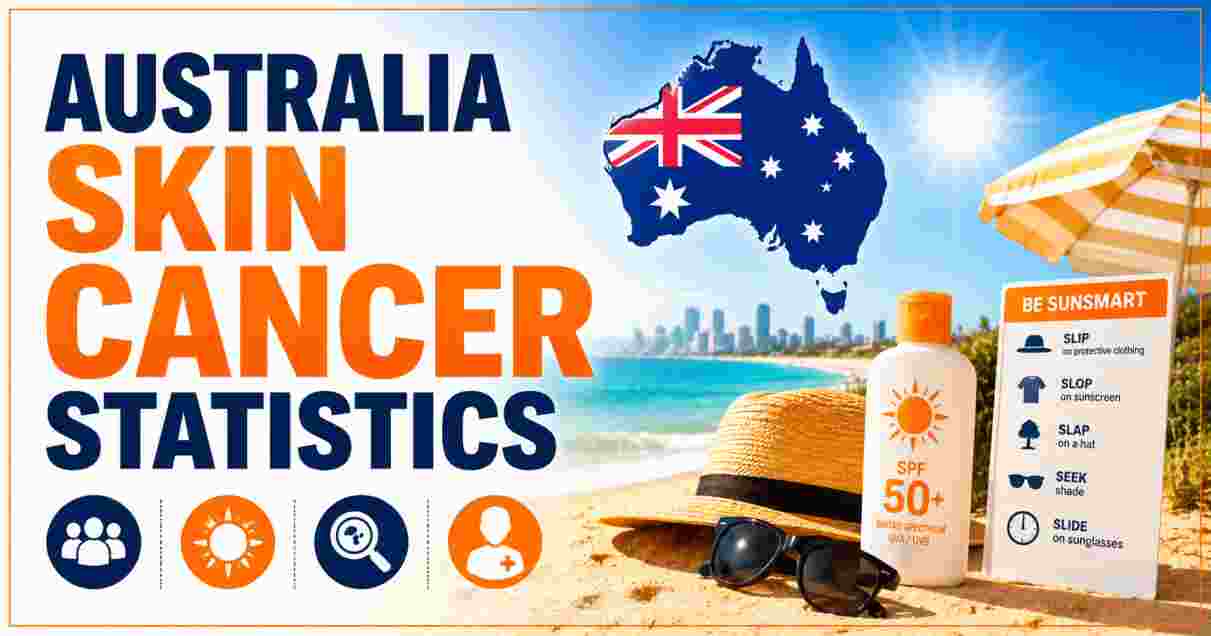
What makes Australia’s 2026 skin cancer picture instructive is the divergence between two simultaneous trends. Incidence is rising in older Australians — driven by population ageing and cumulative UV damage — while rates in under-40s have been declining since the late 1990s, attributed to the SunSmart and Slip-Slop-Slap campaigns begun in 1981. Melanoma mortality has been falling since its 2013 peak — from 8.0 to an estimated 5.3 deaths per 100,000 in 2025, a 33.75% reduction — driven by immunotherapy and BRAF-targeted therapies now subsidised through the PBS. The system is treating more people but losing fewer: a measurable pharmacological triumph running alongside a demographic incidence challenge that ageing shows no sign of easing. The Australian Government allocated $10.3 million in October 2024 toward a National Targeted Skin Cancer Screening Roadmap — the first formal step toward an organised screening framework in a country that has never had one.
Interesting Facts: Australia Skin Cancer Statistics 2026
| Fact | Figure |
|---|---|
| Skin cancer share of all new Australian cancer diagnoses | ~80% |
| Lifetime risk of skin cancer (any type) by age 70 | 2 in 3 Australians (~69%) |
| Male lifetime risk of skin cancer | ~73% |
| Female lifetime risk of skin cancer | ~65% |
| Estimated new melanoma diagnoses in 2025 (AIHW) | 17,443 (10,187 male, 7,256 female) |
| Melanoma ranking among Australian cancer diagnoses | 3rd most common |
| Melanoma age-standardised incidence rate (est. 2025) | 63 per 100,000 |
| Melanoma incidence rate — males (est. 2025) | 78 per 100,000 |
| Melanoma incidence rate — females (est. 2025) | 50 per 100,000 |
| Estimated melanoma deaths in 2025 (AIHW) | ~1,455 (990 male, 465 female) |
| Estimated total skin cancer deaths in 2025 (AIHW) | ~2,300 |
| Melanoma age-standardised mortality rate (est. 2025) | 5.3 per 100,000 |
| Peak melanoma mortality rate (2013) | 8.0 per 100,000 |
| Reduction in melanoma mortality rate since 2013 | −33.75% |
| 5-year relative survival rate for melanoma (2017–2021) | 94% |
| 5-year survival if detected early (Stage I/II) | Over 90% |
| 5-year survival at Stage IV (advanced) | ~26% |
| Lifetime risk of melanoma diagnosis by age 85 | 1 in 19 overall; 1 in 16 males; 1 in 23 females |
| Lifetime risk of dying from melanoma by age 85 | 1 in 253 overall; 1 in 181 males; 1 in 422 females |
| Medicare-paid NMSC treatment services (2022–23) | 1.1 million+ (over 100 per hour) |
| NMSC treatments per hour (Australia, 2022–23) | 100+ |
| Total skin cancer health system spend (FY 2019/20) | AUD $1.72 billion — most expensive cancer type |
| NMSC (BCC/SCC) share of total skin cancer spend | AUD $1.463 billion |
| Melanoma share of total skin cancer spend | AUD $259 million |
| Government funding for National Skin Cancer Screening Roadmap | $10.3 million (October 2024) |
| Australia-born vs overseas-born melanoma incidence rate | 51 vs 17 per 100,000 (2006–2020 AIHW) |
Source: Australian Institute of Health and Welfare (AIHW) — Cancer Data in Australia 2025 (aihw.gov.au, accessed June 2026); Cancer Australia — Melanoma of the Skin Statistics 2025 (canceraustralia.gov.au); Australian Skin Cancer Foundation — Skin Cancer Statistics 2026 (australianskincancerfoundation.org); Cancer Council Australia — Skin Cancer Incidence and Mortality (cancer.org.au); AIHW — Using Linked Data to Inform Targeted Skin Cancer Screening in Australia (March 2026); Melanoma Institute Australia — Melanoma Facts 2026; PMC / MDPI — Estimated Healthcare Costs of Melanoma and Keratinocyte Skin Cancers in Australia 2021 (PMC8948716)
The $1.72 billion total skin cancer health system spend in FY 2019/20 makes skin cancer the most expensive cancer type to treat in Australia — not because individual treatments are costly, but because the sheer volume of NMSCs through general practice and dermatology exceeds every other cancer combined. $1.463 billion was attributable to NMSC (BCC/SCC); melanoma’s $259 million reflects a smaller caseload treated with progressively expensive immunotherapies. A 2022 peer-reviewed PMC economic analysis projected NMSC costs reaching AUD $1.2 billion by 2025 for new 2021 patient cohorts — consistent with AIHW figures.
The Australia-born versus overseas-born melanoma gap — 51 versus 17 cases per 100,000 (AIHW 2006–2020) — is one of the clearest global demonstrations that melanoma risk is primarily environmental rather than genetic. Australians born in Australia carry three times the melanoma incidence rate of people who migrated in adulthood, directly supporting the SunSmart campaign’s school-based and early childhood focus.
Melanoma Incidence Trends in Australia 2026
Melanoma Age-Standardised Incidence Rate — Australia 1982–2025 (AIHW)
=======================================================================
1982  |████████████████████                              | 27 per 100,000
2000  |████████████████████████████████                  | 54 per 100,000
2016  |█████████████████████████████████████             | 49 per 100,000 (est.)
2021  |█████████████████████████████████████             | 60 per 100,000
2025  |███████████████████████████████████████████       | 63 per 100,000 (est.)
------------------------------------------------------------
Males 2025: 78/100,000  |  Females 2025: 50/100,000
Younger <40: declining  |  Older 65+: rising
Source: AIHW Cancer Data in Australia 2025
| Incidence Metric | Data |
|---|---|
| New melanoma diagnoses 2025 (est., AIHW) | 17,443 |
| New melanoma diagnoses 2021 (actual) | 15,034 |
| New melanoma diagnoses 2016 (est.) | 13,280 |
| Age-standardised incidence rate 2000 | 54 per 100,000 |
| Age-standardised incidence rate 2021 (actual) | 60 per 100,000 |
| Age-standardised incidence rate 2025 (est.) | 63 per 100,000 |
| Male incidence rate 2025 (est.) | 78 per 100,000 |
| Female incidence rate 2025 (est.) | 50 per 100,000 |
| Melanoma incidence rate — ages 30–39 in 2024 | 23.6 per 100,000 (down from 31.4 in 2000) |
| Melanoma incidence rate — ages 40–49 in 2024 | 52.2 per 100,000 (up from 50.5 in 2000) |
| Mean age at melanoma diagnosis (men, 2019) | 66.1 years |
| Mean age at melanoma diagnosis (women, 2019) | 62.8 years |
| Proportion diagnosed under age 40 | 7.9% |
| Melanoma in 15–29 age group | Most common cancer; 15% of all cancers in this group |
| Australia’s global melanoma ranking | Highest in the world (with New Zealand) |
Source: AIHW Cancer Data in Australia 2025 (October 2025); Cancer Australia Melanoma Statistics 2025; Cancer Council Australia Skin Cancer Incidence and Mortality; Australian Skin Cancer Foundation statistics 2026 (australianskincancerfoundation.org)
The trajectory from 27 cases per 100,000 in 1982 to 63 per 100,000 in 2025 represents a more than doubling of the age-standardised melanoma incidence rate over four decades. This rise is driven primarily by the ageing of the Australian population: melanoma incidence is strongly age-dependent, peaking in the 85–89 age group, and as the proportion of Australians in older cohorts grows, so does the overall incidence rate even when age-specific rates in younger groups are falling. The AIHW’s risk analysis confirms this: lifetime risk of being diagnosed with melanoma has tripled since 1982, from 1 in 46 people to an estimated 1 in 15 — but this is substantially a function of more Australians living to the ages at which melanoma is most prevalent, not of younger people becoming more at risk.
The age-group divergence is the policy-relevant story. Australians aged 30–39 saw incidence fall from 31.4 per 100,000 in 2000 to 23.6 in 2024 — attributable to SunSmart-era sun-safe behaviour. Those 40–49 saw modest change (50.5 to 52.2), while older cohorts drive rising aggregate numbers. The mean diagnosis age of 66.1 years for men and 62.8 for women confirms melanoma is predominantly a disease of older Australians — though it remains the most common cancer in Australians aged 15–29, a reminder that UV damage accumulates from childhood.
Melanoma Mortality and Survival in Australia 2026
Melanoma Age-Standardised Mortality Rate — Australia 2013–2025 (AIHW)
=======================================================================
2013 (peak)  |████████████████████████████████████████████████| 8.0 per 100,000
2016         |████████████████████████████████████████████    | 6.2 per 100,000
2021         |████████████████████████████████████████        | 5.9 per 100,000
2025 (est.)  |████████████████████████████████████            | 5.3 per 100,000
------------------------------------------------------------
Reduction from peak 2013 to 2025 estimate: −33.75%
Source: Cancer Australia; AIHW Cancer Data in Australia 2025
| Mortality and Survival Metric | Data |
|---|---|
| Estimated melanoma deaths 2025 (AIHW) | 1,455 (990 male, 465 female) |
| Actual melanoma deaths 2023 | 1,527 (1,038 male, 489 female) |
| Estimated total skin cancer deaths 2025 (AIHW) | ~2,300 |
| Melanoma mortality rate 2025 (est.) | 5.3 per 100,000 (7.9 male, 3.1 female) |
| Melanoma mortality rate 2021 (actual) | 5.9 per 100,000 (8.8 male, 3.4 female) |
| Melanoma mortality rate 2013 (peak) | 8.0 per 100,000 |
| Reduction in mortality rate from 2013 peak | −33.75% |
| 5-year relative survival rate (2017–2021) | 94% |
| 5-year relative survival — females (2017–2021) | 95% |
| 5-year survival — Stage I/II (localised) | Over 90% |
| 5-year survival — Stage IV (metastatic) | ~26% |
| Lifetime risk of death from melanoma by age 85 | 1 in 253 |
| 1-in-253 compared to 2013 peak lifetime risk | Down from 1 in 140 (2013 peak) |
| Risk of death by age 30 in 2020 vs 1982 | Less than one-sixth (1 in 62,000 vs 1 in 9,100) |
| Primary driver of mortality reduction | Immunotherapy + BRAF-targeted therapies |
Source: Cancer Australia — Melanoma of the Skin Statistics (canceraustralia.gov.au, 2025); AIHW Cancer Data in Australia 2025; AIHW — Risk of Melanoma of the Skin by Age and Over Time; AIHW — Using Linked Data to Inform Targeted Skin Cancer Screening in Australia (March 2026)
The melanoma mortality story in Australia is one of the most dramatic turnarounds in modern oncology. After decades of rising death rates, mortality peaked in 2013 at 8.0 deaths per 100,000 people and began falling. By 2025, the estimated rate is 5.3 per 100,000 — a reduction of 33.75% from the 2013 peak — and the estimated number of deaths has fallen from approximately 1,625 in 2013 to 1,455 in 2025, despite a substantially larger population and significantly more diagnoses. This decoupling of incidence and mortality is the defining feature of Australia’s melanoma landscape in 2026: more people are being diagnosed, but a far higher proportion are surviving.
The drivers are earlier detection and the PBS-subsidised introduction of PD-1 checkpoint inhibitors (pembrolizumab, nivolumab) and BRAF/MEK-targeted therapies (dabrafenib, trametinib) from the mid-2010s — transforming Stage IV melanoma from a disease with median survival measured in months to one where long-term remission is achievable. The 94% overall 5-year survival conceals critical stage-dependent variation: over 90% at Stage I/II versus ~26% at Stage IV. Every diagnostic delay that allows progression from Stage II to IV represents roughly a 3.5-fold increase in mortality risk.
Non-Melanoma Skin Cancer Statistics in Australia 2026
Non-Melanoma Skin Cancer (NMSC) Treatment Volume — Australia (Medicare Data)
=============================================================================
2014      |████████████████████████████████████████████████| ~959,243 Medicare services
2017 (Vic)|████████████████████████████████████████████████| 141,269 NMSC treated in Victoria alone
2022–23   |████████████████████████████████████████████████| 1.1–1.2 million services nationally
------------------------------------------------------------
Over 100 NMSC treatments per hour, every hour, in Australia
NMSC health system cost (FY 2019/20): AUD $1.463 billion
Source: AIHW; Medicare Australia; Cancer Council Australia
| NMSC Metric | Data |
|---|---|
| NMSC types | Basal cell carcinoma (BCC), squamous cell carcinoma (SCC) |
| NMSC share of all skin cancer diagnoses | Majority — exceed all other cancers combined |
| Medicare-paid NMSC treatment services (2022–23) | Over 1.1–1.2 million |
| NMSC treatments per hour (2022–23) | 100+ |
| Medicare-paid NMSC services in 2014 | ~959,243 procedures |
| NMSC health system spend (FY 2019/20) | AUD $1.463 billion |
| Estimated NMSC deaths (2025) | ~845 (2,300 total skin cancer minus 1,455 melanoma) |
| NMSC share of cancer health system spend | 8.1% of all cancer health spending |
| Victorian NMSC treatments in 2017 | 141,269 (387 per day) |
| Direct Medicare costs (BCC + SCC) | Over $100 million (direct only) |
| Total BCC + SCC costs including diagnosis/pathology | Over $700 million |
| BCC vs SCC relative frequency | BCC far more common; SCC higher mortality |
| Australia-born SCC/BCC incidence | Much higher than overseas-born |
| Risk factor for NMSC | Cumulative UV exposure over lifetime |
Source: Cancer Council Australia — Skin Cancer Incidence and Mortality (cancer.org.au); AIHW Cancer Data in Australia 2025; Australian Skin Cancer Foundation Statistics 2026; Medicare Australia data cited in health.vic.gov.au NMSC report; ASSC — 45 New Genetic Causes of NMSC (assc.org.au); AIHW 2016 Skin Cancer in Australia
Non-melanoma skin cancers are the dominant skin cancer burden by volume, cost, and treatment load despite receiving less public attention than melanoma. The 1.1 million+ Medicare-paid services in 2022–23 are processed primarily through GP rooms and dermatology clinics via excision, cryotherapy, and topical treatment — most never entering hospital admission data. Total BCC and SCC costs exceed $700 million annually when diagnosis, treatment, and pathology are combined. NMSC accounts for 8.1% of all Australian cancer health system spending — remarkable given that neither BCC nor SCC are routinely counted in official cancer incidence statistics. The most recent national NMSC incidence data is from 2002, when NMSC already exceeded all other cancers combined — a situation that population ageing has since intensified.
Skin Cancer Risk Factors and Demographics in Australia 2026
Melanoma Risk Groups — Australia (AIHW / Cancer Australia / Cancer Council)
============================================================================
Age 65+              |████████████████████████████████████████████████| Highest death rates
Males overall        |████████████████████████████████████████████    | Higher incidence AND mortality
Non-Indigenous       |████████████████████████████████████████        | Higher rates than First Nations
Regional (vs metro)  |████████████████████████                        | Higher rates than cities
Socioeconomic disadv.|████████████████████████                        | Higher death rates
Australia-born       |████████████████████████████████████████████████| 3x higher than overseas-born
------------------------------------------------------------
SE Queensland: melanoma incidence nearly double the national average
Source: AIHW 2026 (linked data report); Cancer Council Australia
| Risk Factor / Demographic Metric | Data |
|---|---|
| Sex — incidence | Males: 78/100,000; Females: 50/100,000 (2025 est.) |
| Sex — mortality | Males: 7.9/100,000; Females: 3.1/100,000 (2025 est.) |
| Age — peak incidence group | 85–89 year age group |
| Age — high risk from | 65+ (consistently highest death rates, AIHW 2026) |
| Indigenous status | Non-Indigenous Australians: higher rates than First Nations |
| Geography — regional vs remote | Regional higher than Remote and Major Cities |
| Socioeconomic status | Areas of most disadvantage: higher death rates |
| Country of birth | Australia-born: 51/100,000 vs overseas-born: 17/100,000 |
| SE Queensland specific risk | Melanoma incidence nearly double the national average |
| Skin type | Fair skin (Fitzpatrick I/II) carries highest risk |
| UV exposure pattern | ~95% of melanoma attributed to UV radiation |
| Occupation | Outdoor workers face highest cumulative UV exposure |
| Disability status | AIHW 2026 linked data assessing gap — data previously limited |
Source: AIHW — Using Linked Data to Inform Targeted Skin Cancer Screening in Australia (aihw.gov.au, March 2026); Cancer Australia — Melanoma Statistics 2025; Australian Skin Cancer Foundation 2026; AIHW Cancer Data in Australia — Country of Birth comparison (2025)
The AIHW’s March 2026 linked data report — produced to support the development of the National Targeted Skin Cancer Screening Roadmap — is the most comprehensive recent analysis of skin cancer risk inequities across Australia’s population. It confirmed that death rates from melanoma are consistently higher for older Australians, non-Indigenous Australians, people in regional areas, and people in the most socioeconomically disadvantaged areas. Some of these patterns reflect differential UV exposure histories; others reflect differential access to early detection and treatment. The regional higher-than-remote pattern is particularly striking: people in remote areas have lower melanoma rates than regional residents, likely reflecting both lower sun exposure in indoor lifestyles and, for Indigenous communities, the protective effect of higher skin melanin content against UV damage.
Southeast Queensland — Brisbane, the Sunshine Coast, and the Gold Coast — bears a disproportionate burden, with melanoma incidence in some sub-regions approaching double the national average, reflecting latitude, outdoor lifestyle, and a predominantly fair-skinned population. The finding that ~95% of melanoma cases are attributable to UV radiation makes skin cancer one of the most preventable major cancers in Australia’s profile — and makes the $10.3 million Screening Roadmap investment both a treatment planning tool and an implicit argument for sustained primary prevention funding.
Skin Cancer Prevention Programs and Screening in Australia 2026
Key Australian Skin Cancer Prevention Milestones
=================================================
1981       | Slip-Slop-Slap campaign launched (Victoria) — Cancer Council VIC
1988       | SunSmart program expanded nationally
1990s      | School sun-safe policies implemented broadly
2004+      | SunSmart UV alert integrated into Bureau of Meteorology forecast tools
Late 1990s | Melanoma incidence rates in under-40s begin declining
2013       | Melanoma mortality rate peaks — then begins falling
Mid-2010s  | PBS subsidises PD-1 inhibitors and BRAF therapies — survival improves
Oct 2024   | Australian Government allocates $10.3M for National Screening Roadmap
2026       | MIA leads Roadmap development; AIHW provides data support
------------------------------------------------------------
Source: Cancer Council Australia; AIHW; Cancer Australia; Australian Government
| Prevention / Screening Metric | Data |
|---|---|
| Slip-Slop-Slap campaign launch year | 1981 — Victoria |
| SunSmart national expansion | 1988 |
| Melanoma incidence in under-40s — trend | Declining since late 1990s |
| Melanoma mortality — began falling | After 2013 peak |
| Government Screening Roadmap investment | $10.3 million — October 2024 |
| Agency leading Roadmap development | Melanoma Institute Australia (MIA) |
| Data support agency | Australian Institute of Health and Welfare (AIHW) |
| National Targeted Skin Cancer Screening Program — status | Roadmap under development 2025–2026 |
| SunSmart UV alert integration | BoM weather forecasts — UV index daily |
| Sun protection recommended when UV index | 3 or above |
| 5-year survival improvement with early detection | Over 90% at Stage I/II vs ~26% at Stage IV |
| Annual melanoma diagnoses prevented (est., Vic SunSmart) | Modelled to have reduced projected incidence |
| School sun-safe policies — current status | Mandatory in most Australian states |
Source: Cancer Council Australia — SunSmart History and UV Radiation Prevention Policy; AIHW — Using Linked Data to Inform Targeted Skin Cancer Screening (March 2026); Cancer Australia Australian Cancer Plan 2025; ScienceDirect — Skin Cancer Prevention Programs Economic Credentials; AIHW Cancer Data in Australia 2025
The Slip-Slop-Slap campaign — launched in 1981 with a memorably simple message — evolved into the SunSmart program, which added UV index alerts in daily weather forecasts, mandatory school hat and shade policies, and a monitoring infrastructure enabling Australia to track whether prevention investments are working. The evidence that they are comes from AIHW data: melanoma incidence in under-40s declining since the late 1990s corresponds precisely to the cohort that grew up with SunSmart from childhood. Cancer Council Australia’s modelling of the Victorian SunSmart program found measurably reduced melanoma incidence compared to states with lower prevention investment.
The $10.3 million October 2024 Roadmap investment is Australia’s first formal commitment to organised skin cancer screening — despite having the world’s highest melanoma burden, Australia has never had a national program equivalent to its bowel, breast, or cervical cancer programs. The Melanoma Institute Australia, with AIHW data support, is developing recommendations for targeted screening focused on highest-risk groups by age, UV history, and phenotype. The survival justification is stark: 90%+ five-year survival at Stage I/II versus ~26% at Stage IV. Shifting even a modest proportion of late-stage diagnoses to early-stage would generate substantial population health gains without requiring universal screening.
Disclaimer: The data research report we present here is based on information found from various sources. We are not liable for any financial loss, errors, or damages of any kind that may result from the use of the information herein. We acknowledge that though we try to report accurately, we cannot verify the absolute facts of everything that has been represented.