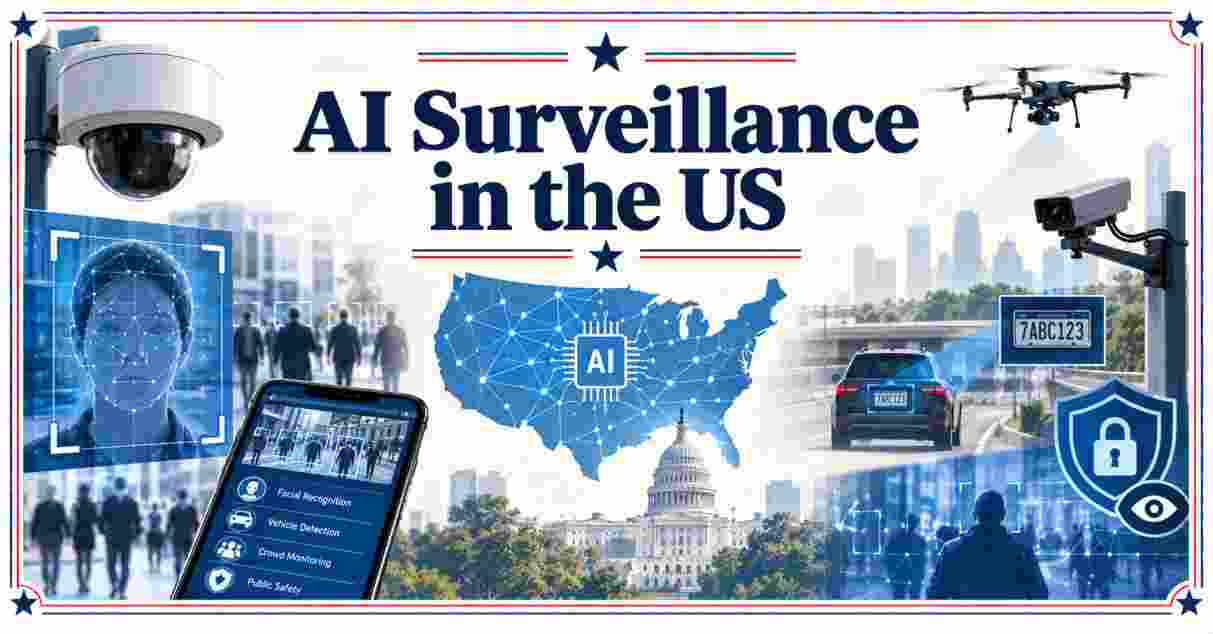
More than 2,000 US law enforcement agencies now have access to facial recognition systems, and over 120,000 AI-powered license plate readers scan roughly 20 billion vehicle movements every month. At the same time, 61% of US companies use AI analytics to monitor employee behavior and productivity.
AI Surveillance in the US 2026 – Introduction
AI surveillance in the US 2026 has expanded faster than the laws meant to govern it. Georgetown Law’s Center on Privacy and Technology has documented that more than 2,000 law enforcement agencies across the country now carry facial recognition access, while researchers estimate roughly half of American adults already sit inside at least one searchable facial recognition database, often without ever being told. Private companies like Clearview AI and Flock Safety have built nationwide surveillance infrastructure largely outside any single federal regulatory framework, selling access to police departments, federal agencies and, increasingly, private businesses.
The reach of AI surveillance in the US 2026 extends well beyond policing. At work, AI-driven monitoring tools now track keystrokes, facial expressions and movement patterns for a majority of American employees, even as a clear majority of the public says they oppose it. States have responded with a wave of new legislation — 155 workplace AI bills and 257 facial recognition and policing bills introduced in 2026 alone — but regulation remains fragmented and inconsistent from state to state. This report breaks down workplace monitoring, police facial recognition, license plate tracking and the legislative response shaping AI surveillance in America, using data confirmed through October 2026.
Interesting Facts About AI Surveillance in the US 2026
| Fact | Confirmed 2026 Data |
|---|---|
| US law enforcement agencies with facial recognition access | 2,000+ |
| Americans believed to be in a searchable facial database | ~50% of adults |
| Flock Safety AI cameras operating nationwide | 120,000+, across 49 states |
| Monthly vehicle scans processed by Flock’s network | ~20 billion |
| US companies using AI analytics to monitor employee behavior | 61% |
| State AI workplace bills considered in 2026 | 155 |
| State facial recognition/policing bills tracked in 2026 | 257, across 34 states |
Source: Georgetown Law Center on Privacy and Technology; Flock Safety; Wikipedia; Multistate.us; AI Laws by State tracker, 2026.
The chart illustrates just how large these three surveillance systems have grown relative to each other: over 2,000 agencies with facial recognition access, more than 120,000 physical AI cameras scanning vehicles nationwide, and a privately held facial database Clearview AI itself claims holds more than 70 billion images. The table underneath adds the workplace dimension — 61% of US companies now use AI analytics to monitor employees, a figure that sits alongside 155 separate state bills introduced in 2026 specifically to regulate that practice.
The scale of legislative activity shown in the table — 257 bills across 34 states targeting police and facial recognition use alone — reflects how unsettled this area of law remains. No comprehensive federal framework governs any of the technologies in this report, leaving a genuinely state-by-state patchwork that varies enormously depending on where in the country a person lives or works.
Police Facial Recognition Statistics 2026: A Technology Without National Rules
PUBLIC OPINION ON POLICE FACIAL RECOGNITION, 2026 (percent of US adults)
Believe it would benefit society     | ██████████████████████████████████████████████ 46%
Remain uncertain                     | ███████████████████████████ 27%
Want government limits on police use | ████████████████████████████████████████████████████ 55%
| Metric | 2026 Figure |
|---|---|
| Law enforcement agencies with facial recognition access | 2,000+ |
| Americans believed enrolled in a searchable facial database | ~50% |
| Clearview AI scraped facial images (company’s own claim) | 70+ billion |
| Clearview AI scraped facial images (journalist-reported estimate) | 30+ billion |
| Adults who want government limits on police facial recognition use | 55% |
Source: Georgetown Law Center on Privacy and Technology; Rolling Out, September 2026; Market.us Facial Recognition Statistics, 2026; Campaign Zero, “The Private Companies Quietly Building a Police State.”
Clearview AI sits at the center of police facial recognition in America, and the scale of its database depends on which source is counting: the company’s own website claims more than 70 billion facial images sourced from public web content, while journalistic investigations have put the figure closer to 30 billion — a wide range, but either number represents the largest known facial recognition database in the world, built almost entirely without the consent of the people whose faces it contains. Thousands of law enforcement agencies, from local police departments to ICE, now use Clearview’s search platform to generate investigative leads from that database.
Public opinion on this technology is genuinely split rather than uniformly opposed. Roughly 46% of American adults believe widespread police facial recognition would benefit society, while 27% remain uncertain — leaving a meaningful plurality open to the technology’s use. At the same time, 55% say they want the government to impose limits on how police specifically can use it, suggesting most Americans support facial recognition in principle but want guardrails on its application, a distinction state legislators have struggled to translate into consistent law. Flock Safety’s own AI-powered camera network has become one of the fastest-growing pieces of this surveillance infrastructure, detailed further in this breakdown of Flock AI camera statistics in the US, which covers the network’s rapid expansion to more than 120,000 locations nationwide.
License Plate Reader Statistics 2026: Flock Safety’s Nationwide Network
FLOCK SAFETY NETWORK GROWTH, 2025-2026
Early 2025 cameras tracked         | ██ 17
Feb 2026 cameras (TechCrunch)      | ████████████████ 80,000
Aug-Sept 2026 cameras (DeFlock)    | ████████████████████████ 119,000-135,000
Current total (Flock's own count)  | ████████████████████████ 120,000+
| Metric | 2026 Figure |
|---|---|
| Flock Safety AI cameras nationwide | 120,000+ across 49 states (all except Alaska) |
| Vehicle scans processed monthly | ~20 billion |
| Vehicle scans per day (average) | ~667 million |
| Vehicle scans per second (average) | ~7,700 |
| Public school systems with Flock cameras installed | 100+ |
| Documented cases of public opposition/contract cancellations (2026) | 100+ (of 150+ total tracked) |
Source: World Socialist Web Site, October 2026; DeFlock.org crowd-sourced mapping; The 74 investigation; TechCrunch, February 2026.
Flock Safety’s automated license plate reader network has grown at a pace few surveillance technologies have matched historically, expanding from roughly 17 tracked cameras at the start of 2025 to more than 120,000 by late 2026, now processing an estimated 20 billion license plate scans every month — a rate of roughly 7,700 scans per second nationwide. The company’s cameras photograph the rear of every passing vehicle by default, logging plate number, color, make, model and distinguishing marks alongside location and time, and Flock reports its devices now operate in 49 of 50 states, with Alaska the sole exception.
The network’s reach into unexpected spaces has drawn particular scrutiny. More than 100 public school districts have installed Flock cameras, originally pitched for student safety, and investigations by The 74 and 404 Media found that data from those school cameras can be searched by law enforcement including the Department of Homeland Security. Separately, despite Flock stating it doesn’t share data with ICE directly, reporting has repeatedly shown local police departments granting federal immigration agents access to searches on their behalf — a pattern that has fueled a genuine backlash, with DeFlock documenting more than 100 instances of camera removals, contract cancellations or rejected proposals in 2026 alone, including residents in Oregon physically cutting down and spray-painting camera poles.
Workplace AI Monitoring Statistics 2026: What Employers Track and Why
EMPLOYER AI MONITORING ADOPTION, 2026 (percent of US employers)
Use video surveillance in physical offices   | ███████████████████████████████████████████████ 69%
Use biometric access controls                | ████████████████████████████████████ 58.3%
Use AI analytics for productivity monitoring | ███████████████████████████████████████ 61%
| Metric | 2026 Figure |
|---|---|
| Employers using video surveillance in physical offices | 69% |
| Employers using biometric access controls | 58.3% |
| Companies using AI analytics for productivity/behavior monitoring | 61% |
| Americans who oppose AI tracking their movements at work | 61% |
| Americans who oppose AI monitoring their desk presence | 56% |
Source: WorkTime, “50+ employee monitoring statistics & data in 2026”; HIGH5 Research Dataset, 2026.
Workplace AI monitoring has moved well past simple login timestamps and activity logs. 69% of employers now use video surveillance inside physical offices, nearly matched by the 58.3% who deploy biometric access controls such as fingerprint scanners, facial recognition and location-tracking badge systems. Layered on top of that physical infrastructure, 61% of US companies use AI-powered analytics specifically to measure employee productivity or behavior, with these systems going beyond simple logging to flag anomalies, score performance and surface behavioral patterns that manual review would never catch.
That expansion runs directly against public sentiment. 61% of Americans oppose employers using AI to track their physical movements at work, and 56% oppose AI systems that monitor whether they’re present at their desk — meaning a clear majority of the workforce rejects practices that are already standard at most companies. This gap between employer adoption and employee acceptance is the central tension driving 2026’s legislative wave, with California’s AB 1883 specifically targeting the most invasive edge of this trend: the bill, sent to the governor’s desk in 2026, would prohibit employers from using workplace surveillance tools that collect neural data or attempt to recognize workers’ emotional states, a direct response to AI tools now capable of analyzing facial expressions and tone of voice in real time. For how this kind of AI-driven analysis compares to the threat-detection side of the AI industry, see this look at Project Glasswing statistics, which covers a parallel 2026 initiative using AI specifically to counter AI-enabled cyberattacks rather than monitor human behavior.
AI Surveillance Legislation 2026: A Fragmented State-by-State Response
2026 STATE LEGISLATIVE ACTIVITY ON AI SURVEILLANCE
Workplace AI monitoring bills               | ██████████████████████████ 155 bills
Facial recognition/police AI bills          | ██████████████████████████████████████████ 257 bills (34 states)
States with facial recognition restrictions | ██████████████████ several states (VT, ME, others)
| Metric | 2026 Figure |
|---|---|
| State AI workplace bills considered (2026 session) | 155 |
| States with facial recognition/policing AI legislation tracked | 34 states, 257 bills |
| California AB 1883 (neural data/emotional recognition ban) | Sent to governor’s desk, 2026 |
| States with biometric privacy laws governing employer data | Multiple states (count varies by tracker) |
Source: Multistate.us, September 2026; AI Laws by State tracker, April 2026; Stateline, June 2026.
The sheer volume of 2026 legislative activity — 155 workplace AI bills and 257 separate facial recognition and police AI bills across 34 states — shows lawmakers responding to public pressure, even if the resulting patchwork remains deeply inconsistent. Some states, including Vermont and Maine, have moved toward outright facial recognition restrictions or moratoriums on government use, while others have focused narrower bills specifically on requiring employee notification before AI-driven workplace surveillance begins, an approach several states proposed in the 2026 session alongside restrictions on monitoring personal devices.
Police departments, meanwhile, have continued adopting AI tools faster than most state legislatures can regulate them. Stateline’s June 2026 reporting found departments nationwide using AI to draft incident reports, analyze body camera footage and manage growing volumes of digital evidence, with vendors including Axon, Motorola Solutions, TRULEO, Flock Safety and Clearview AI all supplying overlapping pieces of this infrastructure. More than a dozen states have passed laws specifically regulating facial recognition, drone surveillance or automated license plate readers, according to the National Conference of State Legislatures — but with no federal floor underneath any of it, the specific rules governing AI surveillance in any given American city depend almost entirely on which state, or even which police department, happens to be involved. The same gap between rapid technology adoption and uneven oversight shows up in how AI tools are reshaping crime analysis more broadly, covered in this look at highest crime cities in the US, where AI-powered surveillance and predictive policing are flagged as a growing source of civil liberties debate even as cities credit the same tools with measurable crime reductions.
Frequently Asked Questions About AI Surveillance in the US 2026
How many US law enforcement agencies use facial recognition?
More than 2,000 law enforcement agencies across the United States have access to facial recognition systems, according to Georgetown Law’s Center on Privacy and Technology.
How large is Clearview AI’s facial recognition database?
Clearview AI’s own website claims more than 70 billion scraped facial images, while independent journalistic investigations have estimated the figure closer to 30 billion. Either number represents the largest known facial recognition database in the world.
How many AI-powered license plate readers are in the US?
More than 120,000 Flock Safety cameras operate across 49 states, processing an estimated 20 billion vehicle scans per month.
Does ICE have access to Flock Safety’s camera network?
Flock Safety states it does not share data with ICE directly, but multiple investigations have found local police departments granting federal immigration agents access to searches of Flock’s database on their behalf.
What percentage of US companies monitor employees using AI?
61% of US companies use AI-powered analytics to measure employee productivity or behavior, according to 2026 workplace monitoring research.
Do most Americans support AI workplace monitoring?
No. 61% of Americans oppose employers using AI to track their physical movements, and 56% oppose AI monitoring of desk presence specifically.
What is California’s AB 1883?
A 2026 bill sent to the governor’s desk that would prohibit employers from using workplace surveillance tools that collect neural data or attempt to recognize employees’ emotional states.
How many states have introduced AI surveillance legislation in 2026?
States considered 155 bills addressing AI in the workplace and a separate 257 bills addressing facial recognition and police AI use across 34 states during the 2026 legislative session.
Is there a federal law regulating AI surveillance in the US?
No comprehensive federal framework currently governs facial recognition, license plate readers or workplace AI monitoring. Regulation exists primarily at the state level and varies significantly by jurisdiction.
What percentage of American adults are in a facial recognition database?
Researchers estimate that roughly half of American adults already have their image stored in at least one database accessible to law enforcement.
Are Flock Safety cameras facing public opposition?
Yes. The crowd-sourced tracking project DeFlock has documented more than 150 cases of opposition nationwide, including over 100 in 2026 alone, ranging from contract cancellations to physical camera removals.
Disclaimer: The data research report we present here is based on information found from various sources. We are not liable for any financial loss, errors, or damages of any kind that may result from the use of the information herein. We acknowledge that though we try to report accurately, we cannot verify the absolute facts of everything that has been represented.