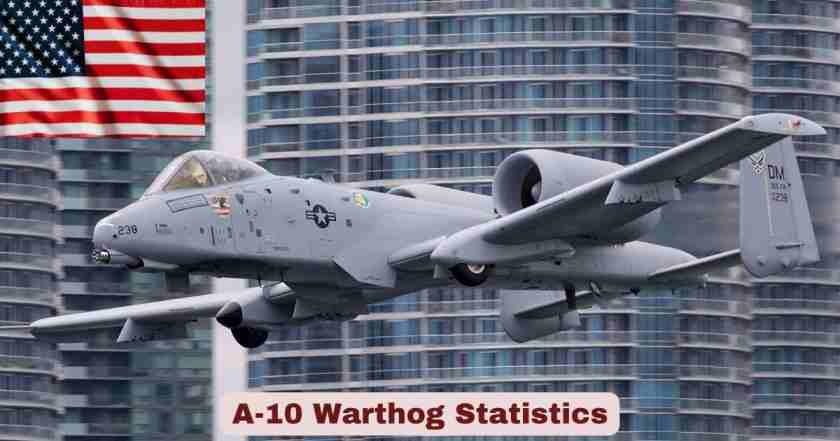
A-10 Warthog in America 2026
The A-10 Thunderbolt II — universally known as the “Warthog” or simply the “Hog” — is a single-seat, twin-turbofan, straight-wing close air support (CAS) attack aircraft designed and built by Fairchild Republic for the United States Air Force. First flown on May 10, 1972, and entering operational service in 1977, the A-10 is the only production aircraft in U.S. Air Force history designed solely for the close air support mission — the lethal, low-altitude, high-exposure task of flying directly over a land battlefield to destroy tanks, armored vehicles, artillery, and ground troops threatening friendly forces below. The aircraft was quite literally engineered around its gun: the GAU-8/A Avenger, a seven-barrel, hydraulically-driven 30mm rotary cannon that fires 3,900 rounds per minute of armor-piercing depleted uranium shells and whose recoil force of 10,000 pounds actually exceeds the thrust of either of the aircraft’s two engines individually. The airframe’s twin General Electric TF34-GE-100 turbofan engines are mounted high on the rear fuselage specifically to keep them clear of ground debris ingestion and combat damage, the cockpit is encased in a titanium “bathtub” providing protection against rounds up to 23mm, and the aircraft can continue flying after losing an engine, half a tail, one elevator, and chunks of wing — a combat survivability philosophy so thorough that the A-10 has in documented instances returned to base with catastrophic structural damage that would have destroyed any other aircraft. In 2026, after 49 years of operational service, the Warthog remains an active combat aircraft — employed during the first 24 hours of Operation Epic Fury against Iran on March 1, 2026, where CENTCOM and General Dan Caine confirmed A-10s were used to “hunt and kill fast-attack watercraft” in the Strait of Hormuz.
The A-10’s story in 2026 is defined by one of the most extraordinary institutional contradictions in modern American military history: it is simultaneously being retired and being sent into active combat operations. The U.S. Air Force’s FY2026 budget request included $57 million to retire all 162 remaining A-10s by the end of FY2026 — an acceleration of the previous retirement schedule that had extended to FY2028. Congress, characteristically unconvinced that the Air Force has a viable replacement ready to assume the A-10’s close air support mission, responded through the FY2026 National Defense Authorization Act (NDAA) by mandating that at least 103 total A-10s must remain in service through September 30, 2026, with 93 designated as Primary Mission Aircraft. The Air Force is simultaneously required to brief Congress by March 31, 2026 with a detailed, tail-number-by-tail-number transition plan covering every proposed divestment through 2029. So as of March 21, 2026, the A-10 is neither fully retired nor fully preserved — it exists in a legislative and operational limbo that reflects the broader dilemma of an Air Force trying to simultaneously fight today’s wars with aging platforms and modernize for tomorrow’s fights against near-peer adversaries who field the advanced air defense systems that make low, slow A-10 operations genuinely dangerous. The aircraft has survived more than a decade of institutional retirement attempts by the same Air Force that continues to deploy it into combat. The A-10 Warthog is perhaps the most tenacious piece of hardware in the American military’s entire inventory — and in 2026, it is still in the fight.
A-10 Warthog Key Facts 2026
| Fact Category | Key Fact / Data Point |
|---|---|
| Official Designation | A-10C Thunderbolt II — current production variant; originally A-10A |
| Common Nicknames | “Warthog”, “Hog”, “Flying Gun”, “Tankbuster”, “BRRRT” |
| Manufacturer | Fairchild Republic Company — Farmingdale, New York (no longer in business) |
| First Flight | May 10, 1972 |
| Entered Operational Service | October 1977 — 354th Tactical Fighter Wing, Myrtle Beach AFB, South Carolina |
| Total Airframes Built | 716 total (all variants, all years — 1972–1984) |
| Active Fleet (March 2026) | Approximately ~150–162 A-10C aircraft — Congress-protected minimum of 103 operational |
| Peak Fleet Size | Approximately ~356 aircraft in early 2000s |
| Total Retirements to Date | 554+ aircraft retired — from 716 built to ~162 remaining |
| FY2026 Air Force Budget Request | $57 million to retire all 162 remaining A-10s in FY2026 — as part of 340-aircraft total retirement plan |
| Congress Response — FY2026 NDAA | Blocked full retirement — mandated minimum 103 total / 93 PMAI through September 30, 2026 |
| NDAA Congressional Briefing Requirement | Full 2027–2029 transition plan with tail-number-level detail due to Congress by March 31, 2026 |
| Most Recent Combat Action (March 2026) | March 1, 2026 — A-10s employed in first 24 hours of Operation Epic Fury (Iran) — confirmed by CENTCOM; General Dan Caine confirmed used to “hunt and kill fast-attack watercraft” in Strait of Hormuz |
| 2025 Combat Action — Middle East | March 29, 2025 — 124th Fighter Wing A-10s deployed to Middle East for Houthi/Yemen operations |
| 2024 Combat Action — Syria | November 29 and December 3, 2024 — A-10s struck pro-Assad forces; December 2024 — A-10s struck 75+ ISIS targets alongside B-52s and F-15Es during Assad regime collapse |
| Aircraft Designed Around | GAU-8/A Avenger 30mm cannon — entire airframe built around the gun |
| Boneyard Storage Location | Davis-Monthan AFB, Tucson, Arizona — “The Boneyard” (AMARG) |
| Unit Flyaway Cost (Original) | $4.7 million (FY1977 dollars); approximately $18–20 million in today’s dollars |
| Annual Operating Cost per Aircraft | Approximately $15–17 million per aircraft per year (USAF estimate) |
| Wing Replacement Program | Boeing wing replacement program for 173 aircraft — extended fleet life significantly |
Source: Wikipedia Fairchild Republic A-10 Thunderbolt II (updated March 20, 2026); USAF Fact Sheet A-10C Thunderbolt II; Defense One June 30, 2025; TheWorldData.com A-10 Statistics (March 2026); FY2026 NDAA (signed December 2025) via Aerospace Global News December 10, 2025; SOFX July 10, 2025; FlightGlobal June 27, 2025; Flying Magazine December 9, 2025
The 716 total A-10 airframes built between 1972 and 1984 represent the entire production run of a single manufacturer — Fairchild Republic — in the last program that company ever produced before ceasing operations. Today, with approximately 162 aircraft remaining, the fleet has shrunk by more than 77% from what was built — a collapse that reflects both natural attrition and 15 years of increasingly aggressive Air Force retirement campaigns, each one blocked or slowed by Congress before eventually succeeding in extracting portions of the fleet. The Boeing wing replacement program — which replaced the wings on 173 aircraft with freshly manufactured wing assemblies, giving them thousands of additional airframe hours — extended service life well beyond what the original structural limits allowed and is directly responsible for many of the remaining aircraft being airworthy at all. Without those replacement wings, the fleet would have shrunk to near-zero on structural grounds years before the current political debate reached its current state. The irony is rich: the Air Force’s own wing replacement investment is one of the reasons it still has A-10s to argue about retiring in 2026.
The March 1, 2026 Operation Epic Fury confirmation that A-10s were employed in the first 24 hours of the Iran campaign — specifically to “hunt and kill fast-attack watercraft” in the Strait of Hormuz, per General Dan Caine — encapsulates everything the congressional defenders of the Warthog have been arguing for years. The A-10 was not designed to kill small boats. It was designed to kill Soviet main battle tanks on the plains of Central Europe. Yet the GAU-8’s depleted uranium armor-piercing rounds tearing through the thin aluminum hulls of IRGC fast-attack craft at 3,900 rounds per minute — delivering a devastating volume of fire that no other aircraft can match against swarming small targets — is exactly the kind of mission adaptation that the Warthog has demonstrated over and over across five decades of service. It was not supposed to kill helicopters in the Gulf War; it killed two. It was not supposed to be the primary counter-drone platform in the Middle East in 2025; A-10 units deployed there for precisely that mission. And it was not supposed to be hunting fast-attack boats in the Strait of Hormuz in 2026; it is doing exactly that. The A-10 keeps outlasting every scenario its critics use to justify retiring it.
A-10 Warthog Technical Specifications Statistics in the US 2026
| Technical Parameter | Specification / Data |
|---|---|
| Crew | 1 (single pilot) |
| Length | 53 ft 4 in (16.26 m) |
| Wingspan | 57 ft 6 in (17.53 m) |
| Height | 14 ft 8 in (4.47 m) |
| Wing Area | 506 sq ft (47.0 sq m) |
| Empty Weight | 29,000 lb (13,154 kg) |
| Max Takeoff Weight | 51,000 lb (23,133 kg) |
| Fuel Capacity | 11,000 lb (4,990 kg) internal fuel |
| Powerplant | Two General Electric TF34-GE-100A turbofan engines |
| Engine Thrust (Each) | 9,065 lb-force (40.3 kN) each — 18,130 lbf total |
| Maximum Speed | 381 knots (439 mph / 706 km/h) at sea level |
| Combat Speed (Typical) | 300–350 knots (345–403 mph) |
| Cruise Speed | 300 knots (345 mph / 555 km/h) |
| Stall Speed | 120 knots (138 mph / 222 km/h) — unusually low; allows precise ground attack passes |
| Range | 2,580 nautical miles (2,970 miles / 4,780 km) — ferry range with full fuel |
| Combat Radius | 250 nautical miles (288 miles / 463 km) — with 1.88 hours loiter |
| Combat Radius (Maximum) | 800 nautical miles (920 miles) — with external tanks |
| Service Ceiling | 45,000 ft (13,716 m) |
| Rate of Climb | 6,000 ft/min (30.5 m/s) |
| Cockpit Protection | 1,200 lb titanium “bathtub” encasing pilot — resists direct 23mm cannon hits |
| Redundant Systems | Dual engines, flight controls, hydraulic systems — aircraft can fly with one engine, partial tail loss, partial wing loss |
| Engine Placement | High rear fuselage — minimizes ground debris ingestion and separates from battle damage in fuselage |
| Wing Design | Straight wing with 9 hardpoints — optimized for heavy weapons load, not high speed |
Source: USAF Official A-10C Fact Sheet; Wikipedia Fairchild Republic A-10 Thunderbolt II (updated March 20, 2026); GlobalSecurity.org A-10 Thunderbolt II; fas.org A-10 specifications; Military Factory A-10C
The A-10’s design philosophy is fundamentally different from every other combat aircraft in the U.S. Air Force’s inventory, and those differences explain both its extraordinary longevity and the Air Force’s consistent desire to retire it. While the F-35 and F-22 are optimized for speed, stealth, and defeating sophisticated integrated air defense systems at high altitude, the A-10 is optimized for low altitude, low speed, high weapons load, and exceptional survivability after being shot. The titanium bathtub — the 1,200-pound cocoon of titanium armor surrounding the pilot’s seat — is the most visible expression of this philosophy: the A-10 is designed to absorb punishment, not avoid it. The maximum 51,000-pound gross takeoff weight relative to the 29,000-pound empty weight means the aircraft can carry 22,000 pounds of weapons and fuel — more than its own empty weight — across nine underwing and fuselage hardpoints, a payload capacity that no modern Western fighter can match at comparable cost. The straight wing design, which sacrifices the high-speed performance of swept-wing fighters, gives the A-10 a 120-knot stall speed that allows it to fly slow, deliberate attack passes against ground targets with a precision that faster aircraft cannot replicate.
The 250-nautical-mile combat radius with loiter is the operational parameter that makes the A-10 irreplaceable for troops in contact. “Loiter time” — the ability to orbit over a battlefield, waiting for ground controllers to designate targets, and then delivering immediate fires — is what separates a dedicated CAS platform from a multi-role fighter dropping in and departing. The A-10 carries 11,000 pounds of internal fuel and can be configured to carry additional external tanks, giving it the ability to remain over a ground battle for extended periods that jets optimized for speed and range simply cannot replicate. When a ground force is in contact with enemy troops at distances measured in meters — when calling in precision-guided bombs would risk friendly casualties from blast radius — the GAU-8’s 30mm fire delivered from a slow, precise A-10 making repeated attack passes provides a form of close fire support that no other fixed-wing aircraft can replicate at the same level of accuracy and discrimination. This is why every ground commander who has served in a theater with A-10s available becomes their most vocal defender — and why Congressional representatives from states with A-10 units reliably vote to block retirement.
A-10 Warthog GAU-8 Avenger Cannon Statistics in the US 2026
| GAU-8/A Avenger Parameter | Data / Specification |
|---|---|
| Official Designation | General Electric GAU-8/A Avenger (produced by General Dynamics since 1997) |
| Full System Designation | A/A 49E-6 Gun System |
| Caliber | 30×173mm |
| Number of Barrels | Seven (7) — Gatling-type rotary design |
| Rate of Fire (Fixed) | 3,900 rounds per minute (65 rounds per second) — fixed rate since redesign; original: selectable 2,100 or 4,200 rpm |
| Muzzle Velocity | 1,013–1,070 meters per second (Mach 3+) |
| Effective Range (Design Optimum) | 4,000 feet (1,220 meters) in a 30-degree dive |
| Accuracy | 80% of rounds within a 40-foot (12.4 m) diameter circle from 4,000 feet |
| Rounds per Second (Sustained) | 65 rounds per second (after 0.5-second spin-up; 50 rounds first second) |
| Magazine Capacity | 1,174 rounds maximum; 1,150 rounds typical combat load |
| Total Fire Duration (Full Magazine) | Approximately 18 seconds at sustained rate — gun fired in 1–2 second bursts in practice |
| Gun Weight (Alone) | 620 lb (280 kg) |
| Full System Weight (Gun + Feed + Full Drum) | 4,029 lb (1,828 kg) with full ammunition load |
| Total System Length | 19 ft 5.5 in (5.93 m) — muzzle to rearmost point |
| Ammunition Drum Diameter | 34.5 inches (88 cm) |
| Ammunition Drum Length | 71.5 inches (1.82 m) |
| Gun’s Share of A-10 Unladen Weight | ~16% — the gun is 16% of the aircraft’s empty weight |
| Recoil Force | 10,000 lb-force (45 kN) — exceeds thrust of each A-10 engine individually |
| Effect of Recoil on Aircraft Speed | Gun recoil reduces aircraft airspeed while firing |
| Mount Position | Slightly offset to port — firing barrel aligned with aircraft centerline on starboard side |
| Tail Jack Required When | A jack must be placed under the A-10’s tail whenever the gun is removed — aircraft tips rearward without gun’s counterbalancing weight |
| Primary Ammunition — API | PGU-14/B Armor-Piercing Incendiary — depleted uranium core; 14 oz projectile |
| Primary Ammunition — HEI | PGU-13/B High-Explosive Incendiary — steel jacket, HEI mix, impact fuse; 13.3 oz projectile |
| Standard Ammo Mix | 5-to-1 ratio of API (PGU-14/B) to HEI (PGU-13/B) |
| Armor Penetration — API @ 500 meters | 69 mm of Rolled Homogeneous Armor (RHA) at 30-degree attack angle |
| Armor Penetration — API @ 1,000 meters | 38 mm of RHA |
| Cannon Inspection Interval | Every 36 months or 25,000 rounds — full disassembly, cleaning, inspection |
| Gulf War Confirmed Kills (1991) | 900+ Iraqi tanks, ~2,000 military vehicles, ~1,200 artillery pieces |
Source: Wikipedia GAU-8 Avenger (updated March 19, 2026); General Dynamics Ordnance and Tactical Systems — GAU-8/A Data Sheet (gdots.com); Military.com GAU-8 Avenger profile; The Aviationist July 2025 (engineering/maintenance); Fourmilab.ch GAU-8 technical analysis; Weaponsystems.net GAU-8 profile; MilitaryUpdate.net GAU-8 Avenger analysis July 2025
The GAU-8/A Avenger’s 10,000 lb-force recoil exceeding the thrust of each of the A-10’s engines is not merely an interesting engineering footnote — it is the defining physical fact around which the entire airframe was designed. The gun is mounted slightly to port of the aircraft’s centerline specifically so that the firing barrel (which rotates to the starboard position at the 9 o’clock position of the cylinder’s rotation as the gun fires) is aligned exactly on the centerline when it discharges. This ensures that the massive recoil force acts through the aircraft’s center of mass rather than off to one side, which would torque the aircraft out of alignment with the target. The front landing gear is positioned to the starboard side to compensate for this asymmetric gun placement. The tail jack requirement — a maintenance procedure mandating that a support jack be placed under the A-10’s tail whenever the GAU-8 is removed for inspection — highlights that the aircraft’s entire center of gravity is calibrated around the gun’s weight. Remove the gun, and the aircraft physically tips backward. It is not possible to state more clearly that a machine was built around a single component.
The Gulf War kill record — confirmed by official after-action assessments as 900+ Iraqi tanks, ~2,000 military vehicles, and ~1,200 artillery pieces — established the A-10/GAU-8 combination as the most lethally effective anti-armor air weapon ever deployed in combat. That kill count, achieved across 44 days of combat operations in 1991, is a record that no subsequent air platform has approached in scope or efficiency against armored formations. The depleted uranium core of the PGU-14/B API round — heavier and harder than standard steel penetrators — punches through 69mm of rolled homogeneous armor at 500 meters, sufficient to defeat the top and side armor of most main battle tanks at attack angles the A-10 routinely achieves. At 65 rounds per second, a single 2-second burst delivers 130 depleted uranium rounds onto a tank — a volume of penetrating fire that creates multiple hull breaches, ignites fuel, detonates ammunition, and produces catastrophic vehicle kills with a reliability that guided missiles achieve only one at a time, at far higher cost. This is what ground commanders mean when they describe the Warthog as irreplaceable.
A-10 Warthog Weapons Payload and Armament Statistics in the US 2026
| Weapons / Payload Parameter | Data / Specification |
|---|---|
| Internal Gun | GAU-8/A Avenger 30mm cannon — 1,150-round typical load |
| External Hardpoints | 11 total — 8 under-wing + 3 under-fuselage (1 centerline + 2 side) |
| Maximum External Weapons Load | 16,000 lb (7,257 kg) |
| Guided Bombs — Precision | GBU-10, GBU-12 Paveway II/III laser-guided bombs (500–2,000 lb) |
| JDAM | GBU-31, GBU-38 Joint Direct Attack Munition (GPS-guided) |
| Small Diameter Bomb | GBU-39/B SDB — 250 lb; can carry multiple per hardpoint |
| Rockets | Hydra 70mm rockets in LAU-61 pods; 2.75-inch folding fin aircraft rockets |
| Air-to-Ground Missiles | AGM-65 Maverick — infrared/laser-guided; primary anti-armor missile |
| Anti-Ship / Anti-Boat Capability | AGM-65 Maverick + GAU-8 combination — confirmed against IRGC fast-attack craft March 2026 |
| Air-to-Air Missiles (Emergency) | AIM-9 Sidewinder — self-defense only |
| Countermeasures | AN/ALQ-184 ECM pod; ALE-47 chaff/flare dispensers; ALR-69 RWR |
| Targeting Pod | AN/AAQ-28 LITENING or AN/AAQ-33 Sniper Advanced Targeting Pod (ATP) |
| ROVER (Remotely Operated Video Enhanced Receiver) | Datalink system enabling ground troops and pilots to share real-time video targeting data |
| Maximum Single Weapon Size | Mk 84 2,000 lb unguided bomb or equivalent-weight guided variant |
| Laser Designator Pod | LITENING AT or Sniper — self-designating laser capability for LGB delivery |
| Counter-UAS Role (Confirmed 2025) | A-10s confirmed hunting and downing Iranian-supplied Shahed-type drones in Middle East, 2025 |
| Total Weapons Load Example (CAS Config) | 4× AGM-65 Maverick + 2× AIM-9 Sidewinder + 2× SUU-25 flare dispensers + full GAU-8 load |
Source: USAF A-10C Fact Sheet; Wikipedia Fairchild Republic A-10 Thunderbolt II; GlobalSecurity.org A-10 weapons; Military Factory A-10C armament; TheWorldData.com A-10 Statistics March 2026; Wikipedia General Dynamics F-16 Fighting Falcon (counter-UAS comparison); Zona Militar December 14, 2025
The 11 hardpoints carrying up to 16,000 pounds of external weapons give the A-10 an ordnance-carrying capacity that exceeds many dedicated strike aircraft at a fraction of their cost. The AGM-65 Maverick missile — available in infrared-guided (AGM-65B/D), television-guided (AGM-65A), and laser-guided (AGM-65E/G) variants — is the primary air-to-ground precision weapon for the A-10 outside the GAU-8, capable of engaging armored vehicles, fortifications, small ships, and hardened bunkers at ranges of several miles. In the March 2026 Operation Epic Fury employment against Iranian fast-attack craft, the combination of AGM-65 Maverick strikes at standoff range and GAU-8 strafing runs at closer distances represents exactly how A-10 pilots are trained to sequence their weapons against fast-moving small-boat swarms — beginning at distance with guided missiles and transitioning to the cannon for targets that close the range or survive initial hits. The ROVER datalink system — which allows ground combat controllers to see exactly what the A-10’s targeting pod camera sees in real time — is the technology that makes the A-10’s CAS integration with Army and Marine ground forces so precise, allowing a soldier on the ground to tell a pilot “I can see the target on your screen, clear hot” rather than relying purely on verbal description of terrain.
The counter-UAS mission that A-10 units executed in the Middle East throughout 2025 — confirmed by Zona Militar’s December 2025 reporting that A-10s had destroyed Shahed-type Iranian drones during CENTCOM operations — represents the Warthog’s most unexpected 21st-century role. The GAU-8’s high volume of fire and relatively low cost per round (compared to air-to-air missiles) makes it a potentially effective counter against cheap, mass-produced drones that are not worth engaging with a $400,000 AIM-120 AMRAAM. An A-10 expending GAU-8 rounds at 65 rounds per second against a Shahed drone costing less than $50,000 is a favorable exchange ratio that no other USAF platform can replicate at comparable cost. The congressional arguments for preserving the A-10 consistently underscore this adaptability: every time the Air Force identifies a mission the A-10 cannot perform, the aircraft’s crews and operators find a way to make it work. Counter-tanks in 1991, counter-insurgency in Afghanistan, counter-ISIS in Syria, counter-drones in Yemen in 2025, counter-fast-boats in the Strait of Hormuz in 2026 — the Warthog keeps finding new reasons to exist.
A-10 Warthog Fleet and Retirement Statistics in the US 2026
| Fleet / Retirement Metric | Data / Statistic |
|---|---|
| Total A-10s Built (All Variants) | 716 aircraft — built 1972–1984 by Fairchild Republic |
| Active Fleet (FY2023) | Approximately 281 aircraft (prior to recent acceleration) |
| Active Fleet (FY2025) | Approximately 270 A-10C — per Wikipedia (citing USAF 2025 data) |
| Active Fleet (March 2026) | Approximately ~150–162 aircraft — FY2026 retirements ongoing |
| FY2023 Retirements | 21 aircraft |
| FY2024 Retirements | At least 42 aircraft |
| FY2025 Retirements (Authorized) | 56 aircraft authorized |
| FY2026 Air Force Budget Request | Retire all remaining 162 A-10s in FY2026 — $57 million allocated |
| FY2026 NDAA Congressional Mandate | Minimum 103 total A-10s retained through September 30, 2026; minimum 93 Primary Mission Aircraft (PMAI) |
| Congress Briefing Deadline | USAF must deliver full tail-number-level 2027–2029 transition plan by March 31, 2026 |
| Original Planned Retirement Year | FY2028 (before FY2026 acceleration request) |
| Prior Planned Retirement Year | “End of the decade” — USAF stated in multiple budget cycles before 2025 |
| Accelerated Retirement Rationale (USAF) | Part of 340-aircraft total FY2026 retirement plan — fund modernization; address cost-cutting directive from SecDef Hegseth; “A-10 too vulnerable for future contested airspace” |
| Retirement Cost | $57 million for full fleet retirement — included in FY2026 budget |
| Boneyard Aircraft at Davis-Monthan (AMARG) | Hundreds of earlier-retired A-10s stored — some potentially restorable |
| Boeing Wing Replacement Program | 173 aircraft received new wing assemblies — extended their structural service life |
| A-10 Annual Fleet Operating Cost | Approximately $15 million per aircraft per year — USAF cited as unsustainable for aging platform |
| Total Annual Cost for 103-Aircraft Fleet | Approximately $1.5–1.8 billion per year |
| South Korea A-10 Replacement | Upgraded F-16Cs began replacing A-10s in South Korea FY2025 |
| Taiwan Transfer Proposal | Discussed in Congress 2025 — no formal decision as of March 2026 |
Source: Wikipedia Fairchild Republic A-10 Thunderbolt II (March 20, 2026); Flying Magazine December 9, 2025 (NDAA fleet mandates); Aerospace Global News December 10, 2025 (FY2026 NDAA analysis); SOFX July 10, 2025; Defense One June 30, 2025; FlightGlobal June 27, 2025; National Security Journal July 6, 2025; Eurasian Times July 3, 2025; Defense Security Monitor July 1, 2025
The annualized retirement rate for the A-10 fleet tells a story of accelerating divestment that the NDAA’s congressional floor has been straining to slow. Starting at 21 retirements in FY2023, progressing to at least 42 in FY2024 and 56 authorized in FY2025, the trajectory shows a fleet being drawn down at nearly triple the original pace within three fiscal years. From 281 aircraft in early FY2023 to approximately 150–162 by early 2026 — a reduction of roughly 40–47% in three years — the A-10 fleet is shrinking faster than any other major USAF aircraft type in the same period. The congressional mandate holding the floor at 103 aircraft through September 30, 2026 is a temporary dam against this flow, not a structural reversal of it: the same NDAA that mandates the 103-aircraft minimum also requires the Air Force to deliver its 2027–2029 divestment plan by March 31, 2026, signaling that Congress is not trying to save the A-10 permanently — it is demanding proof that the Air Force has a credible transition plan before allowing the final retirements to proceed. That briefing deadline has almost certainly passed or is passing this week, making the March 31, 2026 USAF congressional briefing one of the most consequential near-term events in the aircraft’s final chapter.
The Taiwan transfer discussion — raised in multiple congressional hearings and defense analysis circles throughout 2025 — reflects a creative attempt to give the A-10 a post-USAF life while simultaneously addressing Taiwan’s need for combat aircraft that could resist a Chinese amphibious invasion. Taiwan’s military planners have publicly expressed interest in a platform capable of massing anti-armor fires against Chinese PLAN amphibious assault vehicles attempting to cross the Taiwan Strait beach zones — a mission the A-10 was literally designed for. The political and technical challenges of a foreign military sale of active USAF aircraft during an active draw-down are significant, and no formal decision had been reached as of March 2026. But the conversation itself is a testament to the A-10’s reputation: when military planners around the world think about what would work best against massed armor on a defended beach, they think of the Warthog. After 49 years of service, 716 airframes built, 554 retired, and more than a dozen countries watching them storm Iranian fast boats in the Strait of Hormuz in 2026, the A-10 Thunderbolt II has earned a legacy that no retirement memo can erase.
A-10 Warthog Combat History and Operational Statistics in the US 2026
| Operation / Conflict | Year(s) | A-10 Role / Achievement |
|---|---|---|
| IOC / First Deployment | 1977 | 354th TFW Myrtle Beach AFB — first operational unit; deployed to Europe for NATO Cold War deterrence |
| Operation El Dorado Canyon (Libya) | 1986 | A-10s based in UK; flew support sorties |
| Operation Desert Shield / Desert Storm (Gulf War) | 1990–1991 | 144 A-10s deployed; 900+ Iraqi tanks, ~2,000 military vehicles, ~1,200 artillery destroyed; two Iraqi helicopters shot down (air-to-air) with GAU-8; 8 aircraft lost in combat or accidents |
| Operation Deliberate Force (Bosnia) | 1994–1995 | CAS strikes against Bosnian Serb positions; confirmed kills |
| Operation Allied Force (Kosovo) | 1999 | CAS and BAI strikes in Serbia/Kosovo; operated over contested territory |
| Operation Enduring Freedom (Afghanistan) | 2001–2014+ | Became primary CAS platform for US ground forces; flew over 75,000 sorties in Afghanistan; beloved by Army and Marine troops |
| Operation Iraqi Freedom / Operation New Dawn | 2003–2011 | Primary CAS in Iraq; thousands of sorties; protected ground convoys, struck IED emplacers, provided convoy escort |
| Operation Inherent Resolve (Syria/Iraq — ISIS) | 2014–2021+ | Extensively used against ISIS — struck armor, vehicles, command nodes, and fighters |
| Syria Strike — Assad Forces | November 29 & December 3, 2024 | A-10s struck pro-Assad vehicles, mortars, and T-64 tank to protect US forces in eastern Syria |
| Syria — Anti-ISIS Strikes (Assad Collapse) | December 2024 | A-10s participated in “dozens” of airstrikes against 75+ ISIS targets alongside B-52s and F-15Es during Assad regime collapse |
| Middle East / Yemen Deployment | March 29, 2025 | 124th Fighter Wing A-10s deployed to CENTCOM AOR for Houthi operations; A-10s confirmed hunting Iranian Shahed drones |
| Operation Epic Fury (Iran War) | March 1, 2026 — ONGOING | A-10s confirmed employed in first 24 hours of Operation Epic Fury; General Dan Caine: A-10s used for “hunting and killing fast-attack watercraft” in Strait of Hormuz |
Source: Wikipedia Fairchild Republic A-10 Thunderbolt II (updated March 20, 2026); CENTCOM Public Affairs — Operation Epic Fury statement March 1, 2026; GlobalSecurity.org A-10 history; MilitaryUpdate.net GAU-8 Gulf War kills; Zona Militar December 14, 2025 (drone kills); USAF A-10 historical records
The 44 days of Operation Desert Storm in 1991 remain the defining combat performance of the A-10 Thunderbolt II — the test against which every argument for and against its retention is ultimately measured. The destruction of over 900 Iraqi tanks, approximately 2,000 military vehicles, and 1,200 artillery systems by 144 deployed A-10s produced a kill rate per aircraft that no single platform in any Air Force has matched in any subsequent conflict. The two Iraqi helicopter kills with the GAU-8 — a weapon designed to destroy tanks, not aircraft — demonstrated the system’s versatility in ways even its designers had not predicted. The loss of 8 aircraft in those 44 days, while significant, represented a 5.5% loss rate for a platform flying at extremely low altitudes over a heavily armed adversary — a rate that Air Force planners concluded was acceptable in that environment but would be catastrophic against a near-peer adversary like China or Russia with modern integrated air defense systems. That threat assessment is the core of the Air Force’s retirement argument and the reason it has been sustained despite congressional resistance: the Warthog’s survivability depends entirely on the threat environment being permissive enough to let it get low and slow.
The operational record from December 2024 through March 2026 — three months of continuous A-10 combat action across Syria, Yemen, and now the Strait of Hormuz — is the most sustained combat use of the type since the Afghan campaign and directly contradicts the narrative that the A-10 is a platform without a current mission. The December 2024 strikes targeting 75 ISIS positions during the Assad regime collapse demonstrated the platform’s continued relevance in counter-insurgency and non-state actor scenarios. The 2025 Houthi deployment of the 124th Fighter Wing — an Air National Guard unit from Boise, Idaho — confirmed that Guard A-10 units are fully integrated into CENTCOM combat operations, not merely reserve training organizations. And the March 1, 2026 Strait of Hormuz employment against Iranian fast-attack craft — a mission that would have seemed implausible for a Cold War tank-killer just five years ago — demonstrates that in the hands of skilled pilots supported by targeting pods, ROVER datalinks, and a full arsenal of precision weapons, the A-10 Thunderbolt II keeps finding new ways to be the most useful aircraft in the theater it is assigned to. That is a 49-year record that very few weapons systems in history have matched.
Disclaimer: The data research report we present here is based on information found from various sources. We are not liable for any financial loss, errors, or damages of any kind that may result from the use of the information herein. We acknowledge that though we try to report accurately, we cannot verify the absolute facts of everything that has been represented.