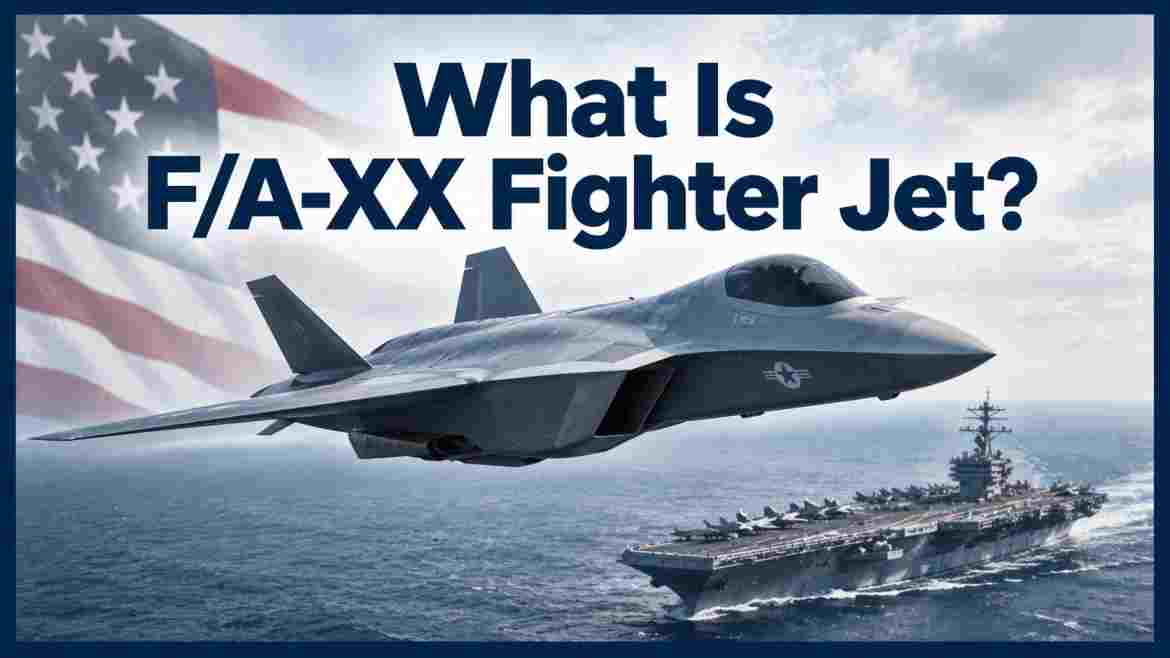
On September 29, 2026, the Pentagon awarded Boeing a full-scale development contract worth more than $20 billion to build the F/A-XX, the US Navy’s first sixth-generation carrier-based fighter, beating out rival Northrop Grumman. The win gives Boeing both of America’s crewed sixth-generation fighter programs, alongside the Air Force’s F-47, marking the first time a single company has captured both frontline fighter competitions since the 1970s.
What Is F/A-XX Fighter Jet?
F/A-XX Fighter Jet is the US Navy’s answer to a question it first started asking in 2008: what comes after the F/A-18 Super Hornet? The Super Hornet fleet is approaching the end of its roughly 9,000-hour service life by the early 2030s, and the Navy needs a replacement carrier-based strike fighter capable of operating alongside the F-35C while extending the reach and survivability of the carrier air wing against increasingly capable adversary air defenses, particularly in the Pacific. After nearly two decades of on-and-off development, requirement changes, and a competition that outlasted its own expected timeline by more than a year, the Navy finally has its answer: Boeing, building the aircraft at its St. Louis, Missouri facility, the same plant that currently produces the outgoing Super Hornet and EA-18G Growler.
The September 29 announcement closed out a competition that had grown so quiet in recent months that defense reporters described it as being “in limbo,” following an 18-month-plus pause in public news about the program’s progress and a funding dispute between the Navy, Congress, and the White House that at one point threatened to derail the effort entirely. Lockheed Martin, the third original competitor, was eliminated from the running back in March 2025, leaving Boeing and Northrop Grumman as the final two contenders heading into this year’s decision.
Interesting Facts about F/A-XX Fighter Jet 2026
| Category | Figure |
|---|---|
| Contract award date | September 29, 2026 |
| Contract value (full-scale development phase) | More than $20 billion |
| Winning company | Boeing (St. Louis, Missouri) |
| Runner-up | Northrop Grumman |
| Eliminated earlier in competition | Lockheed Martin (March 2025) |
| Companion contract to wind down Super Hornet/Growler lines | ~$16.7 million |
| FY2026 congressional funding approved for the program | $1.7 billion |
| Range advantage over F-35C | ~25% greater |
| Expected entry into service | 2030s, replacing F/A-18E/F Super Hornets and EA-18G Growlers |
The single most striking fact about the F/A-XX award is the position it puts Boeing in: the company now holds both of the US military’s crewed sixth-generation fighter contracts, having already won the Air Force’s F-47 program in March 2025. According to defense analysts, no single company has won separate US Air Force and US Navy frontline fighter competitions since the 1970s, making the F/A-XX award as significant for what it says about America’s fighter-jet industrial base as for the aircraft itself. That concentration of two massive, technically demanding programs inside one company has already prompted public speculation about whether the US aerospace industry has the capacity to develop both aircraft simultaneously without one program slowing the other down.
The timing of the award also carries a bittersweet note for Boeing’s existing Navy production line. On the very same day the F/A-XX contract was announced, the Navy issued Boeing a much smaller, roughly $16.7 million contract specifically to plan the orderly shutdown of the Super Hornet and Growler production lines in St. Louis — the same facility that will now build the F/A-XX. One Boeing Navy fighter program is closing its doors just as the next one opens them, a transition years in the making but only now becoming official.
The September 2026 Contract: What Boeing Actually Won
F/A-XX COMPETITION TIMELINE
LOCKHEED MARTIN ELIMINATED   ████  March 2025
NAVY DECISION EXPECTED       ████████████████  ~August 2026
CONTRACT AWARDED TO BOEING   ████████████████████  Sept 29, 2026
| Element | Detail |
|---|---|
| Announcing body | US Department of War (Pentagon) |
| Contract phase | Full-scale (Engineering and Manufacturing) development |
| Contract includes | Multiple test aircraft for ground, airworthiness, systems, and weapons integration testing |
| Original expected decision date | By the end of August 2026 |
| Actual announcement date | Tuesday, September 29, 2026 |
| Key official statement | Acting Navy Secretary Hung Cao called it “a new era for the U.S. Navy” |
Data Source: US Department of War contract announcement, USNI News, Naval News
The F/A-XX award is structured as a full-scale development contract, meaning it funds the detailed engineering, manufacturing, and testing phase that follows a competition win, rather than a production order for operational squadrons. Per the Pentagon’s own announcement, the contract “procures multiple test aircraft for ground, airworthiness, systems, and weapons integration testing,” the standard next step before an aircraft moves toward low-rate initial production. Michael Duffey, Under Secretary of War for Acquisition and Sustainment, and Acting Navy Secretary Hung Cao both spoke at the September 29 announcement, with Cao describing the sixth-generation fighter as delivering “a generational leap in air superiority” for Navy aviators.
The decision arrived considerably later than originally planned. The Navy had been expected to name a winner by the end of August 2026, but the announcement slipped into late September following what Reuters and other outlets described as a genuine funding dispute pitting the Navy and some members of Congress against the White House’s cost-assessment office, which at one point reportedly considered redirecting F/A-XX development money to other programs. Congress ultimately approved $1.7 billion for the program as part of the Fiscal Year 2026 defense budget and explicitly directed the Pentagon to move forward with an Engineering and Manufacturing Development contract award, effectively forcing the decision that arrived in late September. For a broader look at how naval personnel levels are tracking alongside this expanding aircraft program, see our US Navy Personnel Statistics report.
F/A-XX Capabilities and Features in 2026
KEY F/A-XX PERFORMANCE TARGETS VS. F-35C
RANGE                ████████████████████████████████  +25%
PAYLOAD CAPACITY     ████████████████████████████       Substantially greater
STEALTH GENERATION   ██████████████████████████████████  6th-gen / "stealth++"
| Feature | Detail |
|---|---|
| Range | ~25% greater than the F-35C (roughly 837 nautical miles in earlier competition benchmarks) |
| Stealth | Advanced next-generation, low-observable stealth features and signature reduction |
| Propulsion | Supercruise capability (sustained supersonic flight without afterburner) |
| Drone teaming | Can control multiple Collaborative Combat Aircraft (CCA) “loyal wingman” drones simultaneously |
| Sensors/AI | Advanced networked sensors, AI-assisted targeting and data fusion |
| Refueling | Interoperable with the MQ-25 Stingray unmanned carrier-based tanker |
| Cockpit configurations observed | Both single-seat and side-by-side tandem layouts, the latter for a dedicated drone “mission coordinator” |
Data Source: US Navy program statements, Wikipedia F/A-XX program page, The War Zone, Naval News
F/A-XX’s headline performance target is range: the aircraft is designed to extend the effective reach of the carrier air wing by roughly 25% over the F-35C, addressing a long-standing Navy concern that its current carrier-based aircraft can’t project power far enough into contested airspace against adversaries fielding longer-range anti-ship and air-defense systems. That extra range is paired with supercruise capability, letting the aircraft sustain supersonic speeds without relying on fuel-hungry afterburners, and next-generation stealth shaping intended to reduce its radar signature well beyond what the F-35C or F/A-18 offer today.
Perhaps the most operationally significant feature isn’t about the F/A-XX flying alone at all: it’s built from the outset to control Collaborative Combat Aircraft, the Navy’s family of semi-autonomous “loyal wingman” drones, coordinating their sensors and weapons alongside its own. The Navy has framed this manned-unmanned teaming as central to its entire sixth-generation concept, with senior officers explicitly folding CCA development into the same conceptual umbrella as F/A-XX itself, and describing artificial intelligence as “part of that” broader vision. The Navy currently has four separate CCA designs under contract from General Atomics, Boeing, Anduril, and Northrop Grumman, all of which are expected to eventually operate under F/A-XX direction once both systems mature. The aircraft is also designed to be refueled in flight by the Navy’s MQ-25 Stingray unmanned tanker drone, itself still working through its own production delays as it heads toward carrier deployment.
Boeing vs. Northrop Grumman: How the Competition Played Out
F/A-XX COMPETITORS AND OUTCOMES
LOCKHEED MARTIN   ████  Eliminated, March 2025
NORTHROP GRUMMAN  █████████████  Runner-up, Sept 2026
BOEING            █████████████████████  Winner, Sept 2026
| Company | Status | Key Detail |
|---|---|---|
| Boeing | Winner | Also holds the Air Force’s F-47 contract (awarded March 2025) |
| Northrop Grumman | Runner-up | Publicly teased its own F/A-XX design; also builds the B-21 Raider bomber |
| Lockheed Martin | Eliminated | Dropped from F/A-XX competition in March 2025 |
Data Source: Naval News, USNI News, 19FortyFive
The F/A-XX competition originally involved all three of America’s major fighter-jet primes, but Lockheed Martin was cut from contention back in March 2025, leaving the contest as a straight two-way fight between Boeing and Northrop Grumman heading into 2026. Northrop Grumman publicly teased its own F/A-XX design concept earlier this year, with a teaser video that observers noted bore a strong resemblance to the company’s YF-23 stealth demonstrator, the aircraft that famously lost the Air Force’s competition that produced the F-22 Raptor back in 1991 — an echo some commentators saw as a pointed, if unsuccessful, callback.
Boeing’s win means the company now simultaneously manages two of the most technically ambitious fighter programs in the world, alongside continued production responsibilities for legacy aircraft. Industry observers have pointed to Boeing’s multibillion-dollar investment in expanding its own fighter development and manufacturing capacity, made in the period between the F-47 award and the F/A-XX decision, as likely central to its success in a second consecutive sixth-generation competition — a scale of investment that also raises the stakes considerably if either program runs into cost overruns or schedule delays.
F/A-XX vs. F-47: Two Sixth-Gen Fighters, One Company
BOEING'S TWO SIXTH-GENERATION FIGHTER PROGRAMS
F-47 (AIR FORCE)     ████████████████████████████  Awarded March 2025, first flight targeted 2028
F/A-XX (NAVY)        ████████████████████  Awarded Sept 2026, first flight uncertain
| Program | Service | Awarded | Target First Flight |
|---|---|---|---|
| F-47 | US Air Force | March 21, 2025 | 2028 |
| F/A-XX | US Navy | September 29, 2026 | Uncertain; could follow by decade’s end if pace matches F-47 |
Data Source: Naval News, Simple Flying, The War Zone
Boeing’s Air Force sixth-generation fighter, the F-47, was awarded roughly eighteen months before the F/A-XX and is reportedly on track for a first flight in 2028 — a tailless jet described by aviation analysts as featuring “multi-spectral stealth,” sometimes referred to informally as “stealth++” given how far it pushes beyond current fifth-generation signature reduction. If the F/A-XX program follows a similar roughly three-year gap between contract award and first flight, the Navy’s fighter could take to the air as soon as the end of the decade, though naval analysts caution that timeline assumes no major delays, and the Navy’s program has historically moved more slowly and secretively than its Air Force counterpart.
The two aircraft are not identical designs adapted for different services; they answer different operational requirements. The F-47 is built around Air Force expectations for a long-range air superiority platform operating from land bases, while the F/A-XX must additionally satisfy the much harsher structural, weight, and operational demands of catapult launches and arrested carrier landings, along with corrosion resistance for sustained sea deployment. Both programs, however, share the same underlying sixth-generation philosophy: a crewed “quarterback” aircraft directing formations of autonomous Collaborative Combat Aircraft drones, extreme low-observability, and advanced networked sensor fusion, reflecting a broader shift across the US military toward manned-unmanned teaming as the organizing concept for next-generation air power. That same manned-unmanned teaming logic is already reshaping how the Navy thinks about its existing carrier aviation assets, a dynamic covered in more detail in our MV-22 Osprey Statistics report. For more on how the broader US military basing and deployment picture supports these next-generation platforms, our US Military Bases Around the World report covers the global footprint these aircraft will eventually operate from.
What Happens Next: Replacing the Super Hornet Fleet
| Milestone | Detail |
|---|---|
| Super Hornet service-life limit | ~9,000 flight hours, reached by the early 2030s |
| Aircraft F/A-XX replaces | F/A-18E/F Super Hornet and EA-18G Growler |
| Aircraft F/A-XX complements (not replaces) | F-35C Lightning II |
| Production line location | St. Louis, Missouri (Boeing) |
| Formal Navy aircraft designation | Not yet announced as of the contract award |
Data Source: Wikipedia F/A-XX program page, The War Zone, USNI News
The F/A-XX’s core mission, per the Navy’s own program requirements, is to replace the aging F/A-18E/F Super Hornet strike fighter and EA-18G Growler electronic-warfare aircraft beginning sometime in the 2030s, while operating alongside — not replacing — the F-35C, which will continue serving as the carrier air wing’s primary stealth strike platform for years to come. That distinction matters because it shapes how the two aircraft will be employed together: the F-35C bringing proven fifth-generation stealth and sensor fusion already in service today, and the F/A-XX bringing longer range, drone-quarterbacking capability, and next-generation signature reduction once it eventually joins the fleet.
Notably, as of the contract announcement, the Navy had not yet assigned the aircraft a formal service designation — it remains “F/A-XX” for now, an experimental program name rather than an operational aircraft designation like “F/A-18” or “F-35.” That detail, combined with the Navy’s historically tight-lipped approach to program details compared with the Air Force’s more public F-47 rollout, means much of the aircraft’s exact specifications, unit cost, and total planned fleet size remain undisclosed even after this contract award. What is clear is the strategic logic driving the whole effort: with China actively flight-testing its own next-generation fighter concepts, the Navy has made clear it sees F/A-XX’s combination of range, stealth, and drone-teaming capability as essential to maintaining carrier-based air superiority in a potential Pacific conflict scenario through the 2030s and beyond.
Frequently Asked Questions
What is the F/A-XX?
The F/A-XX is the US Navy’s next-generation, sixth-generation, carrier-based strike fighter, being developed by Boeing to replace the F/A-18E/F Super Hornet and EA-18G Growler beginning in the 2030s, while operating alongside the F-35C.
Who won the F/A-XX contract?
Boeing won the F/A-XX competition, beating Northrop Grumman. The Pentagon announced the award on September 29, 2026. Lockheed Martin, the program’s third original competitor, had been eliminated from contention back in March 2025.
How much is the F/A-XX contract worth?
The full-scale development contract is valued at more than $20 billion, covering the engineering, manufacturing, and testing phase, including multiple test aircraft for ground, airworthiness, systems, and weapons integration testing.
When will the F/A-XX enter service?
The Navy expects the F/A-XX to begin replacing Super Hornets and Growlers sometime in the 2030s. A first flight has not been officially scheduled, but analysts suggest it could occur by the end of the decade if development follows a pace similar to Boeing’s F-47 program for the Air Force.
What makes the F/A-XX different from the F-35C?
The F/A-XX is designed with roughly 25% greater range than the F-35C, more advanced next-generation stealth, supercruise capability, and the ability to control multiple Collaborative Combat Aircraft drones simultaneously. The F-35C will continue operating alongside it rather than being replaced by it.
Is Boeing building both the Air Force’s and Navy’s sixth-generation fighters?
Yes. Boeing won the Air Force’s F-47 Next Generation Air Dominance contract in March 2025 and the Navy’s F/A-XX contract in September 2026, making it the first company to hold both branches’ frontline fighter contracts simultaneously since the 1970s.
What happens to the Super Hornet production line?
The Navy awarded Boeing a separate $16.7 million contract on the same day as the F/A-XX award to plan an orderly shutdown of the F/A-18E/F Super Hornet and EA-18G Growler production lines at Boeing’s St. Louis, Missouri facility — the same site that will now build the F/A-XX.
Disclaimer: The data research report we present here is based on information found from various sources. We are not liable for any financial loss, errors, or damages of any kind that may result from the use of the information herein. We acknowledge that though we try to report accurately, we cannot verify the absolute facts of everything that has been represented.