
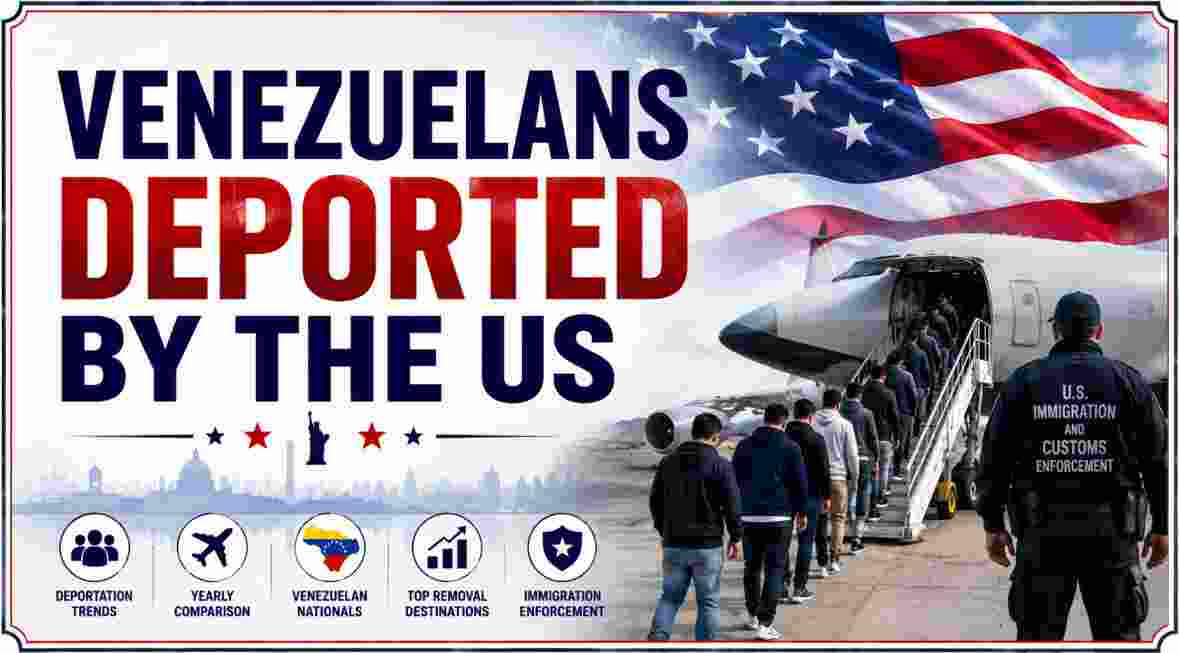
Venezuelans Deported by the US 2026
Venezuelans deported by the US in 2026 sit at the center of one of the most legally and politically contested enforcement stories of the entire immigration crackdown, made even more extraordinary by a single event: on January 3, 2026, the United States military captured Venezuelan President Nicolás Maduro in a raid on Caracas, ending his 13-year rule and throwing the entire premise behind Venezuelan deportation protections into open dispute. Roughly 600,000 Venezuelans living in the US under Temporary Protected Status have had that protection terminated over the past year, even as the country they would be returned to underwent a sudden, US-orchestrated regime change with an uncertain transitional government still finding its footing.
This report compiles the key verified statistics on Venezuelans deported by the US in 2026, covering ICE enforcement data, Temporary Protected Status terminations, the controversial use of the Alien Enemies Act to remove Venezuelan nationals to a third country, and how the political landscape has shifted since Maduro’s capture. Because DHS suspended its regular public statistics reporting in February 2026, several of the figures below are the most recent verified numbers available rather than fully current, and this is noted explicitly wherever it applies.
Interesting Facts About Venezuelans Deported by the US 2026
| Fact Category | Key Data Point |
|---|---|
| Venezuelan nationals arrested by ICE, full year 2025 | 12,445 — 6.4% of top-15 country arrests |
| Venezuela’s rank among ICE arrest nationalities, 2025 | 7th, up from 12th in 2020 |
| Growth in Venezuelan arrests, 2020–2025 | +260% — the largest percentage increase of any top-10 country |
| Venezuelan nationals in ICE detention (recent reporting) | 4,556 — approximately 8.0% of the detained population |
| Venezuelans affected by the 2023 TPS termination (Feb 2025) | ~350,000 |
| Venezuelans affected by the 2021 TPS termination (Nov 2025) | ~250,000 |
| Total Venezuelans who lost or are losing TPS protection | ~600,000 |
| Venezuelans deported to El Salvador under the Alien Enemies Act | 137, per a January 12, 2026 State Department court filing |
| Status of those 137 individuals as of January 2026 | Whereabouts unknown to the US government, per Secretary Rubio |
| Date of the US military operation that captured President Maduro | January 3, 2026 |
| First Venezuela deportation flight after Maduro’s capture | Approximately 200 people (reports range 199–231), Phoenix to Caracas |
| DHS position on reinstating TPS after Maduro’s capture | Explicitly declined — “will likely not change course” |
Source: ICE enforcement data compiled via The Global Statistics ICE Deportation List by Country; US State Department court filings; DHS public statements; House of Commons Library briefing on the US capture of Maduro, 2025–2026
The numbers above capture a genuinely unusual policy collision: the US government spent much of 2025 arguing that Venezuela’s political conditions had “improved” enough to justify ending deportation protections, only to then carry out a military operation in January 2026 that removed the same government it had cited as justification. Despite that, DHS’s public position has remained unchanged — Secretary Noem stated on January 4, 2026 that Venezuela is “more free today than it was yesterday” and confirmed deportation flights would continue without pause, resuming within days of the raid.
What stands out numerically is the 260% growth rate in Venezuelan ICE arrests between 2020 and 2025, the steepest increase among any of the top-ten deportation nationalities tracked, reflecting both a larger Venezuelan population inside the US following the mass exodus under Maduro and a specific enforcement focus tied to alleged Tren de Aragua gang activity. The 137 individuals deported under the Alien Enemies Act whose current location the US government says it cannot verify remains one of the most legally significant unresolved figures in the entire 2025–2026 deportation record.
Venezuelan TPS Timeline 2026
| Date | Event |
|---|---|
| March 2021 | Venezuela first designated for TPS under the Biden administration |
| 2023 | Venezuela TPS redesignated, later extended by Biden through October 2, 2026 |
| February 5, 2025 | DHS Secretary Kristi Noem terminates the 2023 TPS designation |
| May 19, 2025 | Supreme Court allows the Trump administration to proceed with ending 2023-designation TPS while litigation continues |
| September 5, 2025 | Federal Judge Edward Chen rules the TPS termination unlawful, temporarily reinstating protections |
| September 8, 2025 | DHS announces termination of the separate 2021 TPS designation, effective November 7, 2025 |
| October 3, 2025 | Supreme Court allows DHS to proceed with ending the Biden-era extension entirely |
| November 7, 2025 | 2021-designation TPS protections end for roughly 250,000 additional Venezuelans |
| January 3, 2026 | US captures President Maduro in a military raid on Caracas |
| January 4–5, 2026 | DHS confirms deportation flights to Venezuela will continue; declines to reinstate TPS |
Source: US Citizenship and Immigration Services (USCIS); National TPS Alliance v. Noem court filings; DHS public statements; House of Commons Library, 2025–2026
The TPS timeline shows a program that was legally contested at nearly every step, with federal courts repeatedly finding the administration’s termination process unlawful only for the Supreme Court to allow the terminations to proceed on procedural grounds while the underlying legal questions remained unresolved. The two separate TPS designations — one from 2021, one from 2023 — were terminated on different tracks roughly nine months apart, meaning the roughly 600,000 affected Venezuelans lost protection in two distinct waves rather than all at once.
The most consequential single date on this timeline is January 3, 2026, when the underlying premise of the entire policy debate shifted overnight. Advocates who had spent months arguing Venezuela remained too dangerous to receive returnees now had to reckon with a country in the midst of an externally imposed leadership transition, while the administration’s position — that conditions had already improved before the raid even happened — became harder to reconcile with a government structure that, as of early 2026, was still being actively shaped by US officials on the ground.
ICE Enforcement Data on Venezuelan Nationals 2026
VENEZUELAN ICE ARRESTS — RANK AND GROWTH, 2020 vs 2025
════════════════════════════════════════════════════════════════════
2020 Rank   12th   ████████░░░░░░░░░░░░
2025 Rank    7th   ████████████████░░░░
Growth      +260%  ████████████████████ (largest % increase, top 10)
════════════════════════════════════════════════════════════════════
| Metric | Data Point |
|---|---|
| Venezuelan arrests, full year 2025 | 12,445 |
| Percentage of top-15 country arrests | 6.4% |
| Rank among all nationalities, 2025 | 7th |
| Rank among all nationalities, 2020 | 12th |
| Five-year growth rate, 2020–2025 | +260% |
| Trend direction | Described as “explosive growth” — steepest of any top-10 country |
| Venezuelan nationals in ICE detention (recent data) | 4,556 |
| Share of ICE detention population | ~8.0% |
Source: ICE enforcement statistics compiled via The Global Statistics; TRAC Immigration; Deportation Data Project, 2025–2026
Venezuela’s rise from 12th to 7th place in ICE arrest rankings between 2020 and 2025, driven by 260% growth, outpaces every other nationality in the top ten except Ecuador. Unlike Mexico, Guatemala, and Honduras — countries with decades-long, well-established migration corridors to the US — Venezuela’s surge is a comparatively recent phenomenon tied directly to the mass exodus of roughly eight million people who fled the country under Maduro’s rule over the past decade, many of whom entered the US during the Biden administration and are now facing enforcement action after losing TPS protection.
At 4,556 individuals and roughly 8% of the total ICE detention population, Venezuelan nationals represent one of the larger single-country detained groups, trailing only Mexico, Guatemala, Honduras, and El Salvador in absolute numbers. For readers wanting the complete country-by-country breakdown behind these figures — including how Venezuela compares to all 72 nationalities tracked in current ICE enforcement data — our companion report on the ICE Deportation List by Country provides the full ranked table and five-year historical trend.
The Alien Enemies Act and Third-Country Removals 2026
| Metric | Data Point |
|---|---|
| Legal basis invoked | Alien Enemies Act of 1798 |
| Venezuelans deported to El Salvador under this authority | 137 |
| Confirmation source | State Department court filing, January 12, 2026, via Secretary Marco Rubio |
| Current whereabouts of the 137 individuals | Stated as unknown to the US government |
| March 2025 single-batch deportation to El Salvador | 238 Venezuelans and 23 Salvadorans on one flight |
| Court intervention | Supreme Court temporarily halted related deportations April 19, 2025; Fifth Circuit ruled the AEA invocation baseless on September 2, 2025 |
| Justification cited by the administration | Alleged Tren de Aragua gang membership among some deportees |
Source: Wikipedia summary of court filings and reporting on March 2025 American deportations of Venezuelans; State Department court filings, January 2026
The invocation of the 1798 Alien Enemies Act — a wartime statute never previously used in this manner for immigration enforcement — to remove Venezuelan nationals to El Salvador rather than to Venezuela itself represents the single most legally unprecedented action taken against any deportee nationality during the current enforcement campaign. The Fifth Circuit’s September 2025 ruling that the Act’s invocation was “baseless” and its subsequent blocking of further removals under this authority did not undo the transfers that had already occurred, leaving the 137 individuals whose location the US government says it cannot verify in ongoing legal limbo.
This case sits at the center of a broader pattern the enforcement data reveals: third-country removals — sending deportees to a country other than their own — have been used far more extensively against Venezuelan nationals than against most other nationalities during this enforcement period, driven largely by the administration’s characterization of Tren de Aragua as a designated terrorist organization. For a wider view of how third-country deportation policy has been applied across the broader enforcement system, our Illegal Immigration Statistics in US coverage documents how detention, removal, and legal-protection terminations have scaled up across all nationalities during the same period.
Deportation Flights to Venezuela: Before and After Maduro’s Capture
| Period | Data Point |
|---|---|
| Typical pre-capture flight schedule | Wednesdays and Fridays, per Human Rights First tracking |
| Last confirmed flight before disruption reports | December 10, 2025 |
| December 2025 dispute | Venezuela claimed flights were suspended; Trump administration denied this |
| First flight following Maduro’s capture | Reported the same week as the January 3, 2026 raid |
| Passengers on that flight | Between 199 and 231 (reports vary) |
| Route | Phoenix, Arizona to Caracas, Venezuela via Eastern Airlines |
| DHS statement on flight continuity | “Flights are not paused” — confirmed January 5, 2026 |
Source: Human Rights First flight tracking; DHS statements to Fox News, January 2026; New York Post reporting on post-capture deportation flight, January 2026
The resumption of deportation flights to Caracas within days of the operation that captured Venezuela’s own head of state is one of the more striking operational details in this entire dataset — DHS Secretary Noem confirmed on January 5, 2026 that flights were continuing on their normal schedule, even as the country’s government was in active transition under Vice President-turned-acting-president Delcy Rodríguez. The scene captured by wire photographers showed deportees disembarking in Caracas just as the political situation on the ground remained fluid enough that senior US officials themselves described the transition as still unfolding.
The discrepancy over whether flights were paused in December 2025 — with Venezuela’s government at the time claiming a suspension that the Trump administration denied — reflects the broader information difficulties that have characterized Venezuelan deportation reporting throughout this period, a pattern that predates and continues past the change in Venezuela’s own government.
Undocumented and Protected Venezuelan Population Context 2026
| Population Metric | Data Point |
|---|---|
| Venezuelans who fled the country under Maduro’s rule (UNHCR estimate) | Approximately 8 million |
| Venezuelans granted TPS eligibility as of January 2025 | Approximately 600,000 |
| Share of Venezuelan TPS holders now without legal status | Effectively all, pending ongoing litigation |
| Venezuelan and other-nationality parolees with rescinded status (2025) | 500,000+ (Cuba, Haiti, Nicaragua, Venezuela combined) |
| DHS alternative offered to former TPS holders | Refugee status application — disputed by advocates as not procedurally available |
| Status of asylum processing (as of early 2026) | Paused since December 2025; USCIS not processing affirmative asylum applications |
Source: UNHCR Venezuela situation reporting; DHS statements; Prism Reports interviews with immigration advocates, February 2026
The scale of Venezuela’s displacement crisis — roughly 8 million people who left the country during Maduro’s tenure, one of the largest forced migration events in recent Latin American history — provides essential context for why the TPS termination affected such a large population inside the US relative to other nationalities. With affirmative asylum processing paused since December 2025 and DHS’s suggestion that former TPS holders pursue refugee status facing pushback from immigration attorneys who say no such practical pathway currently exists, advocates describe a population left with essentially no clear legal route to remain in the country even as conditions in Venezuela remain genuinely unsettled following the leadership change.
That combination — the loss of a protected status, the pause in alternative legal pathways, and a homeland in the midst of an externally driven political transition — is what community organizations cited to Prism Reports in February 2026 as driving what they described as Venezuelans “feeling abandoned and betrayed” by the shift in US policy, a sentiment that appears in advocacy reporting on both sides of the debate over how the administration has handled the aftermath of Maduro’s removal.
Data Reliability Notes for Venezuelan Deportation Statistics 2026
| Category | Status as of Early 2026 |
|---|---|
| DHS regular public immigration statistics | Suspended beginning February 2026 |
| Primary alternative data sources currently in use | Deportation Data Project (FOIA-based); TRAC Immigration; court filings |
| Full 2026 calendar-year Venezuelan deportation total | Not yet available — year in progress |
| Whereabouts of AEA-transferred deportees | Confirmed unknown to the US government as of January 12, 2026 |
| TPS legal status | Still subject to active litigation as of this writing |
Source: Cross-referenced DHS, State Department, and independent tracking organization data, current as of early-to-mid 2026
Because DHS stopped publishing its regular immigration enforcement statistics in February 2026, independent organizations using Freedom of Information Act litigation — chiefly the Deportation Data Project — have become the primary source for verifying deportation figures for Venezuelan nationals and other groups alike. Readers should treat any Venezuela-specific deportation total for the full 2026 calendar year as provisional until official or FOIA-obtained figures catch up, and should note that the TPS legal questions at the center of this entire policy area remained unresolved in ongoing federal litigation at the time this report was compiled.
Disclaimer: The data research report we present here is based on information found from various sources. We are not liable for any financial loss, errors, or damages of any kind that may result from the use of the information herein. We acknowledge that though we try to report accurately, we cannot verify the absolute facts of everything that has been represented.