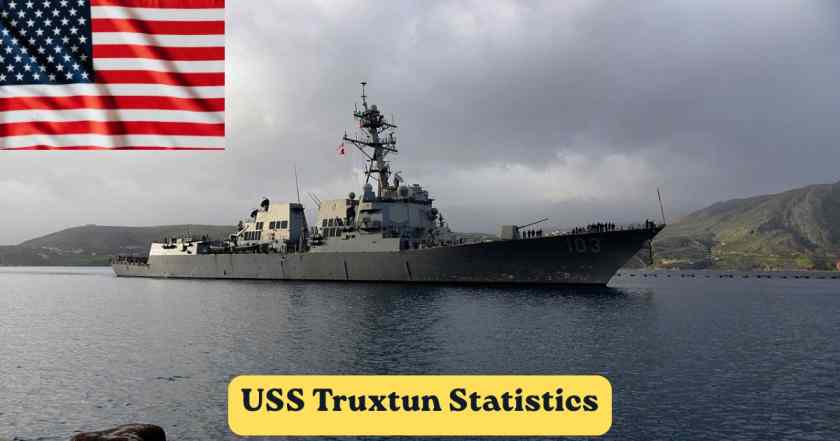
USS Truxtun (DDG-103) in 2026
The USS Truxtun (DDG-103) is an Arleigh Burke-class Flight IIA Aegis guided-missile destroyer in active service with the United States Navy — and one of the most operationally distinctive warships in the entire fleet, distinguished by a combination of distinguished lineage, a unique engineering installation found on no other ship in the world, and a sustained record of deployments across the most strategically significant maritime theaters of the 21st century. Named for Commodore Thomas Truxtun (1755–1822) — one of the original six commanders appointed by President George Washington to the newly formed U.S. Navy and a hero of the Quasi-War with France — the DDG-103 is the sixth U.S. Navy warship to bear the Truxtun name, carrying forward a naval lineage that stretches back more than two centuries. Constructed at Ingalls Shipbuilding (now Huntington Ingalls Industries) in Pascagoula, Mississippi — the only Arleigh Burke-class ship not built at Bath Iron Works — the DDG-103 was commissioned on April 25, 2009 in Charleston, South Carolina, and currently homeports at Naval Station Norfolk, Virginia, assigned to Destroyer Squadron 26 (DESRON 26). As of April 2026, the ship is at sea in the Atlantic Ocean on an independent deployment that began February 3, 2026 — just three months after returning from a seven-month deployment that included a stint in the Red Sea — with Cmdr. Taylor Auclair serving as Commanding Officer, confirmed by DVIDSHUB photos from April 4 and 6, 2026.
What makes the USS Truxtun (DDG-103) uniquely singular among all 73 active Arleigh Burke-class destroyers in the United States Navy is a fact that is rarely discussed in public but has profound implications for naval propulsion technology: it is the only warship in the U.S. Navy fitted with a hybrid electric drive (HED) system. In 2012, the Navy contracted with L3 Technologies to develop a fuel-efficient hybrid electric propulsion system for the Flight IIA Arleigh Burke class — a system using a permanent magnet motor developed by General Atomics that would allow destroyers to propel themselves at speeds up to 13 knots on electric motor power rather than burning jet fuel in their gas turbines. Truxtun was selected as the sole test platform. When the Navy cancelled the broader program in March 2018 — citing the program’s inability to provide adequate power at operational speeds without risking a ship-wide electrical blackout, and the $52 million already spent against a projected $356 million total cost — it left the DDG-103 as a technological island: the only destroyer in the world fitted with this system, operating a propulsion configuration that no other ship shares. Beyond this unique engineering distinction, the Truxtun has participated in some of the most geopolitically significant naval deployments of the past decade, from the Black Sea during the 2014 Crimea crisis to Red Sea operations and the June 2025 Mediterranean positioning in response to Iranian ballistic missile salvos — and is currently deployed again as of February 2026, pressing forward into the CENTCOM or SOUTHCOM areas of responsibility amid the ongoing tension generated by Operation Epic Fury against Iran.
Interesting Facts About USS Truxtun DDG-103 2026 | Key Stats at a Glance
| Fact Category | Key Detail |
|---|---|
| Hull Designation | DDG-103 |
| Ship Class | Arleigh Burke-class, Flight IIA |
| Combat System | Aegis Combat System |
| Namesake | Commodore Thomas Truxtun (1755–1822) — one of 6 original US Navy commanders appointed by George Washington |
| Ship Number in Truxtun Lineage | 6th US Navy warship to bear the name Truxtun |
| Builder | Ingalls Shipbuilding (Northrop Grumman / HII), Pascagoula, Mississippi — only Burke not built at Bath Iron Works |
| Commissioned | April 25, 2009 — Charleston, South Carolina |
| Keel Laid | April 11, 2005 |
| Launched | April 17, 2007 |
| Christened | June 2, 2007 — Pascagoula, MS; sponsors: Truxtun descendants Susan Scott Martin and Carol Leigh Roelker |
| Homeport (2026) | Naval Station Norfolk, Virginia |
| Squadron Assignment | Destroyer Squadron 26 (DESRON 26) |
| Commanding Officer (April 2026) | Cmdr. Taylor Auclair (confirmed DVIDSHUB April 4, 2026) |
| Unique Technical Distinction | Only ship in the US Navy fitted with a hybrid electric drive (HED) system |
| HED Developer | General Atomics (permanent magnet motor); L3 Technologies (system integration contract) |
| HED Speed Capability | Propels ship up to 13 knots on electric motor power |
| HED Program Cancelled | March 2018 — Navy cancelled broader 34-destroyer program; Truxtun retained as only fitted ship |
| Total Spent on HED Program | $52 million (actual); projected full program cost was $356.25 million |
| Christening During Construction Fire | May 20, 2006 — Major electrical fire at Ingalls Shipbuilding engulfed two levels; damage worth millions of dollars |
| Captain Phillips Film | Truxtun’s sailors appeared in the 2013 Tom Hanks film “Captain Phillips” |
| February 2026 Collision | February 11, 2026 — Collided with USNS Supply during at-sea resupply in Caribbean; 2 sailors injured; both ships sailed safely |
| Current Deployment (2026) | Departed Norfolk February 3, 2026 — independent deployment; likely SOUTHCOM or CENTCOM |
| June 2025 Iran Response | One of 5 BMD-capable destroyers positioned in Mediterranean as Iran launched ballistic missile salvos (USNI News, June 20, 2025) |
| BRIGHT STAR 25 | September 2025 — Participated in US-Egypt BRIGHT STAR 25 exercise in Alexandria, Egypt |
| Active Service Duration (as of 2026) | 17 years |
Source: Wikipedia — USS Truxtun (DDG-103) (updated February 26, 2026); USNI News — “Destroyer USS Truxtun to Deploy” (February 2, 2026); DVIDSHUB — USS Truxtun (DDG-103) Unit Page (April 2026); Military History Fandom — USS Truxtun (DDG-103) (citing The War Zone, February 12, 2026 — collision); War History Online — “US Navy Cancels Hybrid Program” (2018); USNI News Archive — June 20, 2025 (BMD Mediterranean positioning); Cruising Earth AIS Tracker (2026)
The key facts capture two parallel stories that make the USS Truxtun (DDG-103) exceptional among its class. The first is operational: a ship that has been continuously and aggressively deployed since its 2009 commissioning, participating in the Black Sea reassurance mission at one of the most politically sensitive moments in post-Cold War European security history, standing watch in the Red Sea during the Houthi maritime threat campaign, and now deployed again within just three months of returning from a seven-month deployment — a pace that reflects the extraordinary operational demands placed on the current U.S. Navy destroyer force. The second story is technological: a ship carrying a propulsion system that exists nowhere else in the U.S. Navy, installed at a cost of $52 million as the test platform for a program that was ultimately cancelled, leaving the DDG-103 as a unique operational experiment whose hybrid electric drive is monitored, evaluated, and operated by its crew in a configuration no other destroyer crew anywhere in the world shares.
USS Truxtun DDG-103 2026 | Core Technical Specifications
| Specification | Official Data |
|---|---|
| Class & Type | Arleigh Burke-class Flight IIA guided-missile destroyer |
| Builder | Ingalls Shipbuilding, Pascagoula, Mississippi (Northrop Grumman Ship Systems; now Huntington Ingalls Industries) |
| Ordered | — |
| Keel Laid | April 11, 2005 |
| Launched | April 17, 2007 |
| Commissioned | April 25, 2009 |
| Displacement | 9,200 tons (full load) — Arleigh Burke Flight IIA standard |
| Length | 509 ft 6 in (155.30 m) |
| Beam | 66 ft (20 m) |
| Draft | 31 ft (9.4 m) |
| Primary Propulsion | 4 × General Electric LM2500-30 gas turbines; 2 shafts |
| Primary Power Output | 100,000 shp (75,000 kW) |
| Unique Secondary Propulsion | Hybrid Electric Drive (HED) — General Atomics permanent magnet motor via quill drive on reduction gearbox |
| HED Speed Capability | Up to 13 knots (24 km/h; 15 mph) on electric motor |
| HED Operational Role | Night steaming, ballistic missile defense, anti-submarine operations at low speed |
| Speed (standard gas turbine) | Exceeds 30 knots |
| Range | 4,400 nautical miles at 20 knots |
| Complement | ~280–329 officers and enlisted (Flight IIA standard; some sources cite up to 380 depending on configuration) |
| Aircraft Complement | 2 × MH-60R Seahawk helicopters — full Flight IIA enclosed hangar |
| Years in Active Service (2026) | 17 years |
| Construction Incident | Electrical fire May 20, 2006 — two levels, millions in damage; construction continued |
Source: Wikipedia — USS Truxtun (DDG-103) (February 26, 2026); Cruising Earth AIS Tracker (2026 — “17 years active service”); War History Online — HED technical detail (2018); NavSource / SeaForces.org DDG-103 data; VetFriends.com USS Truxtun profile
The USS Truxtun’s specifications follow the standard Arleigh Burke Flight IIA template in nearly every dimension — except the hybrid electric drive. The four GE LM2500-30 gas turbines producing 100,000 shp give the ship the same raw propulsion power as every other Burke in the fleet, enabling speeds exceeding 30 knots and providing the electrical generation capacity that powers the Aegis combat system. What the HED adds is a parallel propulsion pathway: at speeds below 13 knots — the regime used for ballistic missile defense patrols, anti-submarine operations, and night steaming — the ship can disengage its gas turbines and use the permanent magnet electric motor to drive the shafts instead, theoretically reducing fuel consumption and acoustic signature in the low-speed regime where destroyers spend a significant portion of their operational time.
The reason the Navy cancelled the broader program despite this logic is revealing: at low speeds, destroyers still need to power their Aegis radar, weapons systems, communications, and hotel load from their onboard generators. When the three ship’s generators were simultaneously powering the electric drive motor and the ship’s entire electrical load, the combined demand approached the total generator capacity — meaning a single unexpected power draw could cause a ship-wide blackout, leaving the vessel without propulsion, weapons capability, and lighting simultaneously. As War History Online reported, the ship was “a light-switch flipping on away from causing a ship-wide blackout.” The engineering problem was solvable in principle, but the Navy decided the cost and complexity of solving it across 34 destroyers was not justified — leaving the DDG-103 as a permanent reminder of a technology that was promising in theory but impractical at the electrical power margins of the existing ship class.
USS Truxtun DDG-103 2026 | Weapons & Combat Systems
| Weapons / Combat System | Detail |
|---|---|
| Combat System | Aegis Combat System (AWS) — tracks and engages air, surface, and subsurface threats simultaneously |
| Primary Radar | SPY-1D(V) multifunction phased-array radar |
| Vertical Launch System (VLS) | 96 total Mk 41 VLS cells (1 × 32-cell + 1 × 64-cell) |
| VLS — Anti-Aircraft (Standard) | RIM-66M SM-2 Standard surface-to-air missile |
| VLS — Extended Range AA | RIM-156 SM-2ER |
| VLS — Anti-Ballistic Missile | RIM-161 SM-3 — enables ballistic missile defense (BMD) missions |
| VLS — Long-Range / Terminal BMD | RIM-174A SM-6 ERAM — also capable anti-ship and terminal BMD role |
| VLS — Close-In AA | RIM-162 ESSM — quad-packed; 4 per VLS cell |
| VLS — Land Attack | BGM-109 Tomahawk cruise missile — confirmed long-range strike capability |
| VLS — Anti-Submarine | RUM-139 Vertical Launch ASROC |
| Deck Gun | 1 × 5-inch (127 mm)/62 Mk 45 Mod 4 lightweight gun |
| Close-In Weapon System | 1 × 20 mm Phalanx CIWS |
| Secondary Guns | 2 × 25 mm Mk 38 machine gun systems; 4 × .50 caliber (12.7 mm) guns |
| Torpedoes | 2 × Mark 32 triple torpedo tubes (6 total); Mark 46 / Mark 50 / Mark 54 torpedoes |
| BMD Capability | SM-3 and SM-6 enable engagement of ballistic missiles in mid-course and terminal phases — confirmed operationally (June 2025 Mediterranean deployment) |
| Aircraft | 2 × MH-60R Seahawk helicopters (full enclosed Flight IIA hangar) |
| Anti-Submarine Warfare | MH-60R plus bow-mounted sonar (AN/SQS-53) and towed array (AN/SQR-19) |
Source: Wikipedia — USS Truxtun (DDG-103) (February 26, 2026, full armament section); VetFriends.com USS Truxtun profile (citing Tomahawk capability and Aegis system); USNI News June 20, 2025 (confirming BMD-capable status for Mediterranean deployment); SeaForces.org DDG-103 standard armament
The 96-cell Mk 41 VLS magazine is the operational heart of USS Truxtun’s combat capability — a flexible magazine that can be loaded for anti-aircraft, land attack, ballistic missile defense, or anti-submarine missions depending on deployment tasking. The ballistic missile defense capability provided by the SM-3 and SM-6 missiles has been operationally relevant in the most immediate sense during the June 2025 Iranian ballistic missile salvos: USNI News specifically reported on June 20, 2025 that the U.S. had positioned five BMD-capable guided-missile destroyers in the Mediterranean Sea as Iranian forces launched their salvos — and Truxtun was identified among the ships in the Mediterranean theater at that time, having participated in BRIGHT STAR 25 in Egypt in September 2025 and operating in the CENTCOM AOR throughout the summer.
The HED system’s specific utility for BMD operations is one of its clearest operational rationales: ballistic missile defense patrols require a ship to hold a precise geographic position for extended periods at low speed — the exact regime where the HED’s 13-knot electric propulsion is most useful — while keeping the Aegis SPY-1D radar and SM-3/SM-6 fire control systems fully powered and ready to engage. The engineering tension between powering the drive motor and powering the combat systems simultaneously is therefore most acute precisely when it matters most tactically, which is part of why the program’s electrical margin problems were considered operationally significant rather than merely a technical inconvenience.
USS Truxtun DDG-103 2026 | Namesake — Commodore Thomas Truxtun
| Namesake Historical Metric | Detail |
|---|---|
| Full Name | Commodore Thomas Truxtun |
| Born | February 17, 1755 — Hempstead, New York |
| Died | May 5, 1822 — Philadelphia, Pennsylvania |
| Appointed By | One of 6 original US Navy commanders appointed by President George Washington to the newly formed U.S. Navy |
| Most Famous Action | Commanded USS Constellation against French frigate Insurgente — February 9, 1799 (Quasi-War with France) |
| USS Constellation Victory | Captured the Insurgente after a 1.5-hour battle; one of the first significant US Navy victories |
| Second Major Action | USS Constellation vs. French frigate Vengeance — February 1, 1800 |
| Historical Significance | Pioneer of U.S. Navy tactics, training, and discipline in the Quasi-War era |
| Naval Legacy | Published influential manuals on naval tactics, signaling, and seamanship that shaped early U.S. Navy doctrine |
| Ships Named After Him (US Navy) | 6 total — DDG-103 is the sixth and most recent |
| First USS Truxtun | Schooner (1842) |
| Other USS Truxtuns | Screw steamer (1862), torpedo boat destroyer (1901), destroyer (1920), destroyer (1941) |
| Quasi-War Context | 1798–1800 — Undeclared naval war between United States and France; Truxtun’s victories were defining moments |
| George Washington Connection | Washington specifically chose Truxtun as one of the founding officers of the US Navy in 1794 |
Source: Wikipedia — USS Truxtun (DDG-103) (February 26, 2026, namesake section); Wikipedia — Thomas Truxtun; VetFriends.com USS Truxtun DDG-103 profile; Naval History and Heritage Command biographical records
The namesake of USS Truxtun (DDG-103) — Commodore Thomas Truxtun — is one of the most consequential figures in American naval history, and yet he is far less known to the general public than his historical significance warrants. As one of the six original commanders appointed by George Washington when the U.S. Navy was formally re-established in 1794 (the Navy had been disbanded after the Revolutionary War in 1785), Truxtun was not merely an officer — he was a founding architect of American naval doctrine, tactics, and professionalism. The manuals he wrote on naval signaling, seamanship, and tactics became foundational texts for the early officer corps, and his emphasis on aggressive offensive action combined with rigorous discipline and training established a culture that distinguished the early U.S. Navy from the more cautious traditions of European naval powers.
His victory over the French frigate Insurgente on February 9, 1799 — capturing the enemy ship after a 74-minute battle in which Constellation suffered 3 killed and 15 wounded against French losses of 29 killed and 41 wounded — was one of the most tactically decisive early victories in U.S. naval history, demonstrating that the new American navy could engage and defeat a peer European warship in open battle. His subsequent engagement with the French Vengeance in February 1800 — a far larger and more powerful ship — earned additional recognition for the resolve he showed in pressing the attack despite facing a significant disadvantage in firepower. The USS Truxtun (DDG-103) carries this legacy into the 21st century as a warship bearing the name of a man who proved, against the skepticism of a new nation still uncertain of its military identity, that American sailors could fight and win.
USS Truxtun DDG-103 2026 | Operational History & Key Deployments
| Event / Deployment | Date & Key Detail |
|---|---|
| Construction Fire — Ingalls Shipbuilding | May 20, 2006 — Major electrical fire engulfed two levels of the ship during construction; damage worth millions; construction continued |
| Commissioned | April 25, 2009 — Charleston, South Carolina |
| Hybrid Electric Drive Installation | 2012 — First (and only) HED system fitted under R&D contract with General Atomics |
| Eisenhower CSG Deployment | Multiple deployments with USS Dwight D. Eisenhower carrier strike group — Arabian Sea and Mediterranean |
| Black Sea Deployment — Crimea Response | March 2014 — Sailed to Black Sea with USS Donald Cook; conducted training with Romanian and Bulgarian navies; NATO reassurance mission following Russia’s annexation of Crimea |
| HED Program Cancelled (broader program) | March 2018 — Navy cancelled the 34-destroyer rollout; Truxtun retained as sole fitted ship; $52M spent of projected $356M |
| Eisenhower CSG Deployment Completion | August 10, 2020 — Truxtun completed deployment with Dwight D. Eisenhower CSG; returned to Norfolk |
| Sudan Evacuation Positioning | April 2023 — U.S. Navy moved ships including Truxtun to Red Sea in case military evacuation of Americans from Sudan was needed |
| Captain Phillips Film Feature | 2013 — Sailors aboard Truxtun appeared in the Tom Hanks film “Captain Phillips” (about the 2009 Maersk Alabama piracy incident) |
| Russian Naval Flotilla Tracking | June 12, 2024 — Truxtun, Donald Cook, Delbert D. Black, USCG Stone, and P-8 Poseidon deployed to track Russian naval flotilla less than 30 miles off Key Largo, Florida, heading to Havana, Cuba for exercises |
| Seven-Month Deployment (2025) | ~March–October 2025 — Seven-month deployment including Red Sea operations (CENTCOM) |
| BRIGHT STAR 25 | September 1–19, 2025 — Participated in US-Egypt multinational exercise BRIGHT STAR 25; docked at Ras Al Tin Naval Base, Alexandria, Egypt |
| Return to Norfolk | October 2025 — Returned from seven-month deployment |
| BMD Mediterranean Positioning | June 20, 2025 — One of five BMD-capable destroyers positioned in Mediterranean as Iran launched ballistic missile salvos (USNI News confirmed) |
| Independent Deployment Announced | February 2, 2026 — U.S. 2nd Fleet announced Truxtun would deploy just 3 months after returning from last 7-month deployment |
| Departed Norfolk | February 3, 2026 — Independent deployment; destination unannounced; likely SOUTHCOM or CENTCOM |
| USNS Supply Collision | February 11, 2026 — Collided with USNS Supply (T-AOE-6) during at-sea resupply in Caribbean Sea; 2 sailors injured; both ships sailed safely |
| Atlantic Ocean Operations | April 4–6, 2026 — Confirmed at sea in Atlantic Ocean; flight quarters with Seahawk helicopter; CO Cmdr. Taylor Auclair confirmed (DVIDSHUB) |
Source: Wikipedia — USS Truxtun (DDG-103) (February 26, 2026); Military History Fandom — USS Truxtun (citing The War Zone February 12, 2026); USNI News — “Destroyer USS Truxtun to Deploy” (February 2, 2026); USNI News Archive — June 20, 2025 (BMD Mediterranean); DVIDSHUB DDG-103 Unit Page (April 2026); Stars and Stripes — Sudan Navy deployment (April 2023); Tampa Bay Times — Russian flotilla Florida (June 2024)
The operational history of USS Truxtun (DDG-103) reads as a tour of the most strategically significant naval events of the past decade. The March 2014 Black Sea deployment alongside USS Donald Cook — responding to Russia’s annexation of Crimea by sending two American destroyers into what Russia considers its near-abroad — was one of the most politically deliberate naval deployments since the Cold War, explicitly designed to demonstrate that the United States would contest Russian attempts to exclude NATO allies from the Black Sea. The fact that Truxtun was selected for this mission alongside Donald Cook reflected its Aegis BMD capability — both ships could, if needed, engage Russian ballistic missiles, providing a defense value to Romanian and Bulgarian allies that went beyond symbolic solidarity.
The June 2024 Russian flotilla tracking operation — with Truxtun, two other destroyers, a Coast Guard cutter, and a P-8 Poseidon maritime patrol aircraft deployed to monitor a Russian naval formation operating just 30 miles off the Florida coast — was the most vivid demonstration of how the Cold War dynamic has returned to American waters. Russian warships operating in the Caribbean and off the U.S. East Coast have become an increasingly regular occurrence, and the U.S. Navy’s response of dispatching a multi-ship, multi-domain tracking formation signals that even close-to-home naval operations now require the kind of dedicated surveillance and deterrence architecture previously reserved for forward theaters. The February 2026 collision with USNS Supply during at-sea resupply in the Caribbean — injuring two sailors but leaving both ships able to continue under their own power — is a reminder that even routine logistics operations at sea carry real risk, and that the high operational tempo demanded of the current destroyer force creates the conditions where accidents become statistically more likely.
USS Truxtun DDG-103 2026 | Hybrid Electric Drive — The Unique Technology
| Hybrid Electric Drive (HED) Metric | Detail |
|---|---|
| Program Initiated | 2012 — US Navy contracted with L3 Technologies |
| Sole Test Platform | USS Truxtun (DDG-103) — only ship fitted |
| Motor Technology | Permanent magnet motor developed by General Atomics |
| Integration Method | Uses pre-existing quill drive on the reduction gearbox — no major hull modification required |
| HED Maximum Speed | 13 knots (24 km/h; 15 mph) on electric motor alone |
| Operational Regime | Night steaming; ballistic missile defense patrols; anti-submarine warfare; port approach/departure |
| Total Program Spending (actual) | $52 million |
| Projected Full Program Cost (34 ships) | ~$356.25 million |
| Program Cancellation Date | March 2018 |
| Cancellation Reason (Official) | “Department priorities” — insufficient funding in FY2019 budget request |
| Cancellation Reason (Technical) | At speeds below 13 kn, combined electrical load (HED motor + ship systems) approached full generator capacity — risk of ship-wide blackout |
| Generator Arrangement | 3 generators; 2 running + 1 standby — combined load with HED motor overwhelmed capacity |
| British Royal Navy Parallel | Royal Navy employed equivalent system in Type 23 Duke-class frigates — encountered similar problems |
| Expert Assessment (Bryan Clark, CSBA) | Problems were “valid but could have been resolved through strategic engineering” — cancellation “seemed a little unnecessary” |
| Current Status of HED on Truxtun | Operational — Truxtun continues to operate the system; monitored and evaluated |
| Future Relevance | Technology potentially informative for future ship designs with larger generator capacity |
| DDG(X) Applicability | Navy’s next-generation DDG(X) destroyer features integrated electric drive from design — HED experience directly informs this |
Source: War History Online — “US Navy Cancels Hybrid Program” (2018, citing Navy FY2017 budget submission and Bryan Clark, CSBA); Wikipedia — USS Truxtun (DDG-103) (February 26, 2026, HED section); The National Interest — HED technical analysis
The hybrid electric drive story is the most technically fascinating aspect of USS Truxtun’s entire history — and one that has implications far beyond a single ship’s engineering configuration. The concept was sound: gas turbines are highly efficient at high speed but relatively inefficient at the low speeds where destroyers spend a significant portion of their operational time during BMD patrols, ASW operations, and port transitions. By switching to electric motor drive at these speeds — similar to how a hybrid car uses its electric motor in stop-and-go traffic — the Navy hoped to reduce fuel consumption meaningfully across the fleet, cutting both operating costs and the logistics burden of fuel resupply at sea. The British Royal Navy’s Type 23 frigates demonstrated the concept was viable at smaller displacement, and the quill drive approach of using the pre-existing reduction gearbox meant the system could be retrofit without cutting the hull open.
The problem that emerged during operational testing — that the combined electrical demand of the HED motor running simultaneously with all the ship’s combat systems approached or exceeded the three generators’ total output — was not a fundamental flaw in the concept but a specific consequence of the Arleigh Burke’s electrical architecture, which was designed to power the Aegis combat system at full capability but not to simultaneously power a propulsion motor as well. Bryan Clark’s assessment that the problem “could have been resolved through strategic engineering” — essentially by installing larger or more generators — is credible, and the Navy’s DDG(X) next-generation destroyer program, which builds integrated electric propulsion into the design from the keel up with substantially larger generation capacity, can be seen in part as the logical continuation of what the USS Truxtun HED experiment demonstrated: that electric propulsion on destroyers is the right long-term direction, but that retrofitting it onto a platform designed around a different electrical architecture is the wrong way to get there.
USS Truxtun DDG-103 in 2026 | Current Status & 2026 Deployment
| Current Status / 2026 Metric | Data |
|---|---|
| Current Status | Active service — at sea on independent deployment |
| Commanding Officer (April 2026) | Cmdr. Taylor Auclair (confirmed DVIDSHUB April 4, 2026 photo caption) |
| Homeport | Naval Station Norfolk, Virginia |
| Squadron | Destroyer Squadron 26 (DESRON 26) |
| Last Major Deployment | Seven-month deployment (~March–October 2025) — Red Sea (CENTCOM) + BRIGHT STAR 25 Egypt |
| Returned From Last Deployment | October 2025 |
| Time Before New Deployment | ~3 months — departed February 3, 2026 |
| New Deployment Announced | February 2, 2026 — U.S. 2nd Fleet announcement |
| New Deployment Departed | February 3, 2026 from Naval Station Norfolk |
| Deployment Type | Independent deployment (not CSG-assigned) |
| Likely Destination (USNI) | SOUTHCOM or CENTCOM — both seeing warship build-up; SOUTHCOM: Operation Southern Spear; CENTCOM: Iran/Epic Fury tensions |
| USNS Supply Collision | February 11, 2026 — Caribbean Sea; 2 sailors injured; both ships self-sufficient after |
| Confirmed At-Sea Location | Atlantic Ocean — April 4–6, 2026 (DVIDSHUB photos) |
| Aircraft Operations (April 2026) | Flight quarters observed; Seahawk helicopter operations confirmed (April 6, 2026) |
| Iran/Epic Fury Context | Truxtun previously served as one of 5 BMD destroyers in Mediterranean during Iranian salvo campaign (June 2025); likely available for CENTCOM tasking |
| Operation Southern Spear Context | Multiple US destroyers operating in Caribbean to intercept alleged drug trafficking boats |
| Next Expected Return | Unknown — independent deployments typically 4–9 months |
| US Navy Warships in CENTCOM (Feb. 2026) | 10 ships including Abraham Lincoln CSG (Arabian Sea), Delbert D. Black (Red Sea), Mitscher + McFaul (Persian Gulf) |
Source: USNI News — “Destroyer USS Truxtun to Deploy” (February 2, 2026, news.usni.org); DVIDSHUB DDG-103 Unit Page (April 2026 — confirming Cmdr. Auclair and Atlantic location); Military History Fandom — USS Truxtun (DDG-103) (citing The War Zone, February 12, 2026 — USNS Supply collision); USNI News Fleet and Marine Tracker (February 2, 2026 — CENTCOM ship count)
The USS Truxtun’s February 2026 deployment — announced and executed just three months after returning from a seven-month Red Sea deployment — is a striking illustration of the operational tempo currently being demanded of the U.S. Navy’s destroyer force. With 10 ships in CENTCOM, 12 in the Caribbean supporting Operation Southern Spear, and ongoing requirements across the Mediterranean, the Baltic, and the Indo-Pacific, the Navy’s supply of available, ready destroyers is stretched to a degree that has prompted senior naval officials to repeatedly warn Congress about fleet size and readiness. Deploying a ship that returned in October on an independent deployment in February — without even the nominally longer interdeployment period that CSG assignments provide — reflects the direct translation of these strategic demands into individual ship deployment cycles.
The USNS Supply collision on February 11, 2026 — just eight days into the new deployment — added an immediate operational complication. At-sea replenishment collisions, while relatively rare, are a known hazard of the complex alongside refueling evolution, and the fact that both ships were able to continue operating under their own power after the incident reflected the structural resilience of both the Arleigh Burke destroyer hull and the Lewis and Clark-class T-AOE supply ship. The two injured sailors recovered, and the Truxtun continued its deployment rather than returning to port — a decision that reflects both the ship’s structural integrity post-collision and the operational priority placed on maintaining forward presence in an environment where every available destroyer counts.
Disclaimer: The data research report we present here is based on information found from various sources. We are not liable for any financial loss, errors, or damages of any kind that may result from the use of the information herein. We acknowledge that though we try to report accurately, we cannot verify the absolute facts of everything that has been represented.