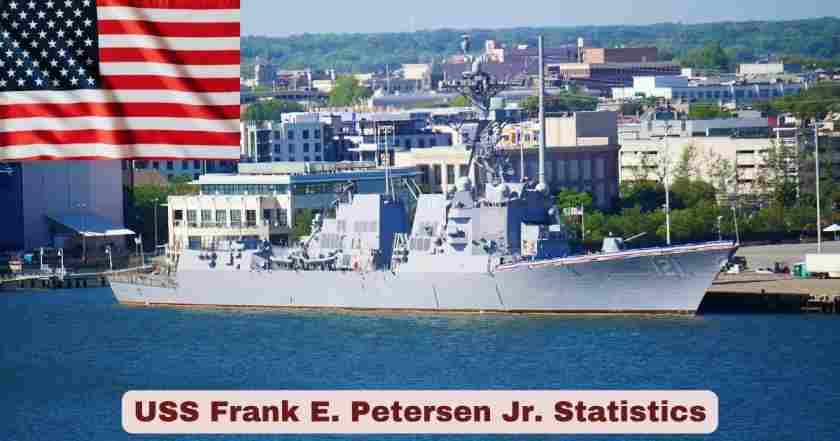
USS Frank E. Petersen Jr. (DDG-121) in 2026
The USS Frank E. Petersen Jr. (DDG-121) is an Arleigh Burke-class (Flight IIA Technology Insertion) Aegis guided-missile destroyer in active service with the United States Navy — and one of the most symbolically significant warships ever commissioned in American naval history. Named for United States Marine Corps Lieutenant General Frank E. Petersen Jr., the first African-American Marine Corps aviator and the first African-American Marine Corps general, the ship carries a name that embodies one of the most extraordinary careers in the history of American military service. The ship’s motto — “Into the Tiger’s Jaw” — comes directly from Petersen himself, a phrase he used throughout his life to describe the spirit of confronting and overcoming both combat adversity and social injustice without flinching. The ship was built by Huntington Ingalls Industries at the Ingalls Shipbuilding division in Pascagoula, Mississippi — the same facility that has produced some of the most capable surface combatants in the US Fleet — and represents the full maturation of the Arleigh Burke Flight IIA Technology Insertion upgrade package, which added enhanced Aegis combat system capabilities including integrated air and missile defence with ballistic missile defence capacity. The contract was announced on 30 March 2016; the first steel was cut in April 2016; the keel was laid on 21 February 2017; she was launched on 13 July 2018; christened on 6 October 2018; and formally commissioned into the United States Navy on 14 May 2022 at Charleston, South Carolina — a ceremony presided over by Ms. Gayle Petersen, the late Lieutenant General’s daughter.
As of April 2026, the USS Frank E. Petersen Jr. is in active operational deployment assigned to the Abraham Lincoln Carrier Strike Group (CSG-3), serving in the Arabian Sea / CENTCOM area of operations during Operation Epic Fury — the US military operation against Iran that began in February 2026. The ship’s current mission, as reported by AIS tracking data and DVIDS (Defence Visual Information Distribution Service) records, is operating as Air Defence Commander for the Abraham Lincoln Strike Group, a role that takes full advantage of its Aegis Baseline 9C2 combat system’s integrated air and missile defence capabilities — precisely the kind of high-end threat environment for which DDG-121 was designed and built. The ship had previously returned to its homeport at Joint Base Pearl Harbor-Hickam, Hawaii on 12 December 2024 after a five-month maiden deployment with the same carrier strike group — a deployment that took it through the US 3rd, 7th, 5th, and 6th Fleet areas of operation, covering the Indo-Pacific and Middle East. In 2026, the ship is once again forward-deployed in the region that has become the most operationally demanding theatre for US naval forces, placing USS Frank E. Petersen Jr. at the centre of American naval power projection at a critical moment in global history.
Interesting Facts About USS Frank E. Petersen Jr. 2026
Here are the most striking and verified facts about USS Frank E. Petersen Jr. (DDG-121) — drawn from the US Navy, Wikipedia, Military Wiki Fandom, DVIDS, Huntington Ingalls Industries, US Pacific Fleet press releases, Carrier Strike Group 3 records, and AIS ship tracking data as of April 12, 2026.
| # | Fact | Detail |
|---|---|---|
| 1 | Ship designation | USS Frank E. Petersen Jr. (DDG-121) — guided-missile destroyer, hull number 121 |
| 2 | Ship class | Arleigh Burke-class (Flight IIA Technology Insertion) — Aegis guided-missile destroyer |
| 3 | Builder | Huntington Ingalls Industries, Ingalls Shipbuilding, Pascagoula, Mississippi — the 33rd destroyer built by Ingalls for the US Navy |
| 4 | Contract announced | 30 March 2016 — Huntington Ingalls Industries press release |
| 5 | Steel cutting (first fabrication) | April 27, 2016 — first 100 tons of steel cut in a ceremony at the fabrication shop |
| 6 | Keel laid | 21 February 2017 — Pascagoula, Mississippi |
| 7 | Launched | 13 July 2018 |
| 8 | Christened | 6 October 2018 — christening ceremony; Ms. D’Arcy Neller, wife of Marine Commandant Gen. Robert Neller, toured the ship |
| 9 | Acceptance Trials | Completed 16 September 2021 — two days at sea |
| 10 | Delivered to US Navy | 30 November 2021 — signing ceremony at Ingalls Shipbuilding |
| 11 | Commissioned | 14 May 2022 — Port of Charleston, South Carolina; ceremony presided over by Ms. Gayle Petersen, Lt. Gen. Petersen’s daughter |
| 12 | Homeport | Joint Base Pearl Harbor-Hickam, Hawaii |
| 13 | Ship’s motto | “Into the Tiger’s Jaw” — Petersen’s lifelong phrase for confronting adversity and injustice; also the title of his 1998 autobiography |
| 14 | Combat System | Aegis Baseline 9C2 — includes integrated air and missile defence (IAMD) and enhanced Ballistic Missile Defence (BMD) capabilities |
| 15 | Maiden deployment | July–December 2024 — five-month deployment with USS Abraham Lincoln Carrier Strike Group; returned to Pearl Harbor 12 December 2024 |
| 16 | Maiden deployment role | Assigned as Integrated Air and Missile Defence Commander for the Abraham Lincoln CSG — the strike group’s most advanced destroyer |
| 17 | Maiden deployment stats | Over 475 hours of flight quarters, 17 replenishments-at-sea, 15 sea and anchor details, qualified 60 Sailors in SCAT and 17 in SRF-B |
| 18 | Current status (April 2026) | Arabian Sea / CENTCOM AOR — assigned to Abraham Lincoln CSG, serving as Air Defence Commander during Operation Epic Fury — AIS tracking (April 2026) |
| 19 | Assignment | Part of Destroyer Squadron 21 (DESRON 21), Carrier Strike Group 3 |
| 20 | Battle Effectiveness Award | Awarded the 2024 Battle Effectiveness “E” Award — DVIDS (2024) |
Source: Wikipedia — USS Frank E. Petersen Jr. (DDG-121) (updated December 2025); Military Wiki Fandom — USS Frank E. Petersen Jr.; DVIDS — DDG-121 unit page; US Navy CPFNEWS / US Pacific Fleet press release — USS Frank E. Petersen Jr. and USS Michael Murphy Return to Pearl Harbor (December 12, 2024); Army Recognition — Huntington Ingalls Delivers DDG-121 (November 2021); Carrier Strike Group 3 — Wikipedia; Cruising Earth AIS tracker (April 2026); DVIDSHUB — 2024 Battle Effectiveness Award
The ship’s role as Integrated Air and Missile Defence Commander during both its maiden deployment with the Abraham Lincoln Carrier Strike Group and its current 2026 deployment is not a routine assignment — it is a designation given only to the most capable and technologically advanced destroyer in a strike group. The IAMD Commander role means DDG-121 is the primary node responsible for detecting, tracking, and engaging air and missile threats to the entire carrier strike group, using its Aegis Baseline 9C2 combat system and SPY-1D multifunction radar to maintain a 360-degree air picture and execute layered defence against everything from subsonic aircraft to hypersonic missiles. The fact that DDG-121 held this role in its very first deployment — and holds it again in 2026’s most demanding operational theatre — reflects both the maturity of its Aegis system and the confidence the US Navy places in its crew’s proficiency. For a ship commissioned in May 2022 to be serving as its carrier strike group’s air defence nerve centre during active combat operations by 2026 is a remarkable operational trajectory.
The motto “Into the Tiger’s Jaw” carries a weight that sets this ship apart from most naval vessels — it is not a phrase chosen by a committee but a principle drawn from the lived experience of the man it honours. Lt. Gen. Frank E. Petersen Jr. used those words to describe the willingness to confront impossible odds — in the cockpit over Korea and Vietnam, in officers’ clubs where he faced racial discrimination, in Marine Corps promotion boards where he was told he would never make general. The ship that bears his name operates in that same spirit: deployed far from home, in contested waters, serving as the first and most capable layer of defence for thousands of sailors aboard USS Abraham Lincoln and the ships of CSG-3. That continuity between a man’s character and a ship’s mission is what elevates the USS Frank E. Petersen Jr. beyond a hull number.
USS Frank E. Petersen Jr. Ship Specifications and Technical Statistics 2026
| Technical Parameter | Specification |
|---|---|
| Hull designation | DDG-121 |
| Ship class | Arleigh Burke-class, Flight IIA Technology Insertion (TI) |
| Overall length | 505 to 509.5 feet (153.9 to 155.3 m) — Arleigh Burke Flight IIA standard |
| Beam (width) | 66 feet (20.1 m) — Arleigh Burke class standard |
| Displacement | 8,300 to 9,700 tons full load — Arleigh Burke class range |
| Draft | Approximately 30.5 feet (9.3 m) |
| Propulsion | Four General Electric LM2500-30 gas turbines, two shafts — 100,000 shaft horsepower |
| Maximum speed | In excess of 30 knots (34.5 mph) |
| Range | Approximately 4,400 nautical miles at 20 knots |
| Combat System | Aegis Combat System with Aegis Baseline 9C2 |
| Primary radar | AN/SPY-1D multifunction passive electronically scanned array radar — 360-degree coverage |
| Integrated capabilities (Aegis 9C2) | Integrated Air and Missile Defence (IAMD) + Ballistic Missile Defence (BMD) |
| Vertical Launch System (VLS) | 96 Mark 41 VLS cells — Arleigh Burke Flight IIA standard |
| VLS missile types | Standard Missile-2 (SM-2MR) for air defence; Standard Missile-6 (SM-6); Tomahawk Land Attack Cruise Missiles; Vertical Launch ASROC (VLA) for anti-submarine warfare |
| Main gun | 5-inch/62-calibre (127 mm) Mark 45 Mod 4 naval gun — longer barrel installed from DDG-81 onward |
| Anti-submarine torpedoes | 6 × Mark 46 torpedoes from two triple tube mounts |
| Close-In Weapon System (CIWS) | Phalanx CIWS (20mm gatling gun) for close-range threat defeat |
| Additional gun armament | Mark 38 25mm machine gun — visible in DVIDS photos from live-fire exercises January–February 2026 |
| Helicopter hangars | Two hangars for anti-submarine warfare (ASW) helicopters — Flight IIA addition |
| ASW helicopters | Supports SH-60 Seahawk helicopters |
| Crew | Approximately 280–330 sailors — Arleigh Burke Flight IIA standard |
| Electronic warfare | Advanced electronic warfare suites — Arleigh Burke class specification |
| Composite materials | Hangars constructed of composite materials — DDG-86 and later ships, including DDG-121 |
Source: Wikipedia — Arleigh Burke-class destroyer (updated April 2026); Huntington Ingalls Industries / Army Recognition — DDG-121 delivery (November 2021); Wikipedia — USS Frank E. Petersen Jr. (DDG-121); DVIDS — DDG-121 live-fire exercise photos (January–February 2026); Carrier Strike Group 3 Wikipedia; Technical Parameters EU — USS Frank E. Petersen Jr. technical profile (January 2026)
The Arleigh Burke Flight IIA Technology Insertion configuration that DDG-121 represents is the most advanced iteration of the world’s most proven guided-missile destroyer design. The core upgrade from the base Flight IIA standard is the Aegis Baseline 9C2 combat system, which adds full Integrated Air and Missile Defence capability — meaning DDG-121 can simultaneously manage engagements against both aircraft and ballistic missiles, coordinate IAMD across an entire strike group, and do so in the same combat system without switching modes. This matters enormously in 2026’s operational environment: the Iran conflict has demonstrated that modern naval threats come in layered packages — subsonic cruise missiles, ballistic missiles, drone swarms, and fast attack craft may all present simultaneously, and the IAMD capability allows DDG-121 to process and engage across all those threat types with a single integrated system. The 96 Mark 41 VLS cells that give DDG-121 its offensive and defensive magazine depth are capable of holding any combination of Standard Missiles, Tomahawks, and VLA rounds, giving the ship extraordinary flexibility across different mission profiles in a single load-out.
The addition of two helicopter hangars in Flight IIA — starting with USS Oscar Austin (DDG-79) — is one of the most consequential design decisions in Arleigh Burke class history, and DDG-121 benefits fully from this capability. Flight I and II ships had a single helicopter landing pad and no hangar, meaning embarked helicopters could not be maintained or sheltered aboard ship and had to return ashore for maintenance. Flight IIA’s dual hangars allow DDG-121 to operate and sustain two SH-60 Seahawk helicopters independently, dramatically extending the ship’s anti-submarine warfare range and effectiveness. In the Arabian Sea deployment of 2026, where submarine threats from Iran’s Kilo-class submarines and Ghadir midget submarines represent a genuine concern, those helicopter hangars translate directly into operational capability that the ship’s predecessor Flight I destroyers could not have matched.
USS Frank E. Petersen Jr. Deployment and Operations Statistics 2026
| Deployment / Operations Parameter | Data |
|---|---|
| Maiden deployment duration | Five months — July to December 2024 |
| Maiden deployment assigned to | USS Abraham Lincoln Carrier Strike Group (ABECSG / CSG-3) |
| Maiden deployment role | Integrated Air and Missile Defence (IAMD) Commander for the strike group |
| Maiden deployment return date | 12 December 2024 — returned to Joint Base Pearl Harbor-Hickam |
| Maiden deployment: flight quarters | Over 475 hours of flight quarters |
| Maiden deployment: small boat operations | 10 hours of small boat operations |
| Maiden deployment: replenishments-at-sea | 17 replenishments-at-sea (RAS) conducted |
| Maiden deployment: sea and anchor details | 15 sea and anchor details |
| Maiden deployment: SCAT qualifications | 60 Sailors qualified in Small Craft Action Team (SCAT) |
| Maiden deployment: SRF-B qualifications | 17 Sailors qualified in Security Reaction Force Basic (SRF-B) |
| Maiden deployment: promotions | 6 new Chief Petty Officers, 6 new First Class Petty Officers, 18 new Second Class Petty Officers |
| DESRON 21 composition | USS O’Kane (DDG-77), USS Frank E. Petersen Jr. (DDG-121), USS Spruance (DDG-111) |
| CSG-3 total sailors | The Abraham Lincoln CSG represents more than 6,000 Sailors deployed from San Diego and Pearl Harbor |
| 2026 current deployment | Arabian Sea / CENTCOM AOR — Operation Epic Fury (Iran war) |
| 2026 role | Air Defence Commander for Abraham Lincoln Carrier Strike Group |
| Previous 2026 location (before CENTCOM) | South China Sea / Indo-Pacific — redirected to CENTCOM area January 2026 |
| Commanding officer (maiden deployment) | Capt. Kevin Louis |
| Executive officer (maiden deployment) | Cmdr. Sean Standen |
| Command Master Chief | Command Master Chief Justin Bowen — active as of February 2026 (DVIDS) |
| 2024 Battle Effectiveness Award | Awarded the 2024 Battle Effectiveness “E” Award — DVIDS |
| Live-fire exercises (2026) | Conducted live-fire exercises January 23, 2026 and February 10, 2026 in 7th Fleet AOR — DVIDS |
| Abraham Lincoln CSG 2024 deployment areas | US 3rd Fleet, 7th Fleet, 5th Fleet, and 6th Fleet areas of operation |
Source: DVIDS — USS Frank E. Petersen Jr. Unit Page (multiple reports 2024–2026); US Pacific Fleet / CPFNEWS — USS Frank E. Petersen Jr. & USS Michael Murphy Return to Pearl Harbor (December 12, 2024); Wikipedia — USS Frank E. Petersen Jr.; Carrier Strike Group 3 — Wikipedia; Cruising Earth AIS tracker (April 2026); Military Wiki Fandom — USS Frank E. Petersen Jr.; DVIDS — Live-fire exercise photos (January 23, 2026 and February 10, 2026)
The USS Abraham Lincoln Carrier Strike Group’s assessment that DDG-121 is “the most advanced Arleigh Burke-class guided-missile destroyer” in the strike group — used in official US Navy press releases describing the maiden deployment return in December 2024 — is an extraordinary official declaration for a ship commissioned less than three years earlier. It is language that reflects the Aegis Baseline 9C2’s capabilities in the IAMD role, positioning DDG-121 not merely as one destroyer among many in the strike group but as the designated lead for air and missile defence — a role whose criticality in today’s threat environment cannot be overstated. The operational record from the maiden deployment confirms the crew matched that confidence: 475+ hours of flight quarters, 17 replenishments-at-sea, and successful qualification of 77 sailors in combat-readiness programmes are the hallmarks of a ship that spent its first deployment building the deep operational proficiency that challenging environments demand.
The rapid transition from the Indo-Pacific to the CENTCOM area of operations in early 2026 — with DVIDS records showing DDG-121 conducting live-fire exercises in the US 7th Fleet area as recently as January 23, 2026, and AIS tracking data placing her in the Arabian Sea by April 2026 — reflects the operational tempo that has characterised US naval responses to the escalating Iran conflict. Ships of the Abraham Lincoln CSG were initially deployed to the Indo-Pacific for regional security and stability operations, but the outbreak of large-scale US-Iran hostilities in February 2026 redirected the strike group’s assets to the 5th Fleet area of responsibility in the CENTCOM theatre. For DDG-121, that transition meant moving from routine freedom-of-navigation operations and deterrence patrols to active air-defence operations against a nation that has fired ballistic missiles at US-allied targets and threatened the Strait of Hormuz — precisely the threat environment for which Aegis Baseline 9C2 integrated air and missile defence was designed.
Lt. Gen. Frank E. Petersen Jr. — The Man Behind the Ship: Key Facts 2026
| Biographical Parameter | Data |
|---|---|
| Full name | Frank Emmanuel Petersen Jr. |
| Born | March 2, 1932 — Topeka, Kansas |
| Died | August 25, 2015 — Stevensville, Maryland; lung cancer; age 83 |
| Military service total | 38 years — June 1950 to August 1, 1988 |
| Years as a Marine | Approximately 36 years as a Marine Corps officer |
| First historic role | First African-American Marine Corps aviator — commissioned as a Marine aviation officer October 22, 1952 |
| Second historic role | First African-American Marine Corps general — promoted to Brigadier General February 23, 1979 by President Jimmy Carter |
| Third historic role | First African-American Lieutenant General in the Marine Corps — promoted June 12, 1986 |
| Korean War service | 1953 — flew 64 combat missions; awarded the Distinguished Flying Cross and 6 Air Medals |
| Vietnam War service | 1968 — commanded Marine Fighter Attack Squadron 314 (VMFA-314), “The Black Knights” |
| Total combat missions | Over 350 combat missions across Korea and Vietnam |
| Total flying hours | More than 4,000 hours in fighter and attack aircraft |
| First African-American to command a tactical fighter squadron | 1968 — VMFA-314, the Black Knights, in Vietnam |
| VMFA-314 award | Won the 1968 Robert M. Hanson Award for Most Outstanding Fighter Squadron in the USMC |
| Purple Heart | Awarded 1968 — wounded in action over North Vietnam; shot down and rescued in the DMZ |
| Final USMC position | Commanding General, Marine Corps Combat Development Command, Quantico, Virginia |
| Naval aviator honours | Held titles of “Silver Hawk” (senior ranking aviator in the Marine Corps) and “Gray Eagle” (senior ranking aviator in the US Navy) at retirement |
| Gray Eagle Trophy | Awarded August 21, 1987 – June 15, 1988 — given to the most senior aviator on active duty in the Navy |
| Education | BA in Social Science (1967) and MA in International Relations (1973) — both from George Washington University |
| Autobiography | “Into the Tiger’s Jaw: America’s First Black Marine Aviator” — co-authored with J. Alfred Phelps, published 1998 |
| NAACP Man of the Year | 1979 — for becoming the first Black general in the Marine Corps |
| Post-military career | Vice President of Corporate Aviation, DuPont de Nemours — retired 1997 |
| Presidential appointment | 2010 — President Obama appointed him to the Board of Visitors, US Naval Academy |
| Total medals for bravery | At least 20 medals for bravery in combat at retirement — BlackPast |
| Ship’s motto connection | “Into the Tiger’s Jaw” — Petersen’s lifelong phrase for confronting adversity, injustice, and combat without flinching |
Source: Wikipedia — Frank E. Petersen (updated December 2025); The History Makers — Lt. Gen. Frank E. Petersen Jr. Biography; IMDB — Frank E. Petersen biography; National Air and Space Museum — Remembering Frank E. Petersen Jr. (2015); BlackPast — Frank E. Petersen Jr. (1932–2015); Encyclopedia.com — Petersen, Frank E.; African American Registry — Frank Petersen; AFRO American Newspapers — Lt. Gen. Frank E. Petersen (2022); Because of Them We Can — Frank E. Petersen Jr.; Gathering of Eagles Foundation — Petersen biography
The story of how Frank E. Petersen Jr. became the first Black aviator in the Marine Corps is one of the most quietly extraordinary narratives in American military history — and understanding it is essential to understanding why the ship that bears his name means so much to those who serve aboard her and to those who follow its deployments. Petersen aced the Navy entrance exam so convincingly in 1950 that the recruiter refused to believe a Black man could have scored that high without cheating and made him take the test again. He passed again. That pattern — of being forced to repeatedly prove what was already proven, simply because of his race — would define the structural obstacle he navigated for the next four decades. When he entered the Naval Aviation Cadet Program in 1951, he chose the Marine Corps specifically because Jesse Brown, the first Black Navy aviator, had already broken that barrier — Petersen wanted to open a new door rather than walk through one already opened. By the time he finished, he had become not just the first Black Marine aviator but the first Black officer in either the Navy or the Marines to command a tactical fighter squadron, an air group, an air wing, and a major base. He did all of it while flying more than 350 combat missions and accumulating over 4,000 flying hours. The Distinguished Flying Cross, the Purple Heart, the Legion of Merit, and more than 20 medals for bravery in combat are the formal record; the informal record is that he transformed what African-American Marines could aspire to achieve.
The “Gray Eagle” and “Silver Hawk” titles that Petersen held at retirement represent something that pure career statistics cannot capture. The Gray Eagle Trophy is not given for rank or achievement — it is given to the single active-duty naval aviator who has held their aviation designation the longest. When Petersen held both the Gray Eagle (most senior Navy aviator) and the Silver Hawk (most senior Marine aviator) simultaneously from 1987 to 1988, he was not just the most decorated Black Marine in history — he was by the measure of time in aviation the most experienced and senior aviator in the entire US Navy and Marine Corps combined. That someone who was told by a Navy recruiter in 1950 that he would make “a great steward” because of his race could, 37 years later, hold the title of most senior aviator in the entire naval service is a fact that no statistics can adequately convey. The ship named in his honour does its best to honour that arc.
Arleigh Burke Class and DDG-121’s Place in the US Fleet Statistics 2026
| Fleet Context Parameter | Data |
|---|---|
| Arleigh Burke class total active ships (January 2025) | 74 ships active with 25 more planned — the most numerous warship class in the US Navy — Wikipedia |
| DDG-121 position in class | The 33rd destroyer built by Ingalls Shipbuilding for the US Navy — Army Recognition (November 2021) |
| Ships under construction at DDG-121 delivery (November 2021) | Four more Ingalls ships under construction: DDG-123 (Lenah Sutcliffe Higbee), DDG-125 (Jack H. Lucas), DDG-128 (Ted Stevens), DDG-129 (Jeremiah Denton) |
| Flight IIA upgrades (DDG-79 and later) | Two helicopter hangars; longer Mark 45 Mod 4 gun; composite hangar materials |
| Aegis Baseline 9C2 capability | Integrated Air and Missile Defence (IAMD) + Ballistic Missile Defence (BMD) — in DDG-121 and other TI ships |
| Overall class missile armament | Over 90 missiles carried — the Arleigh Burke class is larger and more heavily armed than many previous guided-missile cruiser classes |
| Class length range | 505 to 509.5 feet (153.9 to 155.3 m) |
| Class displacement range | 8,300 to 9,700 tons — larger than all previous US destroyer classes |
| DDG MOD programme (2021 onwards) | Navy approved “Smart Start Plan” for DDG MOD upgrades; DDG-91 first to receive SLQ-32(V)7 in 2023 |
| CIWS replacement programme (from 2025) | Starting 2025, US Navy replacing Phalanx CIWS on newer destroyers with RIM-116 Rolling Airframe Missile (RAM) launchers for improved point defence |
| DDG-51 service life | Designed for at least 35 years of service life with mid-life modernisation |
| Class combat systems | Arleigh Burke ships can simultaneously fight air, surface, and subsurface battles |
| Class operational missions | Peacetime presence, crisis management, sea control, power projection, carrier strike group escort, ballistic missile defence, anti-submarine warfare |
| US Navy’s shipbuilding legacy | Huntington Ingalls Industries is America’s largest military shipbuilding company — builder of DDG-121 |
| Class naming convention | Arleigh Burke class named after Fleet Admiral Arleigh Burke — destroyer admiral in World War II and later Chief of Naval Operations |
Source: Wikipedia — Arleigh Burke-class destroyer (updated April 2026); Army Recognition — Huntington Ingalls Delivers DDG-121 (November 2021); US Navy — Carrier Strike Group 3; Wikipedia — USS Frank E. Petersen Jr.
The Arleigh Burke class’s position as the most numerous warship class in the US Navy — 74 active ships as of January 2025 with 25 more on order — reflects a naval acquisition strategy that has prioritised capability consistency and volume over specialisation. Where previous generations of US naval surface combatants spread their investment across multiple ship classes (the Spruance, Kidd, and Ticonderoga classes all coexisted in the Fleet simultaneously), the Navy bet heavily and continuously on the Arleigh Burke design, iterating through Flight I, Flight II, Flight IIA, and now Flight IIA Technology Insertion and Flight III variants while keeping the same fundamental hull, propulsion, and combat systems architecture. DDG-121 represents the TI generation — the bridge between Flight IIA and Flight III — and its Aegis Baseline 9C2 system’s IAMD and BMD capabilities reflect lessons learned from watching ballistic missile threats evolve in North Korea, Iran, and elsewhere over the past decade. The 25 ships still on order ensure the class will continue to define US surface warfare capability well into the 2040s.
The 33rd destroyer built by Huntington Ingalls Industries for the US Navy — a count that DDG-121’s delivery in November 2021 achieved — represents a remarkable 35-year relationship between a single shipyard and a single ship class. Ingalls Shipbuilding has built Arleigh Burke destroyers continuously since the 1980s, and the workforce proficiency, tooling, and supply chain infrastructure that this sustained production has built represents a form of national defence industrial capacity that is as strategically important as the ships themselves. The four destroyers under construction at Ingalls at the time DDG-121 was delivered — including DDG-123 Lenah Sutcliffe Higbee, DDG-125 Jack H. Lucas, DDG-128 Ted Stevens, and DDG-129 Jeremiah Denton — represent the continuation of that industrial momentum, ensuring that the US Navy’s most capable surface combatant continues to be produced at a facility with generations of institutional knowledge behind every weld.
Disclaimer: The data research report we present here is based on information found from various sources. We are not liable for any financial loss, errors, or damages of any kind that may result from the use of the information herein. We acknowledge that though we try to report accurately, we cannot verify the absolute facts of everything that has been represented.