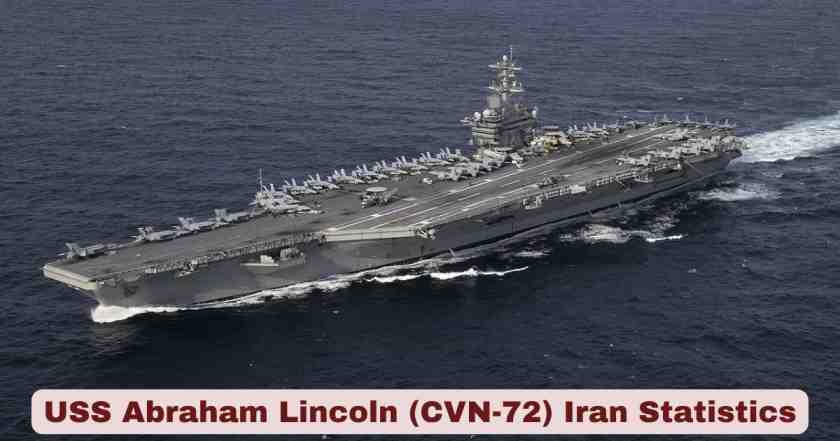
USS Abraham Lincoln (CVN-72) Iran Strike 2026
The USS Abraham Lincoln (CVN-72) has become one of the most operationally significant warships in the world in 2026, sitting at the center of the most consequential U.S. military campaign in the Middle East in more than two decades. When the United States Central Command (CENTCOM) launched Operation Epic Fury on February 28, 2026, the Abraham Lincoln was already deployed in the North Arabian Sea, approximately 500 miles from Iran’s southern coast, serving as the primary naval strike platform against Iranian military targets. Her role in this conflict marks a defining chapter not just for Carrier Strike Group 3 (CSG-3), but for the entire doctrine of naval power projection — confirming that nuclear-powered aircraft carriers remain the irreplaceable backbone of American warfighting capability in the modern era.
What makes the USS Abraham Lincoln CVN-72 Iran 2026 deployment particularly remarkable is the speed and scale at which it escalated from deterrence to active combat. The carrier had been operating in the Indo-Pacific under U.S. 7th Fleet authority as recently as November 2025, before being redirected toward the Middle East amid rising tensions with Tehran. By January 26, 2026, CVN-72 and her strike group had formally entered the U.S. Central Command area of operations, joining one of the largest concentrations of American naval firepower assembled in the region since Operation Iraqi Freedom in 2003. The combination of her embarked Carrier Air Wing Nine (CVW-9) — featuring F-35C Lightning II stealth fighters and EA-18G Growler electronic warfare aircraft — positioned the Abraham Lincoln as the tip of the spear for Operation Epic Fury, a campaign that has since produced staggering military statistics and redefined the trajectory of U.S.-Iran relations.
USS Abraham Lincoln (CVN-72) Interesting Facts 2026
| Fact | Detail |
|---|---|
| Hull Classification | CVN-72 (Nuclear-Powered Aircraft Carrier) |
| Class | Nimitz-class (5th vessel in class) |
| Commissioned | November 11, 1989 |
| Homeport | Naval Air Station North Island, San Diego, California |
| Flight Deck Length | 1,092 feet (longer than the Empire State Building’s height) |
| Full-Load Displacement | ~104,300 tons |
| Beam (Width) | 252 feet |
| Draft | 41 feet |
| Propulsion | 2 × Westinghouse A4W nuclear reactors, 260,000 shaft horsepower |
| Maximum Speed | 30+ knots |
| Nuclear Refueling Cycle | 20–25 years (next refueling expected ~2040s) |
| Aircraft Capacity | Up to 90 fixed-wing aircraft and helicopters |
| Embarked Air Wing (2026) | Carrier Air Wing Nine (CVW-9) |
| Primary Strike Aircraft | F/A-18E/F Super Hornets, F-35C Lightning II |
| EW Aircraft | EA-18G Growlers (Electronic Attack Squadron 133) |
| Total Crew | Approximately 5,680 personnel |
| Ship’s Company | ~3,200 sailors |
| Air Wing Personnel | ~2,400 |
| Total Compartments | 4,800 onboard |
| Aircraft Elevators | 4 (3 starboard, 1 port), each lifting 130,000 lbs |
| Strike Group Designation | Carrier Strike Group 3 (CSG-3) |
| Destroyer Squadron | DESRON 21 |
| Original Construction Cost | $6.8 billion |
| Total Lifecycle Cost | Estimated ~$20 billion over 50 years |
| RCOH Overhaul Cost | Exceeded $3 billion (2013–2017, Newport News Shipbuilding) |
| RCOH Duration | 49 months (May 2013 – May 2017) |
| Operational Motto | “Shall Not Perish” |
| 2026 Theater | U.S. 5th Fleet / CENTCOM — Arabian Sea / North Arabian Sea |
Data Source: U.S. Navy, Naval Sea Systems Command, Commander Naval Air Forces Pacific (AIRPAC), Newport News Shipbuilding Technical Specifications; USS Abraham Lincoln Public Affairs — 2026
The USS Abraham Lincoln (CVN-72) is no ordinary warship — she is a floating sovereign territory of American military power that has been operating continuously for over three decades. Her 1,092-foot flight deck makes her longer than the Empire State Building stands tall, and her ~104,300-ton full-load displacement puts her among the largest warships in human history. Powered by two Westinghouse A4W nuclear reactors generating 260,000 shaft horsepower, CVN-72 can sustain speeds in excess of 30 knots indefinitely without stopping to refuel the ship itself — a strategic advantage that allowed her to sprint from the South China Sea to the North Arabian Sea in under two weeks in January 2026, repositioning across thousands of nautical miles at a pace no conventionally powered vessel could match.
The 5,680 personnel aboard the Abraham Lincoln make her a genuine floating city, complete with medical facilities, dental clinics, a bakery, legal offices, and over 4,800 separate compartments distributed across her hull. Her Carrier Air Wing Nine (CVW-9) embarks a mix of F-35C Lightning II fifth-generation stealth fighters, F/A-18E/F Super Hornets, EA-18G Growlers for electronic warfare, E-2 Hawkeye airborne early warning aircraft, and MH-60 Seahawk helicopters — giving CSG-3 a genuinely multi-domain offensive and defensive capability. The 4 aircraft elevators, each capable of lifting 130,000 pounds, cycle aircraft between the hangar deck and flight deck around the clock, enabling the around-the-clock flight operations that CENTCOM documented throughout Operation Epic Fury in early 2026.
USS Abraham Lincoln (CVN-72) Iran Deployment Timeline 2026
| Date | Event |
|---|---|
| November 2025 | CVN-72 operating within U.S. Indo-Pacific Command (USINDOPACOM) under U.S. 7th Fleet |
| January 8, 2026 | Participated in military exercise in the South China Sea, testing Phalanx CIWS |
| January 15, 2026 | Ordered to redirect from South China Sea toward U.S. Central Command area |
| January 26, 2026 | Abraham Lincoln Carrier Strike Group officially arrives in CENTCOM area of operations |
| January 27, 2026 | President Trump declares multi-day aerial military drills |
| February 3, 2026 | Iranian Shahed-139 drone flies toward the ship ~500 miles from Iran’s coast; U.S. F-35C shoots it down |
| February 7, 2026 | CENTCOM Commander Adm. Brad Cooper makes official announcement aboard USS Abraham Lincoln in the Arabian Sea |
| February 16, 2026 | CENTCOM releases photos of CVN-72 conducting around-the-clock flight operations in the Middle East |
| February 19, 2026 | CSG-3 conducts PHOTOEX (Photo Exercise) in the Arabian Sea as a show of force |
| February 28, 2026 | Operation Epic Fury begins at 1:15 a.m. EST — Abraham Lincoln launches strike sorties; over 1,000 targets hit on opening day |
| March 1, 2026 | IRGC falsely claims USS Abraham Lincoln struck by 4 ballistic missiles; CENTCOM denies: “The Lincoln was not hit” |
| March 5, 2026 | Iranian military again falsely claims drone strike on CVN-72; U.S. releases photos showing normal flight operations |
| March 6, 2026 | F/A-18F Super Hornets (VFA-41) and EA-18G Growlers (VAQ-133) documented launching from Abraham Lincoln in support of Operation Epic Fury |
| March 11, 2026 | Adm. Cooper announces 5,500+ targets struck in Iran; announces from Abraham Lincoln |
| March 23, 2026 | CENTCOM reports 9,000+ targets struck, 140+ Iranian vessels damaged or destroyed, 9,000+ combat flights |
Data Source: U.S. Central Command (CENTCOM) official press releases and social media updates; U.S. Navy public affairs — 2026
The deployment timeline of the USS Abraham Lincoln in 2026 reads like a masterclass in rapid naval repositioning in response to geopolitical crisis. In less than three weeks from being ordered to redirect on January 15, the carrier had transited from the South China Sea, navigated through the Straits of Malacca, crossed the Indian Ocean, and formally entered CENTCOM’s area of operations by January 26 — a transit distance of thousands of nautical miles achieved at the nuclear-powered carrier’s sustained high speed. This rapid redeployment underscored the strategic value of nuclear propulsion: no refueling stops, no logistical delays, just a sustained sprint across the globe driven by two A4W reactors humming at full power.
The February 3, 2026 incident — when an Iranian Shahed-139 drone approached CVN-72 at approximately 500 miles from Iran’s southern coast and was shot down by an embarked F-35C — marked the first direct kinetic confrontation between Abraham Lincoln’s air wing and Iranian forces. From that moment, the trajectory toward Operation Epic Fury became increasingly clear. By the time February 28 arrived, the carrier’s squadrons were launching around-the-clock combat sorties, with CENTCOM confirming that Abraham Lincoln’s air wing played an active role in striking over 1,000 Iranian targets on the operation’s opening day alone — one of the most intense single-day air strike campaigns since the Gulf War.
Operation Epic Fury 2026 | USS Abraham Lincoln Strike Statistics
| Metric | Confirmed Figure | Source / Date |
|---|---|---|
| Operation Start Date | February 28, 2026, 1:15 a.m. EST | CENTCOM official statement |
| Targets Struck — Opening Day | 1,000+ | CENTCOM fact sheet, March 1, 2026 |
| Total Targets Struck (by March 11) | 5,500+ | CENTCOM, Adm. Cooper video update |
| Total Targets Struck (by March 12) | ~6,000 | CENTCOM fact sheet, Stars & Stripes |
| Total Targets Struck (by March 23) | 9,000+ | CENTCOM update, March 23, 2026 |
| Total Combat Flights (by Day 16) | 6,000+ | Adm. Cooper, CENTCOM update |
| Total Combat Flights (by March 23) | 9,000+ | CENTCOM March 23 update |
| Iranian Vessels Damaged/Destroyed (by March 12) | 60+ (incl. 30+ minelayers) | CENTCOM, Stars & Stripes |
| Iranian Vessels Damaged/Destroyed (by March 23) | 140+ | CENTCOM March 23 update |
| Iranian Minelayer Ships Destroyed | 16 confirmed (as of March 12) | CENTCOM |
| Iranian Drone Attacks Reduced | Down 83% since start of operation | Gen. Dan Caine, Joint Chiefs, March 11 |
| Iranian Ballistic Missile Attacks Reduced | Down 90% since start of operation | Gen. Dan Caine, Joint Chiefs, March 11 |
| Iranian Drones Launched (early phase) | 2,000+ | CENTCOM, Adm. Cooper |
| Iranian Ballistic Missiles Launched (early phase) | 500+ | CENTCOM, Adm. Cooper |
| Weapon Systems Used | 20+ types (B-2 bombers, F-22, F-35, EA-18G, MQ-9, HIMARS, ATACMS, Tomahawk) | CENTCOM |
| Kharg Island Targets Struck | 90+ targets | CENTCOM (March 13–14) |
| U.S. Service Members Killed (as of March 8) | 7 (incl. 6 in KC-135 crash March 12) | CENTCOM |
| U.S. Service Members Wounded (as of March 24) | 290 (255 returned to duty; 10 remain seriously wounded) | CENTCOM spokesperson Capt. Tim Hawkins, DefenseScoop |
| Iranian Casualties (as of March 21) | 3,230+ killed (incl. 1,400+ civilians) | HRANA (Human Rights Activists News Agency) |
Data Source: U.S. Central Command (CENTCOM) official updates, CENTCOM.mil, DefenseScoop, Stars & Stripes, U.S. Department of War (war.gov) — February–March 2026
The operational statistics coming out of Operation Epic Fury are nothing short of historically staggering, and the USS Abraham Lincoln sits at the heart of nearly every number. When CENTCOM reported that U.S. forces had struck 9,000+ targets inside Iran by March 23, 2026, and had launched 9,000+ combat flights since February 28, these figures represent a level of sustained air campaign intensity not seen in the region since the initial shock-and-awe phases of the Iraq War in 2003. The destruction of 140+ Iranian naval vessels — including what President Trump described as the elimination of Iran’s entire navy — and the confirmed 16 Iranian minelayer ships destroyed near the Strait of Hormuz speak to a deliberate and systematic campaign to neutralize Iranian power projection at sea. The 83% reduction in Iranian drone attacks and 90% reduction in ballistic missile attacks since the operation began confirm that the campaign has materially degraded Tehran’s offensive military capability.
The human cost on the American side is equally sobering: 290 U.S. service members wounded by March 24, 2026, of whom 255 (roughly 88%) had returned to duty, while at least 13 were killed in total — including 6 airmen in the crash of a KC-135 refueling aircraft over western Iraq on March 12. These losses underscore that the USS Abraham Lincoln and her strike group operate in an environment where Iranian ballistic missiles, drones, cruise missiles, and naval mines pose real and lethal threats, even as CENTCOM repeatedly and publicly rejected Iranian claims of having struck CVN-72 directly. The CENTCOM spokesperson’s March 1, 2026 statement — “The Lincoln was not hit” — became one of the most cited official military statements of the conflict, directly countering a coordinated Iranian information campaign that claimed, over five consecutive days, to have sunk or disabled America’s most prominent warship in theater.
USS Abraham Lincoln (CVN-72) Carrier Strike Group 3 Composition 2026
| Asset | Type / Detail | Home Port |
|---|---|---|
| USS Abraham Lincoln (CVN-72) | Nimitz-class nuclear aircraft carrier — CSG-3 Flagship | NAS North Island, San Diego, CA |
| Carrier Air Wing Nine (CVW-9) | Strike Fighter Squadrons, EW, AEW, Helos, F-35C units | Embarked CVN-72 |
| VFA-41 “Black Aces” | F/A-18F Super Hornets | Documented on March 6, 2026 over flight deck |
| VAQ-133 “Wizards” | EA-18G Growlers (Electronic Attack Squadron) | Documented launching March 1 and March 6, 2026 |
| VMFA-314 (Marines) | F-35C Lightning IIs | Marine Fighter Squadron, embarked CVW-9 |
| USS Frank E. Petersen Jr. (DDG-121) | Arleigh Burke-class guided-missile destroyer | Part of CSG-3 |
| USS Spruance (DDG-111) | Arleigh Burke-class guided-missile destroyer | Naval Station San Diego, CA |
| USS Michael Murphy (DDG-112) | Arleigh Burke-class guided-missile destroyer | Naval Station Pearl Harbor, HI |
| DESRON 21 | Destroyer Squadron 21 — surface escort command | Assigned to CSG-3 |
| Attack Submarine | At least 1 attack submarine (undisclosed class/name) | Undisclosed |
Data Source: Fox 5 San Diego, U.S. Navy public affairs, CENTCOM official press imagery and statements — 2026
Carrier Strike Group 3 (CSG-3), centered on the USS Abraham Lincoln, represents one of the most capable combined-arms naval formations in the world, and in 2026 it has been operating at a wartime tempo that stretches every system and every sailor aboard. The combination of the carrier’s F-35C Lightning IIs from VMFA-314 — fifth-generation stealth fighters capable of penetrating dense Iranian air defenses — alongside the EA-18G Growlers of VAQ-133 providing electronic attack and radar suppression support created a highly lethal and coordinated air campaign that allowed subsequent waves of F/A-18F Super Hornets from VFA-41 to prosecute targets with minimized risk. Meanwhile, the guided-missile destroyers of DESRON 21, including USS Spruance and USS Frank E. Petersen Jr., were confirmed by CENTCOM imagery to have fired Tomahawk cruise missiles at Iranian targets — extending the strike group’s reach from the Arabian Sea deep into the Iranian interior.
The presence of at least one attack submarine within the strike group adds a critical dimension to CSG-3’s lethality that goes largely unreported. On March 4, 2026, open-source reporting confirmed that a U.S. Navy submarine fired a torpedo and sank the Iranian frigate IRIN Dena off the coast of Sri Lanka — demonstrating that the submarine component of the Abraham Lincoln’s strike group was conducting coordinated offensive operations across an extraordinarily wide geographic arc, from the North Arabian Sea to the Indian Ocean. This kind of multi-domain, multi-theater strike coordination, with the Abraham Lincoln serving as the organizing nerve center, confirmed the continued doctrinal centrality of the nuclear-powered carrier strike group in 21st-century high-intensity conflict.
USS Abraham Lincoln (CVN-72) Iran Drone & Missile Incidents 2026
| Date | Incident | Outcome / U.S. Response |
|---|---|---|
| February 3, 2026 | Iranian Shahed-139 drone approaches CVN-72 in Arabian Sea, ~500 miles from Iran’s coast | F-35C shoots down drone; first direct intercept |
| March 1, 2026 | IRGC claims 4 ballistic missiles struck USS Abraham Lincoln | Pentagon: “Weren’t even close”; CENTCOM: “The Lincoln was not hit” |
| March 5, 2026 | Iranian military claims drone strikes hit USS Abraham Lincoln | U.S. releases photos of CVN-72 conducting normal flight operations same day |
| March 5–10, 2026 | Iran repeats claims of sinking/damaging CVN-72 — five consecutive days | CENTCOM and Pentagon publicly deny all claims; photos released as counter-evidence |
| March 1–24, 2026 | Iran launches 2,000+ drones and 500+ ballistic missiles at U.S./allied targets (region-wide, including Bahrain, Kuwait, Saudi Arabia, Qatar) | U.S. / allied air defenses intercept majority; Iranian attack rate drops 83–90% by mid-March |
| March 8, 2026 | Iranian-linked drone strikes command center in Kuwait — 6 U.S. Army Reserve soldiers killed | Part of total U.S. casualties in Operation Epic Fury |
| March 12, 2026 | KC-135 refueling aircraft crashes over western Iraq — 6 U.S. airmen killed | Adm. Cooper honors fallen; CENTCOM continues operations |
Data Source: U.S. Central Command (CENTCOM) official statements; Pentagon press briefings; DefenseScoop; Stars and Stripes; Task & Purpose — 2026
The Iranian information campaign targeting the USS Abraham Lincoln in early March 2026 was, by any objective measure, one of the most aggressive and sustained disinformation efforts Tehran has ever aimed at a specific American military asset. Over five consecutive days, Iranian state media and IRGC officials claimed — first that CVN-72 had been struck by four ballistic missiles, then by drone strikes, then that it had been forced to leave the battlefield, and finally that it had “miraculously resurfaced” after being sunk. The speed and consistency with which CENTCOM publicly debunked each claim — releasing timestamped photos and videos of the Abraham Lincoln conducting normal flight operations in the Arabian Sea on the same days Iran claimed it was disabled — represented a highly effective real-time information counter-offensive that further damaged Tehran’s credibility in the region.
The actual threat environment around CVN-72 was nonetheless genuinely dangerous. Iran launched over 2,000 drones and 500 ballistic missiles across the broader theater between February 28 and mid-March 2026, striking targets in Bahrain, Kuwait, Saudi Arabia, Qatar, Jordan, the UAE, and Iraq. The February 3 Shahed-139 intercept — where a single F-35C dispatched an approaching Iranian drone at 500 miles from the carrier — demonstrated both the threat’s reality and the strike group’s layered defensive capability. The Phalanx CIWS, ESSM missiles, RAM systems, and SLQ-32 electronic warfare suite that protect CVN-72 were not merely theoretical deterrents in 2026 — they were actively employed in a combat environment where the Strait of Hormuz, the Arabian Sea, and the skies above them became some of the most contested airspace and waterspace on Earth.
Operation Epic Fury 2026 | Weapons Systems & Assets Deployed from USS Abraham Lincoln Theater
| Weapon / System | Type | Role in Operation Epic Fury |
|---|---|---|
| F-35C Lightning II | 5th-gen stealth multirole fighter | Stealth strike sorties into Iranian air-defended airspace; drone intercept (Feb. 3) |
| F/A-18E/F Super Hornet | Multirole strike fighter | Primary strike aircraft for Iranian military targets |
| EA-18G Growler | Electronic attack aircraft | Radar jamming, SEAD (suppression of enemy air defenses) |
| Tomahawk Cruise Missiles | Long-range precision cruise missile (BGM-109) | Fired by CSG-3 destroyers at Iranian targets |
| ATACMS (Army Tactical Missile System) | Surface-to-surface ballistic missile (up to 186-mile range) | Struck Iranian targets from HIMARS ground launchers |
| B-2 Spirit Stealth Bombers | Strategic bomber | Dropped 2,000-lb penetrator bombs on buried Iranian ballistic missile sites |
| B-1B Lancer / B-52 Stratofortress | Strategic bombers | Struck 200 targets in 72 hours during peak campaign intensity |
| F-22 Raptor | 5th-gen air superiority fighter | Deployed to bases in Israel and Jordan; air superiority missions |
| LUCAS Drones | Low-Cost Uncrewed Combat Attack System (reverse-engineered Shahed-136) | Combat debut in Operation Epic Fury — one-way attack drones built by SpektreWorks, AZ |
| Precision Strike Missile (PrSM) | Long-range precision missile | Combat debut in Operation Epic Fury against undisclosed Iranian targets |
| MQ-9 Reaper | Attack/surveillance drone | Surveillance and strike missions |
| Submarine-launched torpedo | Attack submarine weapon | Sank Iranian frigate IRIN Dena on March 4, 2026 |
Data Source: U.S. Central Command (CENTCOM); DefenseScoop; Stars & Stripes; U.S. Department of War (war.gov) — 2026
The sheer breadth of weapons systems deployed in Operation Epic Fury — with USS Abraham Lincoln as the naval centerpiece — reflects a “combined arms at scale” philosophy that CENTCOM Commander Admiral Brad Cooper described as “unpredictable, dynamic and decisive.” The use of over 20 different weapon systems on the opening day of the operation alone — ranging from B-2 Spirit stealth bombers dropping 2,000-pound penetrator bombs on buried ballistic missile sites to LUCAS one-way attack drones making their combat debut — demonstrated that the U.S. military was not fighting a conventional engagement but a multi-layered, simultaneous decapitation and infrastructure destruction campaign. The fact that B-2 bombers struck nearly 200 targets in just 72 hours during the campaign’s peak intensity underscores the speed at which the American air machine operated when unleashed at full capacity, with the Abraham Lincoln’s CVW-9 providing the persistent forward presence and the tactical air superiority that enabled heavier assets to operate.
The combat debuts of two new American weapons systems in this conflict deserve particular attention. The LUCAS drone — a reverse-engineered version of Iran’s own Shahed-136, built by Arizona-based SpektreWorks — represents a case of America turning Iranian asymmetric warfare doctrine back against Tehran at industrial scale. The Precision Strike Missile (PrSM), whose development was made possible by the U.S. withdrawal from the INF Treaty, also saw its first combat use in Operation Epic Fury, striking undisclosed Iranian targets with a long-range precision capability that no previous Army ground system could match. Together with the submarine-launched torpedo that sent the IRIN Dena frigate to the bottom of the Indian Ocean on March 4, 2026, these new systems signal that the technological gap between American and Iranian military capability — already wide — has been further expanded through this conflict.
USS Abraham Lincoln (CVN-72) Historical Combat Record vs. Iran 2026
| Parameter | Operation Iraqi Freedom (2003) | Operation Epic Fury (2026) |
|---|---|---|
| Theater | Persian Gulf / Arabian Sea | North Arabian Sea / Arabian Sea |
| Mission | Opening strikes on Iraq | Strikes on Iranian military targets |
| Sorties Flown | 16,500 (full deployment) | 9,000+ combat flights (by March 23, 2026 — and ongoing) |
| Ordnance Expended | 1.6 million pounds | Ongoing — includes 2,000-lb penetrator bombs, Tomahawks, ATACMS |
| Targets Struck | Iraqi military targets | 9,000+ Iranian targets (by March 23) |
| Duration of Deployment | 290 days (record longest nuclear carrier deployment at the time) | Ongoing as of March 25, 2026 |
| Enemy Claims of Damaging CVN-72 | None | False claims on 5+ consecutive days — all denied by CENTCOM |
| Air Wing | CVW-14 (F-14, F/A-18) | CVW-9 (F-35C, F/A-18E/F, EA-18G) |
| New Weapons Deployed | N/A | LUCAS drones (combat debut), PrSM (combat debut) |
| AI Integration | None | AI-assisted targeting — confirmed by CENTCOM commander |
Data Source: U.S. Navy historical records; CENTCOM official updates; DefenseScoop — 2026
Placing the USS Abraham Lincoln’s 2026 Iran campaign alongside her role in Operation Iraqi Freedom in 2003 makes the sheer scale of the current conflict immediately apparent. In 2003, the Abraham Lincoln’s air wing flew 16,500 sorties and dropped 1.6 million pounds of ordnance over the course of a 290-day deployment that was at the time the longest nuclear carrier deployment in Navy history. In 2026, CVW-9 and supporting CENTCOM assets have already flown 9,000+ combat flights in under 25 days since Operation Epic Fury began on February 28 — a pace that, if sustained, would dwarf the 2003 campaign’s sortie count well within the original deployment’s timeframe. The technological leap between the two conflicts is equally stark: where 2003 CVW-14 flew F-14 Tomcats and F/A-18s, 2026 CVW-9 deploys F-35C stealth fighters operating alongside AI-assisted targeting systems that CENTCOM’s own commander publicly credited with enabling American forces to identify and strike targets faster than Iranian forces could respond.
The artificial intelligence integration confirmed by Admiral Brad Cooper in his March 11, 2026 update from aboard the Abraham Lincoln represents perhaps the most consequential evolution in carrier strike group warfare since the introduction of precision-guided munitions. By sifting through vast amounts of intelligence data in seconds, these AI tools allowed American targeting officers to cut through the fog of war and make faster, better-informed decisions than any previous generation of military planners — a capability that directly contributed to the 83% reduction in Iranian drone attacks and 90% reduction in ballistic missile attacks achieved by mid-March, as U.S. forces systematically destroyed Iran’s launch infrastructure faster than Tehran could reconstitute it. The USS Abraham Lincoln thus stands not just as a physical strike platform in 2026, but as the command node of an entirely new kind of AI-accelerated naval warfare.
Disclaimer: The data research report we present here is based on information found from various sources. We are not liable for any financial loss, errors, or damages of any kind that may result from the use of the information herein. We acknowledge that though we try to report accurately, we cannot verify the absolute facts of everything that has been represented.