American Polygraph Association’s meta-analysis of 3,723 examinations puts overall decision accuracy at 87%. In 2026, roughly 62% of large US law enforcement agencies still require pre-employment polygraph screening, even though federal law bars most private employers from using the test on their own staff.
What is a Polygraph Test?
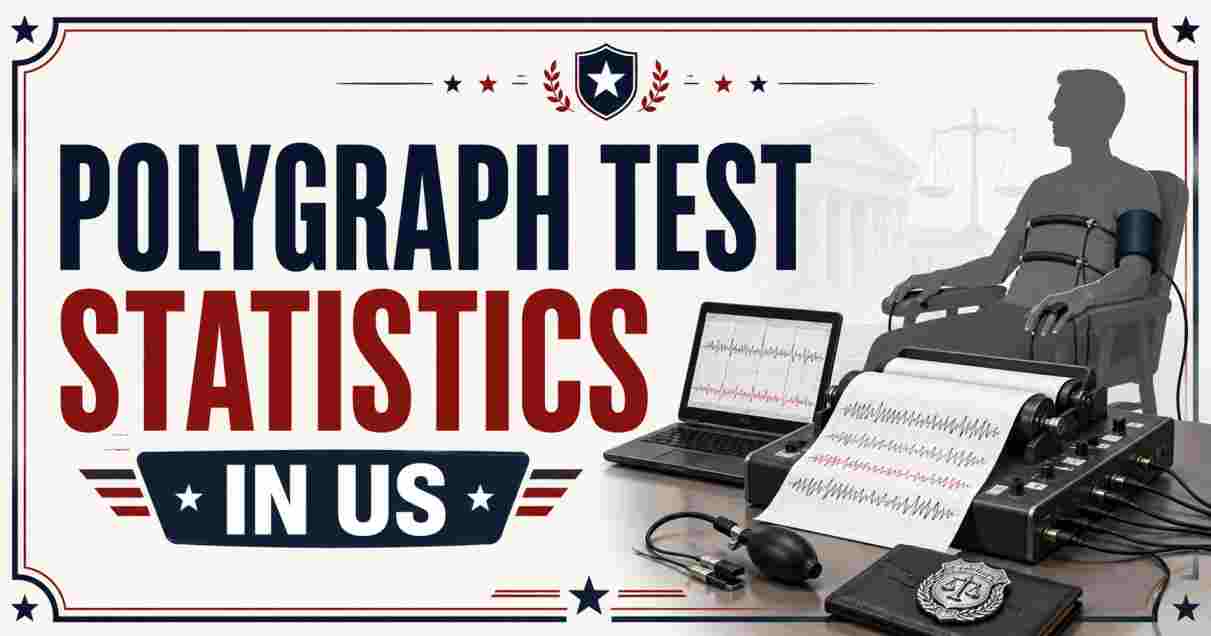
A Polygraph Test works by strapping sensors to a person’s chest, fingertips, and arm to record involuntary physiological changes while an examiner asks a structured sequence of questions. The machine does not detect lies directly. It records heart rate, blood pressure, respiration rate, and electrodermal activity, then a trained examiner compares the reactions to relevant questions against reactions to control questions. Federal agencies, police departments, and private examiners across all 50 states run these exams for hiring screens, criminal investigations, and personal disputes, and the practice has stayed largely unchanged in method since the 1930s even as the scoring software has modernized.
The instrument traces back to 1921, when medical student John Larson built the first continuous-recording device for the Berkeley Police Department. Nearly a century later, the exam remains a fixture of American law enforcement hiring and federal security clearance work, despite a 2003 National Academy of Sciences review that questioned its scientific footing for high-stakes screening. That tension defines almost every statistic in this report, from the 87% accuracy figure examiners cite to the roughly 23 states that will let a jury see the results at all.
Interesting Facts About the Polygraph Test in 2026
| Fact | 2026 Data Point |
|---|---|
| Year invented | 1921, by John Larson, Berkeley PD |
| APA founded | 1966 |
| Active APA members | 2,800+ examiners worldwide |
| Governing federal law | Employee Polygraph Protection Act, 1988 |
| Overall reported accuracy | 87% (APA meta-analysis) |
| NAS 2003 accuracy estimate | ~70% for the Control Question Technique |
| Average test cost | $800 per single-issue exam |
| Pre-EPPA annual test volume | ~2,000,000 tests per year |
| Large agencies using pre-employment screening | 62% |
| States admitting results in court | ~23 states, mostly by stipulation |
Source: American Polygraph Association; U.S. Department of Labor, Wage and Hour Division
These numbers show a technology that never disappeared, it just got fenced in. The 1988 federal law wiped out the vast majority of workplace testing almost overnight, yet the surviving use cases, hiring for police and federal agencies, sex-offender supervision, and voluntary private exams, kept the industry alive and even growing in specific niches. The 2,800+ active members of the American Polygraph Association represent examiners spread across private practice, law enforcement, and government service, and that number has stayed remarkably stable for two decades despite repeated scientific challenges to the underlying methodology.
The gap between the industry’s 87% accuracy claim and the National Academy of Sciences’ more conservative 70% estimate is the central fault line in every policy debate about the US Polygraph Test. Courts, employers, and lawmakers have split the difference by letting the exam operate as an investigative tool that produces admissions and leads, while mostly refusing to treat raw chart readings as courtroom-grade evidence. The sections below unpack how that compromise plays out across accuracy research, government use, law enforcement hiring, and the legal system.
US Polygraph Test Accuracy Rate Statistics 2026
| Technique | Reported Accuracy |
|---|---|
| Single-issue (event-specific) testing | 89%, 11% inconclusive |
| Multiple-issue testing | 85%, 13% inconclusive |
| Combined validated techniques | 87% (confidence interval 80%–94%) |
| NAS 2003 review of CQT field studies | ~70% |
| APA-cited historical research range (since 1980) | 80%–98% |
| Directed Lie Screening Test, innocent examinees | 98% in validated research |
Source: American Polygraph Association Meta-Analytic Survey (2011); National Research Council, National Academy of Sciences (2003)
The 87% headline figure comes from a 2011 American Polygraph Association meta-analysis that pooled 38 qualifying studies covering 3,723 examinations, and it splits meaningfully by technique. Single-issue tests, where the examiner focuses on one specific event, such as a theft or an assault, scored 89% accuracy with an 11% inconclusive rate. Multi-issue screening tests, the kind used for pre-employment or periodic security checks, scored lower at 85% with a 13% inconclusive rate, because asking about several unrelated topics in one session makes it harder to isolate a clean physiological signal.
The National Academy of Sciences 2003 report remains the most cited counterweight to the industry’s numbers. Reviewing decades of research, the panel concluded polygraph testing could discriminate lying from truth-telling “well above chance, though well below perfection,” and separately estimated Control Question Technique accuracy at roughly 70% in security-screening contexts, well below the APA’s field-study figures. The panel also flagged that most existing research suffered from weak design, meaning the true error rate in real hiring and investigative settings is still not settled science, even after a century of use.
That gap between 89%, 87%, and 70% is not simply a case of one side being right and the other wrong. Laboratory studies, the kind the APA leans on most heavily, tend to use mock-crime scenarios where researchers know the ground truth in advance, which makes scoring cleaner but does not always mirror the emotional stakes of a real criminal interrogation or a job interview. Field studies, the kind the NAS panel weighted more heavily, capture real-world stakes but often lack a fully confirmed ground truth for every case, which makes their accuracy estimates harder to pin down precisely. Anyone reading a single accuracy number in isolation is missing that methodological split entirely.
Polygraph Test Usage by US Government Agencies 2026
| EPPA Provision | 2026 Data Point |
|---|---|
| Law enacted | Signed June 27, 1988, effective December 27, 1988 |
| Enforcing agency | U.S. Department of Labor, Wage and Hour Division |
| Civil penalty per violation | Up to $10,000 |
| Pre-EPPA annual private-sector tests | Approximately 2,000,000 |
| Share of pre-EPPA tests in private sector | 98% |
| Tests eliminated by the law | Roughly 85% of prior volume |
| Exempt employer categories | Government, security services, pharmaceutical distributors, ongoing-investigation cases |
Source: Employee Polygraph Protection Act of 1988, U.S. Department of Labor Fact Sheet #36
Before 1988, an estimated 2,000,000 polygraph tests were administered every year in the United States, and roughly 98% of that volume happened in the private sector, largely in retail, banking, and warehousing, where employers used the exam to screen for theft. Congress ended that practice for most private employers with the Employee Polygraph Protection Act, signed by President Reagan and enforced by the Department of Labor’s Wage and Hour Division, which can now levy civil penalties up to $10,000 per violation. The law eliminated an estimated 85% of all workplace polygraph testing almost immediately.
What survived is precisely what makes the US Polygraph Test relevant in 2026: federal, state, and local government agencies are completely exempt, which is why the FBI, CIA, NSA, and thousands of local police departments continue to run the exam routinely for hiring and internal investigations. Security firms and employers conducting a specific-incident investigation into an economic loss also retain limited rights to test. This carve-out means the modern US Polygraph Test market is now overwhelmingly a government and law-enforcement tool, a sharp reversal from its pre-1988 footprint. Anyone researching adjacent employment-law protections can find a broader breakdown in this workplace discrimination statistics report, which covers how EEOC claims intersect with screening practices.
Law Enforcement Polygraph Screening Statistics 2026
| Metric | 2026 Data Point |
|---|---|
| Large agencies requiring pre-employment polygraph | 62% |
| Applicants disqualified from polygraph-only findings | ~25% |
| Applicant pools revealing undisclosed information | 25%–40% |
| Agencies surveyed nationally | 626 agencies |
| Average agency force size | 447 officers |
| Average population served | 522,000 residents |
| Adult community supervision programs using PCSOT | ~80% |
Source: National Survey of Pre-Employment Polygraph Screening Practices in US Police Agencies; American Polygraph Association
A landmark national survey covering 626 law enforcement agencies, with an average force size of 447 officers serving communities of roughly 522,000 people, found that 62% of respondent departments used the polygraph in hiring. Those agencies reported disqualifying approximately 25% of applicants based on information the polygraph surfaced that background checks and interviews had missed entirely, from undisclosed drug use to falsified employment history. Other industry estimates place the broader rate of applicants revealing significant undisclosed information between 25% and 40% of the total pool.
Beyond hiring, Post-Conviction Sex Offender Testing (PCSOT) has become one of the exam’s fastest-growing specialties, now used in an estimated 80% of adult community supervision programs to monitor treatment compliance. This dual role, screening recruits on one end and monitoring convicted offenders on the other, explains why examiner demand held steady even as private-sector use collapsed after 1988. Departments that skip the exam, typically in states with statutory bans, point to alternative vetting tools, but national data still shows the polygraph is majority practice among larger agencies. Departments weighing the financial exposure of hiring mistakes can find related context in this workers’ compensation statistics report, which tracks how screening failures translate into downstream claims costs.
Polygraph Test Admissibility in US Courts 2026
| Legal Standard | 2026 Data Point |
|---|---|
| States admitting evidence in some form | ~23 states |
| States requiring mutual stipulation | ~19 states |
| States using the Daubert standard | 18 states |
| States admitting without stipulation | 1 state (New Mexico, Rule 11-707) |
| States still applying the Frye standard | ~5 states (including NY, PA, IL) |
| Federal courts’ general posture | Discretionary, largely inadmissible |
Source: State-by-state polygraph admissibility analyses; Frye v. United States (1923); Daubert v. Merrell Dow Pharmaceuticals, Inc. (1993)
Roughly 23 states currently allow polygraph results into evidence under specific conditions, and the majority, about 19 states, only permit it when both prosecution and defense agree in advance through a formal stipulation. New Mexico stands alone as the one state that generally admits results without that prior agreement, operating under its own Rule 11-707 framework. The split traces back to two competing standards: the older Frye “general acceptance” test, born from a 1923 polygraph case, and the newer Daubert standard, adopted by roughly 18 states and most federal courts after the Supreme Court’s 1993 ruling, which asks judges to weigh scientific reliability directly.
A shrinking handful of states, including New York, Pennsylvania, and Illinois, still lean on Frye or a Frye-plus hybrid, and those jurisdictions have kept polygraph results out of criminal trials for decades. Everywhere else, the exam functions less as trial evidence and more as an investigative lever, since a subject’s willingness or refusal to take the test often becomes a negotiating signal, even when the chart never reaches a jury. Firms handling cases where scientific evidence admissibility is contested often track parallel issues in professional liability, covered in more depth in this legal malpractice statistics report.
Polygraph Examiner and Industry Cost Statistics 2026
| Metric | 2026 Data Point |
|---|---|
| Active APA-affiliated examiners | 2,800+ |
| States requiring examiner licensing | ~28 states |
| Minimum basic training hours | 400 hours |
| National average single-issue test cost | $800 |
| Full national price range | $200–$2,500+ |
| Pre-employment screening cost range | $350–$500 |
| Federal border screening cost per exam | ~$2,200 |
Source: American Polygraph Association; national polygraph pricing industry surveys
The American Polygraph Association, founded in 1966, represents more than 2,800 examiners working across private practice, law enforcement, and government, and it sets the training bar at a minimum 400-hour Basic Polygraph Examiner Course, typically completed over 10 to 17 weeks. Roughly 28 states now require formal licensing on top of that training, while the remaining states rely on voluntary professional certification through the APA or its regional affiliates. That relatively small, tightly credentialed examiner pool is part of why pricing has stayed fairly consistent, a single-issue private exam averages $800 nationally, with a realistic range of $200 to $2,500+ depending on complexity, examiner experience, and metropolitan location.
Pricing splits by purpose. Pre-employment screening exams, the shorter, standardized kind police departments use, run cheaper at $350 to $500, while personal disputes involving infidelity or multi-issue investigations can climb past $1,000. On the federal end, agencies such as US Customs and Border Protection report spending roughly $2,200 per examination, reflecting more intensive full-scope screening for national-security-adjacent hiring. Metropolitan markets like New York, Los Angeles, and Miami typically charge up to 25% more than rural examiners.
Polygraph Test Failure Rate and False Positive Statistics 2026
| Outcome Category | 2026 Data Point |
|---|---|
| Typical pre-employment failure/disqualification rate | 25%–40% of applicant pools |
| Inconclusive rate, single-issue tests | 11% |
| Inconclusive rate, multi-issue tests | 13% |
| False-positive risk for honest examinees | Statistically real but not precisely quantified |
| Countermeasure detection concern (NAS finding) | Confirmed as a validity risk |
| Constitutional right to refuse | Protected under the Fifth Amendment |
Source: National Academy of Sciences (2003); American Polygraph Association Validity Research
A “failed” polygraph rarely means the machine caught someone lying with certainty. Between the 11% to 13% inconclusive rate built into even the best-validated techniques and a documented false-positive risk for anxious but truthful examinees, the National Academy of Sciences warned that the physiological responses the machine measures, elevated heart rate, sweating, altered breathing, are also produced by simple nervousness or unfamiliarity with the testing environment, not just deception. That distinction matters in a security-screening context, where testing a large population for a small number of genuine threats mathematically inflates the false-positive rate, even at a high nominal accuracy level.
The same 2003 review raised a separate concern about countermeasures, deliberate techniques some examinees use to normalize their physiological readings during relevant questions. Researchers found trained countermeasure use can meaningfully undermine test validity, which is part of why polygraph results function more as an investigative tool that prompts disclosures than as a courtroom-ready verdict. Every examinee also retains a Fifth Amendment right to refuse the test, and that refusal cannot be used as direct evidence of guilt, though it is often treated similarly to a failed result during hiring decisions.
Most polygraph examiners themselves draw a sharp line between a chart-based deceptive finding and a pre-test admission, even though the public tends to lump both under the umbrella word “failed.” A large share of applicants who never make it past a pre-employment polygraph disclosed disqualifying information during the structured interview portion of the exam, before the physiological recording even started, once confronted with pointed questions about drug use, criminal history, or falsified paperwork. That distinction matters for anyone trying to interpret the 25% to 40% disqualification range cited across law-enforcement hiring literature.
Frequently Asked Questions About the US Polygraph Test 2026
Is a polygraph test legal in all 50 states?
Polygraph testing is legal to administer nationwide, but rules around who can require one differ by state. Massachusetts, for example, bans pre-employment polygraph testing for police hiring specifically, while most states allow government agencies and exempt employers to test freely under federal EPPA guidelines.
Can you refuse to take a polygraph test?
Yes. Refusing a polygraph is a protected right under the Fifth Amendment, and in most contexts a refusal cannot be used directly as evidence of guilt in court. That said, employers and investigators can and often do factor a refusal into their overall decision-making process.
What counts as a failed polygraph test?
A “fail” typically means the examiner’s scoring identified deceptive physiological responses to relevant questions. It is distinct from an inconclusive result, which happens in roughly 11% to 13% of validated exams and means the data was not clear enough to make a call either way.
How accurate is a polygraph test in 2026?
The polygraph industry cites 87% overall accuracy based on a 2011 APA meta-analysis of 3,723 examinations. Independent academic reviewers, including the 2003 National Academy of Sciences report, have estimated real-world accuracy closer to 70%, particularly for broad security screening rather than single-issue criminal investigations.
Can polygraph test results be used in court?
Only in about 23 states, and usually only when both sides agree beforehand through a stipulation. New Mexico is the sole state that generally admits results without that prior agreement. Federal courts and states following the Frye standard almost never allow it.
Do US employers require polygraph tests?
Most private employers cannot legally require one under the 1988 Employee Polygraph Protection Act. Government employers, including federal agencies and most police departments, remain fully exempt and continue requiring the test as a standard part of hiring.
How much does a polygraph test cost in the United States?
The national average is around $800 for a single-issue exam, with prices ranging from $200 for basic screenings up to $2,500+ for complex, multi-issue cases. Pre-employment screening exams tend to be cheaper, typically $350 to $500.
Can someone beat a polygraph test using countermeasures?
Research reviewed by the National Academy of Sciences found that trained countermeasures can meaningfully reduce test accuracy, which is one reason polygraph results are treated cautiously in legal and scientific circles rather than as definitive proof.
Which jobs typically require a polygraph test?
Law enforcement officers, federal agents, intelligence agency staff, and certain security-clearance positions are the most common roles requiring a polygraph. Roughly 62% of large US police agencies include it as a mandatory pre-employment step.
How many people take polygraph tests in the US each year?
Exact current-year figures are not centrally published, but pre-1988 volume reached roughly 2,000,000 tests annually, with 98% in the private sector. Since the EPPA eliminated an estimated 85% of that volume, today’s usage is concentrated almost entirely in government, law enforcement, and voluntary private examinations.
Disclaimer: The data research report we present here is based on information found from various sources. We are not liable for any financial loss, errors, or damages of any kind that may result from the use of the information herein. We acknowledge that though we try to report accurately, we cannot verify the absolute facts of everything that has been represented.