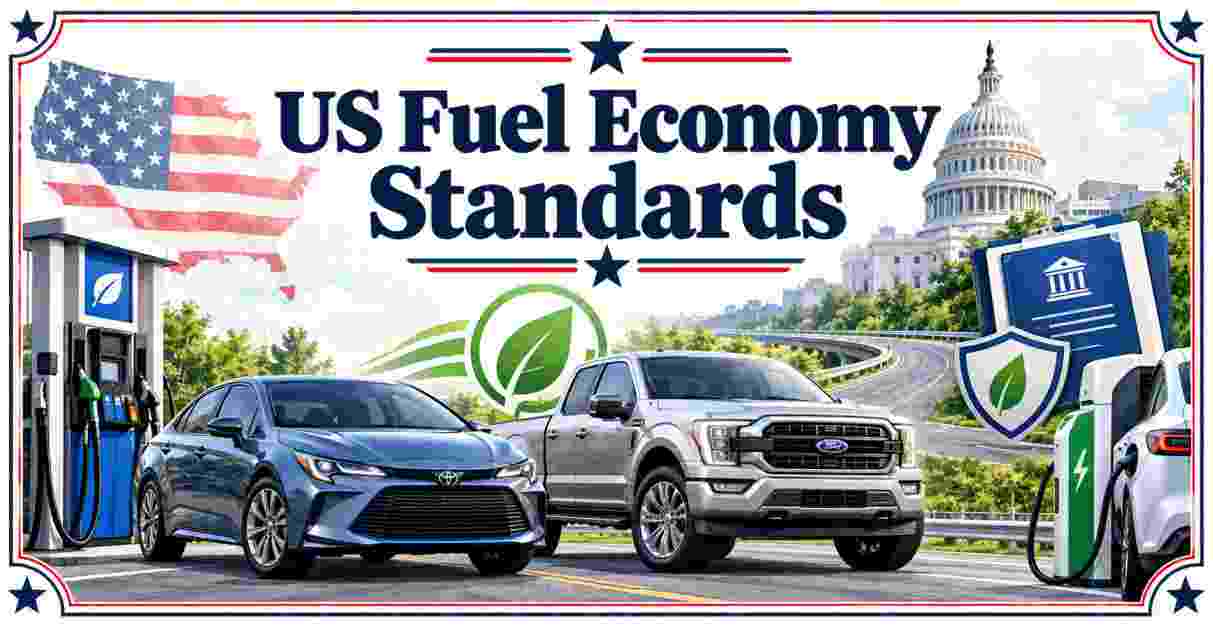
NHTSA finalized a major rollback of Corporate Average Fuel Economy standards on September 28, 2026, cutting the required annual efficiency increase to just 1% through model year 2031. The new target of 34.9 mpg fleet-wide by 2031 replaces a Biden-era requirement that would have pushed the industry average to 49.3 mpg.
US Fuel Economy Standards 2026 – Introduction
US fuel economy standards underwent their most significant revision in years this week, as the National Highway Traffic Safety Administration finalized a rule dramatically slowing the pace at which automakers must improve their fleet-wide gas mileage. The new rule, published in the Federal Register on September 30, 2026, scales back annual stringency increases from the roughly 8% to 10% required under the 2022 Biden-era standards down to just 1% per year through model year 2031, a change NHTSA itself describes as better aligning requirements with “current market conditions.”
This report breaks down US fuel economy standards in 2026 across every dimension: exactly what the new rule changes, the full regulatory history from the original 2020 standards through this latest rollback, the elimination of tradeable EV compliance credits, how automakers and critics have responded, and how this shift connects to the broader collapse of federal EV incentives earlier this year. Understanding these changes matters for anyone purchasing a new vehicle, working in or investing in the automotive industry, or simply tracking how US climate and energy policy continues shifting under the current administration.
Interesting Facts About US Fuel Economy Standards in 2026
| Statistic | 2026 Data |
|---|---|
| Final Rule Announcement Date | September 28, 2026 |
| Federal Register Publication Date | September 30, 2026 |
| New Annual Stringency Increase | ~1% per year through MY2031 |
| Prior (2022 Rule) Annual Increase, MY2024-2025 | 8% per year |
| Prior (2022 Rule) Annual Increase, MY2026 | 10% |
| New Target: Industry Average by MY2031 | 34.9 mpg |
| “No-Action” Baseline That Would Have Applied | 49.3 mpg |
| MY2026 Target Under Original 2020 (First Trump Term) Rule | 40.4 mpg |
| MY2026 Target Under 2022 Biden-Era Rule | ~49 mpg |
| EV Compliance Credit Trading | Ends for new credits (existing credits still usable) |
| Minimum Domestic Passenger Car Standard, MY2026 | 33.9 mpg (separate floor requirement) |
Data Source: Federal Register, NHTSA Final Rule (September 2026)
The numbers above capture a genuine reversal in direction for America’s fuel economy policy. Under the 2022 Biden-era rule, automakers faced annual efficiency increases of 8% for model years 2024 and 2025, jumping to 10% for model year 2026 alone, a trajectory NHTSA projected would push the industry’s fleet-wide average to roughly 49 mpg by this year. The new rule finalized this week replaces that trajectory entirely, requiring just 1% annual improvement through model year 2031, when the industry average target now sits at just 34.9 mpg, well below the 49.3 mpg that would have applied had the prior standards remained in place.
This represents the second major fuel economy rollback in less than a decade, following a similar pattern during the first Trump administration, when the 2020 SAFE Vehicles Rule similarly scaled back Obama-era targets, projecting just 40.4 mpg for model year 2026 compared to the roughly 46.7 mpg the original 2012 standards would have required. The current rollback goes even further than that first-term revision, reflecting what NHTSA describes as a recalibration toward standards the agency considers more achievable without forcing what officials call an unrealistic transition toward electric vehicles.
The September 2026 CAFE Rollback | What Changed
| Detail | Information |
|---|---|
| Rule Name | SAFE Vehicles Rule III |
| Governing Agency | NHTSA, US Department of Transportation |
| Transportation Secretary | Sean P. Duffy |
| Model Years Covered | 2022-2031 |
| Estimated Compliance Cost Impact | Lower technology costs for automakers, per NHTSA |
Data Source: Federal Register, Department of Transportation Announcement
The newly finalized SAFE Vehicles Rule III represents NHTSA’s complete recalibration of Corporate Average Fuel Economy requirements covering model years 2022 through 2031. Announced by Transportation Secretary Sean P. Duffy on September 28, 2026, and published in the Federal Register two days later, the rule’s central change is straightforward: annual fuel economy stringency increases drop from the 8% to 10% range required under the prior administration’s 2022 standards down to approximately 1% annually, a reduction of roughly 90% in the pace of required improvement.
NHTSA’s own technical analysis, included in the final rule text, estimates that the technologies automakers would need to deploy to comply with these relaxed standards will cost significantly less than what compliance with the stricter 2022 standards would have required. The rule explicitly states its standards represent the “maximum feasible” fuel economy levels the agency believes it can legally require, after balancing statutory factors including technological feasibility, economic practicability, and the effect of other federal vehicle standards, a notably more conservative interpretation of that legal standard than the prior administration applied just four years earlier.
CAFE Standard History: From 49 MPG to 34.9 MPG
| Rule/Era | Projected Fleet-Wide MPG | Target Model Year |
|---|---|---|
| 2012 Obama-Era Standards (Baseline) | ~46.7 mpg | MY2026 |
| 2020 SAFE Rule (First Trump Term) | 40.4 mpg | MY2026 |
| 2022 Biden-Era Rule | ~49 mpg | MY2026 |
| 2026 SAFE Vehicles Rule III (Current) | 34.9 mpg | MY2031 |
Data Source: NHTSA Final Rule Documents, Federal Register Historical Filings
The regulatory history of CAFE standards for model year 2026 alone illustrates just how dramatically fuel economy policy has swung between administrations over the past decade and a half. The original 2012 Obama-era trajectory, before any subsequent revision, implied roughly 46.7 mpg as the eventual MY2026 target. The first Trump administration’s 2020 SAFE Vehicles Rule scaled that back to just 40.4 mpg, citing concerns about forcing technologies with questionable consumer benefit. The Biden administration’s 2022 rule then reversed course sharply, pushing the MY2026 target up to roughly 49 mpg, the most aggressive fuel economy requirement in the program’s history.
This week’s SAFE Vehicles Rule III represents the third major directional shift for this same model year window, ultimately settling on a 34.9 mpg target for model year 2031, the furthest year covered by the new rule, a level actually below even the first Trump administration’s 2020 standards. This pattern of each new administration substantially rewriting fuel economy requirements for overlapping model years has created persistent uncertainty for automakers attempting multi-year product planning, since a vehicle platform designed years in advance to meet one administration’s targets can find itself significantly over-engineered, or under-compliant, by the time a new administration revises the rules again before that vehicle reaches showrooms.
The End of EV Compliance Credit Trading 2026
EV Compliance Credit System: Before and After
Pre-2026 Rule     |████████████████████████████████████████ New credits tradeable between manufacturers
Post-2026 Rule    |████████████████ Existing credits usable, no new credits created
| Detail | Status |
|---|---|
| New Tradeable EV Compliance Credits | Eliminated |
| Previously Acquired Credits | Can still be used |
| Primary Companies Affected | EV-focused manufacturers (e.g., Tesla) |
| Credit Buyers (Historically) | Automakers with less-efficient fleets |
Data Source: NPR, Energy News Pro, NHTSA Final Rule
One of the most consequential, if less widely discussed, provisions in the new rule eliminates the creation of new tradeable compliance credits that automakers have historically bought and sold among themselves to meet fuel economy requirements. Under the prior system, manufacturers whose vehicles outperformed CAFE targets, most notably all-electric automakers like Tesla, could sell surplus compliance credits to competitors whose fleets fell short, creating a direct revenue stream for EV-focused companies and a compliance safety valve for traditional automakers slower to electrify.
While the rule allows credits acquired before it takes effect to still be used going forward, it closes off this revenue mechanism for any future compliance periods, a change that particularly affects EV-centric manufacturers that had built credit sales into their financial planning. Industry analysts note this gradual disappearance of credit-sale revenue compounds other recent pressures facing EV makers, coming just months after Congress eliminated federal EV purchase tax credits entirely, creating a one-two punch of reduced consumer incentives and reduced manufacturer compliance-credit revenue within the same calendar year.
Automaker Industry Reaction 2026
| Stakeholder | Position |
|---|---|
| Alliance for Automotive Innovation | Supportive, calls it “appropriate course correction” |
| General Motors | Referred comment to the Alliance |
| John Bozzella (Alliance President/CEO) | “NHTSA made the right call” |
| Critic Perspective (Academic Economists) | Warns it hinders EV competitiveness vs. China |
Data Source: NPR, ABC News, Energy News Pro
Automaker reaction to the rollback has been overwhelmingly positive from the industry’s main trade association. The Alliance for Automotive Innovation, which represents major manufacturers including Ford, General Motors, Stellantis, Toyota, Volkswagen, and Hyundai, praised the final rule, with President and CEO John Bozzella stating that “NHTSA made the right call to better align fuel economy standards with the law and current market conditions.” Bozzella went further in comments to ABC News, characterizing the prior Biden-era standards as having “effectively required a switchover to electric vehicles that was out of step with market realities and customer demand,” calling the new rule an “appropriate course correction.”
Individual automakers have largely deferred to this industry-wide position rather than issuing distinct statements, with General Motors specifically referring press inquiries to the Alliance’s official response. This unified industry support reflects a consistent pattern over the past year, since the same Alliance also welcomed NHTSA’s original December 2025 proposal to weaken the standards and has separately pushed the Environmental Protection Agency to rescind the greenhouse gas endangerment finding that provides the legal foundation for related vehicle emissions regulations, arguing that the Biden-era emissions rules requiring potentially 35% to 56% of new vehicles sold between 2030 and 2032 to be electric were simply not achievable given current market, infrastructure, and affordability conditions.
Critics and Environmental Concerns About the 2026 Rollback
| Concern | Detail |
|---|---|
| Global EV Competitiveness | China’s EV industry now outproduces rest of world combined |
| Slowed Technology Transition | Rule removes pressure driving efficiency gains |
| Broader Rollback Pattern | Part of wider reversal of Biden-era climate policies |
Data Source: NPR, Mprnews.org
Critics of the rollback, including economists who study the auto industry, warn the change carries longer-term competitive risks even as it offers automakers near-term relief. Sue Helper, an economist at Case Western Reserve University who studies the automotive sector, argued that easing CAFE standards will hinder the industry’s broader realignment toward more fuel-efficient and electric vehicles at precisely the moment global competition in that space is intensifying. Helper specifically pointed to China, whose electric vehicle industry, as of 2026, now produces more vehicles than the rest of the world combined, framing the US rollback as potentially ceding further ground in a technology race Washington has otherwise claimed as a strategic priority.
Environmental and consumer advocates have raised similar concerns, noting this rollback arrives as part of a broader pattern of reversing Biden-era climate and clean-energy policies throughout 2025 and 2026, including the elimination of federal EV purchase tax credits, delays to federal electric vehicle charging infrastructure funding, and the withdrawal of California’s long-standing federal waiver that allowed the state to set its own stricter vehicle emissions standards. Taken together, critics argue these changes remove multiple reinforcing pressures that had been pushing the US auto industry toward electrification simultaneously, potentially slowing the pace of technology adoption at a moment when, by critics’ account, the US can least afford to fall further behind international competitors.
The End of Federal EV Tax Credits 2026 Context
| Metric | Value |
|---|---|
| Federal EV Tax Credit (New Vehicles) | Up to $7,500, eliminated |
| Federal EV Tax Credit (Used Vehicles) | Up to $4,000, eliminated |
| EV Market Share Peak (September 2025) | 10.3% |
| Tesla EV Market Share (2025) | 46%, down from 62% in 2022 |
This week’s fuel economy rollback compounds another major federal policy shift that took effect just months earlier: the complete elimination of federal electric vehicle tax credits, which had offered up to $7,500 for new EV purchases and up to $4,000 for used EVs. Detailed in the Electric Car Statistics in U.S report, EV sales surged to a peak 10.3% of the overall new-vehicle market in September 2025, the final month before the credits expired, before dropping dramatically in October as the artificial purchasing urgency created by the expiring incentive dissipated. That same report found Tesla’s share of the US EV market had already fallen to 46% by 2025, down sharply from 62% in 2022, as legacy automakers like Ford, GM, and Hyundai-Kia expanded their own EV lineups.
Together, the end of purchase incentives and this week’s fuel economy rollback remove two of the federal government’s primary levers for accelerating EV adoption within the same calendar year, leaving manufacturers to navigate the ongoing transition toward electrification based primarily on consumer demand and individual state-level policies, including California’s zero-emission vehicle mandates, rather than coordinated federal purchase incentives and efficiency-driven regulatory pressure working in tandem the way they had throughout the prior administration.
EV Market Share Impact 2026
Battery Electric Vehicle Market Share Trajectory, 2025
Jan 2025   |███████ 7.0%
Jul 2025   |█████████ 9.0%
Aug 2025   |██████████ 10.0% (record, pre-credit expiration)
| Metric | Value |
|---|---|
| BEV Market Share, January 2025 | 7.0% |
| BEV Market Share, July 2025 | 9.0% |
| BEV Market Share, August 2025 (Record) | 10.0% |
| EV Sales Growth, Year-over-Year (Aug 2025) | +23% |
| Combined Electrified Vehicle Share (BEV+PHEV+Hybrid) | ~20% of new vehicle sales |
The broader new-vehicle sales data, detailed in the New Car Sales Statistics report, shows just how closely EV momentum through 2025 tracked the looming tax credit deadline rather than reflecting pure organic demand growth. Battery electric vehicle market share climbed steadily from 7.0% in January 2025 to a record 10.0% in August, driven substantially by consumers rushing to purchase before the September 30 credit expiration, with that same report’s analysts specifically cautioning that this incentive-driven “pull-ahead” effect could depress subsequent sales once the artificial urgency passed.
This context matters directly for interpreting the fuel economy rollback’s likely real-world impact. With the combined electrified vehicle segment, spanning battery-electric, plug-in hybrid, and traditional hybrid models, having reached roughly 20% of new vehicle sales by mid-2025, the industry had already built meaningful electrification momentum before this year’s double policy shift. Whether that momentum continues under the weaker fuel economy standards and without federal purchase incentives, or whether it stalls as some analysts predict, will likely become clearer only once several more months of post-tax-credit, post-rollback sales data become available.
Automotive Manufacturing Investment Context 2026
Automotive/EV Infrastructure Capital Investment, 2024 vs 2025
2024 |████████████████████████████████████ $32.4 billion
2025 |████████████████████████████ $28.8 billion (-11.1%)
| Metric | Value |
|---|---|
| Automotive/EV Infrastructure Investment (2025) | $28.8 billion |
| Automotive/EV Infrastructure Investment (2024) | $32.4 billion |
| Year-over-Year Change | -11.1% |
| Semiconductor Facility Investment (2025) | $42.7 billion, +47.8% (CHIPS Act driven) |
The regulatory uncertainty surrounding fuel economy standards and EV policy throughout 2025 and 2026 shows up directly in capital investment data, detailed in the Manufacturing Industry Statistics in US report. Automotive and EV-specific infrastructure spending fell 11.1% to $28.8 billion in 2025, down from $32.4 billion the year before, as traditional automakers balanced ongoing EV transition costs against genuine uncertainty about future market demand and the regulatory environment that would ultimately govern their fleets, a hesitancy that now appears to have been at least partially justified given this week’s rule change.
This pullback in automotive-specific investment stands in sharp contrast to other manufacturing subsectors benefiting from more stable federal support during the same period, with semiconductor facility construction spending surging 47.8% to $42.7 billion, driven by continued CHIPS Act incentives that have remained comparatively insulated from the kind of administration-to-administration policy reversals that have repeatedly reshaped automotive and fuel economy regulation. This divergence illustrates how regulatory consistency, or its absence, directly shapes where manufacturers choose to commit long-term capital, with the auto industry’s fuel economy and EV policy environment proving considerably more volatile than other major manufacturing investment categories tracked over the same window.
What’s Next for Fuel Economy Standards 2026
Key Dates and Open Questions Going Forward
EPA Endangerment Finding Review |██████████████ Ongoing, could remove legal basis for related emissions rules
Next CAFE Rulemaking Cycle      |██████████████ Model years beyond 2031 undetermined
| Open Question | Status |
|---|---|
| EPA Greenhouse Gas Endangerment Finding | Proposed for rescission, under review |
| California Zero-Emission Vehicle Waiver | Withdrawn by federal action |
| Standards for Model Years Beyond 2031 | Not yet addressed |
Data Source: Yahoo Finance, Federal Register
Looking beyond this week’s finalized rule, several related regulatory questions remain unresolved and could further reshape the fuel economy and emissions landscape before the decade ends. The EPA proposed rescinding its long-standing greenhouse gas endangerment finding in July 2026, a move that, if finalized, would remove the legal foundation underpinning separate federal greenhouse gas emissions standards for vehicles entirely, a parallel track to the CAFE rule changes but governed by different statutory authority and currently still working through its own regulatory review process.
Automakers themselves have signaled they want continued certainty rather than another abrupt reversal, with the Alliance for Automotive Innovation explicitly stating that “such a contingency plan will be critical if motor vehicle GHG standards are retained or reinstated in some way,” acknowledging that today’s rollback could itself face legal challenges or future reversal depending on how subsequent elections and court decisions unfold. With standards for model years beyond 2031 not yet addressed by any current rulemaking, the fundamental question of what fuel economy requirements will look like in the next decade remains genuinely open, leaving automakers to plan multi-year vehicle platforms against a regulatory backdrop that has now reversed direction twice within the past six years alone.
US Fuel Economy Standards 2026 – Frequently Asked Questions
What changed with fuel economy standards in September 2026? NHTSA finalized a rule cutting required annual fuel economy improvements from roughly 8% to 10% per year down to about 1% per year through model year 2031, targeting just 34.9 mpg industry-wide by 2031.
How does the new standard compare to what Biden-era rules required? The prior 2022 rule would have pushed the industry average to roughly 49.3 mpg; the new rule sets a far lower target of 34.9 mpg by model year 2031.
Do automakers support the fuel economy rollback? Yes, broadly. The Alliance for Automotive Innovation, representing Ford, GM, Stellantis, Toyota, and others, called it “the right call” and an “appropriate course correction.”
What happens to EV compliance credit trading under the new rule? The rule eliminates the creation of new tradeable compliance credits between manufacturers, though previously acquired credits can still be used, a change that particularly affects EV-focused companies like Tesla.
Why are critics concerned about the rollback? Critics, including academic economists, warn it could slow the US auto industry’s shift toward fuel-efficient and electric vehicles at a time when China’s EV industry already outproduces the rest of the world combined.
Did federal EV tax credits end at the same time? EV tax credits of up to $7,500 for new vehicles and $4,000 for used vehicles ended separately, expiring September 30, 2025, months before this fuel economy rule change.
What was the fuel economy standard under the first Trump administration? The 2020 SAFE Vehicles Rule targeted roughly 40.4 mpg for model year 2026, itself a rollback from Obama-era standards that would have required about 46.7 mpg.
Is there a minimum fuel economy floor separate from the fleet-wide average? Yes. The Minimum Domestic Passenger Car Standard sets a separate floor, requiring 33.9 mpg for model year 2026 regardless of fleet-wide averaging.
How did EV sales trend before the tax credits expired? Battery electric vehicle market share climbed from 7.0% in January 2025 to a record 10.0% in August 2025, driven largely by buyers rushing to purchase before the credit deadline.
Could fuel economy standards change again soon? Possibly. Standards for model years beyond 2031 remain unaddressed, and a parallel EPA review of greenhouse gas emissions rules is still ongoing, leaving the broader regulatory picture subject to further change.
Disclaimer: The data research report we present here is based on information found from various sources. We are not liable for any financial loss, errors, or damages of any kind that may result from the use of the information herein. We acknowledge that though we try to report accurately, we cannot verify the absolute facts of everything that has been represented.