Drug Prices in America 2026
US drug prices in 2026 sit at the intersection of two contradictory realities that define American healthcare — a record level of national pharmaceutical expenditure driven by more people using more medications, and a simultaneous wave of historic pricing interventions that have begun, for the first time in decades, to put measurable downward pressure on what certain Americans pay for certain drugs. The Centers for Medicare & Medicaid Services project prescription drug expenditures will reach approximately $557 billion in 2026, a figure that makes the United States not only the world’s largest drug market in absolute terms but the highest per capita pharmaceutical spender among all developed nations. American patients routinely pay two to three times more for the same brand-name drug than their counterparts in Germany, Canada, or the United Kingdom — a price gap shaped by a complex web of patent protections, pharmacy benefit manager (PBM) rebate systems, and the longstanding absence of federal price negotiation authority for most of the market.
What makes 2026 a genuinely pivotal year for US drug pricing is the convergence of three major structural forces reshaping how Americans access and pay for medications. First, the Inflation Reduction Act’s Medicare drug price negotiation program activated in January 2026, bringing negotiated Maximum Fair Prices for 10 high-expenditure drugs into effect for the first time in Medicare’s history and saving beneficiaries an estimated $1.5 billion in out-of-pocket costs in the program’s first year. Second, the Trump administration launched TrumpRx.gov on February 6, 2026 — a federal portal offering Most-Favored-Nation (MFN) discount coupons on 43 brand-name drugs from five initial manufacturers, with GLP-1 drugs like Ozempic dropping from $1,028 to as low as $199 per month. Third, existing commercial discount platforms — led by GoodRx with 23.5 million monthly users, Cost Plus Drugs with transparent pricing on 2,200+ medications, and a growing biosimilars market — continue to compete fiercely to fill the gaps that government programs leave behind. For the more than 60% of American adults who report worrying about affording their prescription drugs — a new KFF polling high as of 2026 — navigating all of these tools is increasingly the difference between adherence and dangerous rationing.
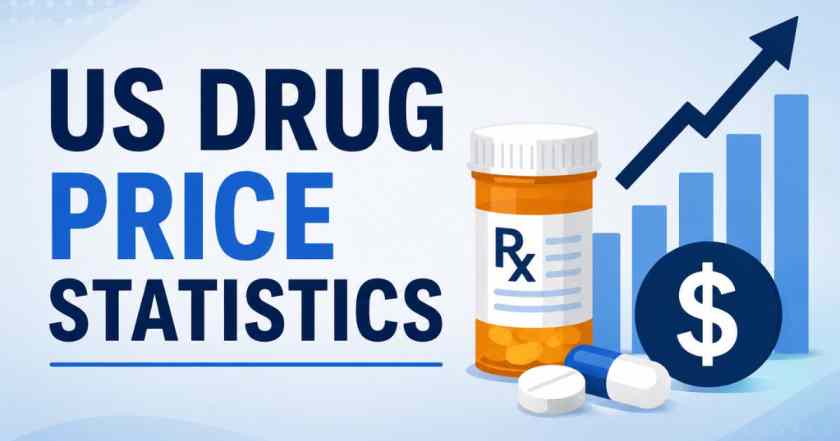
US Drug Price Statistics 2026 | Key Interesting Facts & Data
  US Drug Price 2026: Most Striking Facts at a Glance
  ════════════════════════════════════════════════════

  Projected US Prescription Drug Expenditure 2026
  ████████████████████████████████████████  ~$557 Billion (CMS estimate)

  Share of Americans Worried About Drug Affordability (2026 KFF)
  ████████████████████████████████████████  60%+ — new polling HIGH

  Generics: Share of All US Prescriptions Filled
  ████████████████████████████████████████  90% of all prescriptions

  Generics: Share of Total Drug Spending
  ████                                      Only 12% of drug spending

  IRA Medicare Negotiation — Price Reductions (10 drugs, 2026)
  ████████████████████████████████████████  38% to 79% off list price

  Brand drugs: Share of Total Drug Spending
  ████████████████████████████████████████  88% of spending (10% of Rx)
| Interesting Fact | Data Point | Source |
|---|---|---|
| US prescription drug expenditure projected 2026 | Approximately $557 billion — the highest ever | CMS National Health Expenditure Projections, Feb 2026 |
| Americans worried about affording drugs (2026) | 6 in 10 U.S. adults worried about affording drug costs — a new high since KFF began tracking in 2018 | KFF Public Opinion Poll, March 31, 2026 |
| Adults who didn’t take medication as prescribed due to cost (2026) | 43% of U.S. adults reported not taking medication as prescribed in the past year due to cost | KFF Health Tracking Poll, April 2026 |
| Americans prescribed a drug they couldn’t afford (2025) | Nearly 42% of Americans were prescribed a medication they couldn’t afford in the past year | RazorMetrics 2025 State of Drug Access Report |
| US patients vs. other nations — drug cost premium | U.S. patients pay nearly 3 times more than patients in other developed nations for the same prescription medicines | CNN / 3 Axis Advisors, Jan 2026 |
| Generics share of prescriptions (2024) | 90% of all U.S. prescriptions filled are generic or biosimilar — but only 12% of total drug spending | AAM / IQVIA 2025 Generic & Biosimilar Savings Report |
| Brand drugs — share of spending vs. volume | Brand drugs = only 10% of prescriptions but 88% of total drug spending | AAM / IQVIA 2025 Generic & Biosimilar Savings Report |
| IRA Medicare negotiation — 2026 price reductions | First 10 negotiated drugs cut 38% to 79% off list prices; effective January 1, 2026 | CMS, August 2024; KFF |
| Patient savings from IRA negotiation (2026) | Medicare beneficiaries projected to save $1.5 billion in out-of-pocket costs in 2026 alone | CMS / Medicare Rights Center |
| Medicare savings from IRA negotiation (full-year basis) | Medicare projected to save at least $6 billion from the 10 negotiated drugs in 2026 | CMS / KFF |
| Brand drug price increases for 2026 | Drugmakers raised prices on at least 350 brand-name medications for 2026; median increase ~4% | 3 Axis Advisors data / CNN, Jan 2026 |
| Brand drug price CUTS for 2026 | At least 15 drugs receiving list price cuts of −25% to −85% in 2026 | Drug Channels / DrugChannels.net, Jan 2026 |
| TrumpRx launch date and initial drugs | Launched February 6, 2026 with 43 drugs from 5 manufacturers; by April 2026, 17 manufacturers had signed MFN deals covering an estimated 86% of the branded drug market | White House Fact Sheet, Feb 6, 2026; GovFacts.org |
| Ozempic price before and after TrumpRx | Dropped from $1,028/month to as low as $199/month (average $350); injectable Wegovy from $1,349 to as low as $199 | White House Fact Sheet; AJMC; AMCP |
| GLP-1 users projected annual savings via TrumpRx | Uninsured GLP-1 users expected to save $3,000 per year | White House Savings Analysis, May 2026 |
| MFN Medicaid savings projection | Voluntary MFN framework projected to generate $64.3 billion in federal and state savings over 10 years | White House Research, May 2026 |
| GoodRx monthly active users | 23.5 million monthly users; offers savings at 70,000+ U.S. pharmacies; up to 80% off cash price | DrugPrice.org / GoodRx, 2026 |
| Cost Plus Drugs medication catalog | Transparent pricing on 2,200+ medications; uses cost-plus-15%-margin model | DrugPrice.org, March 2026 |
| Americans filling prescriptions in 2025 | Over 6.7 billion prescriptions filled in 2025 | DrugPrice.org, March 2026 |
| Most expensive single drug in the US (2024) | Lenmeldy — gene therapy for childhood disease — at $4.25 million per treatment | GoodRx / Yahoo Finance, 2024–2025 |
Source: CMS, KFF (March 31, 2026 and April 2026), AAM/IQVIA 2025 Savings Report, 3 Axis Advisors via CNN, White House Fact Sheets (Feb 6 and May 2026), Drug Channels / DrugChannels.net, GovFacts.org, DrugPrice.org, RazorMetrics, Medicare Rights Center — 2024–2026
The facts table above captures the structural tension at the heart of US drug pricing in 2026 — a system where generics cover 90% of all prescriptions but account for only 12% of spending, while brand drugs consumed by a fraction of patients absorb 88 cents of every drug dollar. This inversion is not new, but it has grown more extreme over time. The same IQVIA data shows that since 2019, the total amount spent on all generic drugs in the U.S. has actually declined by $6.4 billion despite increased volume — meaning Americans are getting more generic pills for less money than five years ago. The problem is that brand drug expenditure has risen so dramatically that it overwhelms all generic savings in the aggregate. When the combined spending on just Ozempic and Humira in a single year exceeds the total U.S. spending on 1,000 generic drugs combined, the arithmetic of the affordability crisis becomes unavoidable. The 60%+ of Americans now worrying about drug costs — a KFF polling record as of 2026 — are not misreading the situation.
What the 2026 data also reveals is that the gap between official list prices and what anyone actually pays has never been more confusing or fragmented. A KFF poll conducted in March 2026 found that 43% of adults had not taken medication as prescribed due to cost — yet the same data shows that gross-to-net price spreads are widening, meaning manufacturers are offering larger rebates and discounts behind the scenes while maintaining or raising list prices publicly. The result is a system where patients at the pharmacy counter — particularly those without insurance or those with high-deductible plans — pay based on list prices that bear little relationship to the net prices insurers negotiate. This gap between what a drug costs and what a specific patient pays is the core driver behind the proliferation of discount coupon platforms like GoodRx, cash-pay programs like Cost Plus Drugs, and now federal portals like TrumpRx — all of which exist because the underlying pricing system has failed to provide consistent, transparent, affordable access to essential medicines.
US Drug Price Statistics 2026 | Total Expenditure, National Spending & Cost Growth Trends
  US Prescription Drug Expenditure Trend (selected years)
  ══════════════════════════════════════════════════════════

  2000   ~$120B  ████████████
  2010   ~$260B  ██████████████████████████
  2015   ~$330B  █████████████████████████████████
  2019   ~$380B  ██████████████████████████████████████
  2021   ~$408B  ████████████████████████████████████████
  2024   ~$460B  ██████████████████████████████████████████████
  2026   ~$557B  ████████████████████████████████████████████████████████

  US Total Healthcare Spending 2024:  $5.3 Trillion
  Drug share of total healthcare:     <9% of that total
| US Drug Expenditure & National Spending Metric | Data Point |
|---|---|
| Projected US prescription drug expenditure 2026 | Approximately $557 billion (CMS National Health Expenditure Projections) |
| US prescription drug expenditure 2024 | Projected to exceed $460 billion (CMS estimate for 2024) |
| US total healthcare spending 2024 | $5,278,588,000,000 — over $5.3 trillion total healthcare expenditure |
| Prescription drug share of total healthcare spending | Less than 9% of total US healthcare expenditure in 2024 |
| Government programs’ share of net outpatient drug spending | More than half of net outpatient drug spending paid by federal, state, and local government programs |
| Retail drug spending per capita (1960 vs. 2021, inflation-adjusted) | From $101 per capita in 1960 to $1,147 per capita in 2021 — over 11x increase in real terms |
| Brand drug list price increase pace 2010–2015 | List prices rising 10% to 15% annually (2010–2015 peak era) |
| Brand drug list price increase pace 2019–2023 | Average annual list price increases slowed to approximately 5% |
| Brand drug list price growth 2024–2025 | Further slowed to below 4% annually for two consecutive years |
| Projected brand drug list price growth 2026 | Initial 46brooklyn data projects 4.0% average list price growth for 2026 |
| Number of brand drugs with list price CUTS in 2024–2025 | For 2024–2025 combined, manufacturers cut WAC list prices for more than 20 brand-name drugs |
| Number of brand drugs with list price CUTS in 2026 | At least 15 drugs receiving list price cuts of –25% to –85% in 2026 — reducing gross revenues by $35–$40 billion |
| Total US generic and brand drug spending (2024 snapshot) | ~$98 billion on 3.9 billion generic prescriptions vs. ~$700 billion on just 435 million brand drug scripts |
| CBO IRA drug negotiation savings — 10-year projection | Congressional Budget Office projects the negotiation program saves Medicare $98.5 billion over the next decade |
| Out-of-pocket drug spending trend | Out-of-pocket spending on retail prescriptions has declined since the mid-2000s and expected to fall a further 8% by 2031 |
| Medicare Part D out-of-pocket cap (2026) | $2,100 annual out-of-pocket maximum for Medicare Part D enrollees (up from $2,000 in 2025) |
| Insulin cost-sharing cap (Medicare) | $35 per month cap on insulin cost-sharing for Medicare beneficiaries (effective since 2023) |
Source: CMS National Health Expenditure Projections; Drug Channels / DrugChannels.net (Jan 2026); Peterson-KFF Health System Tracker; 46brooklyn; ASPE/HHS; CBO; Epstein Becker Green — 2024–2026
The $557 billion projected US drug expenditure in 2026 is a number that demands both context and scrutiny. In absolute terms it represents a new record, but the components of that growth tell a more nuanced story than the headline suggests. CMS data consistently confirms that nearly all of the increase in drug spending reflects higher utilization — more people treated, more prescriptions dispensed, and shifts among drugs dispensed — rather than straightforwardly higher prices. The post-pandemic surge in GLP-1 prescriptions for diabetes and obesity management alone has added tens of billions to the national pharmaceutical bill, driven by a genuine expansion in the population receiving treatment for serious metabolic conditions, not by price gouging in isolation. The brand drug list price growth rate, while still positive at approximately 4%, is at its lowest level in at least a decade — a structural shift that Drug Channels analyst Adam Fein has described as the entry into a “Net Pricing Drug Channel” era where net prices, not list prices, increasingly drive actual economics.
The gross-to-net bubble deflation documented in the 2026 data is perhaps the most significant structural development in US pharmaceutical pricing in years. When manufacturers cut list prices on 15 or more brand-name drugs by 25% to 85% in a single year — reducing gross revenues by $35 to $40 billion — they are making a fundamental admission: that the list price system has become so disconnected from actual transaction prices that maintaining inflated list prices no longer serves commercial interests, particularly as Medicare drug price negotiation removes the highest-spending drugs from the gross-to-net game entirely. The CBO’s 10-year savings projection of $98.5 billion from the IRA negotiation program alone signals that the fiscal direction of federal drug spending is shifting, even as total expenditure continues to rise on the back of utilization growth and new high-cost therapies entering the market.
US Drug Price Statistics 2026 | TrumpRx & Most-Favored-Nation Pricing Program
  TrumpRx MFN Price Reductions for Key Drugs (2026)
  ════════════════════════════════════════════════════

  Ozempic (semaglutide / diabetes)
  Before: $1,028/mo  ████████████████████████████████████████████████████
  After:   $199/mo   ██████████  (−81% at lowest dose)

  Wegovy injectable (obesity)
  Before: $1,349/mo  ████████████████████████████████████████████████████████████
  After:   $199/mo   ██████████  (−85% at lowest dose)

  Wegovy pill
  Before: $1,349/mo  ████████████████████████████████████████████████████████████
  After:   $149/mo   ███████  (−89% at lowest dose)

  Zepbound (tirzepatide / obesity)
  Before: $1,088/mo  ████████████████████████████████████████████████████
  After:   $299/mo   ███████████████  (−73% at lowest dose)

  Insulin (NovoLog, Tresiba)
  Capped:   $35/mo   ██  (Medicare / Medicaid)
| TrumpRx & Most-Favored-Nation Pricing Metric | Data Point |
|---|---|
| TrumpRx launch date | February 6, 2026 — launched by President Trump via executive order framework |
| Drugs available at launch | 43 drugs from 5 initial manufacturers: AstraZeneca, Eli Lilly, EMD Serono, Novo Nordisk, and Pfizer |
| MFN deals announced by April 2026 | 17 manufacturers had signed MFN deals — estimated to cover ~86% of the U.S. branded drug market |
| Participating companies (April 2026) | Amgen, AstraZeneca, Boehringer Ingelheim, Bristol Myers Squibb, Eli Lilly, Genentech, Gilead Sciences, GSK, Merck, Novartis, Novo Nordisk, Pfizer, Sanofi, and others |
| Ozempic — before and after TrumpRx | From $1,028/month to average $350/month, as low as $199 depending on dosage |
| Wegovy injectable — before and after TrumpRx | From $1,349/month to as low as $199/month |
| Wegovy pill (oral semaglutide) — before and after | From $1,349/month to as low as $149/month |
| Zepbound (tirzepatide) — before and after TrumpRx | From $1,088/month to average $346/month, as low as $299 |
| Insulin cap (Medicare/Medicaid under MFN deals) | Ozempic, Wegovy, Zepbound, Mounjaro capped at $245/month for Medicare; insulin products (NovoLog, Tresiba) at $35/month maximum |
| Medicare GLP-1 coverage — new in 2026 | For the first time, Medicare will cover Wegovy and Zepbound for patients with obesity and at least one comorbidity; $50 copay per month |
| GLP-1 uninsured user savings (annual, projected) | Uninsured GLP-1 users expected to save $3,000 per year via TrumpRx MFN pricing |
| IVF medication savings via TrumpRx | EMD Serono’s 3 IVF therapies at ~84% discount; couples expected to save more than $6,000 per IVF cycle |
| MFN Medicaid savings — 10-year federal/state projection | Voluntary MFN framework projected to generate $64.3 billion in combined federal and state Medicaid savings over 10 years |
| How TrumpRx works — mechanism | Cash-pay portal: no drugs sold directly; patients use coupons to purchase through manufacturers’ websites or participating pharmacies; purchases do not count toward insurance deductible |
| TrumpRx unavailability | Coupons cannot be used in California or Massachusetts — state laws prohibit prescription drug coupons where generic equivalents are available |
| Key limitation (insured patients) | Most insured patients with Part D coverage or employer coverage see little or no benefit from TrumpRx; designed primarily for uninsured and cash-paying consumers |
| Trump executive order — cost reduction target | Executive Order signed May 2025 promised to reduce prescription drug prices by up to 59% through MFN mechanism |
Source: White House Fact Sheet Feb 6, 2026; White House Savings Analysis May 2026; AJMC; AMCP; KFF TrumpRx Issue Brief (Feb 24, 2026); GovFacts.org; DrugPrice.org — 2025–2026
TrumpRx represents the most high-profile federal intervention in US prescription drug pricing in the modern era — and also, in the view of many health policy analysts, one of the most carefully circumscribed. The headline numbers are genuinely striking: Ozempic falling from $1,028 to as low as $199 per month, Wegovy’s pill form dropping to $149, IVF drugs at 84% discounts — these are not marginal adjustments but transformational price reductions for the specific drugs on the platform’s list. For the uninsured American with type 2 diabetes who has been rationing Ozempic at $1,000 per month or simply going without, the TrumpRx MFN price is potentially life-changing. The projected annual savings of $3,000 per year for uninsured GLP-1 users, and the $64.3 billion in Medicaid savings over ten years, are based on real mathematical reductions from genuine baseline prices — not accounting tricks.
Where the TrumpRx program falls short of its transformational billing is in its reach beyond the cash-paying uninsured. Because purchases made through TrumpRx are cash-pay transactions that bypass insurance coverage and do not count toward deductibles or out-of-pocket maximums, the approximately 300 million Americans with health insurance derive little benefit — and may actually find themselves worse off financially if they pay TrumpRx cash prices while losing insurance credit for those purchases. The 43 drugs covered at launch, while carefully selected to include the highest-profile and highest-cost medications, represent a tiny fraction of the 24,000+ FDA-approved prescription drugs in the U.S. market. KFF analysis confirmed that, for most TrumpRx drugs, archived GoodRx prices from 2025 were already lower for generic equivalents — and the same independent drug policy researchers noted that the TrumpRx list includes drugs where cheaper generics are available for as little as $17 on Cost Plus Drugs versus the TrumpRx “50% off” brand price of $127.91.
US Drug Price Statistics 2026 | Medicare IRA Negotiation — Negotiated Prices for 10 Drugs
  IRA Medicare Drug Price Negotiation — Round 1 (Effective Jan 1, 2026)
  ══════════════════════════════════════════════════════════════════════

  Price Reductions Achieved (38%–79% off list price):
  Eliquis (blood clots)    −56%   ████████████████████████████████████████████████████████
  Jardiance (diabetes)     −66%   ████████████████████████████████████████████████████████████████
  Xarelto (blood clots)    −62%   ████████████████████████████████████████████████████████████
  Entresto (heart failure) ~−53%  ██████████████████████████████████████████████████████
  Imbruvica (blood cancer) −38%   ████████████████████████████████████
  Stelara (psoriasis/IBD)  ~−66%  ████████████████████████████████████████████████████████████

  First-year beneficiary out-of-pocket savings:  $1.5 Billion
  First-year Medicare program savings:           $6 Billion
  10-year CBO projected Medicare savings:        $98.5 Billion
| IRA Medicare Drug Price Negotiation — 2026 Statistics | Data Point |
|---|---|
| First negotiated prices effective date | January 1, 2026 — first time in Medicare’s history that drug prices have been directly negotiated by the federal government |
| Number of drugs in Round 1 (2026) | 10 drugs covered under Medicare Part D |
| Price reduction range — Round 1 | 38% to 79% off list prices across the 10 negotiated drugs |
| Drugs negotiated in Round 1 | Eliquis, Xarelto (blood clots); Jardiance, Farxiga, Januvia, Fiasp/NovoLog (diabetes); Entresto (heart failure/diabetes); Stelara (psoriasis/Crohn’s/IBD); Enbrel (psoriasis/arthritis); Imbruvica (blood cancers) |
| Jardiance price reduction (largest disclosed) | Two-thirds price cut (approximately −66%) — confirmed by Boehringer Ingelheim; also among drugs receiving TrumpRx list price cuts |
| Beneficiary out-of-pocket savings projected (2026) | $1.5 billion in savings for Medicare Part D enrollees in the program’s first year |
| Medicare program savings (full-year basis, 2026) | At least $6 billion in savings vs. what Medicare would have paid at pre-negotiation prices |
| CMS estimated savings if prices had been in effect in 2023 | Would have saved $6 billion in net covered prescription drug costs — representing a 22% net savings on these 10 medications |
| 10-year CBO savings projection | $98.5 billion saved by Medicare over the next decade through the negotiation program |
| Round 2 drugs selected (for 2027 pricing) | 15 drugs covering Part D selected January 17, 2025; negotiations occurring in 2025; final prices effective 2027 |
| Round 2 includes cancer drugs | Includes enzalutamide (Xtandi), pomalidomide (Pomalyst), palbociclib (Ibrance), and acalabrutinib (Calquence) — 4 oncology agents |
| Future negotiation schedule (IRA mandate) | 2028: 15 more Part B or D drugs; 2029 onwards: 20 drugs per year from Parts B and D combined |
| Total Medicare Part D enrollees (2026) | Approximately 54.1 million Americans enrolled in Part D; 67.3 million total Medicare enrollees |
| IRA “Inflation Rebate” provision | Manufacturers must pay rebates to Medicare if prices rise faster than inflation — effective since 2023; designed to deter large annual list price increases |
| Part D out-of-pocket cap (2026) | $2,100 annual maximum; once reached, no further cost-sharing for the remainder of the calendar year |
Source: CMS Fact Sheet — Negotiated Prices for Initial Price Applicability Year 2026; KFF FAQs on IRA Drug Price Negotiation; Medicare Rights Center; OncLive; AJMC; Epstein Becker Green; ASPE/HHS — 2024–2026
The IRA Medicare drug price negotiation program is the most structurally consequential pharmaceutical pricing reform the United States has enacted since the creation of Medicare Part D in 2006. For the first time, the federal government is exercising direct price-setting authority over specific high-expenditure drugs — authority that peer nations like Germany, the United Kingdom, France, and Canada have exercised for decades and that is a central reason why those countries pay substantially less for the same medications. The 10 drugs negotiated for 2026 were chosen because they represent some of the highest Medicare spending in the Part D program and lack generic or biosimilar competition — meaning PBM rebate negotiations had minimal effect on their net prices. The 38% to 79% reductions achieved are not estimates or projections; they are finalized Maximum Fair Prices (MFPs) confirmed by both CMS and participating manufacturers through a structured negotiation period that concluded in August 2024.
The downstream implications for the $557 billion US drug market extend beyond the 54 million Medicare beneficiaries directly affected by Round 1 negotiated prices. Researchers from the National Severe Storms Laboratory — drawing on the same drug class data — have noted that the existence of a government-negotiated benchmark price for a drug like Jardiance (−66%) or Stelara (−66%) creates a credible reference point that commercial insurers and PBMs can leverage in their own negotiations. The IRA’s inflation rebate provision, which penalizes manufacturers for raising Medicare prices faster than CPI, has already contributed to the deceleration of brand drug list price growth from 10–15% annually in the early 2010s to approximately 4% today. As Round 2 (15 drugs, 2027) and subsequent annual rounds add more drugs — ultimately reaching 20 per year by 2029 — the cumulative effect on federal drug spending and commercial market pricing will compound, making the CBO’s $98.5 billion 10-year savings estimate a floor rather than a ceiling.
US Drug Price Statistics 2026 | Discount Coupon Programs — GoodRx, Cost Plus Drugs & Patient Assistance
  Drug Discount Program Landscape 2026: Who They Serve
  ══════════════════════════════════════════════════════

  GoodRx:        23.5M monthly users  ████████████████████████████████████████
                 70,000+ pharmacies   ████████████████████████████████████████
                 Up to 80% savings    ████████████████████████████████████████

  Cost Plus Drugs: 2,200+ medications ████████████████████████████████████
                   Transparent model   ████████████████████████████████████
                   Best for generics   ████████████████████████████████████

  TrumpRx:       43 brand-name drugs  ████████████████████
                 MFN pricing          ████████████████████
                 Cash-pay only        ████████████████████

  Medicare Part D Negotiated Prices:
                 10 drugs in 2026     ████████████████████████
                 54.1M enrollees      ████████████████████████
                 Automatic at pharma  ████████████████████████
| Drug Discount Coupon & Savings Program Metric | Data Point |
|---|---|
| GoodRx — monthly active users | 23.5 million monthly users across the platform |
| GoodRx — pharmacy network | Available at more than 70,000 U.S. pharmacies |
| GoodRx — maximum savings advertised | Up to 80% off the cash price of a prescription |
| GoodRx — how it works | Free pharmacy discount coupons (no insurance needed); BIN/PCN/Group/Member ID codes presented at pharmacy; cannot be used simultaneously with insurance |
| GoodRx Gold — subscription model | Monthly membership offering deeper discounts than standard free coupons on thousands of brand and generic medications |
| GoodRx matching TrumpRx prices | GoodRx pledged in January 2026 to match Novo Nordisk’s oral semaglutide price — demonstrating competitive pressure between platforms |
| Cost Plus Drugs — medication count | Transparent pricing on 2,200+ medications using a cost + 15% margin model |
| Cost Plus Drugs — best use case | Generic medications — typically the lowest cash price for generics vs. any other platform; pharmacist community prefers Cost Plus coupons because they do not claw back money from pharmacies |
| Cost Plus Drugs example pricing | Generic pantoprazole (heartburn) for under $30 via Cost Plus vs. $200 for brand Protonix on TrumpRx |
| Amazon Pharmacy, Costco, Walmart | Additional major discount pharmacy alternatives; no single platform consistently wins on price for every drug — comparison shopping required |
| Medicare Part D Extra Help (Low Income Subsidy) | Copayments as low as $5.10 for generics and $12.65 for brand-name drugs for eligible low-income beneficiaries |
| 340B Drug Pricing Program | Allows qualifying hospitals and pharmacies to purchase drugs at 30–50% off retail — but critics note facilities can bill insurance at full price, reducing patient benefit |
| Manufacturer patient assistance programs (PAPs) | Provide drugs for free or reduced cost to patients meeting income and insurance criteria; eligibility and value vary significantly by manufacturer |
| Copay cards (manufacturer savings cards) | Reduce out-of-pocket costs for brand drugs; but do NOT count toward deductibles or out-of-pocket maximums in plans using copay accumulator programs |
| Generic savings over branded equivalents | Generic drugs now average approximately 22% of brand list price (down from ~34% a decade ago) — increasing patient savings when generics are available |
| Biosimilar savings — cumulative since introduction | Biosimilars have generated $36 billion in total savings for the US healthcare system since their introduction |
| Biosimilar savings growth (2023) | Savings from biosimilar use increased by more than 30% in 2023, reaching $12.4 billion in a single year |
| Most effective single strategy | Prescription drug policy experts recommend checking all platforms + insurance formulary before filling any prescription — no single source wins consistently |
Source: GoodRx (platform data and Nov 2025 coupon guide); DrugPrice.org (March 2026); NPR (March 29, 2026); KFF TrumpRx Issue Brief (Feb 24, 2026); GovFacts.org; AAM/IQVIA 2025 Generic & Biosimilar Savings Report; Wikipedia on US Drug Prices — 2024–2026
The landscape of drug discount programs in 2026 is genuinely competitive and expanding — but it is also deeply fragmented in ways that systematically disadvantage patients without the time, digital literacy, or healthcare support to navigate multiple platforms before every prescription fill. GoodRx’s 23.5 million monthly users and 70,000+ pharmacy network make it the closest thing the US has to a universal pharmacy discount infrastructure, but its effectiveness depends entirely on the specific drug, dosage, and pharmacy location — and for any drug where a generic exists, Cost Plus Drugs’ transparent cost-plus model will typically beat GoodRx’s retail coupon prices. The independent drug pricing researcher quoted by NPR in March 2026 — a clinician from Brigham and Women’s Hospital — put it plainly: there is no single platform that consistently wins on price across all drugs, all dosages, and all pharmacies. The honest answer for patients seeking the lowest cost is to check each platform every time, for every prescription.
The deeper problem the discount coupon ecosystem reveals is structural: these platforms exist because the US prescription drug pricing system fails to provide baseline affordability at the point of dispensing for patients without comprehensive insurance coverage. The $17 generic pantoprazole available through Cost Plus Drugs versus the $127.91 branded Protonix on TrumpRx’s “50% off” offer versus the $0 copay for the same patient with a good employer insurance plan — these three prices for the same therapeutic outcome tell the entire story of American drug pricing inequality in a single example. Until manufacturer copay cards count toward deductibles, until discount coupon purchases count toward out-of-pocket maximums under insurance plans, and until price transparency extends to the full 24,000+ drug market rather than the 43 drugs on TrumpRx or the 2,200 on Cost Plus, the millions of Americans who are rationing, skipping, or going without prescribed medications will continue to do so — not because no discount exists, but because finding and applying it requires work that sick people, in particular, often cannot do.
US Drug Price Statistics 2026 | Affordability Crisis — Patient Behavior & Out-of-Pocket Costs
  Americans' Drug Affordability Struggles (2025–2026 Data)
  ══════════════════════════════════════════════════════════

  Worried about affording drugs (2026 KFF)        60%+   ████████████████████████████████████████
  Not taken medication as prescribed — cost       43%    ████████████████████████████████████████
  Reported drug as "financial burden" (2025)      67%    ████████████████████████████████████████
  Worried about affording drugs (2024)            27%    ██████████████████████
  Uninsured adults worried about healthcare       85%    ████████████████████████████████████████████
  Rationed medications due to cost (2025)         1 in 5 ████████████████████
  Prescribed drug they couldn't afford (2025)     42%    ████████████████████████████████████████

  Cost-saving behaviors (% who took action due to healthcare cost):
  2024:  37%  ████████████████████████████████████
  2025:  46%  ████████████████████████████████████████████
| Drug Affordability & Patient Behavior Metric | Data Point |
|---|---|
| Adults worried about affording drugs (2026 KFF poll) | 6 in 10 (60%+) U.S. adults worried about affording prescription drug costs — new all-time KFF polling high since tracking began in 2018 |
| Adults not taking medications as prescribed due to cost (2026) | 43% of U.S. adults in the past year: 31% took OTC drug instead of filling prescription; 27% didn’t fill a prescription; 19% cut pills or skipped doses |
| Adults reporting prescriptions as financial burden (2025) | Over 67% of Americans who filled a prescription said out-of-pocket cost was at least a minor financial burden |
| Worrying about drug costs — growth | From 27% worried in 2024 to 38% worried in 2025 (GoodRx Research); further escalating to 60%+ in 2026 (KFF) |
| Adults who rationed medications in 2025 | 1 in 5 people who filled a prescription in 2025 reported rationing medications due to cost |
| Financial actions taken due to healthcare costs | In 2024, 37% of Americans took some financial action due to healthcare costs; in 2025, that rose to 46% — including 15% adjusting employment (working more hours or taking additional jobs) |
| Americans prescribed a drug they couldn’t afford (2025) | Nearly 42% prescribed a medication they couldn’t afford in the past year (RazorMetrics, Apr 2025) |
| Uninsured adults worried about healthcare costs | 85% of uninsured adults under 65 worried about affording healthcare, including medications |
| Insured adults also reporting concern | 64% of insured adults under 65 worried about affording healthcare costs — confirming the problem extends well beyond the uninsured |
| Adults in households under $40K — non-adherence | ~52% of adults in households earning under $40,000 reported not taking medications as prescribed due to cost |
| Uninsured non-adherence rate | 58% of uninsured adults under 65 reported not taking medications as prescribed due to cost |
| Difficulty affording medications — by insurance type | Uninsured: 63% difficulty; ACA Marketplace: 48%; Medicare: 30%; Medicaid: 32% (2023 GoodRx survey, still most recent cross-insurance comparison) |
| GLP-1 affordability challenge | 55% of GLP-1 users with health insurance still say it is difficult to afford these drugs |
| Medical debt tied to prescription costs | 23 million Americans carry medical debt; prescription drug costs are a documented contributing factor |
| Consumer appetite for lower-cost alternatives | 90% of respondents said they would accept a switch to a more affordable medication if recommended by their doctor; 85.5% want prescribers to default to the lowest-cost option clinically available |
Source: KFF Public Opinion on Prescription Drugs March 31, 2026; KFF Health Tracking Poll April 2026; GoodRx Research Prescription Cost Burden 2025 (Jun 27, 2025); RazorMetrics 2025 State of Drug Access (Apr 29, 2025); KFF Americans’ Challenges with Health Care Costs April 2026 — 2023–2026
The drug affordability crisis in 2026 is measurably worsening at the exact moment when government programs are generating headline savings — and that paradox reveals something important about the structure of the crisis itself. The 60%+ of Americans now worried about affording their drugs is not a population composed primarily of uninsured individuals in severe poverty; the KFF data makes clear that 64% of insured adults, 30% of Medicare enrollees, and 32% of Medicaid recipients also worry about prescription drug costs. The IRA’s $2,100 Part D cap and the 10 negotiated drugs primarily help Medicare beneficiaries on those specific medications — leaving the vast majority of the population’s drug affordability concerns unaddressed by those reforms. The alarming escalation in the share of Americans taking financial action due to healthcare costs — from 37% in 2024 to 46% in 2025 — confirms that the affordability pressure is intensifying at a rate faster than current policy interventions are relieving it.
The GLP-1 drug affordability statistics are particularly telling in 2026. Despite the much-publicized TrumpRx price reductions, 55% of GLP-1 users who have health insurance report still finding these drugs difficult to afford — because most insured patients access GLP-1s through their insurance plan at the list price minus their insurer’s negotiated discount, not through TrumpRx’s cash-pay channel. The fundamental disconnect between policy announcement and patient experience is most visible here: a drug that falls from $1,028 to $199 on a government website still costs an insured patient whatever their insurance plan’s formulary determines — often hundreds of dollars in cost-sharing. The 90% of survey respondents who say they would accept a lower-cost medication if their doctor recommended it, and the 85.5% who want prescribers to default to the lowest-cost clinical option, signal a patient population that is not ideologically attached to brand names — they simply need a trustworthy, navigable, and consistent pathway to affordable prescriptions that no single program in 2026 reliably provides.
Disclaimer: The data research report we present here is based on information found from various sources. We are not liable for any financial loss, errors, or damages of any kind that may result from the use of the information herein. We acknowledge that though we try to report accurately, we cannot verify the absolute facts of everything that has been represented.