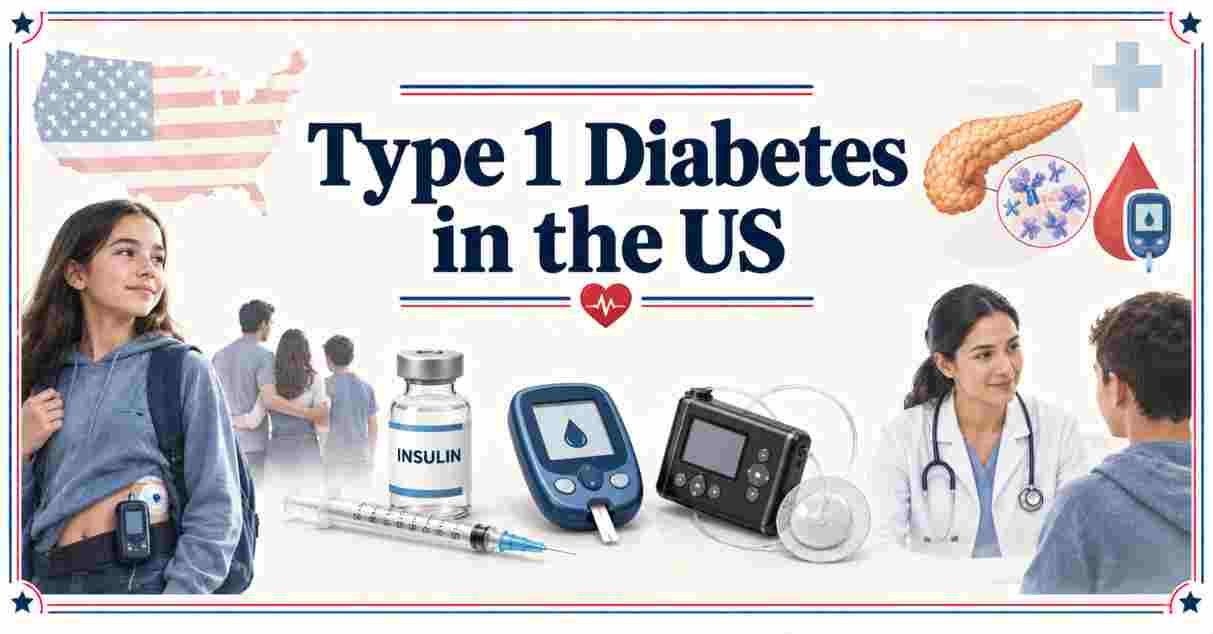
An estimated 2.1 million Americans live with diagnosed Type 1 diabetes in 2026, including 1.8 million adults and 314,000 children and adolescents, according to the CDC. Every covered insulin product is now capped at $35 per month under federal Medicare rules and matching manufacturer programs.
Type 1 Diabetes in America 2026 – Introduction
Type 1 diabetes in the US 2026 affects roughly 2.1 million people, a figure the CDC’s National Diabetes Statistics Report confirms as the most current national estimate. Unlike Type 2 diabetes, which accounts for the overwhelming majority of US diabetes cases, Type 1 is an autoimmune condition in which the pancreas stops producing insulin altogether, usually requiring lifelong insulin therapy from diagnosis onward. It can develop at any age, has no known prevention method, and continues to grow fastest among groups that historically saw it least.
The treatment and cost picture for Type 1 diabetes in the US 2026 looks meaningfully different than it did even three years ago. Insulin, once a source of national outrage over pricing, now carries a $35-per-month cap for Medicare beneficiaries and matching voluntary caps from all three major manufacturers. At the same time, diagnosis patterns are shifting: diabetic ketoacidosis at diagnosis is rising, and the gap in outcomes between racial and ethnic groups remains wide. This report breaks down the prevalence, symptoms, treatment landscape and insulin economics behind Type 1 diabetes in the US 2026, using data verified through October 2026.
Interesting Facts About Type 1 Diabetes in the US 2026
AMERICANS LIVING WITH TYPE 1 DIABETES
Adults (20+)           | █████████ 1.8
Children/Adolescents   | █ 0.314
Total                  | ██████████ 2.1
| Fact | Confirmed 2026 Data |
|---|---|
| Americans with diagnosed Type 1 diabetes | 2.1 million |
| Adults aged 20+ with T1D | 1.8 million |
| Children and adolescents under 20 with T1D | 314,000 |
| Share of all diagnosed diabetes cases that are Type 1 | 5–10% |
| Youth newly diagnosed with T1D (2022) | 21,732 |
| Monthly insulin cost cap (Medicare and major manufacturers) | $35 |
| Average 2026 list price per insulin vial (Humalog) | ~$66 |
Source: CDC National Diabetes Statistics Report, 2026; American Diabetes Association; Breakthrough T1D (formerly JDRF); Inflation Reduction Act insulin provisions.
The chart shows how the 2.1 million total Type 1 diabetes population in the US splits by age: 1.8 million adults carry the overwhelming share, with 314,000 children and adolescents making up the rest. The table underneath fills in the broader context. Type 1 accounts for only 5% to 10% of all diagnosed diabetes cases nationally, a small slice compared to Type 2, but 21,732 youth received a new Type 1 diagnosis in 2022 alone, the most recent year with confirmed CDC figures.
Insulin economics changed the most since the last full accounting of this disease. A $35-per-month cap now applies to every Medicare-covered insulin product, with Eli Lilly, Novo Nordisk and Sanofi all running matching voluntary programs for commercially insured and uninsured patients. A Humalog vial that once listed near $275 before rebates now carries a roughly $66 list price, with most patients paying the $35 cap regardless.
Type 1 Diabetes Prevalence in the US 2026: Who Is Affected and Where
T1D PREVALENCE BY AGE GROUP (per 100,000, US national estimate)
National incidence rate (new cases/year) | ████████████ 24.0
Connecticut incidence rate               | ████████████ 24.2
Washington D.C. incidence rate           | ███████████ 23.8
California incidence rate                | ██████████ 20.6
| Metric | 2024–2026 Data |
|---|---|
| National T1D incidence rate (per 100,000/year) | 24.0 |
| National prevalent cases, under age 20 | 196,778 |
| National prevalent cases, all ages | 1,476,859 (academic T1D-specific model) |
| US global ranking for pediatric T1D cases | 2nd highest worldwide |
| Typical age range for most US adults with T1D | 45–65 years old |
Source: JAMA Network Open state-level incidence study, 2024 data; Breakthrough T1D global incidence and prevalence estimates; CDC National Diabetes Statistics Report.
Two separate data sources produce two separate national totals, and both are worth understanding rather than picking one and ignoring the other. The CDC’s National Diabetes Statistics Report, built from clinical and survey data, puts the diagnosed US T1D population at 2.1 million. A more recent state-level epidemiological model published in JAMA Network Open, using a different methodology closer to the T1D Index framework, estimates 1,476,859 total prevalent cases with a national incidence rate of 24.0 per 100,000 people per year. The gap reflects differing case-ascertainment methods, not a genuine disagreement about the disease’s trajectory.
State-level incidence varies modestly but consistently across the country, with Connecticut’s 24.2 rate and Washington D.C.’s 23.8 rate sitting close to the national average, while California’s 20.6 rate runs somewhat lower. Globally, the United States ranks second in the world for the sheer number of children and adolescents living with Type 1 diabetes, trailing only larger-population countries, and most American adults with the disease fall between 45 and 65 years old, reflecting both the aging of patients diagnosed decades ago and a steady trickle of adult-onset cases. For context on how Type 1 fits into the country’s much larger overall diabetes burden, see this detailed breakdown of diabetes statistics in the United States.
Type 1 Diabetes Symptoms and Diagnosis 2026: The DKA Problem
SHARE OF CHILDREN PRESENTING IN DKA AT T1D DIAGNOSIS (by race/ethnicity)
Black children     | █████████████████████ 45.4%
Hispanic children  | █████████████████████ 45.4%
White children     | ██████████████████ 37.8%
Children under 2   | ██████████████████████████████████ 70.4%
| Group | Share Diagnosed in DKA |
|---|---|
| Children under age 2 | 70.4% |
| Black children | 45.4% |
| Hispanic children | 45.4% |
| White children | 37.8% |
| Overall DKA rate at pediatric T1D diagnosis, US trend | Rising since 2002 |
Source: Diabetes, Obesity and Metabolism journal, US and England DKA hospitalization study, 2002–2020 data; PubMed.
Classic Type 1 diabetes symptoms include excessive thirst, frequent urination, unexplained weight loss, extreme fatigue and blurred vision, developing over days to weeks rather than years. When those symptoms go unrecognized, the result is often diabetic ketoacidosis, or DKA, a life-threatening complication that now accounts for a growing share of how American children are first diagnosed. The data shows this disproportionately affects the youngest children, with 70.4% of those under age 2 presenting in DKA, a rate reflecting how hard early symptoms are to recognize in infants and toddlers.
Racial and ethnic disparities run through this data at every level. Black and Hispanic children both present in DKA at diagnosis 45.4% of the time, compared with 37.8% for white children, and separate research found Black and Hispanic children face 14% and 12% higher relative risk of DKA at diagnosis compared with white children, even after accounting for social vulnerability. These gaps persist well beyond diagnosis: multiple studies tracking HbA1c one year after diagnosis found Hispanic and Black youth averaging 8.7% compared with 7.7% for white youth, a difference tied partly to unequal access to insulin pumps and continuous glucose monitors.
Insulin and Treatment Statistics 2026: What Changed on Cost
MONTHLY INSULIN OUT-OF-POCKET COST BY PAYER (dollars, 2026)
Medicare Part D / Part B cap        | ███ 35
Eli Lilly Insulin Value Program     | ███ 35
Commercial insurance (no state cap) | ██████████████████████████████ up to 500+
No insurance, no program            | ████████████████████████████████████ 250-400 per vial
| Payer / Program | 2026 Monthly Cost |
|---|---|
| Medicare Part D (pharmacy-dispensed insulin) | $35 cap, no deductible |
| Medicare Part B (pump-delivered insulin) | $35 cap |
| Eli Lilly, Novo Nordisk, Sanofi voluntary caps | $35, regardless of insurance status |
| Commercial insurance without a state cap | $50–$500+ |
| States with their own insulin price caps | 25+ states |
Source: Inflation Reduction Act of 2022; CMS Medicare Part D and Part B rules; manufacturer patient assistance program documentation, 2026.
The federal $35 insulin cap, created by the Inflation Reduction Act and effective for Medicare since 2023, now applies separately to every covered insulin product a patient uses — meaning someone on both a long-acting and rapid-acting insulin could still pay up to $70 combined per month, though that remains far below pre-reform costs. Starting in 2026, some Medicare enrollees may pay even less than $35 where a newly negotiated price produces a lower cost-sharing amount under the Maximum Fair Price program.
The cap’s reach beyond Medicare depends entirely on where a patient lives and who insures them. At least 25 states have passed their own insulin price caps for state-regulated commercial plans, and all three major manufacturers — Eli Lilly, Novo Nordisk and Sanofi — now run voluntary $35 programs open to insured and uninsured patients alike, with Sanofi expanding its Insulin Valued Services Program to cover any combination of its products at a single flat $35 monthly price starting January 2026. Patients on employer plans in states without a cap, or using insulins outside a manufacturer’s covered list, remain the most exposed group, sometimes still facing list prices of $250 to $400 per vial before any assistance.
Diabetes Technology and Complications 2026: Pumps, CGMs and Vision Risk
DIABETES TECHNOLOGY AND RELATED COMPLICATION RISK, US 2026
Insulin pump device cost (list)         | ████████████████ $3,500-$9,000
First-year cost, no insurance           | ████████████████████████████ $8,000-$15,000+
Americans with diabetic retinopathy     | ████████████ 4.1 million
Vision-threatening retinopathy subgroup | ███ 899,000
| Item | 2026 Figure |
|---|---|
| Insulin pump device list price | $3,500–$9,000+ |
| Pump supplies, monthly cost | $100–$400 |
| First-year cost with no insurance (device + supplies + insulin) | $8,000–$15,000+ |
| Americans 40+ with diabetic retinopathy | 4.1 million |
| Americans with vision-threatening diabetic retinopathy | 899,000 |
Source: Diabetes technology cost guides citing 2026 manufacturer and insurer data; CDC diabetic retinopathy estimates.
Closed-loop insulin pump systems, first approved by the FDA in 2016, remain central to modern Type 1 management, but the cost barrier is steep before insurance: a device alone runs $3,500 to $9,000, and a fully uninsured first year covering the device, ongoing supplies and insulin can reach $8,000 to $15,000. Medicare Part B covers 80% of pump costs after a $257 deductible, while Medicaid typically covers eligible enrollees at minimal or no cost, leaving commercially insured patients facing the widest range of out-of-pocket outcomes depending on their plan’s deductible structure.
Long-term complications remain a serious concern even with better technology. Diabetic retinopathy affects 4.1 million Americans over age 40, with 899,000 classified as having vision-threatening disease, and the CDC has found that as many as half of patients with retinopathy are not getting timely eye exams. Research has also found access to pumps and continuous glucose monitors itself unevenly distributed, with the largest technology-access gaps appearing between Black and white adolescents specifically, compounding the same disparities already visible in DKA rates at diagnosis. For more on how diabetes-related vision complications play out nationally, see this detailed look at blind and vision loss statistics in the US.
New Treatments and Research 2026
TYPE 1 DIABETES TREATMENT MILESTONES (year of FDA action)
First hybrid closed-loop system approved   | 2016
Teplizumab (Tzield) approved               | 2022
$35 Medicare insulin cap takes effect      | 2023
Sanofi expands $35 cap to all US patients  | 2026
| Milestone | Year |
|---|---|
| First FDA-approved hybrid closed-loop (artificial pancreas) system | 2016 |
| Teplizumab (Tzield) approved — first disease-modifying T1D therapy | 2022 |
| Medicare $35 insulin cap takes effect | 2023 |
| Sanofi expands $35 cap to all US patients regardless of insurance | January 2026 |
Source: FDA approval records; Breakthrough T1D (JDRF) history; Sanofi Insulin Valued Services Program announcement, 2026.
Teplizumab, sold as Tzield, represents the first real shift from managing Type 1 diabetes to delaying it. Approved by the FDA in 2022 after NIH-funded trials, it is designed to delay disease onset in people identified as high-risk through antibody screening, rather than treating the disease after diagnosis. It remains the only FDA-approved disease-modifying therapy for Type 1 diabetes as of 2026, and broader adoption depends heavily on expanding the antibody-screening programs needed to identify eligible candidates before symptoms even appear.
Alongside the drug pipeline, the regulatory and economic landscape kept moving through 2026. Sanofi’s January 2026 expansion of its Insulin Valued Services Program to all US patients, regardless of insurance status, closed one of the last remaining gaps in insulin affordability left after the original Medicare-only $35 cap took effect in 2023. Combined with 25-plus state-level price caps and matching manufacturer programs from Lilly and Novo Nordisk, 2026 marks the first year in over a decade where the majority of insured and uninsured Americans with Type 1 diabetes can reasonably expect to pay close to $35 a month for insulin rather than hundreds. Broader drug-affordability trends tied to diabetes care, including the separate GLP-1 medication boom reshaping treatment economics, are tracked in this breakdown of GLP-1 Ozempic statistics.
Frequently Asked Questions About Type 1 Diabetes
How many people have Type 1 diabetes in the US in 2026?
An estimated 2.1 million Americans have diagnosed Type 1 diabetes, including 1.8 million adults and 314,000 children and adolescents under age 20, according to the CDC.
What percentage of diabetes cases are Type 1?
Type 1 diabetes accounts for roughly 5% to 10% of all diagnosed diabetes cases in the United States. The remaining 90% to 95% are Type 2.
What are the early symptoms of Type 1 diabetes?
Common early symptoms include excessive thirst, frequent urination, unexplained weight loss, fatigue and blurred vision, typically developing quickly over days to weeks rather than gradually.
What does the $35 insulin cap cover in 2026?
It caps out-of-pocket insulin costs at $35 per month per covered product for Medicare Part D and Part B enrollees. All three major insulin manufacturers also run matching $35 voluntary programs for insured and uninsured patients.
Is there a cure for Type 1 diabetes?
No. Type 1 diabetes currently has no cure and requires lifelong insulin therapy. Teplizumab (Tzield), approved in 2022, can delay onset in high-risk individuals but does not cure or reverse the disease.
Why do more children present with DKA at diagnosis now than in the past?
Diabetic ketoacidosis at diagnosis has been rising since 2002 in both the US and England, a trend researchers link to delayed symptom recognition, particularly among very young children and in communities facing greater barriers to timely care.
Are there racial disparities in Type 1 diabetes outcomes?
Yes. Black and Hispanic children are diagnosed in DKA at nearly 45% compared with about 38% for white children, and both groups show higher HbA1c levels in the year following diagnosis, pointing to unequal access to diagnosis speed and diabetes technology.
How much does an insulin pump cost in 2026?
An insulin pump device typically lists between $3,500 and $9,000, with monthly supplies adding $100 to $400. A fully uninsured first year can total $8,000 to $15,000 or more.
What is Tzield and who can use it?
Tzield (teplizumab) is an FDA-approved drug that delays the onset of Type 1 diabetes in people identified as high-risk through antibody screening. It is not a treatment for people already diagnosed with the disease.
Can Type 1 diabetes develop in adults?
Yes. While it is often associated with childhood diagnosis, Type 1 diabetes can develop at any age, and most American adults currently living with the condition are between 45 and 65 years old.
How does the US compare globally for Type 1 diabetes rates in children?
The United States ranks second in the world for the number of children and adolescents living with Type 1 diabetes, behind only larger-population countries with similarly high incidence rates.
Disclaimer: The data research report we present here is based on information found from various sources. We are not liable for any financial loss, errors, or damages of any kind that may result from the use of the information herein. We acknowledge that though we try to report accurately, we cannot verify the absolute facts of everything that has been represented.