The Trionda Ball 2026: How Football’s Most Advanced Match Ball Was Made
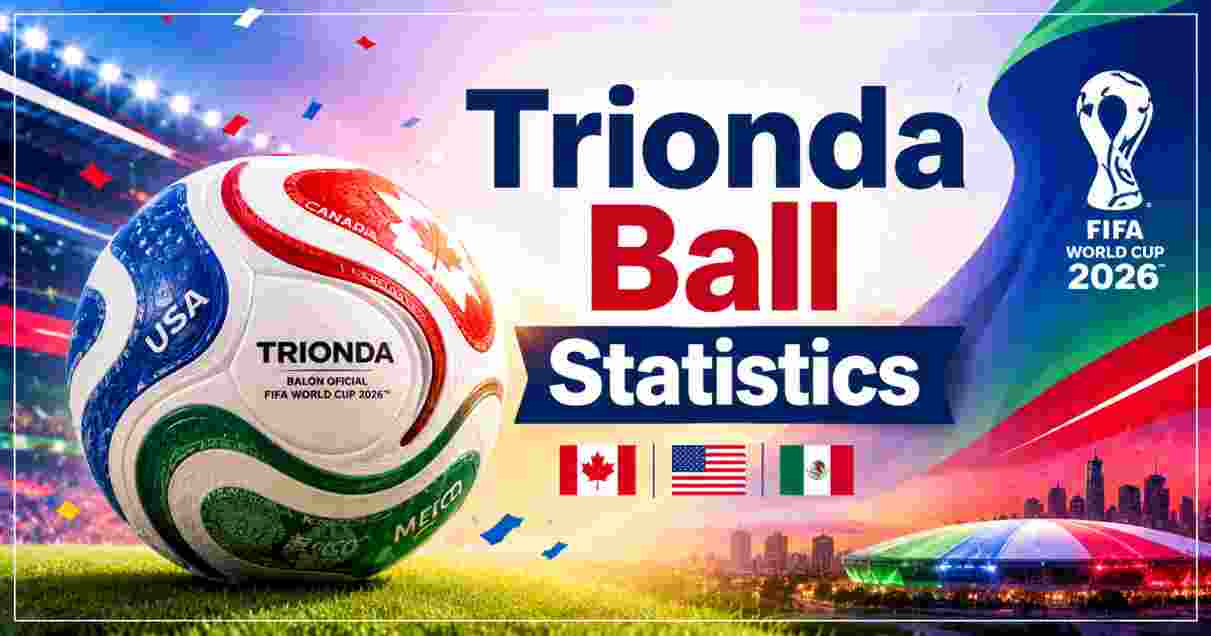
On October 3, 2025, adidas and FIFA unveiled TRIONDA — the official match ball of the FIFA World Cup 2026™ — kicking off the countdown to the biggest football tournament in history. The name is a deliberate bilingual construction: “Tri” from the Latin and Spanish prefix meaning three, representing the three co-host nations — the United States, Canada, and Mexico — and “Onda” from Spanish, meaning wave or vibe. Three waves. Three nations. One ball. What sets TRIONDA apart from every World Cup ball before it is not just the bold red, green, and blue panel design inspired by la ola — the iconic Mexican wave — but the most advanced version of adidas Connected Ball Technology ever deployed in a football: a 500Hz side-mounted IMU sensor chip developed with Kinexon that feeds real-time movement data directly into the VAR system using artificial intelligence.
The tournament TRIONDA will serve is itself historic. The 2026 FIFA World Cup is the 23rd edition and the largest in its 96-year history — expanding from 32 to 48 participating teams and from 64 to 104 total matches, an increase of 40 games over Qatar 2022. The ball will be played across 16 stadiums in 16 host cities, with the United States hosting 78 of the 104 matches including every game from the quarterfinals onward, the final being staged at MetLife Stadium in East Rutherford, New Jersey on July 19, 2026. TRIONDA is also the 15th consecutive World Cup match ball supplied by adidas since the partnership with FIFA began at the 1970 tournament in Mexico — a 56-year supply relationship that is the longest continuous partnership in football equipment history. The ball went on sale globally on October 3, 2025, priced at $170 USD / €160 EUR.
Key Fast Facts: Trionda Ball Statistics 2026
TRIONDA BALL — FAST FACTS SNAPSHOT (FIFA WORLD CUP 2026)
════════════════════════════════════════════════════════════════
  Official Name                       ████████████████████  TRIONDA
  Manufacturer                        ████████████████████  adidas (Herzogenaurach, Germany)
  Reveal Date                         ████████████████████  October 3, 2025
  On Sale Since                       ████████████████████  October 3, 2025
  Official Match Ball Price           ████████████████████  $170 USD / €160 EUR
  Panel Count (new construction)      ████████████████████  4 panels
  IMU Sensor Frequency                ████████████████████  500Hz
  Sensor Position (innovation)        ████████████████████  Side-mounted (first time)
  Technology Partner                  ████████████████████  Kinexon
  FIFA Quality Pro Certified          ████████████████████  YES
  Matches Used In (2026 World Cup)    ████████████████████  104
  Consecutive adidas World Cup Balls  ████████████████████  15th (since 1970)
  adidas–FIFA Partnership Duration    ████████████████████  56 years
  Data Points Per 90-Minute Match     ████████████████████  ~2.7 million
════════════════════════════════════════════════════════════════
| Key Fact | Verified Data Point |
|---|---|
| Official name | TRIONDA |
| Manufacturer | adidas — Herzogenaurach, Germany |
| Official reveal date | October 3, 2025 — global launch event |
| Available for purchase since | October 3, 2025 — adidas.com and select retailers |
| Official Match Ball retail price | $170 USD / €160 EUR |
| Name meaning | “Tri” (three co-host nations) + “Onda” (Spanish: wave / vibe) |
| Design inspiration | La ola — the Mexican wave; fluid three-nation wave geometry |
| Panel construction | 4 panels — brand-new construction for a FIFA World Cup ball |
| Panel colours | Red (Canada) · Blue (USA) · Green (Mexico) |
| National icons on ball | Maple Leaf (Canada) · Five-Pointed Star (USA) · Golden Eagle (Mexico) |
| Gold detailing | Present across all panels — honours the FIFA World Cup™ trophy |
| Surface construction | Thermal bonding — seamless · lower water uptake · more predictable flight |
| Sensor chip specification | 500Hz IMU (inertial measurement unit) motion sensor chip |
| Sensor mount position (NEW) | Side-mounted inside a panel layer — first time NOT centre-mounted |
| Balance solution | Counterweights in the other three panels to compensate for side-mounted chip |
| Technology partner | Kinexon |
| Data output | Real-time ball position, speed, and movement data → VAR system via AI |
| Data rate implication | ~2.7 million data points per 90-minute match (500 readings/second) |
| AI application | Combined with player position data → faster, more accurate offside decisions |
| FIFA certification level | FIFA Quality Pro — highest available; tested for weight, water uptake, shape, size retention |
| Sustainability | Made with recycled materials — inherits Al Rihla 2022 sustainability approach |
| Consecutive adidas World Cup balls | 15th — unbroken supply since 1970 |
| adidas–FIFA match ball partnership | 56 years (1970–2026) |
Source: adidas official press release (October 3, 2025), Sporting KC, Toronto FC, Gulf News, Fox Sports, ESPN, MyTourneyTime — October 2025
The $170 official match ball price positions TRIONDA in the same premium tier as recent World Cup balls and reflects the technology inside the match-day Pro version. The Competition and Training versions carry the same visual design and thermal-bonded surface without the sensor chip. The Club ball, available at mass retailers for as low as $24.99–$35, strips the technology entirely for casual players and fans. The 500Hz data rate is worth contextualising: reporting ball position, orientation, and acceleration 500 times per second means the chip generates approximately 2.7 million individual data points per 90-minute match — enough for the AI system to calculate, within a fraction of a second, whether any part of a player’s body was in an offside position at the precise millisecond the ball was played.
The switch from centre-mounted to side-mounted chip required solving a real physics problem. In previous Connected Ball Technology versions, the sensor sat at the geometric centre of the ball — contributing zero imbalance. Moving it to the side creates a rotational asymmetry during flight. Adidas solved this by adding counterweights across the other three panels, distributing the balance correction around the ball’s circumference to achieve equivalent in-flight stability while simplifying the internal construction by eliminating the previous suspension system entirely.
Trionda Technical Specifications 2026 | Construction, Performance & Design Data
TRIONDA — TECHNICAL SPECIFICATIONS AT A GLANCE
════════════════════════════════════════════════════════════════
  Panels                  4 (departure from 6-panel Al Rihla and prior designs)
  Surface                 Thermal bonded — seamless; low water uptake
  Seam engineering        Intentionally DEEP seams + debossed lines (drag control)
  Embossed icons          Maple leaf, star, eagle (grip + cultural identity)
  Ball size               Size 5 (FIFA international standard)
  Sensor chip             500Hz IMU — side-mounted inside panel layer
  Counterweights          3 other panels (maintain balance)
  Technology partner      Kinexon
  Data destination        VAR system + AI offside processing
  FIFA rating             FIFA Quality Pro (highest)
  Sustainability          Recycled materials (inherits Al Rihla lineage)
  adidas GM quote         "Most visually playful FIFA World Cup ball ever created"
════════════════════════════════════════════════════════════════
| Technical Specification | Detail |
|---|---|
| Number of panels | 4 panels — significant departure from 6-panel (Al Rihla, Telstar 18), 20-panel (Al Rihla’s predecessor Tango), and original 32-panel (Telstar 1970) |
| Panel surface construction | Thermal bonded — seamless — no external stitching; lower water uptake; more predictable trajectory |
| Seam engineering | Intentionally deep seams + strategically placed debossed lines — controlled aerodynamic drag distribution |
| Embossed national icons | Maple leaf · five-pointed star · golden eagle — improve grip in wet and humid conditions |
| Textured surface | Elevated texture — improved grip and control when dribbling or striking in wet conditions |
| Ball size | Size 5 — standard FIFA international match size |
| Sensor chip | 500Hz IMU (inertial measurement unit) motion sensor |
| Sensor mounting | Side-mounted inside a specially created layer in one panel — first time NOT centre-mounted in World Cup history |
| Balance solution | Counterweights across three other panels — maintain flight stability despite asymmetric chip position |
| Technology partner | Kinexon (sports tracking technology) |
| Data output | Precise ball position, speed, orientation → VAR system in real time |
| AI integration | Ball data + player position data + AI → faster semi-automated offside decisions |
| FIFA Quality Pro certification | Highest FIFA rating — mandatory tests: weight, water uptake, shape, size retention |
| Sustainability lineage | Made with recycled materials — inherits approach from Al Rihla 2022 (first fully sustainable World Cup ball) |
| adidas GM statement | Sam Handy, adidas Soccer GM: “With TRIONDA, every detail has an impact. It is the most visually playful FIFA World Cup ball we have ever created.” |
Source: adidas official press release (October 3, 2025), Gulf News, Sporting KC, MyTourneyTime, House of Heat, Kinexon — October 2025
The four-panel construction is one of the most technically ambitious design choices in TRIONDA’s specification. Fewer panels mean larger individual panel surfaces — and larger individual panels place greater demands on the thermal bonding material and process to maintain consistent shape under the pressure changes, temperature swings, and mechanical stress of elite-level play. At the same time, fewer panel join-lines means a smoother overall surface topology, fewer aerodynamic discontinuities as the ball spins through the air, and more consistent behaviour in flight. The intentionally deep seams and debossed lines are not decorative quirks — they are the aerodynamic engineering response to having a large, relatively smooth panel surface: controlled drag points to ensure that as the ball rotates, the airflow separation and wake structure remain stable and predictable rather than randomly alternating, which was the fundamental problem with the Jabulani.
TRIONDA’s sustainability credentials continue the progress made with Al Rihla in 2022. Adidas committed to water-based inks and glues and recycled materials in Qatar; TRIONDA inherits and extends that approach. For a ball that will be produced in the hundreds of thousands for a global consumer market — not just the match-day Pro version but the Competition, Training, and Club tiers — the environmental footprint is substantial. The use of recycled materials across the full production run represents a meaningful supply-chain commitment at scale.
Complete History of adidas FIFA World Cup Balls | 1970 to Trionda 2026
ALL 15 ADIDAS OFFICIAL FIFA WORLD CUP MATCH BALLS
════════════════════════════════════════════════════════════════
  1970  Telstar        Mexico        32 panels · B&W · named after US satellite
  1974  Telstar Durlast Germany      Durable water-resistant coating upgrade
  1978  Tango          Argentina     20-panel triads · iconic "12 circles" illusion
  1982  Tango Espana   Spain         First polyurethane coating
  1986  Azteca         Mexico        First fully synthetic ball in World Cup history
  1990  Etrusco Unico  Italy         First foam layer under outer cover
  1994  Questra        USA           Polyurethane foam · high-speed play design
  1998  Tricolore      France        First coloured World Cup ball
  2002  Fevernova      Korea/Japan   Controversial synthetic foam · criticised flight
  2006  Teamgeist      Germany       14 thermally bonded panels · widely praised
  2010  Jabulani       South Africa  8 panels · notorious erratic knuckleball flight
  2014  Brazuca        Brazil        6 panels · fan-named · widely praised
  2018  Telstar 18     Russia        6 panels · digital Telstar homage · 2 balls burst
  2022  Al Rihla       Qatar         20 panels · first sustainable · first connected
  2026  TRIONDA        USA/Mex/Can   4 panels · 500Hz side-mount AI chip · 3 nations
════════════════════════════════════════════════════════════════
  adidas has supplied the official FIFA World Cup match ball every tournament since 1970
| Year / Ball Name | Host | Innovation / Key Fact |
|---|---|---|
| 1970 — Telstar | Mexico | First adidas supply; 32-panel black-and-white design; named after a US satellite; revolutionised TV visibility |
| 1974 — Telstar Durlast | West Germany | New water-resistant coating; durability upgrade on the Telstar design |
| 1978 — Tango | Argentina | 20-panel interconnected triad design; creates illusion of 12 identical circles; became adidas flagship for decades |
| 1982 — Tango Espana | Spain | First ball with polyurethane coating; harder-wearing for emerging artificial surfaces |
| 1986 — Azteca | Mexico | First fully synthetic ball in World Cup history; nylon-wound polyurethane foam; held shape in heat |
| 1990 — Etrusco Unico | Italy | First ball with foam layer under the outer cover — precursor to all modern inner-layer designs |
| 1994 — Questra | USA | Polyurethane foam layer; designed for high-speed play; first US-hosted World Cup ball — same territory as TRIONDA |
| 1998 — Tricolore | France | First coloured World Cup ball — red, blue, gold panels honouring the French tricolore flag |
| 2002 — Fevernova | Korea/Japan | Synthetic foam inner; criticised for unpredictable flight; first ball for a shared-host tournament |
| 2006 — Teamgeist | Germany | 14 thermally bonded panels; widely praised for consistency; became benchmark for modern construction |
| 2010 — Jabulani | South Africa | 8 panels; became the most criticised World Cup ball in modern history for erratic knuckleball flight |
| 2014 — Brazuca | Brazil | 6 panels; fan-named by global vote; praised as one of the best-performing balls in tournament history |
| 2018 — Telstar 18 | Russia | 6 panels; pixelated Telstar homage for the digital era; two balls burst in France v Australia group game |
| 2022 — Al Rihla | Qatar | 20 panels; first fully sustainable World Cup ball; first Connected Ball Technology deployment (centre-mounted) |
| 2026 — TRIONDA | USA / Mexico / Canada | 4 panels; 500Hz side-mounted AI chip; three-nation design; 15th consecutive adidas ball |
Source: adidas.com Complete History of adidas World Cup Match Balls, ESPN, Fox Sports, MyTourneyTime, FWCUMC — 2025
The panel count tells the entire aerodynamic story of six decades of ball evolution: 32 panels in 1970, allowing each panel to be small enough to maintain shape under pressure, gradually giving way to 20 (Tango), 14 (Teamgeist), 8 (Jabulani), 6 (Brazuca, Telstar 18), and now 4 (TRIONDA). Each reduction was driven by thermal bonding technology advances that allowed larger individual panels to hold their shape, combined with aerodynamic research showing fewer panel join-lines means more consistent airflow over the ball’s surface. The Jabulani’s 8-panel design was supposed to represent the next step in that progression — instead it demonstrated that simply reducing panels without getting the seam geometry right produces an aerodynamically unstable ball. Subsequent designs — Brazuca, Al Rihla, and now TRIONDA — have been as much about seam engineering as panel count.
The Brazuca remains the modern benchmark for a well-received World Cup ball: fan-named through a global vote, praised by players and goalkeepers alike, and performing consistently across Brazil’s varied climatic conditions from the Amazon heat of Manaus to the southern temperate pitches. The Al Rihla from Qatar 2022 introduced the first fully sustainable World Cup ball and the first generation of Connected Ball Technology. TRIONDA inherits both those commitments — sustainability and sensor technology — while making the engineering leap to side-mounted chip and four-panel construction.
FIFA World Cup 2026 | Where TRIONDA Will Be Played — Key Tournament Facts
FIFA WORLD CUP 2026 — TOURNAMENT BY THE NUMBERS
════════════════════════════════════════════════════════════════
  Edition Number              ████████████████████  23rd FIFA World Cup
  Teams                       ████████████████████  48 (up from 32 in 2022)
  Total Matches               ████████████████████  104 (up from 64 in 2022)
  Additional Matches vs 2022  ████████████████████  +40 matches
  Tournament Duration         ████████████████████  39 days (June 11–July 19, 2026)
  Host Nations                ████████████████████  3 — USA, Mexico, Canada
  Host Cities / Stadiums      ████████████████████  16
  US Venues / Matches         ████████████████████  11 venues · 78 matches
  Mexico Venues / Matches     ████                  3 venues · 13 matches
  Canada Venues / Matches     ████                  2 venues · 13 matches
  Opening Match               Mexico vs South Africa · Estadio Azteca · June 11
  Final                       MetLife Stadium, NJ · July 19, 2026
  New Round Introduced        Round of 32 (first time in World Cup history)
  Most Matches — Single Venue AT&T Stadium, Arlington TX (9 matches)
════════════════════════════════════════════════════════════════
| Tournament Statistic | Data Point | Context |
|---|---|---|
| World Cup edition | 23rd FIFA World Cup | 2026 is the 23rd edition since 1930 |
| Tournament dates | June 11 – July 19, 2026 | 39 days of football across North America |
| Total teams | 48 — up from 32 in Qatar 2022 | Largest team expansion in World Cup history |
| Total matches | 104 — up from 64 in Qatar 2022 | +40 matches vs. previous edition |
| Group stage matches | 72 — across 12 groups of 4 | Each team plays 3 group stage matches |
| Knockout stage matches | 32 — Round of 32 through Final | |
| Brand new round | Round of 32 — first time in World Cup history | Teams no longer advance directly from groups to Round of 16 |
| Host countries | 3 — USA, Canada, Mexico | First time three nations co-host a World Cup |
| Host cities / stadiums | 16 total | 11 USA · 3 Mexico · 2 Canada |
| US matches | 78 of 104 | All matches from quarterfinals onward held in the US |
| Mexico and Canada matches | 13 each | |
| Opening match | Mexico vs South Africa at Estadio Azteca, Mexico City | June 11, 2026 · 3:00 PM ET |
| Final venue | MetLife Stadium, East Rutherford, NJ | July 19, 2026 · 3:00 PM ET |
| Semi-final venues | AT&T Stadium (Dallas) + Mercedes-Benz Stadium (Atlanta) | July 14 & 15, 2026 |
| Most matches at single venue | AT&T Stadium, Arlington, TX — 9 matches including a semi-final | |
| Most historic venue | Estadio Azteca — first stadium to host 3 men’s World Cups | Also hosted 1970 and 1986 World Cups |
| Final half-time show | Coldplay — confirmed by FIFA president Infantino | NFL Super Bowl model adopted |
| TRIONDA matches played | 104 — most ever in a single World Cup for any official ball | Prior record: 64 (Al Rihla, Qatar 2022) |
Source: Britannica, Sky Sports, World Cup Wiki, Sports News Blitz, Roadtrips, Wego Travel Blog — May 2026
The 104 matches TRIONDA will serve as official match ball in 2026 is 40 more than any previous World Cup ball has been used in, making this the highest-profile single-tournament deployment of an official match ball in the sport’s history. The Estadio Azteca opening match carries its own symmetry with the ball’s heritage: the same stadium that hosted the 1970 World Cup in Mexico — the tournament at which adidas first supplied the official match ball — will be the venue where TRIONDA takes its first competitive touch in June 2026, 56 years later. Adidas has been making World Cup balls since Mexico first hosted the tournament, and on June 11, 2026, Mexico will open the first 48-team World Cup at the same ground, with an adidas ball, completing a circle that spans the entire history of the modern World Cup ball.
The new Round of 32 is operationally significant for TRIONDA. Every additional round means more matches with the official ball — 40 extra games compared to Qatar, spread across more stadiums, more climates, and more competitive contexts. A ball that performs consistently in the summer heat of Dallas and Atlanta, the coastal humidity of Miami and Los Angeles, the northern temperate conditions of Toronto and Vancouver, and the altitude of Mexico City is a ball facing a genuinely more demanding test than the Al Rihla ever faced in Qatar’s climate-controlled stadium environment. The deep seams, four-panel geometry, and distributed drag engineering built into TRIONDA are not just about aerodynamics at sea level in ideal conditions — they are the engineering response to a tournament that will test every aspect of ball performance across the full spectrum of North American football environments.
Disclaimer: The data research report we present here is based on information found from various sources. We are not liable for any financial loss, errors, or damages of any kind that may result from the use of the information herein. We acknowledge that though we try to report accurately, we cannot verify the absolute facts of everything that has been represented.