Sudden Cardiac Arrest in America 2026
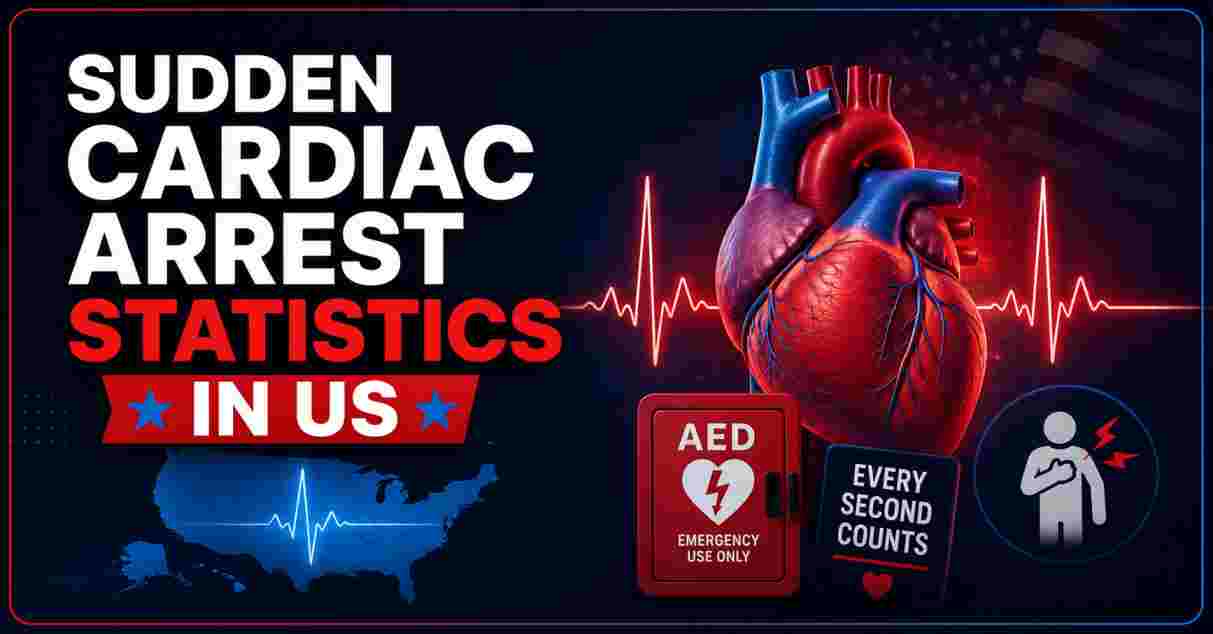
Every day in the United States, approximately 1,000 people collapse and die from sudden cardiac arrest before reaching a hospital. No warning, no chance to call for help, no time for a loved one to react — just a heart that stops beating without notice, in a kitchen, at a gym, on a school field, or at a desk. Sudden cardiac arrest (SCA) is not the same as a heart attack: it is an abrupt electrical malfunction that causes the heart to stop pumping entirely, cutting off oxygen to the brain within seconds and causing death within minutes if nothing is done. According to the Cardiac Arrest Registry to Enhance Survival (CARES) 2024 Annual Report — the most comprehensive and current source of US out-of-hospital cardiac arrest data — an estimated 263,711 EMS-treated, non-traumatic out-of-hospital cardiac arrests (OHCA) occurred across the United States in 2024 alone, with approximately 350,000 total OHCA events including those where EMS did not treat. Nearly 90% of them were fatal. What makes these numbers even harder to sit with is that they have barely moved in three decades of medical advancement — the overall survival rate to hospital discharge has hovered around 10% for the better part of 30 years.
What the 2026 data makes undeniably clear is that sudden cardiac arrest in America is not primarily a hospital problem — it is a community problem. More than 70% of all SCA events occur at home, in private residences where bystanders are often family members with no CPR training and no AED within reach. The AHA’s Nation of Lifesavers initiative was launched specifically to address this gap, with a goal of improving survival for the 350,000+ OHCA events that occur every year. With bystander CPR still initiated in only 41.7% of cases in 2024, the single largest lever for improving SCA survival in America in 2026 is not a new drug — it is public education, CPR training, and AED access.
Key Facts: Sudden Cardiac Arrest Statistics in the US 2026
SUDDEN CARDIAC ARREST — US KEY METRICS AT A GLANCE (2026)
==========================================================

Annual OHCA Events (total est.)        |████████████████████████████████  ~350,000/year
EMS-Treated OHCA Events (2024 CARES)   |████████████████████████          263,711
Overall Survival to Discharge          |▌                                 10.5%
Fatality Rate                          |████████████████████████████████  ~90% fatal
Occur at Home / Residence              |████████████████████████████████  ~70%
Bystander CPR Rate (2024)              |████████████████                  41.7%
Age-Adjusted Mortality Rate (2023)     |████████████████████              131.6 per 100,000
SCA Deaths 1999–2023 (CDC WONDER)      |████████████████████████████████  8,523,980 total

(Sources: CARES 2024 Annual Report; CDC WONDER; AHA; SCA Foundation)
| Fact | Key Figure |
|---|---|
| Estimated annual total OHCA events in the US | Approximately 350,000 — nearly 1,000 per day |
| EMS-treated non-traumatic OHCA in 2024 | 263,711 (CARES 2024, census-extrapolated) |
| OHCA events reported directly to CARES (2024) | 137,119 events |
| CARES registry coverage (as of Jan 2025) | 37 state-based registries + DC; ~186 million Americans (~56% of US population) |
| Overall survival to hospital discharge | 10.5% — CARES 2024 |
| Favorable neurologic outcome at discharge | Approximately 8.2% — CARES 2024 |
| Fatality rate for OHCA | Approximately 90% — virtually unchanged for 30 years |
| OHCA occurring at home / residence | ~70% of all adult OHCA cases |
| Cardiac cause of adult OHCA (2024) | 83.8% of adult OHCA presumed cardiac in origin |
| Male share of OHCA patients (2024) | 63.2% of CARES patients were male |
| Unwitnessed cardiac arrests (2024) | 50.2% of arrests were unwitnessed |
| Bystander-witnessed arrests (2024) | 37.5% witnessed by a bystander |
| Bystander CPR rate (2024) | 41.7% of OHCA cases; 50.1% of witnessed cases |
| SCA deaths in the US (1999–2023) | 8,523,980 total — CDC WONDER database |
| Age-adjusted SCA mortality rate (2023) | 131.6 per 100,000 — down from 196.0 in 1999 |
| SCA listed on death certificates (CDC) | Appears as contributing cause on 13.5% of all US death certificates |
| 1 in every ___ Americans will die of SCA | 1 in 7.4 Americans will die of SCD per CDC data |
| Workplace cardiac arrests annually | Approximately 10,000 cardiac arrests in US workplaces each year |
| Annual workplace cardiac arrest deaths preventable with AEDs | Approximately 160 of ~400 workplace SCD deaths — OSHA |
Source: CARES 2024 Annual Report; CDC WONDER Database; AHA Heart Disease and Stroke Statistics — 2025 Update; Sudden Cardiac Arrest Foundation Latest Statistics; OSHA workplace safety guidelines
What these facts describe is both alarming and, in key respects, solvable. Sudden cardiac arrest kills approximately 1 in 7.4 Americans over a lifetime, claims ~350,000 lives per year, and the tools that can radically improve survival — CPR within minutes, AED defibrillation within 6 minutes — are learnable skills and deployable devices, not exotic hospital treatments. The fact that 50.2% of cardiac arrests are still unwitnessed and bystander CPR is performed in only 41.7% of cases in 2024 is not a scientific failure. It is a public education failure — one the AHA, CDC, and CARES are actively working to reverse.
The CDC WONDER-derived finding that 8,523,980 Americans died from SCA between 1999 and 2023 — published in a December 2025 study in the Journal of Arrhythmia — is one of the starkest population-level figures in American cardiovascular medicine. The decline in the age-adjusted mortality rate from 196.0 in 1999 to 131.6 in 2023 represents genuine progress driven by improved cardiovascular prevention and better post-resuscitation care — but it still means 131.6 of every 100,000 Americans die of sudden cardiac arrest each year.
Sudden Cardiac Arrest Survival Rates in the US 2026
SCA SURVIVAL TO HOSPITAL DISCHARGE — US BY SCENARIO (CARES 2024)
=================================================================

Overall OHCA (all cases)          |▌                   10.5%
Bystander CPR provided            |████                13.0%
No bystander CPR                  |▌                    7.6%
Bystander-witnessed arrest        |████                16.0%
911 responder-witnessed arrest    |█████               18.0%
Unwitnessed arrest                |▌                    4.5%
Public location (bystander AED)   |████████████        33.6%
Home / residence                  |██                   8.9%
Nursing home                      |▌                    ?low
Shockable rhythm (VF/VT)          |████████████        29.4%
Non-shockable rhythm              |██                   6.4%
Witnessed + shockable rhythm      |████████████████    34.4%
Young athletes (on-site AED)      |████████████████████████████████  89%

(Source: CARES 2024 Annual Report; AHA 2025 Guidelines; SCA Foundation)
| Scenario | Survival to Hospital Discharge |
|---|---|
| Overall OHCA — all EMS-treated cases | 10.5% |
| OHCA with bystander CPR | 13.0% |
| OHCA without bystander CPR | 7.6% |
| Bystander-witnessed arrests | 16.0% — over 3x higher than unwitnessed |
| 911 responder-witnessed arrests | 18.0% — nearly 4x higher than unwitnessed |
| Unwitnessed arrests | 4.5% |
| Public location with bystander AED applied | 33.6% — more than triple overall average |
| Home / residence | 8.9% |
| Shockable rhythm (VF or VT) | 29.4% — nearly 5x higher than non-shockable |
| Non-shockable rhythm | 6.4% |
| Witnessed arrest with shockable rhythm | 34.4% |
| In-hospital cardiac arrest (IHCA) | Approximately 21% — Red Cross / AHA |
| Young athletes (on-site AED + certified athletic trainer) | Up to 89% |
| Gym / health club with AED present | 93% vs. 9% without AED |
| CPR started within 3–5 minutes of collapse | Survival increases to 40%–50% |
Source: CARES 2024 Annual Report; AHA Part 7: Adult Basic Life Support, 2025 AHA Guidelines for CPR and ECC; Red Cross CPR Facts & Statistics, updated January 2026; Sudden Cardiac Arrest Foundation Latest Statistics; 2025 study published in Circulation (ARREST registry, 3,723 patients)
The survival rate data is the most important set of numbers in American emergency medicine — and the spread between worst and best outcomes makes the point more powerfully than any argument. The difference between a 4.5% survival rate (unwitnessed, no CPR, no AED) and an 89% survival rate (witnessed, immediate CPR, AED deployed by a trained responder) is not pharmacology — it is time and preparedness. A 2025 study in Circulation analyzing 3,723 patients with witnessed OHCA and ventricular fibrillation found that when the first shock was delivered within 6 minutes, 93% successfully terminated ventricular fibrillation. The window to save a life during sudden cardiac arrest is not hours — it is the first 3 to 6 minutes.
The in-hospital cardiac arrest survival rate of approximately 21% — roughly double the out-of-hospital rate — reflects the advantage of having defibrillators and trained staff immediately available. Even so, 79% of in-hospital cardiac arrest patients do not survive to discharge, underscoring how brutally short the window for meaningful intervention truly is. The gym and health club figure — 93% survival when an AED is present versus 9% when it is not — makes the case for public AED access more powerfully than any policy argument could.
Causes of Sudden Cardiac Arrest in the US 2026
OHCA CAUSES AMONG ADULTS — US 2024 (CARES DATA)
================================================

Cardiac cause (heart disease, arrhythmia)  |████████████████████████████████████████  83.8%
Respiratory / asphyxia                     |████                                       9.1%
Drug overdose                              |██                                          5.3%
Exsanguination / hemorrhage                |▌                                           0.7%
Drowning / submersion                      |▌                                           0.5%
Other medical                              |▌                                           0.6%

(Source: CARES 2024 Annual Report; Red Cross CPR Facts & Statistics, Jan 2026)
| Cause | Share of Adult OHCA (2024) | Notes |
|---|---|---|
| Cardiac cause (coronary artery disease, arrhythmia) | 83.8% | Most common underlying cause in adults |
| Coronary artery disease (CAD) / STEMI | Primary driver of cardiac OHCA | Myocardial scars create arrhythmia substrate |
| Ventricular fibrillation / pulseless VT (shockable) | 19.8% of EMS-treated OHCA have shockable initial rhythm | Treatable with AED if reached in time |
| Respiratory / asphyxia | 9.1% | Includes suffocation, airway obstruction |
| Drug overdose | 5.3% | Significant contributor, esp. opioid-related |
| Exsanguination / hemorrhage | 0.7% | Trauma-related |
| Drowning / submersion | 0.5% | Preventable in most cases |
| Other medical causes | 0.6% | Sepsis, PE, metabolic crises |
| Underlying adult cause: no prior symptoms | 25% of adults had no symptoms before arrest | SCA strikes without warning in 1 in 4 adults |
| AHA: SCA linked to prior heart conditions | ~84% of adult SCA linked to underlying heart conditions | Most had no prior diagnosis |
Source: CARES 2024 Annual Report; AHA Heart Disease and Stroke Statistics — 2025 Update; CDC WONDER; Sudden Cardiac Arrest Foundation Latest Statistics; Journal of Arrhythmia, December 2025 (CDC WONDER SCA mortality study)
The cause profile of sudden cardiac arrest in 2024 confirms this is overwhelmingly a cardiovascular disease problem at its root. The 83.8% cardiac-cause figure from CARES 2024 primarily reflects the downstream consequences of coronary artery disease: decades of plaque buildup, prior heart attacks that left myocardial scar tissue, and the electrical instability those scars create. When that instability tips into ventricular fibrillation — the chaotic quivering that prevents the heart from pumping — the only treatment is defibrillation. Nothing else can restore a normal rhythm once VF has begun.
What makes this so challenging from a public health standpoint is that 25% of adult SCA victims had absolutely no symptoms before their arrest — no chest pain, no shortness of breath, no prior heart diagnosis. The AHA’s estimate that ~84% of adult SCA cases are linked to underlying heart conditions the victim didn’t know they had is a powerful reminder that prevention and risk factor management matter as much as emergency response. The 5.3% of OHCA caused by drug overdose in 2024 reflects the ongoing toll of the opioid and fentanyl crisis — a category that has grown substantially in recent years.
SCA Mortality by Gender and Race in the US 2026
AGE-ADJUSTED SCA MORTALITY RATE BY GROUP — US 2023 (CDC WONDER)
================================================================

Non-Hispanic Black Males     |████████████████████████████████████████  235.18 per 100,000
Hispanic Males               |██████████████████████████████            184.38 per 100,000
All Males (overall)          |████████████████████████████              156.08 per 100,000
All Females (overall)        |████████████████████                      111.09 per 100,000
Northeast / Metro Region     |████████████████████████████████          Highest AAMR regionally

Males die of SCA at 40% higher rate than females (156.08 vs 111.09)
Non-Hispanic Black individuals: highest mortality of any racial/ethnic group

(Source: Journal of Arrhythmia, Dec 2025 — CDC WONDER analysis 1999–2023)
| Group | Age-Adjusted SCA Mortality Rate (per 100,000, 2023) | Notes |
|---|---|---|
| Non-Hispanic Black individuals | 235.18 — highest of all groups | Driven by CAD risk, lower bystander CPR rates |
| Hispanic individuals | 184.38 | Second highest AAMR |
| All males (overall) | 156.08 | Consistently higher than females across all years |
| All females (overall) | 111.09 | Lower rate but significant absolute burden |
| Overall US AAMR (2023) | 131.6 per 100,000 | Down from 196.0 in 1999 — a 32.9% decline |
| Northeast / metropolitan regions | Highest regional AAMRs | Dense populations; extended transport times |
| Male CARES patients share (2024) | 63.2% of all OHCA patients | Men develop CAD earlier and at higher rates |
| Bystander CPR disparity | Less likely in low-income Black and Hispanic neighborhoods | CARES 2024; NEJM 2022 study (110,054 witnessed arrests) |
| Non-white OHCA patients: bystander CPR rate | 27.35% vs. 36.59% for white patients | Significant racial gap in community response |
| Young athlete SCA: male share | 86.3% of SCA/SCD cases in young athletes were male | JAMA Network Open, February 2025 (387 cases) |
Source: Journal of Arrhythmia, “Trends in Mortalities due to Sudden Cardiac Arrest in the United States Population,” December 2, 2025 (CDC WONDER database, 1999–2023); CARES 2024 Annual Report; NEJM, “Racial and Ethnic Differences in Bystander CPR for Witnessed Cardiac Arrest,” 2022; JAMA Network Open, February 24, 2025
The gender and racial disparities in SCA mortality are among the most persistent inequities in American cardiovascular medicine. The December 2025 CDC WONDER analysis found that non-Hispanic Black individuals face an age-adjusted SCA mortality rate of 235.18 per 100,000 — nearly double the national average of 131.6 — reflecting a compounding of cardiovascular risk factors including hypertension, diabetes, and coronary artery disease at younger ages, compounded by significantly lower bystander CPR rates in their communities.
The NEJM’s 2022 analysis of 110,054 witnessed cardiac arrests documented this gap with precision: bystander CPR rates were meaningfully lower in predominantly Black and Hispanic neighborhoods, even after adjusting for other variables. CARES 2024 confirms the disparity continues: non-white OHCA patients received bystander CPR at just 27.35% versus 36.59% for white patients — a nearly 10-percentage-point gap with direct and documented consequences for survival. The AHA’s 2030 Impact Goals explicitly name the elimination of bystander CPR and AED disparities by race, income, sex, and geography as a named priority target.
SCA in Specific Settings: Athletes, Workplace & Children in the US 2026
SCA IN SPECIAL POPULATIONS — US DATA
=====================================

Young athletes overall survival (2014–2016 study)     |████████████████████          48%
Young athletes (on-site AED + athletic trainer)        |████████████████████████████████████  89%
NCAA athlete SCD 20-year decline                       |████████████████████          -29% per 5 years
Pediatric OHCA 9-1-1 calls (2021, AHA)                |████████████████████          13,040 events
Workplace cardiac arrests annually                     |████████████████████████      ~10,000
Workplace SCD preventable with AEDs (OSHA)             |████████████████████          ~160 of 400
1 in ___ US high schools expects SCA event per year    |████████████████████████      1 in 25 schools

(Sources: SCA Foundation; JAMA Network Open 2025; AHA; OSHA)
| Setting / Population | Key Statistic | Source |
|---|---|---|
| Young athletes (ages 11–27) overall SCA survival | 48% — two-year study, 132 cases | SCA Foundation / published study |
| Young athletes (on-site AED + athletic trainer) | 89% survival — versus 48% without | SCA Foundation Latest Statistics |
| Young competitive athletes SCA/SCD (2017–2022) | 387 total cases; mean age 16.5 years; 86.3% male | JAMA Network Open, February 24, 2025 |
| Overall SCA/SCD survival in 387 athlete cases | 50.9% (197 of 387 survived) | JAMA Network Open, February 24, 2025 |
| NCAA athlete SCD — 20-year incidence trend | Declined 29% every 5 years over 20-year study | AHA Scientific Sessions 2023; AHA newsroom |
| SCA: leading cause of death in student-athletes | #1 cause of death among student-athletes | SCA Foundation; AHA |
| SCA events per year in US high schools | 1 in 25 US high schools expects an SCA event per year | SCA Foundation |
| Pediatric OHCA events (2021) | 13,040 events from 1.74 million pediatric 911 calls | AHA 2023 (based on 2021 data) |
| Pediatric OHCA: home location (under 1 year) | 90.6% occur at home | AHA prior data; SCA Foundation |
| Workplace cardiac arrests per year | Approximately 10,000 | SCA Foundation; OSHA |
| Workplace SCD annually | Approximately 400 deaths | OSHA estimates |
| Workplace SCD preventable with on-site AEDs | Approximately 160 of 400 — OSHA | OSHA workplace safety recommendations |
| Young athlete cardiac arrest risk per year | ~1 in 50,000 to 1 in 100,000 | Mayo Clinic, updated April 21, 2026 |
Source: JAMA Network Open, “Sudden Cardiac Arrest Among Young Competitive Athletes Before and During the COVID-19 Pandemic,” February 24, 2025; AHA Newsroom, November 2023; Sudden Cardiac Arrest Foundation Latest Statistics; OSHA workplace safety resources; Mayo Clinic, updated April 21, 2026
Sudden cardiac arrest in athletes and young people gets disproportionate public attention — and the data justifies it. SCA in young athletes is more survivable than in the general population — not because young hearts are more resilient, but because sports settings are more likely to have trained observers, on-site AEDs, and emergency action plans. The 89% survival rate when a certified athletic trainer with an on-site AED responds versus the 10.5% overall OHCA rate is one of the most compelling proof-of-concept findings in emergency cardiac care — a demonstration of exactly what community preparedness can achieve.
The JAMA Network Open February 2025 analysis of 387 SCA/SCD cases in young competitive athletes from 2017 to 2022 found an overall survival rate of 50.9% — far above the general OHCA figure. The 86.3% male share reflects the same gender disparity seen across all SCA populations, and is particularly pronounced in collegiate basketball players, where the AHA’s 2023 Scientific Sessions identified Black male Division I basketball players as the highest-risk collegiate athlete group. Meanwhile, approximately 10,000 cardiac arrests occur in US workplaces annually, and OSHA estimates that roughly 160 of 400 annual workplace cardiac deaths could be prevented with accessible on-site AEDs.
CPR, AEDs & the Chain of Survival in the US 2026
BYSTANDER CPR AND AED USE — US STATE COMPARISON (CARES 2024)
=============================================================

Bystander CPR Rates (highest states):
  Alaska          |████████████████████████████████████████  79.7%
  Nevada          |█████████████████████████████             57.5%
  Oregon          |████████████████████████████              54.6%
  Washington      |████████████████████████████              53.6%
  National avg    |██████████████████████                    41.7%

Bystander AED Use (highest states):
  Nebraska        |███████                                   21.4%
  Nevada          |██████                                    19.0%
  Hawaii          |██████                                    18.2%
  Pennsylvania    |█████                                     17.2%
  National avg    |██                                        ~6%

(Source: CARES 2024 Annual Report; SCA Foundation)
| CPR / AED Metric | Data | Source / Notes |
|---|---|---|
| National bystander CPR rate (2024) | 41.7% of all OHCA cases | CARES 2024 Annual Report |
| Bystander CPR rate in witnessed cases (2024) | 50.1% of witnessed OHCA cases | CARES 2024 Annual Report |
| Highest state bystander CPR rate | Alaska — 79.7% | CARES 2024 Annual Report |
| Survival with bystander CPR vs. without | 13.0% vs. 7.6% — a 71% relative improvement | CARES 2024 Annual Report |
| CPR doubles or triples survival | Survival rates 10%–12% with CPR vs. 2%–8% without | AHA CPR Facts & Stats, accessed 2025 |
| AED shock within 6 minutes: VF termination | 93% of shocks terminated ventricular fibrillation | 2025 study, Circulation, ARREST registry, 3,723 patients |
| Every minute without defibrillation | Survival decreases by 7%–10% per minute | AHA / Red Cross |
| Highest state bystander AED use | Nebraska — 21.4% | CARES 2024 Annual Report |
| Public AED bystander application survival | 33.6% (excluding nursing home events) | CARES 2024 Annual Report |
| AHA 2025 CPR Guidelines update | Children aged 12+ can now be effectively taught CPR and defibrillation | 2025 AHA Guidelines for CPR and ECC |
| CARES registry coverage (Jan 2025) | 37 states + DC; ~186 million people (~56% of US) | MyCARES.net, January 2025 |
Source: CARES 2024 Annual Report; Sudden Cardiac Arrest Foundation Latest Statistics; Red Cross CPR Facts & Statistics, updated January 6, 2026; AHA Part 7: Adult Basic Life Support — 2025 AHA Guidelines for CPR and Emergency Cardiovascular Care; 2025 study in Circulation (ARREST registry)
The CPR and AED data from CARES 2024 tells a clear and consistent story that public health professionals have been making for decades: the single biggest modifiable factor in out-of-hospital cardiac arrest survival is whether a bystander acts in the first minutes. Alaska’s 79.7% bystander CPR rate — the highest in the nation — compared to a national average of 41.7% is not an accident. It reflects years of targeted state-level CPR education campaigns, mandatory CPR training in schools, and a cultural norm around emergency preparedness that other states have not yet matched. The fact that Alaska’s rate is nearly double the national average while using the same medical science and the same AED technology as every other state shows that the gap between current survival rates and what is achievable is primarily a training and awareness gap, not a medical one.
The 2025 AHA CPR and ECC Guidelines now state it is reasonable that children aged 12 and older can be taught effective CPR and defibrillation — expanding the trained bystander pool to include teenagers is both feasible and critical. The AHA’s federal advocacy for the Access to AEDs Act, which would fund CPR training and AED deployment in K-12 schools, reflects the same logic: the more Americans who are trained and the more spaces equipped with AEDs, the more of those 350,000 annual cardiac arrest events end in survival rather than a death certificate.
Disclaimer: The data research report we present here is based on information found from various sources. We are not liable for any financial loss, errors, or damages of any kind that may result from the use of the information herein. We acknowledge that though we try to report accurately, we cannot verify the absolute facts of everything that has been represented.