Subscription Traps in the United Kingdom 2026
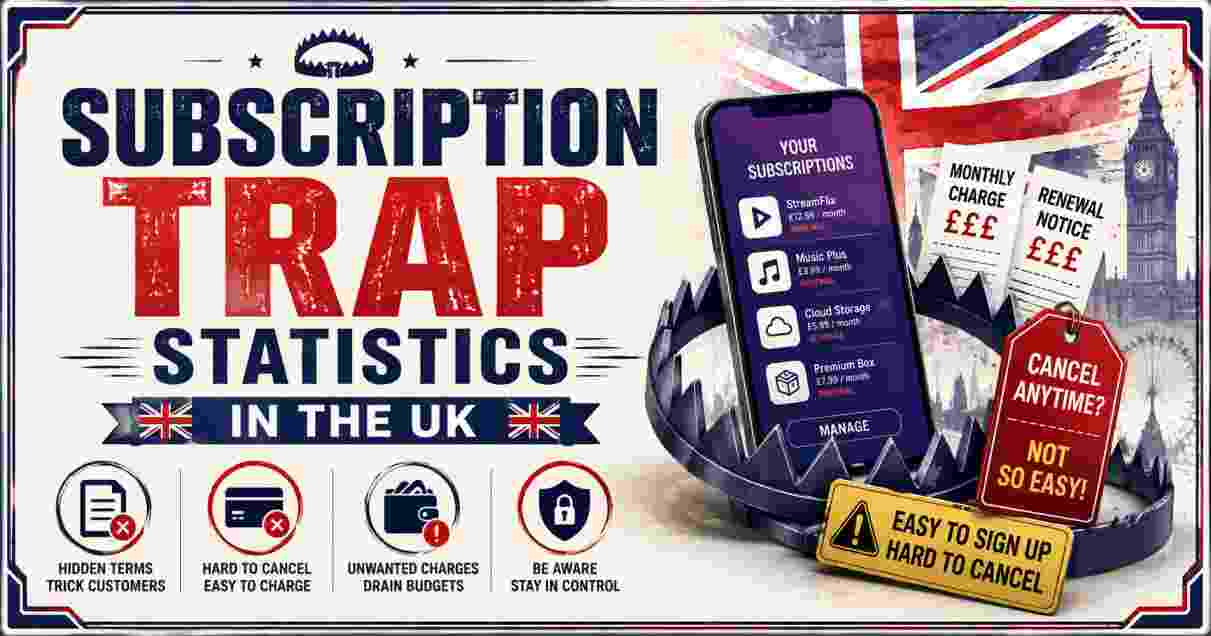
Subscription traps — services that are easy to sign up for but deliberately difficult to cancel, or that quietly roll a free trial into a costly ongoing contract — have become one of the UK government’s top consumer protection priorities heading into the second half of 2026. Just yesterday, on August 9, 2026, Downing Street confirmed that Prime Minister Andy Burnham has vowed to crack down further on hard-to-cancel subscriptions and fake discounts as part of a broader package of measures to tackle the cost-of-living crisis, pledging to make it “as easy to leave a subscription as it is to join.”
This report compiles the latest verified UK government data — sourced directly from the Department for Business and Trade (DBT), the Competition and Markets Authority (CMA), and Citizens Advice — covering how many Britons are trapped in unwanted subscriptions, how much money is lost every year, which sectors generate the most complaints, and the regulatory reforms working their way through Parliament as of this week. As of today, an important update has landed: the Digital Markets, Competition and Consumers Act 2024 (DMCCA) subscription contract reforms, first announced by the DBT in April 2026, are now confirmed to take effect in spring 2027, while the CMA has already begun using its new powers to investigate subscription practices under existing law, well ahead of that formal start date.
Interesting Subscription Trap Facts and Latest Statistics in the UK 2026
| Subscription Trap Fact Category | Latest Verified Figure |
|---|---|
| Total Active UK Subscriptions | 155 million |
| Estimated Unwanted Active Subscriptions | ~10 million (5.8% of all subscriptions) |
| Annual Consumer Spending on Unwanted Subscriptions | £1.6 billion |
| Projected Annual Consumer Savings From New Rules | £400 million |
| Average Cost Per Unwanted Subscription | £14/month (~£170/year) |
| People Rolled From Free/Discounted Trials Into Paid Contracts | 3.5 million |
| People Caught Out by Unexpected Auto-Renewals | 1.3 million |
| New Rules Confirmed Effective Date | Spring 2027 |
Data source: Department for Business and Trade, press release, April 2, 2026; UK Prime Minister’s Office statement, August 9, 2026
These figures reveal just how widespread — and costly — subscription traps have become across the UK. Of the 155 million active subscriptions currently held by British consumers, the Department for Business and Trade estimates that nearly 10 million are unwanted, a scale that equates to roughly 2.9 subscriptions per UK adult overall. Collectively, unwanted subscriptions cost UK consumers an estimated £1.6 billion every year, with the government projecting that its incoming reforms could return £400 million annually back into household budgets once businesses are legally required to make cancellation as simple as sign-up.
The £14-per-month, £170-per-year average cost of a single unwanted subscription illustrates why the issue has become such a pressing part of the cost-of-living crisis narrative dominating British politics in 2026. Two specific consumer behaviours drive the bulk of this detriment: 3.5 million people have been quietly rolled from a free or discounted trial into a fully priced ongoing contract without clear consent, while a further 1.3 million have been caught out by subscriptions that auto-renewed at a higher price without adequate warning — both practices the DBT’s incoming rules are specifically designed to eliminate by spring 2027.
Government-Confirmed Subscription Trap Cost Statistics in the UK 2026
Consumer Inertia (aware, doesn't act)....... £692m  ████████████████████████████████████
Rollovers from Free/Discounted Trials........ £602m  ███████████████████████████████
Forgetting to Cancel a Contract.............. £573m  ██████████████████████████████
Difficulty Cancelling a Subscription......... £382m  ████████████████████
| Source of Unwanted Subscription Spending | Annual Cost |
|---|---|
| Consumer Inertia (aware but doesn’t cancel) | £692 million |
| Rollovers From Free or Discounted Trials | £602 million |
| Forgetting to Cancel a Contract | £573 million |
| Difficulty Actually Cancelling a Subscription | £382 million |
| Total Estimated Annual Unwanted Spending | ~£1.6–2.2 billion |
Data source: UK Government Impact Assessment accompanying the Digital Markets, Competition and Consumers Act 2024 subscription contract reforms
The official government Impact Assessment underpinning the DBT’s subscription reforms breaks down exactly where unwanted subscription spending comes from, and the results show the problem is driven by several distinct behavioural failures rather than a single cause. Consumer inertia — where someone is fully aware of an unwanted subscription but simply never gets around to cancelling it — accounts for the single largest share at £692 million annually, closely followed by rollovers from free or discounted trials into full-price contracts at £602 million, representing around 37% of total unwanted spending on its own.
Forgetting to cancel a contract entirely contributes a further £573 million, while genuine difficulty navigating the cancellation process itself — think unresponsive phone lines, hidden cancellation buttons, or multi-step verification hurdles — accounts for £382 million. The government’s policy response, formalised in the Digital Markets, Competition and Consumers Act 2024, directly targets each of these four failure points through a combined package of clearer pre-contract information, mandatory reminder notices, straightforward exit mechanisms, and new statutory cooling-off rights, reflecting a deliberately comprehensive approach to a problem the Impact Assessment attributes squarely to information failures and behavioural biases such as default bias and inertia.
The Digital Markets, Competition and Consumers Act Subscription Reform Statistics in the UK 2026
Cooling-Off Period After Trial/Auto-Renewal.......... 14 days
Confirmed Rules Effective Date........................ Spring 2027
CMA Maximum Fine (% of Global Turnover)............... 10%
Consumer Enforcement Regime In Force Since............ April 6, 2025
| DMCCA Subscription Reform Metric | Confirmed Detail |
|---|---|
| Statutory Cooling-Off Period (After Trial or Annual Renewal) | 14 days |
| New Rules Confirmed Effective Date | Spring 2027 |
| CMA Direct Enforcement Powers In Force Since | April 6, 2025 |
| Maximum CMA Fine for Consumer Law Breaches | 10% of global annual turnover |
| Minimum Contract Length Triggering Renewal Reminder | 12 months or longer |
| Exempted Sectors | Certain charitable, cultural, and heritage memberships |
Data source: Digital Markets, Competition and Consumers Act 2024; Department for Business and Trade; UK Parliament written statement, September 9, 2024
The Digital Markets, Competition and Consumers Act 2024 (DMCCA) is the primary legislative vehicle behind the UK’s subscription trap crackdown, and its consumer law enforcement provisions have already been in force since April 6, 2025, giving the Competition and Markets Authority direct powers to investigate and fine businesses for consumer law breaches without first going through the courts — a maximum penalty of 10% of a company’s global annual turnover, bringing consumer enforcement into line with the CMA’s existing competition law powers. The subscription-specific provisions, however, were deliberately sequenced to come later, and the DBT has now confirmed these will take effect in spring 2027, giving businesses time to overhaul cancellation processes, IT systems, and contract terms.
Once in force, the new rules will require businesses to provide clear, simple pre-contract information, send reminder notices before any free or discounted trial ends or before a contract of 12 months or longer automatically renews, and guarantee a 14-day statutory cooling-off period that lets consumers cancel penalty-free immediately after a trial converts to a paid contract or after a long-term subscription auto-renews. Certain charitable, cultural, and heritage organisation memberships are explicitly excluded from the new regime. Notably, the CMA is not waiting for spring 2027 to act: as confirmed just days ago, the regulator has already launched an investigation into subscription contracts under existing consumer law, focused on concerns that software customers were not given clear, upfront information about their options before being automatically rolled onto higher-priced plans at renewal — a sign the government intends to use every enforcement tool already available rather than wait for the full statutory regime to arrive.
Prime Minister’s August 2026 Cost-of-Living Subscription Crackdown Statistics in the UK 2026
Estimated Annual Spending on Unwanted Subscriptions (No. 10)........ £1.6 billion
PM Burnham's Cost-of-Living Tour — UK Regions Covered................. All constituent regions
Announcement Date...................................................... August 9, 2026
| August 2026 Announcement Detail | Confirmed Figure |
|---|---|
| Announcement Date | August 9, 2026 (Sunday) |
| No. 10-Cited Annual Spending on Unwanted Subscriptions | £1.6 billion |
| Stated Policy Goal | “As easy to leave a subscription as it is to join” |
| Also Targeted Alongside Subscription Traps | Fake/misleading discount claims |
| Context | Part of broader cost-of-living policy package |
Data source: UK Prime Minister’s Office (10 Downing Street), statement issued August 9, 2026
Prime Minister Andy Burnham’s office confirmed on August 9, 2026 — the day before this report was compiled — that the government is renewing and sharpening its focus on subscription traps and fake discounts as part of a wider push to address the ongoing cost-of-living crisis. In a formal statement, Downing Street reiterated that British consumers are currently “spending an estimated £1.6 billion a year” on subscriptions they don’t actually want, directly echoing the DBT’s earlier April 2026 figures and signalling continuity between the original DMCCA reform package and the current government’s messaging priorities. Burnham stated plainly that “people are sick and tired of rip-off discounts and subscription traps,” framing the issue as a matter of basic economic fairness for households under sustained financial pressure.
The announcement coincided with Burnham’s return to work following a break and the launch of a nationwide “cost of living tour,” which his office said would span all of the United Kingdom’s constituent regions, including economically depressed areas such as Port Talbot in Wales. While the core legislative mechanics of the subscription reform remain those set out in the DMCCA — the 14-day cooling-off period, mandatory reminders, and simplified cancellation — the renewed prime ministerial focus signals that subscription traps are likely to remain a headline consumer protection issue in UK political discourse through the remainder of 2026 and into the spring 2027 implementation window, alongside other early Burnham government measures such as an energy bill tax cut and a cap on bus ticket prices.
Citizens Advice Consumer Complaint Statistics on Subscription Traps in the UK 2026
UK Adults Who Accidentally Took Out a Subscription (Past 12 Months).... 13 million
Cost of Unused Subscriptions, Most Recent Year.......................... £688 million
Cost of Unused Subscriptions, Prior Comparison Period................... £306 million
Adults Supporting a Ban on Non-Consented Auto-Renewals................. 74%
| Citizens Advice Metric | Reported Figure |
|---|---|
| UK Adults Who Accidentally Took Out a Subscription (12 Months) | 13 million (26% of UK adults) |
| Annual Cost of Unused Subscriptions to Consumers | £688 million |
| Increase Compared to Prior Citizens Advice Estimate | +£382 million (up from £306m) |
| Reason: Auto-Renewed Without Knowledge | 40% of accidental subscribers |
| Reason: Forgot to Cancel Free Trial | 39% of accidental subscribers |
| UK Adults Supporting a Ban on Non-Consented Auto-Renewals | 74% |
| People Who Avoided Signing Up Due to Cancellation Concerns | 54% |
Data source: Citizens Advice, national research report
Citizens Advice, the UK’s leading consumer rights charity, has independently tracked the scale of the subscription trap problem and found figures broadly consistent with the government’s own estimates. Its research shows that over 13 million people — 26% of all UK adults — have accidentally taken out a subscription within the past 12 months, spanning everything from fitness apps and food delivery services to repeat pet food orders and magazine subscriptions. Citizens Advice estimates these unused subscriptions have cost UK consumers £688 million in the most recent year measured, a substantial £382 million increase from the £306 million figure the charity recorded when it last examined the issue.
Among those who ended up with an accidental subscription, the two leading causes closely mirror the government’s own Impact Assessment findings: 40% auto-renewed without the consumer’s knowledge, while 39% signed up for a free trial but simply forgot to cancel before being charged. Citizens Advice further found that 54% of UK adults have actively decided against signing up for a subscription specifically because of concerns about how difficult it might be to cancel later — demonstrating that subscription traps don’t just cost money directly, but also actively suppress legitimate consumer demand for services people might otherwise want. Public appetite for reform runs high: 74% of UK adults told Citizens Advice they support an outright ban on automatic subscription renewals in cases where the consumer has not actively agreed to them, a figure the charity has repeatedly cited in calling on government to strengthen protections through what ultimately became the DMCCA’s subscription contract provisions.
Historical Subscription Trap Complaint Pattern Statistics in the UK 2026
People With Problems Cancelling Recurring Payments (GB, Historical)........ 2 million
Consumers Initially Refused When Trying to Cancel (Citizens Advice Cases).. 90%
Most Difficult Sectors to Cancel: Gym, TV/Streaming, Insurance
| Historical Pattern Metric | Citizens Advice Figure |
|---|---|
| People Across Great Britain With Recurring Payment Cancellation Problems | ~2 million |
| Cases Where the Company Initially Refused Cancellation | 9 in 10 (90%) |
| People Unaware They’d Signed Up Until Money Was Taken | 4 in 5 (80%) |
| Most Problematic Subscription Sectors | Gym memberships, TV/streaming, insurance |
| Longest Reported Cancellation Process Duration | Up to 6 months |
Data source: Citizens Advice, “Locked In: consumer issues with subscription traps” report, and subsequent national consumer service case analysis
Longer-running Citizens Advice casework confirms that difficulty cancelling isn’t a new phenomenon but a persistent, structural feature of the UK subscription market that current reforms are specifically designed to break. Analysis of cases brought to the Citizens Advice consumer service found that 9 in 10 people were initially refused by the company when they first attempted to cancel a subscription, while a broader study titled “Locked In: consumer issues with subscription traps” found that roughly 2 million people across Great Britain had experienced problems cancelling recurring payments, often described as Continuous Payment Authorities, commonly used for products like slimming pills, beauty treatments, or streaming media.
Perhaps most strikingly, 4 in 5 people (80%) affected by unwanted recurring payments told Citizens Advice they didn’t realise they had signed up for the payments at all until money was already being taken from their account — underscoring why the government’s incoming reforms place such heavy emphasis on upfront, clear pre-contract information rather than relying solely on post-purchase cancellation rights. Gym and fitness memberships, television and streaming services, and insurance products have consistently ranked among the sectors generating the highest complaint volumes, with some reported cancellation processes stretching to six months and requiring communication through a single restrictive channel, such as a specific phone line with limited opening hours. For context on how deeply digital services have penetrated UK households — the same services most commonly implicated in subscription trap complaints — the UK social media statistics show that streaming, messaging, and app-based subscriptions now sit alongside social platforms as some of the most universally adopted digital services in the country.
International Comparison: Subscription and Consumer Protection Statistics in 2026
UK — Unwanted Subscription Spending............... £1.6 billion annually
Australia — Total Reported Scam Losses (2025)....... $2.18 billion (AUD)
UK Population (2026 estimate)........................ 67.9–69.6 million
| Comparative Consumer Protection Metric | Figure |
|---|---|
| UK: Annual Unwanted Subscription Spending | £1.6 billion |
| UK: Active Subscriptions per Adult | ~2.9 |
| UK: Population, 2026 Estimate | 67.9–69.6 million (source-dependent) |
| UK: CMA Maximum Consumer Law Fine | 10% of global annual turnover |
| Comparable Overseas Regulator: Australia’s National Anti-Scam Centre | $2.18 billion AUD in total 2025 scam losses |
Data source: Department for Business and Trade; Office for National Statistics-derived population estimates; National Anti-Scam Centre, Australia
While subscription traps are a distinct consumer harm from outright fraud, both sit within the same broader UK and international push to modernise digital consumer protection for an economy increasingly built on recurring, auto-renewing, and app-based payment relationships. The UK’s £1.6 billion annual unwanted-subscription figure, set against a national population estimated at somewhere between 67.9 and 69.6 million people depending on the data source used, works out to roughly £23 to £24 per person per year in unwanted subscription spending nationally — a meaningful, quantifiable drag on household budgets that the DMCCA reforms are specifically designed to claw back by spring 2027.
Regulators overseas are pursuing broadly parallel strategies against adjacent forms of digital consumer harm, offering a useful comparative lens even though the specific problem differs. Australia’s dedicated National Anti-Scam Centre, for instance, reported total scam losses of $2.18 billion (AUD) in 2025 across an entirely different category of consumer harm, illustrating a common regulatory pattern across English-speaking markets: dedicated units combining data-sharing, direct enforcement powers, and public awareness campaigns to tackle digital-era consumer detriment at scale, a comparative regulatory landscape explored further in the Australia scam statistics. As the UK’s own population — estimated most recently at around 68 million people according to the latest UK population statistics — continues to grow and digitise, the government’s subscription contract reforms represent one part of a much larger modernisation of British consumer protection law taking shape across 2026 and into 2027.
Sector Breakdown: Where UK Subscription Traps Hit Hardest in 2026
Streaming / TV Services............ High complaint volume
Gym & Fitness Memberships........... High complaint volume, up to 6-month cancellation
Insurance Products................... High complaint volume
Software / SaaS Subscriptions........ CMA active investigation, 2026
| Sector | Documented Issue Pattern |
|---|---|
| Gym and Fitness Memberships | Long minimum terms, restrictive single-channel cancellation, exit fees |
| TV and Streaming Services | Rollover from promotional pricing to full price without clear notice |
| Insurance Products | Auto-renewal at higher premiums without adequate reminder |
| Software (SaaS) Subscriptions | Subject of active 2026 CMA investigation into renewal transparency |
| Food, Beauty, and Delivery Subscriptions | Frequently linked to “free trial” continuous payment authority complaints |
Data source: Citizens Advice; Competition and Markets Authority investigation announcements, 2026
Across both the government’s own Impact Assessment and independent Citizens Advice casework, a consistent set of sectors reappears as the most frequent source of subscription trap complaints. Gym and fitness memberships remain a perennial problem area, characterised by long minimum contract terms, cancellation processes restricted to a single phone line or in-person visit, and exit fees charged to members who need to leave early due to injury, relocation, or financial hardship. Television and streaming services generate a different but equally common complaint pattern: promotional or discounted introductory pricing that quietly reverts to a much higher full price, often with minimal or easily-missed notice before the change takes effect.
Insurance products — frequently sold on 12-month renewable terms — represent exactly the category the DMCCA’s new 14-day cooling-off period on annual renewals is designed to address, since policyholders are often auto-renewed at a materially higher premium without being given a meaningful opportunity to shop around first. Most notably for 2026, software and SaaS subscriptions have become the CMA’s active enforcement focus even ahead of the full statutory regime, with the regulator specifically examining whether customers were given clear information about their options before being automatically rolled onto higher-priced plans that bundled in previously free features — a pattern that closely tracks the broader shift toward subscription-based software licensing across the UK business and consumer technology sectors.
Disclaimer: The data research report we present here is based on information found from various sources. We are not liable for any financial loss, errors, or damages of any kind that may result from the use of the information herein. We acknowledge that though we try to report accurately, we cannot verify the absolute facts of everything that has been represented.