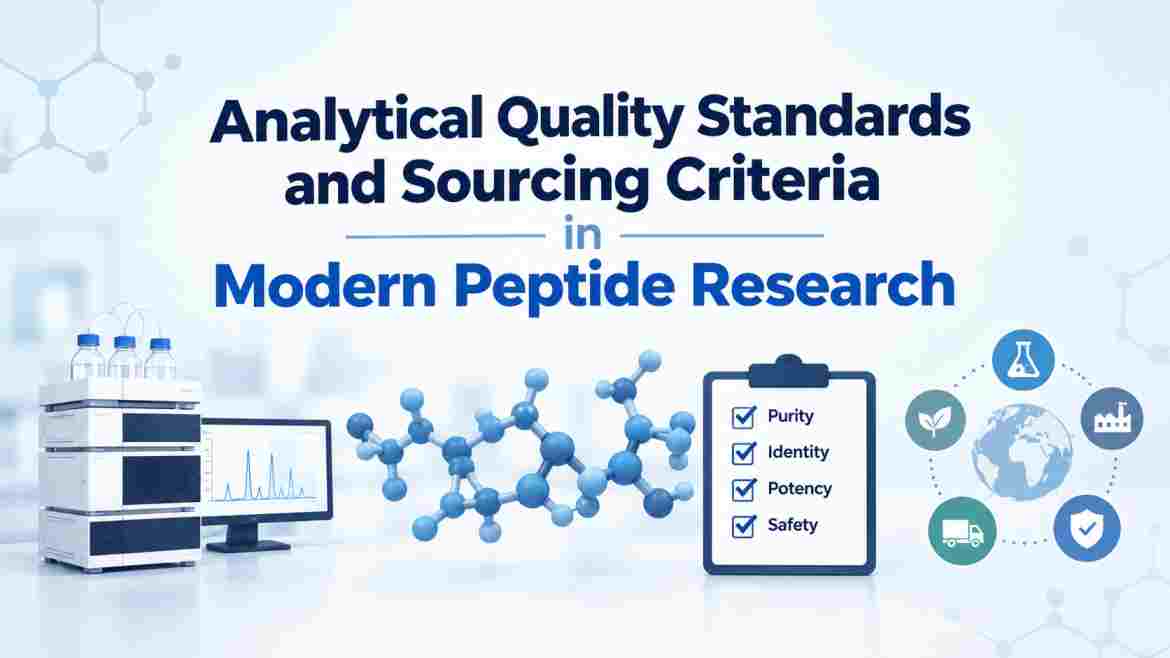
Contemporary biomedical research increasingly depends on high-purity synthetic compounds to investigate complex cellular mechanisms, receptor dynamics, and molecular pathways. In laboratories worldwide, investigators studying molecular biology, biochemistry, pharmacology, and physiology rely on consistent chemical synthesis to generate reproducible experimental data. When academic departments, independent laboratories, and commercial biotech researchers seek to buy research peptides online, evaluating analytical verification, sequence fidelity, and comprehensive chemical documentation represents the primary criterion for maintaining long-term experimental integrity and scientific validity.
Synthetic peptides serve diverse functional roles in modern exploratory biomedical models. From in vitro cell culture assays evaluating complex signal transduction cascades to structural biology investigations characterizing receptor binding affinities, peptide purity directly dictates whether observed cellular responses stem solely from the sequence of interest or from residual synthetic artifacts. In solid-phase peptide synthesis, even minor truncation products, deletion sequences, incomplete deprotections, or stereoisomeric impurities can drastically skew baseline metrics in sensitive binding and kinetic assays.
Analytical Quality Standards in Modern Peptide Synthesis
Modern solid-phase peptide synthesis utilizes automated chemical protocols to assemble amino acid sequences step by step from C-terminus to N-terminus. However, automated chemical assembly is merely the initial phase of reagent preparation; analytical verification is what truly establishes research utility. Standard laboratory quality control frameworks require multi-step verification before a synthesized sequence enters experimental workflows.
High-Performance Liquid Chromatography (HPLC) is the cornerstone analytical method used to quantify peptide purity. By measuring retention time and peak integration across reverse-phase columns, analytical chemists determine the exact percentage of the target peptide sequence relative to minor synthesis byproducts. For rigorous academic research and quantitative assays, purity thresholds exceeding 98% are typically required to prevent non-specific baseline activation, receptor cross-reactivity, or background noise in spectroscopic readings.
Mass spectrometry provides complementary structural validation to confirm sequence fidelity. Analytical techniques such as Electrospray Ionization Mass Spectrometry (ESI-MS) or Matrix-Assisted Laser Desorption/Ionization Time-of-Flight (MALDI-TOF) confirm that the molecular mass of the assembled chain precisely matches theoretical stoichiometric calculations. When researchers examine analytical documentation, reviewing both HPLC chromatograms and mass spectral reports ensures that molecular weight, charge distribution, and chromatographic purity align with stringent experimental standards.
Key Criteria for Sourcing Laboratory Reagents
Selecting reliable peptide reagents involves several rigorous operational criteria designed to eliminate experimental variability across repetitive trials:
- Batch-Specific Certificates of Analysis (COA): Valid suppliers provide comprehensive, lot-specific analytical documentation including raw spectral data rather than generic batch summaries or theoretical spec sheets.
- Proper Lyophilization and Storage: High-grade peptides are provided as lyophilized powders in inert packaging to preserve structural stability during transit and long-term storage in laboratory freezers.
- Reconstitution and Solvent Guidelines: Different peptide sequences exhibit varying solubility profiles depending on hydrophobic residues, requiring clear solvent guidance such as sterile bacteriostatic water, diluted acetic acid, or dimethyl solvent.
- Endotoxin Testing: For sensitive in vitro immunological or cellular proliferation studies, quantification of endotoxin levels ensures that observed immune modulations are not caused by bacterial contaminants.
Impact of Sequence Fidelity on Research Reproducibility
In preclinical workflows, reproducibility is paramount for publishing credible findings and advancing clinical translational candidates. Minor impurities within peptide samples can alter receptor-ligand interactions, misguide kinetic modeling, or introduce confounding cytotoxic variables in cell viability assays. For instance, in investigations examining endocrine signaling, metabolic regulation, or cellular repair cascades, non-target peptide fragments can act as competitive antagonists or partial agonists, producing misleading experimental conclusions.
Furthermore, reliable reconstitution and aliquoting protocols minimize freeze-thaw degradation cycles that can break fragile peptide bonds. Investigators should store lyophilized peptides at -20°C in desiccated environments, reconstituting only the necessary experimental aliquots under sterile laboratory conditions. Implementing standardized storage and handling protocols prevents hydrolytic cleavage, oxidation of sensitive residues like methionine and cysteine, and peptide aggregation over prolonged testing intervals.
Conclusion and Future Scientific Directions
As preclinical research expands across molecular therapeutics, regenerative biology, tissue modeling, and structural proteomics, access to verified chemical sequences remains essential for the scientific community. Prioritizing analytical transparency, high-resolution chromatography, and verifiable spectral documentation ensures that laboratories maintain rigorous scientific standards, minimize experimental artifact risks, and advance meaningful biomedical discoveries across all scientific disciplines.