What is Search Everywhere Optimisation?
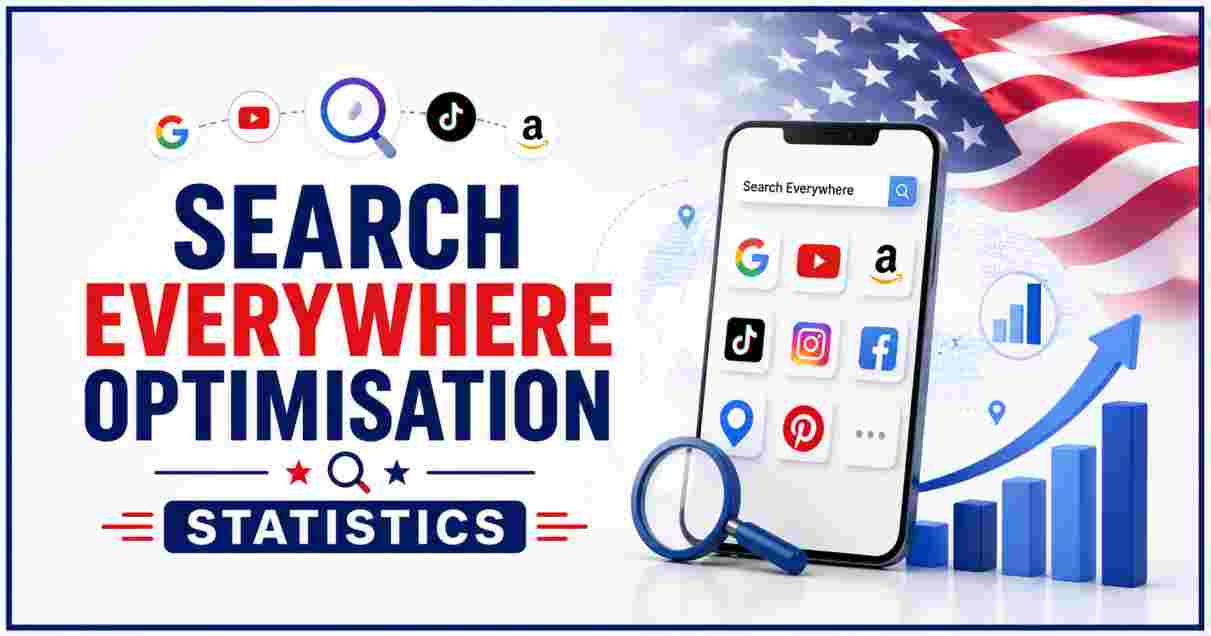
Search Everywhere Optimisation (SEO) — sometimes written as Search Everywhere Optimization — is the strategy of making a brand discoverable across every platform where people now search, not just Google. In 2026, this means building visibility on TikTok, Reddit, YouTube, Amazon, voice assistants like Siri and Alexa, and AI platforms such as ChatGPT, Perplexity, and Google’s Gemini. The approach combines traditional search engine optimization with Answer Engine Optimization (AEO) and Generative Engine Optimization (GEO), reflecting the reality that consumers worldwide no longer default to a single search box when they want information, entertainment, or products.
Globally, Search Everywhere Optimisation statistics for 2026 paint a picture of a genuinely fragmented discovery landscape. Zero-click searches have surpassed the majority threshold in multiple regions, TikTok has grown into a serious search competitor for younger demographics worldwide, Reddit content is being surfaced constantly inside Google and AI answers, and AI-powered platforms are processing billions of queries every week. For brands and publishers tracking these shifts outside the US alone, the 2026 data makes clear that a single-platform strategy — built around Google rankings only — now misses a large and growing share of the world’s search behavior.
Search Everywhere Optimisation 2026 Interesting Facts (Table)
GLOBAL SEARCH FRAGMENTATION SNAPSHOT (2026)
Google Share of Daily Searches | ### 18%
Zero-Click Search Rate (EU)    | ################# 59.7%
TikTok Global MAU              | ###################### 2.04B
Gen Z Using TikTok for Search  | #################### 64-67%
ChatGPT Weekly Active Users    | ############ 900M
Reddit Weekly Active Users     | ####### 443.8M
| Fact | Detail |
|---|---|
| Daily searches across all platforms globally | Over 45 billion, with Google accounting for only about 18% of them |
| Zero-click search rate (EU) | 59.7% of searches end without a click, as of Q1 2026 |
| TikTok global monthly active users | 2.04 billion, up 180 million since its ownership transition |
| Gen Z using TikTok as a search engine | 64%–67% globally |
| TikTok search query growth | +174% year-over-year |
| ChatGPT weekly active users | Approximately 900 million worldwide |
| Reddit weekly active users | 443.8 million, up 19.3% year-over-year |
| Google AI Overviews appearance rate | Over 65% of informational queries globally |
| Google’s referral click share | Still 87.5% of referral clicks globally, despite platform fragmentation |
| Traditional Google search volume forecast decline | Projected to drop 25% by the end of 2026 |
Source: Digital Applied Search Everywhere Optimization Report, SEO Sherpa AI Search Statistics 2026, SparkToro/Datos, Digital Applied TikTok Statistics 2026, Interteam Marketing Reddit Statistics 2026
The single biggest fact underpinning Search Everywhere Optimisation in 2026 is how small Google’s share of total search volume has become when measured against the full universe of daily queries. With over 45 billion searches happening globally each day across all platforms, and Google capturing only around 18% of that volume, the remaining search activity is spread across TikTok, YouTube, Reddit, and a fast-growing set of AI assistants. At the same time, zero-click searches — where a user gets their answer without visiting any website — have crossed the majority threshold in major markets, reaching 59.7% in the EU alone, which means even the searches that do happen on traditional engines increasingly don’t generate a website visit.
The second defining fact is the sheer scale AI platforms have reached in barely two years of mainstream adoption. ChatGPT’s roughly 900 million weekly active users now represent a genuine discovery channel in their own right, arriving at brand and product decisions already partially informed. Combined with TikTok’s 2.04 billion monthly active users and Reddit’s 443.8 million weekly active users, these numbers confirm that 2026 is the year search stopped being a single destination and became a distributed behavior spanning video, community, and conversational AI platforms simultaneously.
Global Zero-Click Search Statistics 2026
ZERO-CLICK SEARCH RATES BY REGION (2026)
United States    | ###################### 58.5%
European Union   | ###################### 59.7%
Global           | ############### 65%+
| Metric | 2026 Global Figure |
|---|---|
| Zero-click search rate (US) | 58.5% |
| Zero-click search rate (EU) | 59.7% |
| Google AI Overviews trigger rate on informational queries | Over 65% globally |
| AI Overview click reduction vs. traditional results | Approximately 34.5% fewer clicks to websites |
| News-query zero-click rate increase | Rose from 56% to 69% in one year following AI Overviews rollout |
| Projected decline in traditional search engine volume by end of 2026 | 25% |
Source: SparkToro/Datos Zero-Click Report, SE Ranking AI Statistics 2026, Ahrefs Zero-Click Study
Zero-click searches are one of the clearest global signals that discovery has fundamentally shifted. With rates surpassing 58–60% in both the US and EU as of early 2026, the majority of searches worldwide now end with the user getting an answer directly on the results page — through featured snippets, knowledge panels, or AI-generated summaries — rather than clicking through to a website. This trend is amplified by Google’s AI Overviews, which now appear on more than 65% of informational queries globally, cutting website referral clicks by roughly 34.5% compared with traditional blue-link results.
The practical consequence for anyone practicing Search Everywhere Optimisation is that traffic volume alone is no longer the right success metric. A brand can be extensively cited inside an AI Overview or a conversational AI answer without ever generating a click, meaning visibility and citation frequency are becoming as important as raw click-through rate. With traditional Google search volume forecast to decline by roughly 25% by the end of 2026, publishers and marketers worldwide are increasingly measuring success by how often their brand is mentioned across AI answers, video platforms, and community discussions — not just by rank position on a results page.
TikTok as a Global Search Engine Statistics 2026
TIKTOK SEARCH BEHAVIOR (2026, GLOBAL)
Global MAU              | ############################ 2.04B
Gen Z Search Usage      | ################## 64-67%
Search Query YoY Growth | ###################### 174%
Fashion Search vs Google| ############################# 503%
| Metric | 2026 Global Figure |
|---|---|
| TikTok global monthly active users | 2.04 billion |
| Projected MAU by end of 2026 | 2.5 billion |
| Gen Z using TikTok as a primary search engine | 64%–67% globally |
| TikTok search query growth (YoY) | +174% |
| Fashion-related search volume vs. Google | 503% higher on TikTok |
| Users taking action after watching a video (search, purchase, etc.) | 92% |
| Fastest-growing regions for TikTok adoption | Southeast Asia, the Middle East, and parts of Africa |
Source: Digital Applied TikTok Statistics 2026, GetAFollower TikTok User Statistics 2026, TTS Vibes TikTok Search Usage Statistics 2026
TikTok’s transformation from an entertainment app into a genuine search engine is one of the defining global stories of 2026. With 2.04 billion monthly active users worldwide and search-specific query volume growing 174% year-over-year, the platform is no longer a niche discovery channel for younger users — it is a mainstream research tool, particularly for fashion, travel, and local business queries, where search volume on TikTok now outpaces Google by as much as 503% in some categories. Growth is not confined to any single region either: Southeast Asia, the Middle East, and parts of Africa are cited as the fastest-growing markets, reinforcing that TikTok’s search behavior is a truly global phenomenon rather than a US or European trend.
What makes this shift especially important for Search Everywhere Optimisation is the action rate tied to TikTok search sessions. 92% of users take some action after watching content — whether that’s searching for more information, visiting a website, or making a purchase — a conversion signal that rivals or exceeds traditional search engine behavior. For global brands, this means TikTok’s on-platform search bar, video captions, and creator content now function as a parallel indexing system that needs its own optimization strategy, separate from but complementary to conventional website SEO.
Reddit Search & Discovery Statistics 2026
REDDIT AS A DISCOVERY ENGINE (2026)
Weekly Active Users       | ####################### 443.8M
Daily Active Users        | ###### 116M
Monthly Visits            | ############### 2.2B+
Keywords Ranking in Google| ########################## 595M+
| Metric | 2026 Global Figure |
|---|---|
| Reddit daily active users worldwide | 116 million |
| Reddit weekly active users worldwide | 443.8 million, up 19.3% YoY |
| Monthly visits to Reddit | Over 2.2 billion, with 78% coming from mobile |
| Keywords Reddit ranks for in Google search results | More than 595 million |
| Share of Reddit’s global traffic from outside the US | Roughly half, led by the UK, Canada, India, and Australia |
| Logged-out browsing share | 56.7% of daily users browse without an account |
Source: Interteam Marketing Reddit Statistics 2026
Reddit has moved from being a niche community forum to functioning as what researchers now describe as a decentralized research engine, and its global footprint backs that description up. With 443.8 million weekly active users and roughly half of its web traffic originating outside the United States — concentrated in the UK, Canada, India, and Australia — Reddit’s influence on global search behavior extends well beyond any single country. Its presence inside 595 million-plus Google search keyword rankings means Reddit threads now routinely appear alongside, or even above, traditional websites for comparison and opinion-based queries.
The high share of logged-out browsing (56.7%) is particularly notable for Search Everywhere Optimisation, since it shows that a large portion of Reddit’s discovery value comes from casual visitors landing on threads via search rather than platform-native browsing. If you’re building out a broader content strategy around community-driven visibility, our companion report on Reddit SEO Statistics 2026 breaks down how Reddit threads are ranking inside Google results and what that means for brand mentions globally. Combined with its growing citation frequency inside AI-generated answers, Reddit has become one of the highest-leverage platforms for brands pursuing visibility beyond their own website.
AI Search Platform Statistics 2026
AI SEARCH PLATFORM SCALE (2026, GLOBAL)
ChatGPT Weekly Active Users    | ###################### 900M
AI Session Volume vs Search    | ####################### 56%
ChatGPT Search Weekly Queries  | ############### 250-500M
Perplexity Weekly Queries      | ### 50M
| Metric | 2026 Global Figure |
|---|---|
| ChatGPT weekly active users | Approximately 900 million |
| AI platform monthly sessions vs. traditional search volume | 56% the size of global search, worldwide |
| ChatGPT Search weekly queries | 250–500 million |
| Perplexity weekly queries | Approximately 50 million |
| Apple’s Gemini integration reach (Siri/Apple Intelligence) | Over 2 billion active Apple devices |
| AI search conversion rate vs. traditional search (service businesses) | 4.4x to 9x higher |
Source: SEO Sherpa AI Search Statistics 2026, StackMatix AI-Powered Search Engine Statistics, Position Digital AI SEO Statistics 2026
The scale of AI search platforms by mid-2026 has reached a point where they can no longer be treated as experimental add-ons to a search strategy. ChatGPT alone reaches roughly 900 million weekly active users, and AI platforms collectively now generate session volume equal to 56% of worldwide traditional search engine volume. The January 2026 announcement that Google’s Gemini would be embedded into Apple’s Siri and Apple Intelligence — extending its reach across more than 2 billion active Apple devices — further cements AI-mediated search as a default behavior rather than a niche one, since it puts a generative AI answer engine on nearly every iPhone globally.
What makes this shift commercially significant is the conversion gap between AI-driven and traditional search traffic. Service businesses report converting 4.4 to 9 times higher from AI search referrals compared with conventional organic traffic, even though the raw volume from AI platforms remains smaller than Google’s. For brands practicing Search Everywhere Optimisation, this means the goal on AI platforms isn’t chasing traffic volume — it’s earning citations inside AI-generated answers, since a single well-placed citation in a ChatGPT or Perplexity response can deliver a pre-qualified, high-intent visitor. Our related analysis on AI Citation Statistics covers exactly how often brands are being cited across these platforms and what drives citation frequency globally.
The adoption pattern behind these numbers is also notably uneven across the world, which matters for any brand planning a truly global Search Everywhere Optimisation strategy. Research shows adoption of generative AI tools growing nearly twice as fast in the Global North compared with the Global South, meaning AI-driven discovery is currently more concentrated in North America, Europe, and parts of East Asia than in emerging markets. That gap is narrowing quickly, however, as Perplexity, Gemini, and regional AI assistants expand distribution deals with device manufacturers and telecom carriers outside the traditional Silicon Valley markets. Brands that wait for AI search to reach uniform global maturity before investing in citation-focused content risk losing first-mover advantage in the markets where adoption is accelerating fastest right now.
YouTube, Voice & Multi-Platform Time Allocation Statistics 2026
DAILY SEARCH & DISCOVERY TIME ALLOCATION (2026, GLOBAL)
TikTok       | ################################# 52 min/day
YouTube      | ############################# 46 min/day
Google Search| #################### 30 min/day
ChatGPT      | ################# 26 min/day
| Platform | Average Daily Time Spent (Global) |
|---|---|
| TikTok | Approximately 52 minutes/day |
| YouTube | Approximately 46 minutes/day |
| Google Search | Approximately 30 minutes/day |
| ChatGPT | Approximately 26 minutes/day |
| Amazon (product search starting point) | 63% of product searches begin here globally |
| Voice assistant usage growth | Rising steadily as Siri/Alexa integrate generative AI answers |
Source: Semrush 2026 Search Everywhere Report, Digital Applied Search Everywhere Optimization Report
Looking at how people actually spend their discovery-related time each day reveals just how far behind Google Search has fallen relative to video and conversational platforms. Globally, users now spend more time on TikTok (roughly 52 minutes/day) and YouTube (roughly 46 minutes/day) than they do on Google Search itself (roughly 30 minutes/day), with ChatGPT close behind at around 26 minutes/day. This time-allocation data is arguably a more honest measure of platform importance than raw query counts, since it captures sustained engagement rather than a single quick lookup.
Amazon’s role as a starting point for product research — capturing 63% of global product searches — further reinforces that Search Everywhere Optimisation must extend into marketplace search algorithms, not just web and social platforms. Together, this time-allocation picture explains why brands can no longer treat a top Google ranking as sufficient: the audience’s actual daily discovery behavior is now split fairly evenly across video, AI conversation, community platforms, and e-commerce search, each requiring its own distinct optimization approach.
Google AI Overviews & Answer Engine Statistics 2026
ANSWER ENGINE IMPACT ON SEARCH (2026)
AI Overview Trigger Rate    | ############### 65%+
Click Reduction from AIO    | #################### 34.5%
Avg. Sources Cited per AIO  | ####### 5.3-28 (by length)
Avg. AI Overview Length     | ### 254 words
| Metric | 2026 Global Figure |
|---|---|
| Google AI Overviews trigger rate on informational queries | Over 65% |
| Average AI Overview response length | 254 words (1,766 characters) |
| Average sources cited (short responses under 600 characters) | 5.3 sources |
| Average sources cited (long responses over 6,600 characters) | 28 sources |
| Working link rate within AI Overviews | 96.45% of cited URLs return successfully |
| Most commonly cited domain in AI Overviews | Google.com itself, appearing in over 43% of responses |
Source: SE Ranking 70+ AI Search Stats 2026, SEO Works AI SEO Statistics 2026
Google’s AI Overviews have become the most consequential single feature shaping global Search Everywhere Optimisation strategy in 2026, precisely because they now sit directly inside the search engine that still delivers the largest share of referral clicks worldwide. Appearing on more than 65% of informational queries, these AI-generated summaries average 254 words and cite anywhere from roughly 5 to 28 sources depending on response length, meaning longer, more detailed AI Overviews create meaningfully more citation opportunities for brands with authoritative, well-structured content.
For global publishers, the practical takeaway is that ranking well in traditional search results is now only half the battle — the other half is being structured and authoritative enough to be pulled into the AI Overview itself, or cited inside a Reddit thread, YouTube video, or AI chatbot answer that Google surfaces alongside it. Our deeper breakdown on Answer Engine Optimization Statistics covers the specific content and structural signals that increase citation likelihood across these AI-generated answer formats, rounding out the full picture of what Search Everywhere Optimisation actually requires heading into the rest of 2026.
Taken together, the global data across every platform points to the same conclusion: discovery in 2026 is not owned by any single company or format. A brand that ranks first on Google but has no presence in TikTok search, no citations inside AI Overviews or ChatGPT responses, and no visibility inside Reddit threads is only capturing a fraction of the audience actively looking for what it offers. Conversely, brands don’t need to dominate every platform equally — the winning approach identified across nearly every 2026 industry report is targeted, audience-specific presence: knowing which two or three platforms beyond Google actually carry the audience’s research and validation behavior, then building genuinely native content for those specific surfaces rather than repurposing a single blog post everywhere. That distinction between omnipresence and intentional, audience-matched visibility is what separates the brands seeing measurable gains from Search Everywhere Optimisation in 2026 from those simply reacting to each new platform as it emerges.
Disclaimer: The data research report we present here is based on information found from various sources. We are not liable for any financial loss, errors, or damages of any kind that may result from the use of the information herein. We acknowledge that though we try to report accurately, we cannot verify the absolute facts of everything that has been represented.