What is Russia Sanctions Bill?
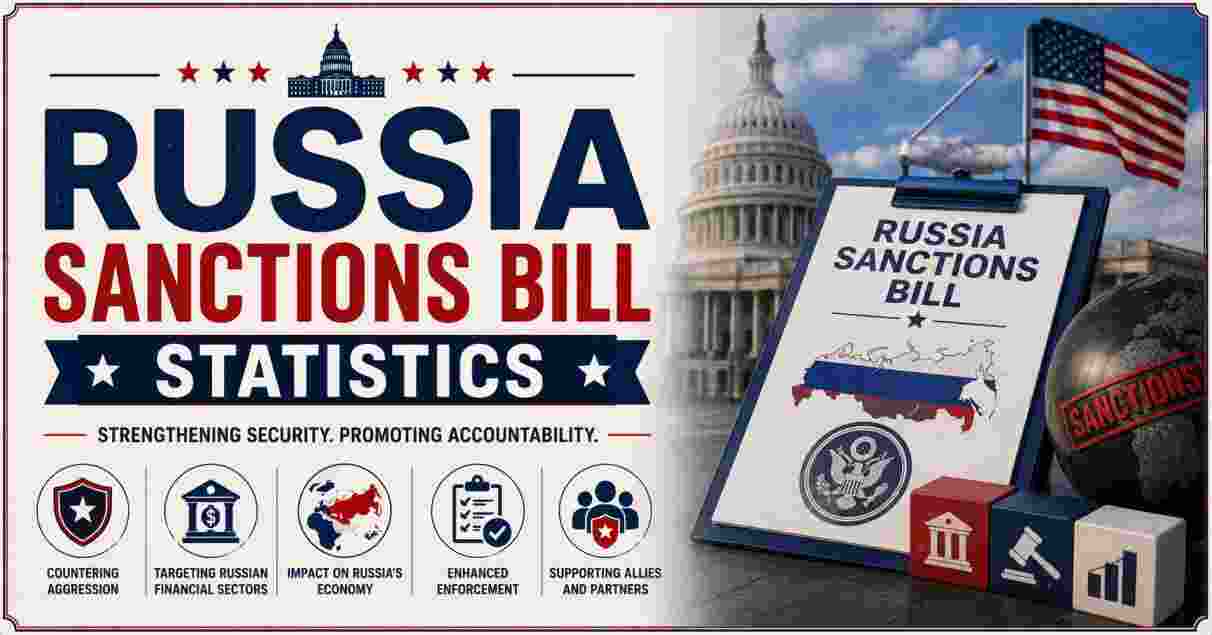
The Russia sanctions bill of 2026 cleared its most significant legislative hurdle on August 7, 2026, when the US Senate voted 86 to 11 to pass the Lindsey O. Graham Sanctioning Russia and Iran Act of 2026, sending the most sweeping sanctions package targeting Moscow’s war economy in years toward the House of Representatives. The 61-page bill would authorize tariffs of up to 100% on the five largest importers of Russian oil and natural gas — a group that includes China and India, the world’s top two buyers of Russian crude — while simultaneously imposing tariffs of up to 500% on goods imported directly from Russia and extending mandatory sanctions on Russian President Vladimir Putin, his inner circle, and the country’s largest financial institutions.
This report compiles the key verified statistics on the 2026 Russia sanctions bill, covering the Senate vote breakdown, the bill’s tariff and sanctions provisions, the countries most directly affected, and the legislative path still remaining before the bill could become law. Sources include the official Senate vote record, congressional press releases and the Foundation for Defense of Democracies’ bill analysis. Because the legislation still requires House passage and presidential signature before taking effect, this article is careful to distinguish between what the Senate has approved and what remains pending.
Interesting Facts About the 2026 Russia Sanctions Bill
| Fact Category | Key Data Point |
|---|---|
| Official bill name | Lindsey O. Graham Sanctioning Russia and Iran Act of 2026 (S. 5025) |
| Final Senate passage vote | 86–11, August 7, 2026 |
| Earlier procedural vote | 86–12, July 29, 2026 |
| Bill length | 61 pages |
| Maximum tariff on top 5 importers of Russian oil/gas | Up to 100% |
| Maximum tariff on direct Russian imports | Up to 500% |
| Waiver threshold | Countries importing less than 15% of Russia’s total natural gas exports and reducing further |
| Grace period before tariffs apply | 30 days after enactment for new Russian energy purchases |
| Bipartisan Senate cosponsors | 60+ |
| Countries most directly targeted | China and India — the two largest buyers of Russian crude oil |
| Iran Sanctions Act extension | 5 years, was set to expire at the end of 2026 |
| Next legislative step | House of Representatives, on recess until September 2026 |
Source: Senate roll call vote record; CBS News, NBC News, CNN, CNBC, August 7, 2026; Centre for Research on Energy and Clean Air (CREA); Foundation for Defense of Democracies Action, S. 5025 bill analysis, July 30, 2026
The numbers above reflect a bill that moved from years of stalled negotiation to overwhelming bipartisan passage within a matter of weeks, a shift directly tied to the sudden death of Senator Lindsey Graham on July 11, 2026, at age 71. Graham had championed sanctions legislation against Russia for more than a year before his passing, and the 86–11 final vote — with only 11 senators opposed — represents one of the largest bipartisan majorities assembled on any Russia-related legislation since the war in Ukraine began. The bill’s dual tariff structure is worth understanding clearly: the 100% rate applies to third countries that continue purchasing large volumes of Russian energy, while the steeper 500% rate applies specifically to goods imported directly from Russia itself — two distinct mechanisms aimed at different targets within the same legislation.
What stands out most is the narrow but consequential list of countries the bill’s tariff authority is designed to reach. Rather than applying broadly to all trading partners, the legislation’s secondary tariff provision targets only the five largest importers of Russian crude oil or natural gas, a group the Centre for Research on Energy and Clean Air identifies as being led by China and India. This narrow targeting reflects a deliberate legislative choice to concentrate economic pressure on the buyers whose continued purchases are seen as most directly financing Russia’s war effort, rather than imposing broader tariffs that could affect a wider range of US trading relationships.
Senate Vote Breakdown 2026
SENATE VOTE ON THE LINDSEY O. GRAHAM SANCTIONING RUSSIA AND IRAN ACT
════════════════════════════════════════════════════════════════════
Final Passage (Aug 7, 2026)     ████████████████████████████████████  86 Yes
                                 ████░░░░░░░░░░░░░░░░░░░░░░░░░░░░░░░░  11 No

Procedural/Cloture Vote (Jul 29)████████████████████████████████████  86 Yes
                                 ████░░░░░░░░░░░░░░░░░░░░░░░░░░░░░░░░  12 No
════════════════════════════════════════════════════════════════════
| Vote Metric | Data Point |
|---|---|
| Final passage vote (Aug 7, 2026) | 86 Yes – 11 No |
| Procedural vote (Jul 29, 2026) | 86 Yes – 12 No |
| Only Republican to vote no on the procedural motion | Sen. Rand Paul (R-KY) |
| Democratic amendment on tariff scope | Proposed by Sen. Raphael Warnock; withdrawn before final vote |
| Amendment votes held on final tariff language | 1, which failed |
| Lead Republican sponsor (posthumous) | Sen. Lindsey Graham (R-SC), died July 11, 2026 |
| Bill reintroduced/carried by | Sen. Darline Graham (R-SC), Lindsey Graham’s sister and successor |
| Lead Democratic sponsor | Sen. Richard Blumenthal (D-CT) |
| Senate Majority Leader supporting passage | Sen. John Thune |
| Senate Minority Leader supporting passage | Sen. Chuck Schumer |
Source: CNN, “Senate passes Russia sanctions bill named in honor of the late Sen. Lindsey Graham,” August 7, 2026; Axios, July 29, 2026; NBC News, August 7, 2026
The consistency between the July procedural vote (86-12) and the August final passage vote (86-11) shows a bill that maintained its overwhelming bipartisan coalition throughout the final weeks of debate, with only marginal shifts in the small group of senators voting against it. Senator Rand Paul stood out as the sole Republican opposing the bill at the procedural stage, articulating a position that Congress “shouldn’t tax Americans to fight Putin,” a framing that reflects broader libertarian-leaning concerns about the tariff authority’s downstream effects on American consumers and businesses rather than direct opposition to sanctioning Russia itself.
Senate Majority Leader John Thune described the legislation as something Graham “cared most passionately about” in his final days, while emphasizing it would give “the president a tool at his disposal to try and end the war in Ukraine.” The vote occurred just hours after senators gathered to honor Graham’s memory and followed a closed-door meeting with Ukrainian President Volodymyr Zelensky, who alongside Finnish President Alexander Stubb reportedly made the case to senators that Russia is in a weakening position — arguments that Axios reported helped solidify wavering support ahead of the vote.
Bill Provisions: Sanctions Targets 2026
| Sanctions Category | Targets |
|---|---|
| Individuals | Vladimir Putin, senior Russian officials, oligarchs, and their family members |
| Financial institutions (mandatory) | Central Bank of Russia, Sberbank, VTB Bank, Gazprombank |
| Corporate entities | State-owned enterprises and foreign companies supporting Russia’s defense industrial base |
| Maritime sanctions | Shadow Fleet Sanctions Act — targets tankers and vessels used to evade oil export sanctions |
| Chinese entities | Companies providing support to Russia’s weapons producers specifically named as a target |
| Iran-related provisions | Extension of the Iran Sanctions Act of 1996 for 5 years; strengthened sanctions on Iran’s energy sector |
| Sanctions revocability | Codifies existing executive-order sanctions; cannot be quietly revoked without written national-interest certification to Congress |
| Termination condition | Sanctions end only if Russia signs and upholds a peace agreement accepted by Ukraine, subject to congressional review |
Source: Foundation for Defense of Democracies Action, S. 5025 bill summary, July 30, 2026; Sen. Roger Wicker press release, August 7, 2026; Sen. Kevin Cramer press release, August 7, 2026
The bill’s sanctions architecture goes well beyond simply authorizing new tariffs — it mandates that the president impose sanctions on Russia’s core financial institutions, including Sberbank, VTB Bank, and Gazprombank, several of which were already subject to earlier rounds of sanctions but now face this authority codified into statute rather than resting solely on executive order, a structural change that makes the sanctions regime considerably harder to unwind through a simple change in administration policy. The inclusion of the SHADOW Fleet Sanctions Act, targeting the network of aging tankers Russia uses to transport oil while evading Western price caps and sanctions, addresses a specific evasion mechanism that has drawn sustained attention from sanctions researchers since Russia began relying heavily on this “dark fleet” following the initial 2022 sanctions wave.
Perhaps the most legally significant provision is the bill’s termination clause: sanctions relief is explicitly tied to Russia signing and upholding a peace agreement that Ukraine itself accepts, with any such termination subject to a congressional review period — a structure designed to prevent a future administration from unilaterally lifting sanctions without meeting this specific condition. This termination framework reflects lessons learned from earlier sanctions regimes that critics argued were too easily modified or waived by executive action alone.
Bill Provisions: Tariff Mechanics 2026
| Tariff Metric | Data Point |
|---|---|
| Tariff rate: top 5 importers of Russian oil/gas | Up to 100% |
| Tariff rate: top 5 facilitators of sanctions evasion | Up to 100% |
| Tariff rate: direct Russian goods imports | Up to 500% |
| Waiver condition | Countries importing less than 15% of Russia’s total natural gas exports and taking significant steps to reduce further |
| Grace period | Tariffs apply only to new Russian energy purchases made 30+ days after enactment |
| Final tariff level determination | Set by US Trade Representative Jamieson Greer |
| EU protection mechanism | Tariffs apply to individual countries, not the EU as a bloc, shielding European partners still reducing Russian energy imports |
| Trigger for “rule of construction” | President may treat UK, EU, G7, or Five Eyes shadow-fleet vessel designations as evidence |
| Waiver requires | Written national-interest certification submitted to Congress |
Source: Foundation for Defense of Democracies Action, S. 5025 bill summary, July 30, 2026; CBS News, August 7, 2026; CNN, August 7, 2026
The tariff mechanics are considerably more targeted than early public reporting sometimes suggested. Rather than a blanket tariff applying to any country doing any business with Russia, the legislation’s secondary tariff provision narrows its scope to only the five countries importing the largest volumes of Russian crude oil or natural gas, plus a separate list of the top five facilitators of sanctions evasion. The 15% natural gas import waiver threshold was specifically designed, according to the bill’s own summary from the Foundation for Defense of Democracies, to shield European allies who remain partially dependent on Russian gas but are actively working to reduce that dependence — distinguishing them from countries like China and India that have significantly increased Russian energy purchases since 2022 rather than reduced them.
The 30-day grace period tied to new purchases creates an important distinction: the tariff structure is explicitly forward-looking and conduct-based, meaning it targets continued or new Russian energy purchases made after the bill takes effect, rather than retroactively punishing countries for historical trade relationships. This design gives targeted countries a genuine incentive and window to reduce Russian energy purchases before the tariff authority would apply to them, rather than facing immediate penalties upon the bill’s enactment. For broader context on how existing US tariff and trade measures against Russia have already reshaped bilateral commerce, our US Tariffs on Russia report documents that US imports from Russia had already collapsed by 64.8% in early 2025 alone under the existing sanctions framework predating this new legislation.
Countries Most Affected: China and India 2026
| Country Impact Metric | Data Point |
|---|---|
| China’s status among Russian crude buyers | Largest single buyer, per Centre for Research on Energy and Clean Air (CREA) |
| India’s status among Russian crude buyers | Second-largest buyer |
| US tariff on India (imposed prior to this bill, 2025) | Raised to 50%, tied to Russian oil purchases |
| Prior sanctions on Russian oil majors (2025) | Rosneft and Lukoil sanctioned by the US |
| Rosneft 2024 revenue despite sanctions | RUB 10.1 trillion — record high, +10.7% year-on-year |
| Rosneft revenue driver | Asian markets, particularly China and India, absorbing discounted Russian crude |
| Brazil’s earlier mention in tariff discussions | Cited in January 2026 proposals alongside China and India |
| Countries with formal waiver eligibility | Those importing under 15% of Russia’s natural gas exports and reducing further |
Source: Centre for Research on Energy and Clean Air, cited via CBS News, August 7, 2026; The Global Statistics, “Top 10 Oil and Gas Companies Statistics 2026”; Finviz/Namrata Sen reporting, January 2026
The bill’s targeting of China and India specifically reflects a straightforward market reality documented by the Centre for Research on Energy and Clean Air: these two countries have become, by a wide margin, the largest purchasers of Russian crude oil since the 2022 invasion redirected Russian export flows away from traditional European buyers. This shift has been financially significant for Russia’s state oil sector — Rosneft’s 2024 revenue climbed to a record RUB 10.1 trillion, a 10.7% increase even while operating under some of the heaviest sanctions in Russian corporate history, a resilience directly attributable to sustained, high-volume purchasing from Asian markets willing to buy discounted Russian crude that Western buyers have largely abandoned. For a deeper look at how Rosneft’s performance compares to the world’s other major oil producers despite this sanctions pressure, our Top 10 Oil and Gas Companies Statistics report documents the company’s full production and revenue figures alongside its Western and Chinese state-owned competitors.
This legislation does not represent the first US economic pressure specifically aimed at India’s Russian oil purchases: the US had already raised tariffs on India to 50% and sanctioned Rosneft and Lukoil directly in mid-2025, well before this broader sanctions bill reached the Senate floor. The new legislation would layer additional, potentially higher tariff authority on top of these existing measures if the House passes it and the president signs it into law, though the bill’s final tariff rate for any specific country would ultimately be set by US Trade Representative Jamieson Greer rather than being automatically fixed at the maximum 100% ceiling.
Legislative History and Timeline 2026
BILL TIMELINE — LINDSEY O. GRAHAM SANCTIONING RUSSIA AND IRAN ACT
════════════════════════════════════════════════════════════════════
Apr 2025      Sanctioning Russia Act of 2025 (S.1241) introduced by Graham
Jan 7-8 2026  Trump greenlights bipartisan sanctions bill
Jul 11 2026   Sen. Lindsey Graham dies unexpectedly, age 71
Jul 28 2026   Bipartisan agreement reached to revive the legislation
Jul 29 2026   Senate procedural vote: 86-12
Aug 7 2026    Senate final passage: 86-11
Sep 2026+     House expected to take up the bill (currently on recess)
════════════════════════════════════════════════════════════════════
| Timeline Milestone | Date |
|---|---|
| Original bill introduced (S.1241, Sanctioning Russia Act of 2025) | April 1, 2025 |
| Trump gives go-ahead for the bill | January 7-8, 2026 |
| Sen. Lindsey Graham dies | July 11, 2026, age 71 |
| Bipartisan agreement to revive legislation reached | July 28, 2026 |
| Senate procedural vote | July 29, 2026 — 86-12 |
| Senate final passage vote | August 7, 2026 — 86-11 |
| House recess status at time of passage | On recess until September 2026 |
| Total time from Graham’s death to Senate passage | ~27 days |
Source: Wikipedia, “Sanctioning Russia Act”; Finviz, January 8, 2026; Axios, July 29, 2026; CNBC, August 7, 2026
The legislative history shows a bill that spent more than a year in negotiation before Graham’s sudden death became the catalyst for final passage. Originally introduced as the Sanctioning Russia Act of 2025 in April 2025, the measure had already secured more than 60 cosponsors well before this year, reflecting genuine bipartisan appetite for tougher Russia sanctions that nonetheless remained stalled by White House concerns over the scope of tariff authority being granted to the president. Graham announced, while standing in front of tanks in the streets of Kyiv on the day before his death, that he and the administration had “finally reached” an agreement on the bill’s language — a moment that took on added significance once his death the following day transformed the legislation’s political momentum.
The remarkably compressed timeline from Graham’s death to final Senate passage — roughly 27 days — reflects how quickly his colleagues moved to honor his legislative legacy, with his sister Sen. Darline Graham taking up sponsorship of the renamed bill. However, the legislation’s path remains incomplete: the House of Representatives was on recess until September 2026 at the time of Senate passage, meaning the bill’s tariff provisions still face further scrutiny — from Democrats concerned about executive tariff authority and from some Republicans wary of the same issue — before any final version could reach the president’s desk.
Political Reactions and Points of Debate 2026
| Perspective | Statement / Position |
|---|---|
| Sen. John Thune (R-SD), Majority Leader | Bill represents what Graham “cared most passionately about”; gives Trump “a tool… to try and end the war in Ukraine” |
| Sen. Roger Wicker (R-MS) | Praised the bill’s SHADOW Fleet Sanctions Act and provisions targeting Chinese support for Russian weapons producers |
| Sen. Darline Graham (R-SC) | Said the legislation was important to her late brother and expressed confidence it would help move peace efforts forward |
| Sen. Elizabeth Warren (D-MA) | Expressed concern over “handing the administration any more tariff authority,” citing prior use of tariff power |
| Sen. Rand Paul (R-KY) | Lone Senate Republican opposed at procedural stage; argued Congress “shouldn’t tax Americans to fight Putin” |
| Sen. Raphael Warnock (D-GA) | Proposed (then withdrew) an amendment to remove tariffs automatically if a country drops out of the top-5 importer list |
| Ukrainian President Volodymyr Zelensky | Met with senators in closed-door session before the vote, argued Russia is in a weakening position |
| Finnish President Alexander Stubb | Joined Zelensky in making the case for the sanctions package to senators |
Source: NBC News, August 7, 2026; CNN, August 7, 2026; The Daily Caller, August 7, 2026; Axios, July 29, 2026
The range of reactions to the bill’s passage reflects genuine, substantive disagreement over how far to extend presidential tariff authority even among senators who broadly support tightening pressure on Russia. Senator Warren’s concern, articulated in comments to CNN in July, centered specifically on the precedent of granting broad tariff powers to a president who has “shown what he will do with broad tariff authority” in unrelated trade contexts — a distinction between supporting the underlying goal of pressuring Russia and being wary of the specific legislative mechanism chosen to achieve it. This tension was significant enough that a formal Senate amendment vote was held to attempt modifying the tariff language, though that amendment ultimately failed.
On the other side, some conservative commentary characterized the bill in starkly different terms: The Daily Caller and other outlets described it as “neocon-backed,” and noted reporting that US intelligence assessments had flagged concern about the broader escalatory risk of the sanctions package, including a Wall Street Journal report referenced in coverage suggesting the measures could factor into tensions with NATO. These sharply differing characterizations — from a bipartisan tribute to a departed senator’s legacy work, to concern over executive overreach, to characterization as excessive escalation — illustrate that while the 86-11 vote margin was overwhelming, the legislation’s underlying policy tradeoffs remain genuinely contested across the political spectrum even among those who ultimately voted for it.
Data Reliability Notes for Russia Sanctions Bill Statistics 2026
| Category | Status as of August 2026 |
|---|---|
| Bill’s legal status | Passed the Senate only; not yet law |
| House timeline | Uncertain; House was on recess until September 2026 at time of Senate passage |
| Final tariff rates by country | Not yet determined; would be set by USTR if the bill becomes law |
| Presidential signature | Pending House passage; not yet occurred |
Source: Cross-referenced Senate vote record, congressional press releases, and major news outlet reporting, current as of August 8, 2026
Because the Lindsey O. Graham Sanctioning Russia and Iran Act of 2026 has, as of this writing, passed only the Senate and still requires House approval and the president’s signature before taking legal effect, all tariff rates, sanctions timelines, and country-specific impacts described in this report reflect the bill’s current text as passed by the Senate, not a finalized or currently enforced law. Readers should treat this as an evolving legislative situation and watch for House action, expected no earlier than September 2026, before assuming any of the bill’s tariff or sanctions provisions have taken effect.
Disclaimer: The data research report we present here is based on information found from various sources. We are not liable for any financial loss, errors, or damages of any kind that may result from the use of the information herein. We acknowledge that though we try to report accurately, we cannot verify the absolute facts of everything that has been represented.