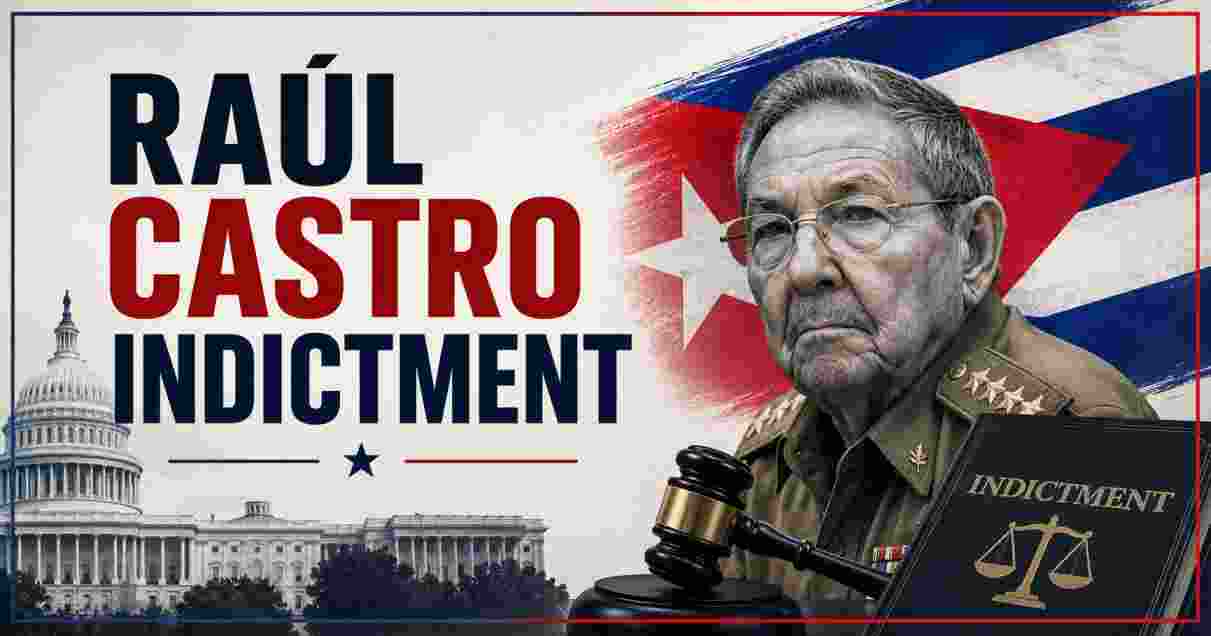
Raúl Castro Indictment 2026: What Just Happened and Why It Matters
On May 20, 2026 — deliberately chosen as Cuban Independence Day — the United States Department of Justice unsealed a federal grand jury indictment charging former Cuban President Raúl Castro, age 94, with conspiracy to kill US nationals, destruction of aircraft, and four individual counts of murder. The charges stem from the February 24, 1996 shootdown of two unarmed civilian Cessna planes operated by Brothers to the Rescue, a Miami-based Cuban exile humanitarian group, by Cuban Air Force MiG-29 fighters in international airspace. The announcement was made by Acting Attorney General Todd Blanche at a ceremony held at Miami’s Freedom Tower — the historic site that once processed thousands of Cuban refugees arriving in the United States — in the presence of the victims’ families, Florida lawmakers, and Cuban-American community leaders. Castro, who at the time of the 1996 attack was serving as Cuba’s Minister of Defense and Armed Forces, allegedly authorized the use of “decisive and deadly action” against the planes in January 1996 and personally met with military leaders to approve the lethal operation.
The indictment is the culmination of a 30-year legal effort that began within months of the 1996 attack, when federal prosecutors in Miami first drafted charges against Castro — only to have successive administrations hold back on unsealing them for diplomatic reasons. What makes the 2026 indictment politically and historically explosive is its timing: it arrives in the middle of a maximum-pressure campaign against Cuba by the Trump administration that already includes a fuel blockade, cascading sanctions targeting Cuba’s military conglomerate, and active military posturing in the Caribbean. Foreign policy analysts across the spectrum are drawing direct comparisons to the legal-pressure playbook used against Venezuelan President Nicolás Maduro before the January 3, 2026 US military operation that captured him — and Havana is watching the same pattern unfold with alarm. Cuba’s government called the indictment a “despicable accusation” and warned that any military aggression would trigger a “bloodbath with incalculable consequences.”
Key Fast Facts: Raúl Castro Indictment 2026
RAÚL CASTRO INDICTMENT — SNAPSHOT OF CRUCIAL NUMBERS
════════════════════════════════════════════════════════════════
  Castro's Age at Indictment                  ██████████████████  94 years old
  Years Since the Shootdown                   ██████████████████  30 years (1996–2026)
  Years Since First Indictment Draft          █████████████████   ~30 years in the making
  Grand Jury Returned Indictment              ████                April 23, 2026
  Indictment Unsealed                         ████                May 20, 2026
  Co-Defendants Charged                       ██                  5 others (pilots + officers)
  Victims Killed in 1996 Attack               ██                  4 men
  American Citizens Among Victims            ██                   3 of 4 victims
  Maximum Sentence (murder / conspiracy)     ██████████████████  Death or life in prison
  Maximum Sentence (destruction of aircraft)  ██                  Up to 5 years per count
════════════════════════════════════════════════════════════════
| Key Fact | Verified Detail |
|---|---|
| Full name of defendant | Raúl Modesto Castro Ruz |
| Date of birth | June 3, 1931 — Birán, Holguín Province, Cuba |
| Age at time of indictment | 94 years old |
| Role in Cuba at time of 1996 shootdown | Minister of Defense and Armed Forces — Cuba’s second-highest authority after Fidel Castro |
| Date of the attack | February 24, 1996 |
| Grand jury indictment returned | April 23, 2026 — Miami federal grand jury |
| Indictment unsealed | May 20, 2026 — Cuban Independence Day |
| Venue of announcement | Freedom Tower, Miami, Florida |
| Announced by | Acting Attorney General Todd Blanche |
| Charges filed | Conspiracy to kill US nationals; destruction of aircraft; four counts of murder |
| Maximum sentence (murder/conspiracy) | Death or life in prison |
| Maximum sentence (destruction of aircraft) | Up to 5 years per count |
| Number of co-defendants | 5 — pilots and military officers involved in executing the shootdown |
| Total victims killed | 4 men |
| US citizens among victims | 3 — Armando Alejandre Jr., Carlos Costa, Mario de la Peña |
| US permanent resident among victims | 1 — Pablo Morales |
| Warrant status | Arrest warrant issued — Blanche: “We expect he will show up here by his own will or by another way” |
Source: NPR, CBS News, CNN, Time, Britannica — May 2026
The numbers behind the indictment tell a story of remarkable legal patience — and calculated political timing. A 94-year-old defendant who has not left Cuba, has shown no sign of leaving, and whose government has made clear it will not extradite him presents an obvious practical challenge. Acting Attorney General Blanche acknowledged this directly but insisted the indictment is not a symbolic gesture: “This isn’t a show indictment,” he said, adding that “there are all kinds of different ways to bring in defendants located in other countries” — a statement that reads very differently in a week when the USS Nimitz aircraft carrier is positioned in the Caribbean. The grand jury that returned the indictment on April 23 did so under seal, meaning the charges had been finalized nearly a month before the dramatic Freedom Tower announcement — a deliberate sequencing that allowed the administration to time the public reveal for maximum political impact on Cuban Independence Day.
The four murder counts are individually significant because three of the four victims — Armando Alejandre Jr., Carlos Costa, and Mario de la Peña — were American citizens, and the fourth, Pablo Morales, was a US permanent resident. Under US federal law, the conspiracy-to-kill-US-nationals charge alone carries the possibility of the death penalty, making this potentially a capital case against a 94-year-old former head of state. No case remotely like this has been pursued by the United States Department of Justice in modern history.
The 1996 Brothers to the Rescue Shootdown | Full Statistics & Timeline
FEBRUARY 24, 1996 — BROTHERS TO THE RESCUE SHOOTDOWN
════════════════════════════════════════════════════════════════
  Planes in the mission that day              ███                  3 Cessna 337C Skymasters
  Planes shot down                            ██                   2
  Planes that escaped                         █                    1 (carrying founder Basulto)
  Victims killed                              ██                   4 (all aboard 2 downed planes)
  Survivors from downed planes                                     0
  Type of missiles used                       Heat-seeking missiles (Cuban MiG-29UBs)
  Location of attack                          International airspace near northern Cuban coast
  Aircraft type: downed planes                Cessna 337C Super Skymaster (unarmed civilian)
  Aircraft type: attacking                    Cuban Air Force Mikoyan MiG-29UB fighters
════════════════════════════════════════════════════════════════
  ICAO & OAS findings: planes were in INTERNATIONAL airspace when shot down
| Incident Detail | Verified Data |
|---|---|
| Date of attack | February 24, 1996 |
| Organization targeted | Brothers to the Rescue (BTTR) — founded 1991 by Cuban-American pilot José Basulto |
| Organization’s stated mission | Search-and-rescue flights over the Florida Straits; identifying Cuban rafters at sea |
| Aircraft involved (BTTR) | 3 × Cessna 337C Super Skymasters — all unarmed civilian aircraft |
| Registration of downed planes | N5485S (2 occupants, 0 survivors) and N2456S (2 occupants, 0 survivors) |
| Third plane (escaped) | N2506 — 4 occupants, 0 fatalities; pilot: José Basulto, BTTR founder |
| Cuban attack aircraft | Mikoyan MiG-29UB fighters — military jets |
| Method of destruction | Heat-seeking missiles |
| Location | International airspace near northern Cuban coastline (per ICAO, OAS findings) |
| Cuba’s position | Claimed planes had entered Cuban airspace; denied by US radar data and international bodies |
| US radar evidence | US Customs Service Supervisory Detection Systems Specialist recorded the entire incident |
| Victims killed | Carlos Costa, Armando Alejandre Jr., Mario de la Peña, Pablo Morales |
| International findings | ICAO and OAS both concluded planes were in international airspace when attacked; no warning given |
| Immediate US response | President Clinton signed the Cuban Liberty and Democratic Solidarity (LIBERTAD) Act — strengthening the embargo |
| UN Security Council | Widely condemned the attack |
| BTTR founding year | 1991 — originally spotters for Cuban rafters; later dropped pro-democracy leaflets |
Source: Wikipedia (1996 Shootdown), CNN, PBS NewsHour, National Security Archive, NBC News — 1996–2026
The forensic picture of what happened on February 24, 1996 is unusually well-documented, which is precisely why prosecutors were able to bring murder charges three decades later with confidence. US Customs radar data recorded the entire incident in real time, establishing with precision where the planes were when they were hit — international airspace, not Cuban territory, as Havana has long claimed. The Organisation of American States and the International Civil Aviation Organization both independently examined the evidence and reached the same conclusion: the planes were outside Cuban airspace and no warning was given before the missiles were fired.
What the newly unsealed indictment adds to the historical record is the intelligence dimension — specifically, that the attack was not a spontaneous military decision but a carefully planned operation with Cuban spies embedded inside Brothers to the Rescue feeding precise mission details back to Havana in the days before the shootdown. According to prosecutors, one spy provided exact information about the planned February 24 flight — effectively allowing Cuban military planners to prepare the intercept in advance. The indictment describes this as a premeditated homicide, not an act of national defense, and alleges that the decision chain ran directly through Raúl Castro as Defense Minister and ultimately to Fidel Castro as final decision maker.
The Co-Defendants & Cuba’s Spy Network | Operation Scorpion & Wasp Network
CO-DEFENDANTS NAMED IN THE MAY 20, 2026 INDICTMENT
════════════════════════════════════════════════════════════════
  1. Raúl Modesto Castro Ruz    — Former Defense Minister / Former President
  2. Lorenzo Alberto Pérez-Pérez  — MiG pilot / military officer
  3. Emilio José Palacio Blanco   — MiG pilot / military officer
  4. José Fidel Gual Barzaga      — Military officer
  5. Raul Simanca Cardenas        — Military officer
  6. Luis Raul González-Pardo Rodríguez — Cuban Air Force pilot (also separately
                                          charged with immigration fraud, 2026)
════════════════════════════════════════════════════════════════
  Prior related convictions: Wasp Network leader Gerardo Hernández —
  convicted 2001, sentenced to life; released in 2014 Obama prisoner swap
| Person / Entity | Role | Legal Status / Outcome |
|---|---|---|
| Raúl Castro | Defense Minister 1996; ordered deadly force authorization | Indicted May 20, 2026 — not in US custody; arrest warrant issued |
| Lorenzo Alberto Pérez-Pérez | MiG pilot / military officer | Co-defendant, indicted April 23, unsealed May 20, 2026 |
| Emilio José Palacio Blanco | MiG pilot / military officer | Co-defendant, indicted April 23, unsealed May 20, 2026 |
| José Fidel Gual Barzaga | Military officer | Co-defendant, indicted April 23, unsealed May 20, 2026 |
| Raul Simanca Cardenas | Military officer | Co-defendant, indicted April 23, unsealed May 20, 2026 |
| Luis Raul González-Pardo Rodríguez | Cuban Air Force pilot (1980–2009) | Co-defendant; also separately indicted for immigration fraud (lied on Form I-485 about military service) |
| Gerardo Hernández (Wasp Network leader) | Led Cuban spy ring “La Red Avispa” embedded in Miami exile community | Convicted 2001 of espionage + conspiracy to commit murder; sentenced to life; released 2014 in Obama-era prisoner swap — caused outrage among victims’ families |
| Operation Scorpion | Cuban intelligence operation to infiltrate and sabotage BTTR | Named explicitly in 2026 indictment; spies tasked to “perfect the confrontation” and “provide information” on Basulto’s plans |
| La Red Avispa / Wasp Network | Cuban intelligence spy ring inside Miami’s exile community | Five members convicted in 2000 trial; ring extended from military installations in Miami and Tampa into BTTR itself and even offices of US members of Congress |
| Prior Cuban Air Force indictments (pre-2026) | MiG pilots and ordering general charged in earlier, separate indictment | Never tried — all remain in Cuba |
| Ana Montes | Senior DIA intelligence analyst, Cuban spy for 16 years | Arrested 2001; pleaded guilty conspiracy to commit espionage 2002; sentenced to 25 years in prison |
Source: NPR, CNN, CBS News, Local10/WPLG, US DOJ — 2000–2026
The Wasp Network dimension of the indictment transforms this from a straightforward murder case into something far more sprawling — a documented, multi-year Cuban intelligence operation that penetrated not just Brothers to the Rescue but US military installations and congressional offices. The fact that Gerardo Hernández, convicted in 2001 and sentenced to life in prison specifically for conspiracy to commit murder in connection with this same shootdown, was released in the 2014 Obama prisoner swap and returned to Cuba as a hero explains the fury within the Cuban-American community when the swap was announced. To many families of the victims, the swap felt like the US government undoing its own verdict. The 2026 indictment is, in part, a response to that — an attempt to reassert the legal record that the shootdown was a state-sponsored premeditated murder, not a legitimate national defense action.
Luis Raul González-Pardo Rodríguez, one of the co-defendants, has the unusual distinction of being caught inside the US immigration system. He had apparently immigrated to the United States and filed a Form I-485 application for permanent residence in 2025, falsely claiming he had never received military training and never served in a military unit — when in fact he had been a Cuban Air Force pilot for nearly 30 years, from 1980 to 2009. A DOJ photograph published with his indictment shows him in uniform in front of a military jet. He faces up to 15 years in federal prison on the immigration fraud charges alone, and is now also a named defendant in the murder case.
Raúl Castro’s Political Career | Key Facts & Timeline
RAÚL CASTRO — POLITICAL CAREER TIMELINE
════════════════════════════════════════════════════════════════
  1931      ● Born June 3, Birán, Holguín Province, Cuba
  1953      ● Participated in failed Moncada Barracks assault; imprisoned
  1956      ● Helped launch the revolution that brought Fidel to power (1959)
  1959      ● Appointed head of Cuba's armed forces and Defense Minister
  1962      ● Appointed Deputy Prime Minister
  1972      ● Became First Deputy Prime Minister
  1976      ● Named First Vice President of Council of State
  1996      ● As Defense Minister, allegedly authorized MiG shootdown of BTTR
  2006      ● Fidel Castro ill; Raúl assumes acting powers
  2008      ● Officially becomes President of Cuba
  2011      ● Becomes First Secretary of Communist Party of Cuba
  2018      ● Steps down as President (succeeded by Miguel Díaz-Canel)
  2021      ● Steps down as Communist Party First Secretary
  2026      ● Indicted by US federal grand jury — May 20, 2026
════════════════════════════════════════════════════════════════
  Defense Minister tenure: 1959–2006 — 47 YEARS (longest-serving globally)
| Career Milestone | Year | Detail |
|---|---|---|
| Born | June 3, 1931 | Birán, Holguín Province, Cuba — full name Raúl Modesto Castro Ruz |
| Moncada Barracks assault | 1953 | Failed attempt to overthrow Batista; imprisoned alongside Fidel |
| Cuban Revolution | 1956–1959 | Key military commander; helped launch the revolution from Mexico |
| Defense Minister appointed | 1959 | Head of Cuba’s Revolutionary Armed Forces — held this post for 47 years until 2006 |
| Deputy Prime Minister | 1962 | Consolidated power as Cuba’s undisputed #2 official |
| First Deputy PM | 1972 | Further entrenchment in Cuba’s governing hierarchy |
| First Vice President | 1976 | Formally designated Fidel’s constitutional successor |
| 1996 BTTR shootdown | February 24, 1996 | Allegedly authorized deadly force against civilian planes as Defense Minister |
| Acting President | July 2006 | Took over all duties when Fidel Castro underwent emergency surgery |
| Officially becomes President | February 2008 | First Cuban president not named Castro in leadership role since 1959 — but still Castro by name |
| Communist Party First Secretary | 2011 | Assumed Fidel’s final formal position of authority |
| Stepped down as President | 2018 | Succeeded by Miguel Díaz-Canel — Raúl retained Party role |
| Stepped down from Party | 2021 | Formally retired from all official positions |
| US federal indictment | May 20, 2026 | Charged with conspiracy to murder US nationals, destruction of aircraft, 4 counts of murder |
Source: Biography.com, Britannica, Kiddle/Wikipedia — verified across multiple sources
Raúl Castro’s career statistics are remarkable even before the 2026 indictment. His 47-year tenure as Defense Minister from 1959 to 2006 is believed to be the longest continuous service as a national defense minister in recorded history. During those four-and-a-half decades, he built Cuba’s military into a force that outlasted the Soviet Union — which had been its primary patron — survived the economic catastrophe of the “Special Period” in the 1990s after Soviet subsidies collapsed, and persisted through 64 consecutive years of US economic embargo. The fact that he is now 94 years old and facing a US murder indictment for an act he allegedly committed when he was 64 adds a dimension of historical surrealism to a case that is already without modern precedent.
The timing of the indictment relative to his last known public appearance is also significant. Castro was last seen publicly in Cuba earlier in May 2026 — just days before the charges were unsealed. The Cuban government has not indicated his whereabouts since the announcement, and there is no evidence he has left the island. He would need to be 94 years old with no prior criminal record in the US, facing a maximum sentence of death or life imprisonment, before a federal court in Miami — in a case where the government would call the surviving family members of three American citizens as witnesses.
US Legal & Political Context | Why Now, and What Comes Next in 2026
ESCALATION LADDER: US PRESSURE ON CUBA — 2025 TO MAY 2026
════════════════════════════════════════════════════════════════
  Jan 2025   ● Cuba re-listed as State Sponsor of Terrorism (Trump 1st day)
  Jul 2025   ● Díaz-Canel sanctioned; tourism ban reimposed
  Jan 3, '26 ● US captures Maduro; Venezuela cuts Cuba oil (crisis trigger)
  Jan 29,'26 ● EO 14380: secondary tariffs on Cuba oil suppliers signed
  Feb 20,'26 ● Supreme Court blocks EO 14380 tariff mechanism
  May 1, '26 ● EO 14404: Cuba sanctions regime signed
  May 7, '26 ● GAESA + 11 officials + 3 orgs sanctioned by OFAC
  May 17,'26 ● Axios: Cuba acquired 300+ attack drones from Russia & Iran
  May 20,'26 ● Castro indicted; USS Nimitz arrives in Caribbean (same day)
  May 21,'26 ● Sec. Rubio: "doubtful of diplomacy with Cuba"
  May 23,'26 ● Standoff ongoing — no extradition, no arrest, no deal
════════════════════════════════════════════════════════════════
| Legal / Political Factor | Detail | Significance |
|---|---|---|
| Indictment as “legal pretext” concern | Foreign Policy: indictment mirrors the Maduro lawfare playbook preceding US Venezuela operation | Raises question of whether legal action precedes military action — as it did with Maduro |
| USS Nimitz arrival (same day as indictment) | Aircraft carrier positioned in Caribbean on May 20, 2026 — Cuban Independence Day | Simultaneous military and legal pressure; deliberate signaling |
| USSOUTHCOM video posted | “Lethal. Precise. Ready.” — with planes, tanks, amphibious craft, aerial photo of Cuba | Unprecedented public military posturing against Cuba in modern history |
| Trump on escalation (May 20) | “No, there won’t be escalation. I don’t think there needs to be.” | Ambiguous — does not foreclose military options; framed as Cuba’s choice |
| Secretary Rubio on diplomacy (May 21) | “Doubtful of diplomacy with Cuba” — per AP | Closes diplomatic window further; Rubio has personal Cuban-American political stakes |
| Florida reopened state investigation | Florida AG Uthmeier announced reopening of state criminal investigation into Castro on May 20 | Biden administration previously shut down Florida’s investigation; federal-state coordination now complete |
| Biden admin history | Biden administration shut down Florida’s criminal investigation of Castro — Uthmeier confirmed this | Politicization of the prosecution timeline across administrations is explicit |
| LIBERTAD Act (1996) | Clinton signed it days after the shootdown; codified and strengthened the Cuba embargo | Still in full force in 2026; Helms-Burton Title III enforced since 2019 |
| Gerardo Hernández 2014 release | Wasp Network leader convicted of murder conspiracy, released in Obama prisoner swap | Victims’ families view 2026 indictment as partial redress for that decision |
| Cuba’s response | Foreign Minister Rodríguez Parrilla: charges are “illegitimate and illegal” | Cuba defends shootdown as protection of national sovereignty; will not extradite Castro |
| Cuba’s population awareness | CNN: for Cubans on the island who support the revolution, “there is little chance Castro is going anywhere, much less a Miami courtroom” | Domestic Cuban political reality limits practical enforcement |
| Extradition status | No extradition treaty between US and Cuba | Legal enforcement entirely dependent on military or voluntary action — neither is imminent |
Source: Foreign Policy, CNN, CBS News, AP, Florida AG Office, Time — May 2026
The answer to “why now?” on the indictment is less about the law and more about the political moment. Federal prosecutors in Miami first drafted charges against Castro in the 1990s, meaning the legal case has existed for nearly 30 years. Multiple administrations — Republican and Democrat alike — chose not to unseal those charges, calculating that the diplomatic costs outweighed the legal symbolism. What changed is not the evidence but the strategic intent: the Trump administration, having already demonstrated in Venezuela that it will use legal indictments as precursors to coercive action, is applying the same architecture to Cuba. The fact that Acting AG Blanche explicitly warned that there are “all kinds of different ways to bring in defendants located in other countries” — spoken in the same week an aircraft carrier arrived in the Caribbean — is a message that requires no translation.
For the victims’ families, none of this geopolitical calculation diminishes the personal weight of May 20, 2026. Mirta Costa Méndez, sister of Carlos Costa, expressed the feeling shared by many when she said it was justice for her brother and the other three men — Armando Alejandre Jr., Mario de la Peña, and Pablo Morales — who died in international airspace on a humanitarian mission 30 years ago. Whether a 94-year-old man in Havana ever stands in a Miami courtroom, the indictment has permanently altered the legal and historical record: the United States federal government has formally charged the former leader of Cuba with the premeditated murder of American citizens, backed by three decades of evidence, a unanimous grand jury, and a sitting administration that has made regime change in Havana an explicit policy goal.
Disclaimer: The data research report we present here is based on information found from various sources. We are not liable for any financial loss, errors, or damages of any kind that may result from the use of the information herein. We acknowledge that though we try to report accurately, we cannot verify the absolute facts of everything that has been represented.